

There is no universal “normal” average height for women. What is considered average in one country may be regarded as tall or short in another. The standard height is not some fixed number that applies to everyone everywhere. It changes depending on where you grow up, what you eat, and most importantly, who your parents are.
For example, a woman who is 5’3″ in the United States might feel completely different about her height if she lived in the Netherlands, where women average 5’7″. Geography, nutrition, and access to good healthcare all play a role in determining how tall someone becomes. Your height is not just about your genes, though they matter most. What you ate as a kid, whether you had proper medical care, and even the country you grew up in, all influenced your final height.
Understanding these differences helps explain why there is no average height for women. In this article, we examine what the data actually reveal about women’s heights globally and the factors that truly determine where you land on the chart.
What Is the Average Height for Women?
The numbers vary depending on where you look. Based on CDC data, the average height of women in the United States is approximately 5 feet 3.5 inches. That is roughly 63.5 inches or 161 centimeters. If you are close to that height, you are average for an American woman.
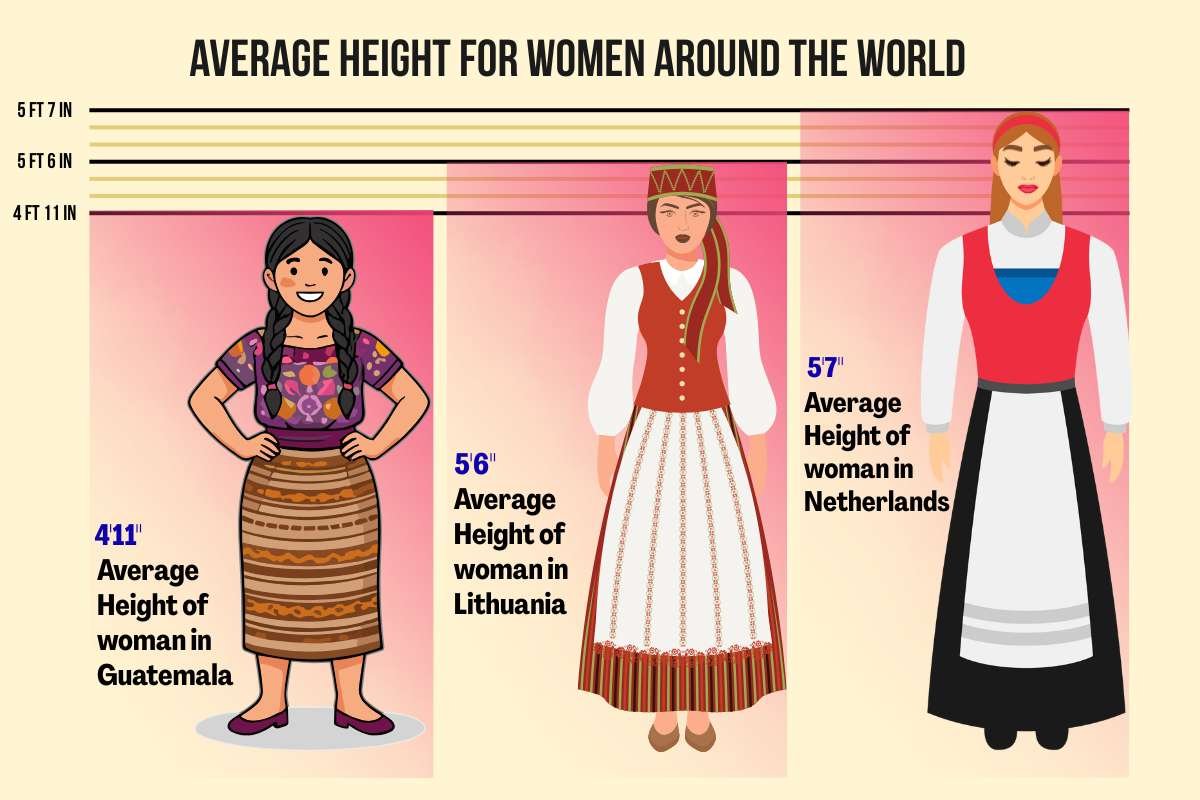
However, step outside the United States, and things change quickly. In the United Kingdom, women average 5 feet 4 inches, just half an inch taller than American women. In Australia and Canada, the numbers are similar, hovering around 5 feet 4 inches. Head to Europe, though, and you will see a noticeable shift. Dutch women, for example, average 5 feet 7 inches tall, making them among the tallest women in the world. Montenegro and Denmark also have average heights above 5 feet 6 inches.
On the other end of the spectrum, women in Guatemala average just under 4 feet 9 inches, while women in parts of Southeast Asia and South America tend to be shorter than the global average. The global average stands at around 5 feet 4 inches when all countries are combined.
The reason for these differences is not complex. Better nutrition during childhood, access to quality healthcare, and living conditions all play considerable roles in how tall you become. In developed countries with strong healthcare systems, women tend to be taller. In regions where malnutrition or limited access to medical care is common, average heights tend to be lower. Your genes set your potential, but your environment helps determine whether you reach it.
What Determines a Woman’s Height?
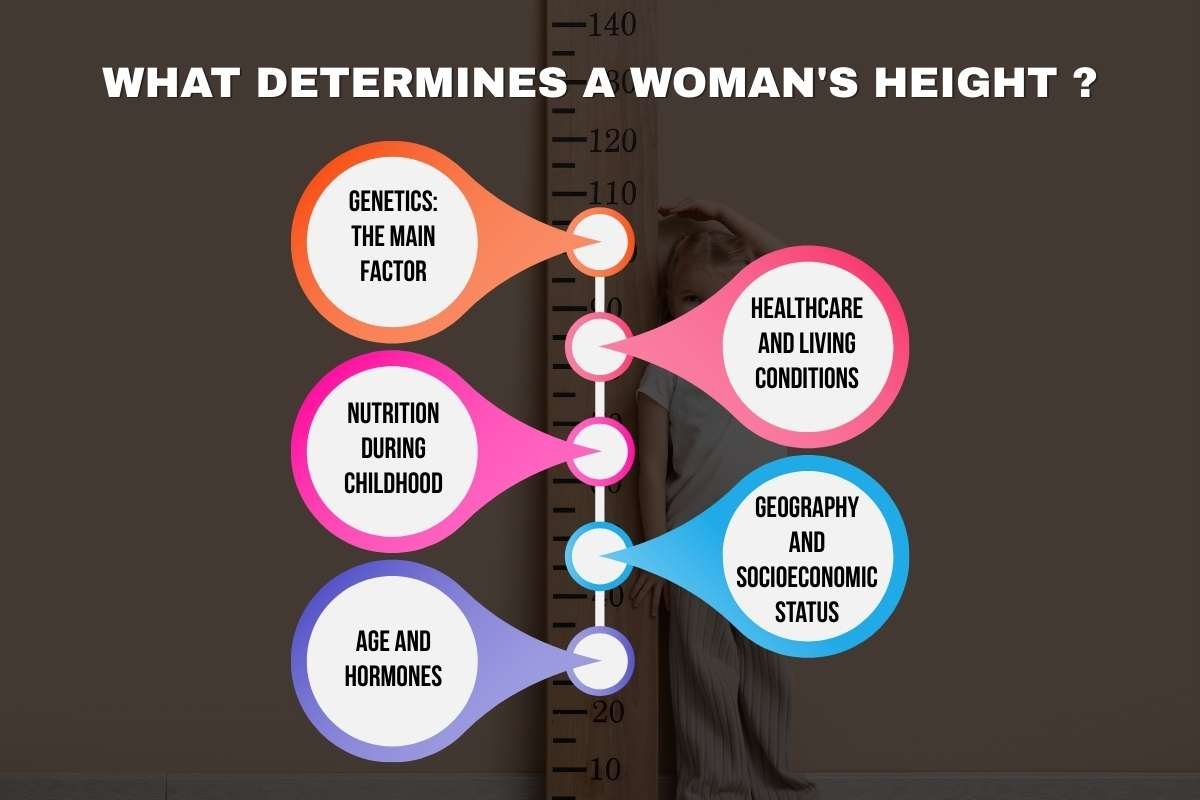
Several factors work together to determine the average height for women. Understanding what influences your height helps explain why some women are taller or shorter than others.
1. Genetics: The Main Factor
Your genes are responsible for about 80 percent of your height. If both of your parents are tall, you are likely to be tall as well. If both are short, you are more likely to be brief. This hereditary trait gets passed down through your family, just like eye color or hair color. Your grandparents’ height influences your parents, who, in turn, affect your height.
However, genetics only sets your potential. Whether you actually reach that potential depends on other factors.
2. Nutrition During Childhood
What you ate growing up matters a lot. Without proper nutrition during pregnancy, early childhood, and adolescence, your growth can be stunted. This means you may not reach your full height potential as an adult.
Key nutrients for growth include:
- Protein: Supports muscle and bone development
- Calcium: Builds strong bones
- Vitamin D: Helps your body absorb calcium
- Zinc: Important for cell growth
Girls and young women need plenty of dairy products and green vegetables. By the time you reach 25, your body stops storing calcium in your bones. Getting enough calcium early means stronger bones for the rest of your life.
3. Healthcare and Living Conditions
Access to quality medical care during childhood affects height. Clean water, sanitation, and freedom from chronic illness all allow children to grow properly. Medical conditions like chronic kidney disease, cystic fibrosis, and celiac disease can all impact growth by affecting how your body absorbs nutrients.
Research shows that about 40 percent of children diagnosed with chronic kidney disease before puberty have reduced height as adults.

Read More:
4. Geography and Socioeconomic Status
Where you grow up influences your height. Countries with better healthcare systems and higher standards of living tend to have taller populations. The average height for women in developed nations is typically higher than in developing countries.
Dutch women average 5 feet 7 inches because the Netherlands has:
- Strong healthcare access
- Good nutrition standards
- High living standards
- Better socioeconomic conditions overall
The Dutch population has grown 19 centimeters taller over the past 150 years, a greater increase than any other population in the world.
5. Age and Hormones
Your growth happens during specific periods. Most girls stop growing between the ages of 16 and 18, although some continue into their early 20s. Once your growth plates close, typically by age 21, you can no longer grow taller. No supplement, exercise, or diet change can add height after this point.
The average height for women in the U.S. has remained stable for the past 40 to 50 years, suggesting that we have reached our height ceiling in developed countries.
Average Height for Women Around the World
The average height for women varies dramatically depending on where you live. A woman who is 5 feet 3 inches tall might feel short in the Netherlands but tall in Guatemala. These differences arise due to genetic, nutritional, healthcare, and environmental factors. In some countries, the average height of women has increased over the past hundred years due to improved nutrition and medical care, while in others, it has remained relatively stable.
Understanding where the average height for women falls in different parts of the world helps explain why there is no single “normal” height. Europe tends to have the tallest women, while Southeast Asia and Latin America have shorter averages.
| Country | Average Height | Height in Cm |
| Netherlands | 5 ft 7 in | 170.36 cm |
| Montenegro | 5 ft 7 in | 169.96 cm |
| Denmark | 5 ft 6.7 in | 169.47 cm |
| Iceland | 5 ft 6.5 in | 168.91 cm |
| Latvia | 5 ft 6.5 in | 168.81 cm |
| Estonia | 5 ft 6.4 in | 168.66 cm |
| Serbia | 5 ft 6.3 in | 168.29 cm |
| Czech Republic | 5 ft 6.1 in | 167.96 cm |
| Lithuania | 5 ft 6 in | 167.63 cm |
| United Kingdom | 5 ft 4.5 in | 163.5 cm |
| United States | 5 ft 3.5 in | 161.3 cm |
| China | 5 ft 2.4 in | 159.8 cm |
| Brazil | 5 ft 3 in | 160.5 cm |
| Mexico | 5 ft 2 in | 157.5 cm |
| India | 5 ft 1 in | 155 cm |
| Philippines | 5 ft | 152.4 cm |
| Nepal | 4 ft 11 in | 150.86 cm |
| Guatemala | 4 ft 11 in | 149.38 cm |
How to Measure Height?
Measuring your height accurately helps you know exactly where you stand compared to the average height for women. Most people do it wrong at home, which throws off the numbers. Here is the right way to do it.

What You Need:
- Flat surface against a wall
- Full-length mirror (optional)
- Measuring tape or yardstick
- Pencil and paper
- Someone to help (best option)
Step-by-Step Process:
- Remove shoes and accessories. Stand barefoot on a flat, hard floor. Remove hats, heavy jewelry, or anything else on your head.
- Stand straight against the wall. Keep your back, shoulders, and head in contact with the wall. Look straight ahead, not up or down. Feet together, heels against the wall.
- Tuck your chin. Keep your chin parallel to the floor. Relax your shoulders, but stand tall.
- Mark the spot. Have someone place a flat object (like a book) on top of your head, touching the wall. Mark that spot with a pencil.
- Measure up. Use the measuring tape from the floor to your mark. Measure twice to be sure.
Common Mistakes to Avoid:
- Measuring in shoes or thick socks
- Slouching or looking up
- Measuring alone without a proper head marker
- Using a curved tape measure
Height is usually measured this way in medical studies. Do it in the morning when you are tallest (you shrink slightly throughout the day). Repeat every few months if you continue to grow.
The 2025 Fashion Equation: How Height Affects Your Clothing Fit

Shopping for clothes becomes much easier once you understand how the average height for women affects sizing. If you are approximately 5 feet 4 inches tall, you likely wear regular or standard sizes. However, height determines more than just your size. It determines your inseam.
An inseam is the measurement from your inner thigh to your ankle. For women under 5 feet 4 inches, look for an inseam between 25 and 27 inches. Women around the average height typically wear 28 to 30-inch inseams. If you are taller than 5 feet 8 inches, you will likely need an inseam of 31 to 34 inches.
The problem is that most stores still carry one standard length and expect you to hem or have your jeans tailored to fit. Many brands now offer petite, regular, and tall options, but they are not always easy to find. Petite sizing accounts for shorter arms, legs, and torsos, not just a smaller size number.
In 2025, more retailers are recognizing that the average woman needs options beyond one generic fit. Brands like Levi’s, Madewell, and Citizens of Humanity now specifically label inseam lengths on their websites, making it easier to shop online. If you know your exact inseam, shopping becomes much simpler.
It is important to know your measurements. Measure from the inside of your leg at the crotch down to your ankle while standing barefoot. That number is your inseam. Once you have it, finding clothes that actually fit becomes much easier, regardless of your height.
Health and Longevity
Your height affects more than just how clothes fit. It actually influences your health risks in ways that might surprise you. The average height for women comes with its own set of health advantages and challenges.
Taller women face a higher risk of certain cancers. For every 4 inches increase in height, the overall cancer risk goes up about 16 percent. This includes breast cancer, colon cancer, and melanoma. The reason seems to be that taller people have more cells in their bodies, which increases the chances that something could go wrong in those cells.
Shorter women tend to have lower blood pressure and better cholesterol levels on average. They also have a lower risk of stroke and heart disease compared to taller women. This inverse relationship between height and cardiovascular risk is well-documented in medical research.
The most interesting finding comes from genetics. Shorter women are more likely to carry the FOXO3 gene variant, which is associated with increased longevity. Individuals with this protective gene variant tend to live significantly longer than those without it. Studies show that carriers of the longevity-associated FOXO3 allele have nearly double the chance of living past 95 years compared to those without it.
So the average height for women comes with trade-offs. Taller women need to monitor for cancer risks, while shorter women benefit from lower heart disease risk and may carry genes associated with living longer. Neither height is inherently better or worse for your health; they are simply different.
Conclusion
The average height for women is not a single number that defines you. Whether you are 4 feet 11 inches or 6 feet tall, you are normal. Your height is a reflection of your genes, where you grew up, and the healthcare you had access to during your childhood. Instead of asking if you are “normal,” it makes more sense to focus on staying healthy, feeling confident, and wearing what fits your body and life best.