Key Points:
- NASA ISS crew conducted biomedical research and upgraded autonomous medical systems in orbit.
- Critical science experiments were prepared for return to Earth aboard the SpaceX Dragon spacecraft.
- Astronaut health and station operations were supported through muscle tests and orbital reboost preparations.
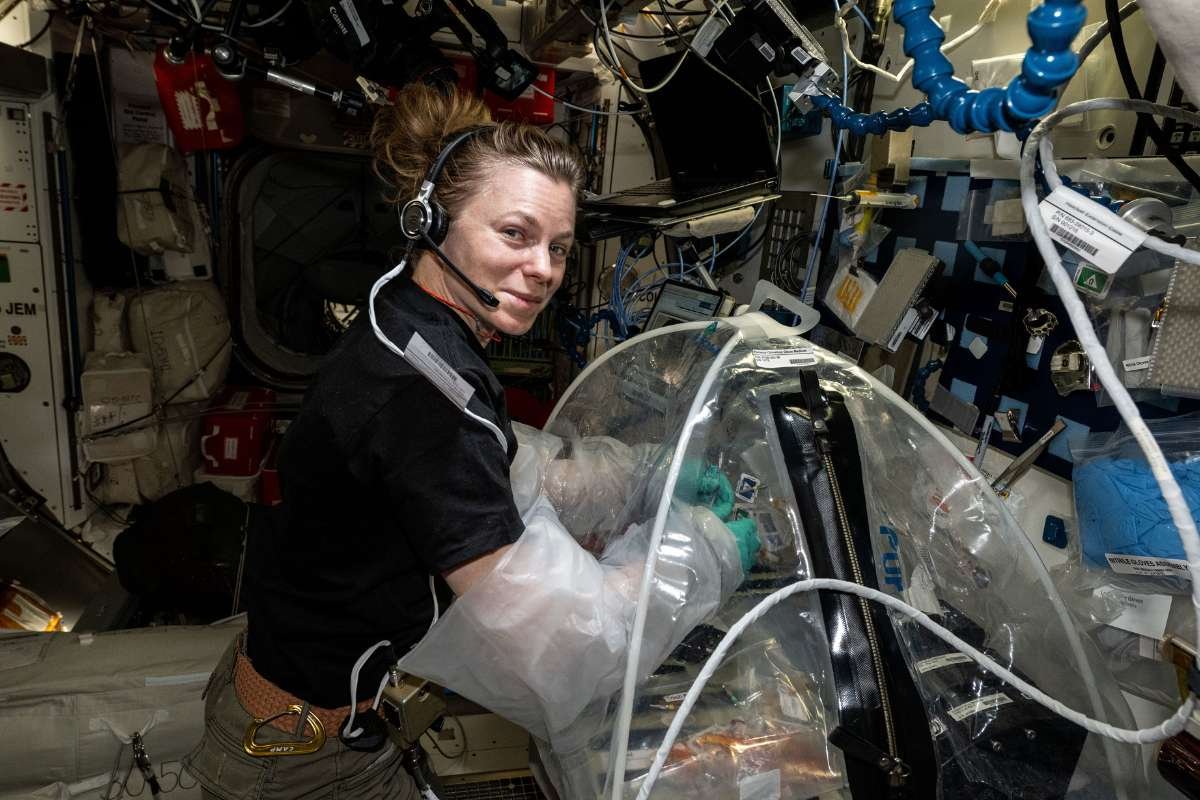
The NASA ISS crew, including Zena Cardman, dedicated Thursday to advancing biomedical science and preparing key research hardware for return to Earth, reinforcing the station’s role as a hub for human health research in microgravity. Crew members focused on medical diagnostics, biological samples, and long-term experiment management as part of Expedition 74’s packed operational schedule.
NASA Flight Engineer Chris Williams began the day by working inside the European Columbus laboratory module, where he upgraded and configured the EchoFinder-2 ultrasound system. This advanced medical device enables the NASA ISS crew to perform detailed internal scans without direct guidance from ground-based specialists. The system represents a major step forward in autonomous healthcare for space missions, particularly for future crews traveling farther from Earth, where real-time medical support may not be possible.
Williams later moved to Japan’s Kibo laboratory to dismantle and inspect specialized research cassettes used to grow protein crystals in microgravity. These samples are highly valued by researchers because crystals formed in space often have superior structural quality, helping scientists better understand molecular behavior. Insights gained from these studies may contribute to the development of more effective pharmaceuticals and medical treatments on Earth.
Dragon Cargo Prepared for Return and Analysis
Beyond biomedical work, significant attention was given to preparing scientific payloads for return aboard a SpaceX Dragon spacecraft currently docked to the station. Williams organized and secured a diverse range of experiments scheduled to come back to Earth during Dragon’s upcoming departure, with support from the NASA ISS crew.
Among the returning cargo are material science samples exposed to the space environment, liquid crystal technologies developed in microgravity, and biological specimens, including stem cells directed to form brain and heart tissue. Once on Earth, researchers will conduct in-depth analysis to understand how microgravity influences cellular behavior, material properties, and structural development, knowledge that could shape future medical therapies and industrial innovations.
The Dragon spacecraft is expected to remain attached to the station until spring, serving both as a cargo carrier and an operational asset. Its departure will mark the conclusion of multiple long-running experiments that required months of exposure to orbital conditions.
Muscle Health and Station Operations Remain a Priority
While U.S. crew members focused on biomedical hardware and cargo, Russian cosmonauts Sergey Kud-Sverchkov and Sergei Mikaev conducted tests on handheld muscle-stimulation devices designed to counteract muscle loss in microgravity alongside the NASA ISS crew. The cosmonauts attached electrodes to their legs and backs to assess performance and ensure proper function.
Muscle atrophy remains one of the most significant challenges of long-duration spaceflight. Electrical muscle stimulation systems are increasingly viewed as valuable supplements to traditional exercise routines, helping astronauts maintain strength and endurance while reducing strain and time demands.
In addition to research activities, the docked Dragon spacecraft is scheduled to assist with an orbital reboost before undocking. This maneuver will raise the ISS’s altitude, supporting station operations and extending its functional lifespan.
Together, the day’s activities highlight the ISS’s ongoing mission to advance science, protect astronaut health, and prepare for the future of human space exploration both in low Earth orbit and beyond.
Visit more of our news! CIO Women Magazine