
I have watched women learn to make themselves smaller without ever being told to. We lower our voices in meetings. We soften statements with smiles. We prepare twice as long, rehearse twice as hard, and still wonder if we are “ready.” The room never says no outright. It simply waits for us to doubt ourselves first.
This is how discrimination lives now; inside the pauses, the silences, the unspoken rules. Statistics give it shape later, but women feel it early. When McKinsey tells us that fewer women rise at the first promotion, that the ladder narrows before it even begins, it confirms something we already know in our bodies. Patriarchy doesn’t slam doors but leaves them half open, just enough to make us blame ourselves for not pushing harder.
When we talk about Women in C-suite roles, we often dress the conversation in optimism. Progress. Pipelines. Potential. But beneath that language sits exhaustion. The cost of being “the first,” “the only,” or “the exception.” The strain of proving leadership in a system that was never designed for female lives, female ambition, or female complexity.
And yet, women keep going. Not because the system is fair, but because stopping feels like erasure. The women who reach the C-suite do not arrive untouched. They carry the weight of years spent translating themselves, surviving bias disguised as feedback, and choosing resilience when the alternative was disappearance.
This guide exists to name that truth. To look directly at Women in C-suite roles—not as inspiration, not as an anomaly, but as evidence. Evidence of what women can do, and of what must change so they no longer have to do it this way.
Where We Really Stand on Women in C-Suite Roles?
McKinsey’s 2024 “Women in the Workplace” report shows women now hold 29% of C-suite positions in large companies, up from 17% in 2015. That jump proves change works when companies invest in it. Yet women of color hold only 7% of those roles, and representation declines at each promotion level, especially at the “broken rung” from entry-level to manager.
Global data from LinkedIn and the World Economic Forum shows women represent 46% of entry-level roles but only about 25% of C-suite positions on average. In India, a recent Avtar study found women hold just 19% of C-suite roles, well below the global average of roughly 30%. The same research reported that about 60% of women leaders cited work–life integration as a core barrier, and attrition at senior levels spiked from 4% to 10% during the pandemic and still hasn’t returned to pre-COVID levels.
So when we talk about women in C-suite roles, we talk about a pipeline that narrows too early, a system that leaks talent, and cultures that still imagine leadership using a “male blueprint.”
Key Challenges Women Face in C-Suite Roles

You don’t fix a problem you refuse to name. The main obstacles for women in C-suite roles show up again and again in research and in real careers.
1. The Male Blueprint of Leadership
The World Economic Forum describes a “male blueprint”—a default image of leadership built around traditionally masculine traits like constant availability, hyper-competitiveness, and linear career paths with no breaks. When boards and CEOs unconsciously use that blueprint, they see women as “exceptions” instead of as leaders.
LinkedIn data in that same analysis shows women’s share drops from 46% at the entry level to 25% in the C-suite, even though the talent pool remains strong. Women don’t suddenly lose ambition; the blueprint simply stops fitting them.
2. The Broken Rung and Biased Promotion
McKinsey finds that for every 100 men promoted to manager, only 81 women move up, and only 54 Black women do. That gap at the first step compounds over time, so by the time companies look for C-suite candidates, the bench of women is artificially thin.
Gender bias also shows up in hiring and promotion. In the Avtar study, 44% of respondents cited bias in selection and promotion as a barrier to women reaching senior roles. When leaders assume women may not want tough turnaround assignments or global roles, they quietly sideline them from the experiences that lead to C-suite succession.
3. Work–Life Integration and Care Burdens
In India and many other markets, about 60% of senior women cite work–life integration as their top challenge, especially around caregiving. The pandemic deepened this: attrition among senior women jumped from 4% in 2019 to 10% in 2020, and only eased to 8% by 2024, still above pre-pandemic levels.
Rigid schedules, “always on” expectations, and long-hours cultures push many women to step back or step out just when they should step into C-suite roles.
4. Networks, Sponsorship, and the Confidence Tax
The World Economic Forum highlights how women’s networks often stay separate—professional circles here, personal circles there—while many male leaders build powerful blended networks that convert into opportunity. Women also report less access to sponsors who will champion them behind closed doors, not just mentor them.
On top of that, self-stereotyping and lack of visible role models create a “confidence tax”: women hesitate to throw their names in the ring unless they tick 100% of the criteria, while men often apply when they meet around 60%.
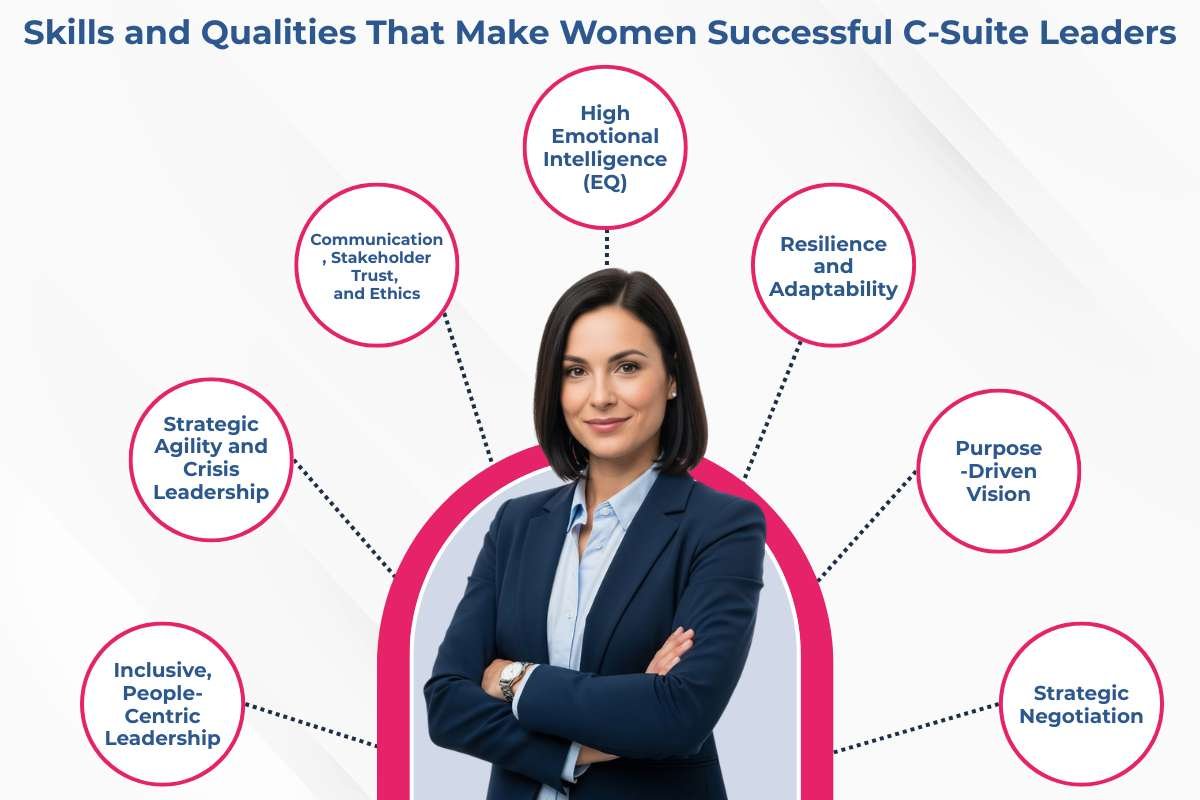
Skills and Qualities That Make Women Successful C-Suite Leaders
Despite all of this, data keeps showing a clear pattern: when women reach the C-suite, they deliver.
1. Inclusive, People-Centric Leadership
McKinsey’s research finds senior women often lead with more people-focused behaviors—coaching, feedback, and allyship—and invest more in DEI and employee well-being. Center for Creative Leadership (CCL) points out that women leaders tend to excel in collaboration, empathy, and change leadership, which directly supports complex transformation efforts.
2. Strategic Agility and Crisis Leadership
Studies on board diversity link higher gender diversity with better risk management and more robust long-term performance. Spencer Stuart, looking at Fortune 500 C-suites, reports that 40% of functional C-suite roles are now held by women, and companies increasingly tap women for roles that require cross-functional thinking (chief customer, chief growth, chief transformation).
3. Communication, Stakeholder Trust, and Ethics
CCL’s work on women in the C-suite underlines strong communication, stakeholder engagement, and ethical decision-making as core strengths. Employees often rate women C-suite leaders as more transparent and more consistent, which supports retention and culture.
4. High Emotional Intelligence (EQ):
Women often excel at “reading the room.” This ability to empathize and build trust allows them to navigate complex stakeholder relationships and foster high-performing, loyal teams.
5. Resilience and Adaptability:
Navigating a career path filled with bias builds a unique kind of “leadership muscle.” Successful women leaders bounce back from setbacks with a strategic focus that benefits the entire organization.
6. Purpose-Driven Vision:
McKinsey’s research on women CEOs highlights that they often lead through purpose rather than ego. They align the organization’s goals with long-term societal and employee impact, creating a compelling story that rallies stakeholders.
7. Strategic Negotiation:
Effective executives know how to influence without authority. Successful women refine their negotiation tactics to secure better opportunities, resources, and buy-in for their initiatives.
Benefits of Having Women in C-Suite Positions: Why Gender Diversity Wins

This isn’t just about fairness. Companies with more women in C-suite roles gain hard-edged business advantages.
- Better financial performance: Multiple meta-analyses and large corporate studies connect gender-diverse leadership teams with stronger profitability and innovation.
- Improved decision quality: Diverse C-suites challenge groupthink, surface more perspectives, and anticipate stakeholder reactions more accurately.
- Employer brand and retention: McKinsey finds women leaders are more likely to sponsor other women and invest in flexibility, which improves retention across the board, not only for women.
- Customer alignment: Women influence or control a majority of consumer purchasing decisions in many sectors, so women in C-suite roles help leadership mirror actual customers.
As Nupur Garg of Winpe said about India’s 19% figure: this isn’t a capability problem; it’s a systems problem that wastes talent and slows performance.
Real-World Examples: 5 Powerful Women in C-Suite Roles
To excel in the modern corporate hierarchy, observing those who have already redrawn the blueprints is essential. These five leaders don’t just occupy executive offices; they actively redefine what it means for Women in C-suite Roles to drive global economic shifts.
Here is a look at their impact, strategic maneuvers, and the data-backed results of their leadership.
1. Jane Fraser – CEO, Citigroup
Fraser is currently executing “Project Bora Bora,” the most significant restructuring of Citigroup in decades. She has moved the bank away from a cluttered, regional management structure to a streamlined model focused on five core functional pillars: Banking, Markets, Services, Wealth Management, and US Personal Banking.
- Impact: Under her leadership, Citi’s net profit surged 37% to $12.7 billion in 2024, with total revenues hitting $81 billion—the bank’s highest since 2010.
- The “C-Suite” Lesson: She proved that a leader must sometimes shrink to grow. By exiting consumer franchises in 14 international markets (including the high-profile separation of Banamex in Mexico), she freed up capital to dominate in “Services”—a unit that now powers the global movement of $5 trillion daily. Fraser’s ability to navigate these “hard-for-the-bottom-line” years illustrates the high-stakes resilience required of Women in C-suite Roles.
2. Gail Boudreaux – CEO, Elevance Health

Boudreaux transformed the former “Anthem” from a traditional insurer into a “whole-health” technology powerhouse. She prioritized the scaling of Carelon, the company’s healthcare services brand, which now accounts for a massive portion of their growth.
- Impact: In fiscal year 2025, Elevance Health reported operating revenue of $197.6 billion, a 13% increase year-over-year. Her focus on “Value-Based Care” and AI-enabled digital solutions helped the company manage a membership base of 45 million people during a period of intense regulatory volatility.
- The “C-Suite” Lesson: Boudreaux demonstrates that the modern executive must be a “Chief Integration Officer.” By bridging the gap between pharmacy services, home health, and traditional insurance, she built a diversified platform that is currently outperforming pure-play competitors.
3. Reshma Kewalramani, M.D. – CEO, Vertex Pharmaceuticals
As a physician-CEO, Kewalramani shifted the R&D paradigm from “incremental improvement” to “curative breakthrough.” She famously bet the company’s future on CRISPR technology, leading to the historic 2023/2024 approvals of CASGEVY—the world’s first-ever CRISPR-based gene-editing therapy.
- Impact: Beyond the scientific milestone, she managed the commercial launch for over 16,000 eligible patients with Sickle Cell Disease and Beta Thalassemia. She oversees an R&D budget exceeding $4 billion annually, targeting high-need areas like Type 1 Diabetes and chronic pain.
- The “C-Suite” Lesson: She embodies the “Expert-Leader” archetype. Her clinical background allows her to make high-conviction decisions on drug pipelines that traditional finance-focused CEOs might shy away from, proving that deep domain expertise is a primary fuel for Women in C-suite Roles.
4. Roshni Nadar Malhotra – Chairperson, HCLTech

Malhotra took the helm of a $14 billion global IT giant and immediately pivoted it toward “Supercharging Progress” through sustainability and AI. She led HCLTech to become the first India-headquartered company to join the Water Resilience Coalition.
- Impact: In FY 2025, HCLTech reported revenues of ₹117,055 Crore (~$14B), driven by a massive 66-deal “Large Deal” pipeline. Her leadership has achieved a 46% reduction in Scope 1 and 2 emissions since 2020, positioning HCLTech as the industry’s ESG leader.
- The “C-Suite” Lesson: She represents the “Social-Capital” executive. By integrating the HCL Foundation’s work (impacting 7.5 million lives) directly into the corporate identity, she has secured HCLTech’s reputation as one of Ethisphere’s “World’s Most Ethical Companies” for two consecutive years.
5. Safra Catz – Executive Vice Chair (Former CEO), Oracle
Catz is the undisputed queen of M&A and financial discipline. She recently transitioned to the Executive Vice Chair role in late 2025 after a legendary run as CEO, where she navigated Oracle’s high-stakes pivot from on-premise software to a “Cloud-First” titan.
- Impact: In 2025, Oracle’s Remaining Performance Obligations (RPO) skyrocketed 41% to $138 billion, largely due to its aggressive pursuit of AI workloads and the $28 billion acquisition of Cerner. She famously predicted that Oracle’s cloud growth would surge past 40% in 2026, a forecast currently being validated by market demand for OCI (Oracle Cloud Infrastructure).
- The “C-Suite” Lesson: Catz shows that “operationalizing a vision” is just as important as having one. While others talked about AI, she built the infrastructure to support it, turning financial rigor into “strategic firepower.” Her recent transition also highlights a key trend for Women in C-suite Roles: the move toward high-influence board and advisory roles to shape the next generation of leadership.
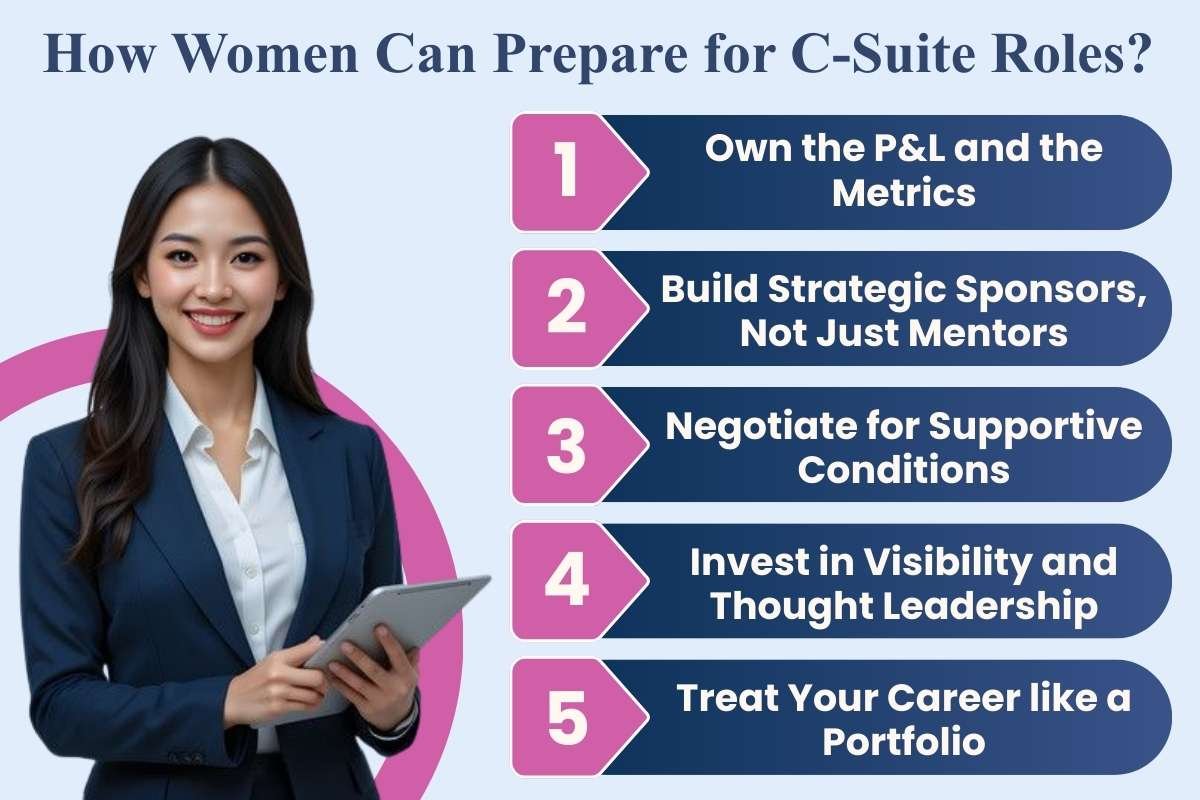
How Women Can Prepare for C-Suite Roles?
Women don’t need to “fix themselves.” They need clear strategies and systems that actually support them. Here’s how to approach both.
1. Own the P&L and the Metrics
Research from Spencer Stuart shows that although 40% of functional C-suite roles are held by women, fewer women hold core P&L roles that feed directly into CEO pipelines. If you aim for the top:
- Seek roles that own revenue, budgets, or full business units.
- Track your impact in numbers—growth, margin, churn, productivity—and talk openly about those results.
2. Build Strategic Sponsors, Not Just Mentors
McKinsey emphasizes that sponsorship—leaders who stake their reputation on you—matters far more than generic advice. To build this:
- Deliver visible wins for key senior stakeholders.
- Ask directly for support for stretch roles, high-visibility projects, and board exposure.
- Offer value back: insight, honest feedback, and results.
3. Negotiate for Supportive Conditions
The Avtar and Business Standard coverage on women in C-suite roles in India shows that work–life integration and culture drive attrition. Use your influence to:
- Negotiate flexibility and results-oriented metrics, not seat time.
- Push for childcare support, parental leave parity, and predictable travel where possible.
- Encourage remote/hybrid policies that keep high-potential women in the pipeline.
4. Invest in Visibility and Thought Leadership
LinkedIn’s spotlight on women in C-suite roles highlights how visible female leaders shape aspiration and pipeline. Share:
- Articles, talks, panels, and internal forums.
- Clear narratives about your leadership philosophy, not just your résumé.
- Your own lessons on failure, resilience, and career pivots.
5. Treat Your Career like a Portfolio
Aspen Institute and CCL both show that women who reach the C-suite make deliberate, sometimes non-linear moves to gather experiences across functions and geographies.
Think in “chapters”:
- Chapter 1: Technical depth.
- Chapter 2: People leadership.
- Chapter 3: P&L / market ownership.
- Chapter 4: Enterprise-level roles (strategy, transformation, corporate development).
Map where you are and what experiences you still need, then seek them deliberately.
Key Challenges Women in C-Suite Roles Still Need Companies to Fix

While individual strategies matter, organisations must change the playing field for women in C-suite roles to truly thrive.
- Fix the broken rung: Set explicit, audited promotion targets at first and second-line manager levels.
- Redesign leadership models: Ditch the male blueprint and define leadership around outcomes, values, and inclusive behaviors.
- Measure and reward inclusion: Tie bonuses for senior leaders to measurable pipeline and inclusion metrics.
- Support re-entry and career breaks: Structured returnship programs bring experienced women back into the pipeline instead of losing them forever.
- Normalize male allyship: Senior men sponsor women, challenge biased comments, and share care responsibilities, not “help” with them.
When companies do this, they don’t “help women” as a side project. They redesign leadership for the 21st century.
FAQs about Women in C-Suite Roles
1. Why do we still see so few women in C-suites?
Because bias stacks up at every stage—hiring, promotion, stretch assignments, and culture. McKinsey’s data on the broken rung plus World Economic Forum insights on the male blueprint show how systemic this is.
2. Do women actually want C-suite jobs?
Yes. Surveys across McKinsey, LinkedIn, and Avtar show high ambition among senior women; the issue is not appetite, but opportunity, sponsorship, and workable conditions.
3. Are companies with women in C-suites more profitable?
Many large-scale studies link higher gender diversity in leadership with better profitability, innovation, and risk management, even after adjusting for industry and size. Correlation isn’t causation, but the pattern repeats across markets.
4. How can male leaders support women in C-suite roles?
They can share power: sponsor women for P&L roles, challenge biased decisions, support flexible work, and share care responsibilities at home so partners can pursue demanding roles.
5. I’m mid-career. Is it too late to aim for the C-suite?
No. Many women in C-suite roles stepped in after 40, sometimes after career breaks or lateral moves. Focus on building P&L experience, visibility, and sponsorship over the next 5–10 years; treat it as a strategic plan, not a miracle.
Conclusion
Women do not reach the C-suite because the path clears for them. They reach it carrying the marks of every narrow passage they were told to pass through quietly. The years of recalculating tone. The promotions that arrived late, if at all. The moments when leadership felt like something to be earned endlessly, never simply assumed.
When women hold power at the top, they change more than titles or reporting lines. They change the air in the room. Decisions are slow just enough to consider the impact. Success stretches beyond ego and into continuity. People stay. Ideas survive. Organizations remember they are made of humans, not hierarchies.
But progress that depends on endurance alone is not progress; it is survival. Women in C-suite roles should not have to be extraordinary just to be present. They should not need to absorb bias as a rite of passage or wear resilience like armor. A system that requires this is not demanding excellence; it is preserving imbalance.
So the real question is no longer whether women belong at the top. The data has answered that. The stories have answered that. The question is whether we are willing to dismantle the structures that make their leadership feel conditional.
Because women in C-suite roles do not need permission, they need power that stays. They need systems that stop testing their worth. And they deserve a future where leadership does not cost them parts of themselves they were never meant to surrender.