

“It is obvious that discrimination exists. Women do not have the opportunities that men do.”
Shirley Chrislom
The quote by Shirley Chrislom completely explains what the glass ceiling is. To be a woman is a daily fight; a fight for a better life, a safer future, and equal opportunities. Even in 2026, the glass ceiling effect on women is clearly visible.
In today’s blog, we will look at how the glass ceiling still affects women, trying to understand the daily struggles they have to go through.
But before understanding the glass ceiling effect on women in 2026, let’s find out what the glass ceiling is.
What is the Glass Ceiling?
Marilyn Loden coined the “glass ceiling” term in 1978. She introduced it during a panel at the Women’s Exposition in New York, describing invisible barriers blocking women’s career advancement beyond middle management.
The term “glass ceiling” describes a metaphor for the invisible barriers that prevent qualified individuals, most often women and members of minority groups, from rising to the highest levels of leadership within an organization.
Unlike a “concrete ceiling,” which might be a formal policy, the glass ceiling is transparent. From the outside, the path to the top looks clear, but as people climb, they hit a solid, unspoken limit that stops their progress regardless of their merit or achievements.
Why Does It Happen?
The glass ceiling effect on women isn’t due to a single rule. Instead, it is a collection of subtle, systemic factors that work together:
- Unconscious Bias: Decision-makers often unconsciously hire or promote people who look or act like them, reinforcing the status quo.
- Lack of Mentorship: High-level networking often happens in exclusive circles, leaving many professionals without the “sponsors” needed to advocate for their promotion.
- Stereotypes: Outdated assumptions about leadership styles or family commitments can lead to people being overlooked for high-pressure roles.
- The “Sticky Floor”: This describes how some groups get stuck in low-level, supportive roles with fewer promotion tracks, making it even harder to reach the “ceiling” in the first place.
History of the Glass Ceiling in the Workplace
The history of the “glass ceiling” is a story of how a quiet observation in the 1970s transformed into a global movement for workplace equity. While women have worked for centuries, the specific struggle to reach the “top floor” of corporate power only became a defined cultural conversation as the 20th century drew to a close.
The Origins: Coining the Term (1970s–1980s)
The phrase didn’t emerge from a boardroom, but from the lived experiences of female professionals who noticed a pattern they couldn’t explain.
While the term is often attributed to others, Loden is widely credited with first using it during a speech at a Women’s Action Alliance Conference. She argued that the “lack of aspiration” in women wasn’t the problem; rather, an invisible barrier of biased management was the culprit.
The term entered the mainstream when a Wall Street Journal article titled “The Glass Ceiling: Why Women Can’t Seem to Break the Invisible Barrier That Blocks Them from the Top Jobs” explored the struggles of corporate women. The glass ceiling effect on women described a world where the path to the top seemed open, but a transparent ceiling kept women at the level of middle management.
Institutional Recognition: The Glass Ceiling Commission (1991)
By the 1990s, the issue moved from magazine articles to government policy. In the United States, the Civil Rights Act of 1991 created the Glass Ceiling Commission.
The commission spent four years studying workplace dynamics and found that the “ceiling” was sustained by two main factors:
- Societal Barriers: Education and the “pipeline” of talent.
- Internal Business Barriers: Non-transparent recruitment, exclusion from informal networks, and lack of mentorship.
The Evolution of the Metaphor (2000s–Present)
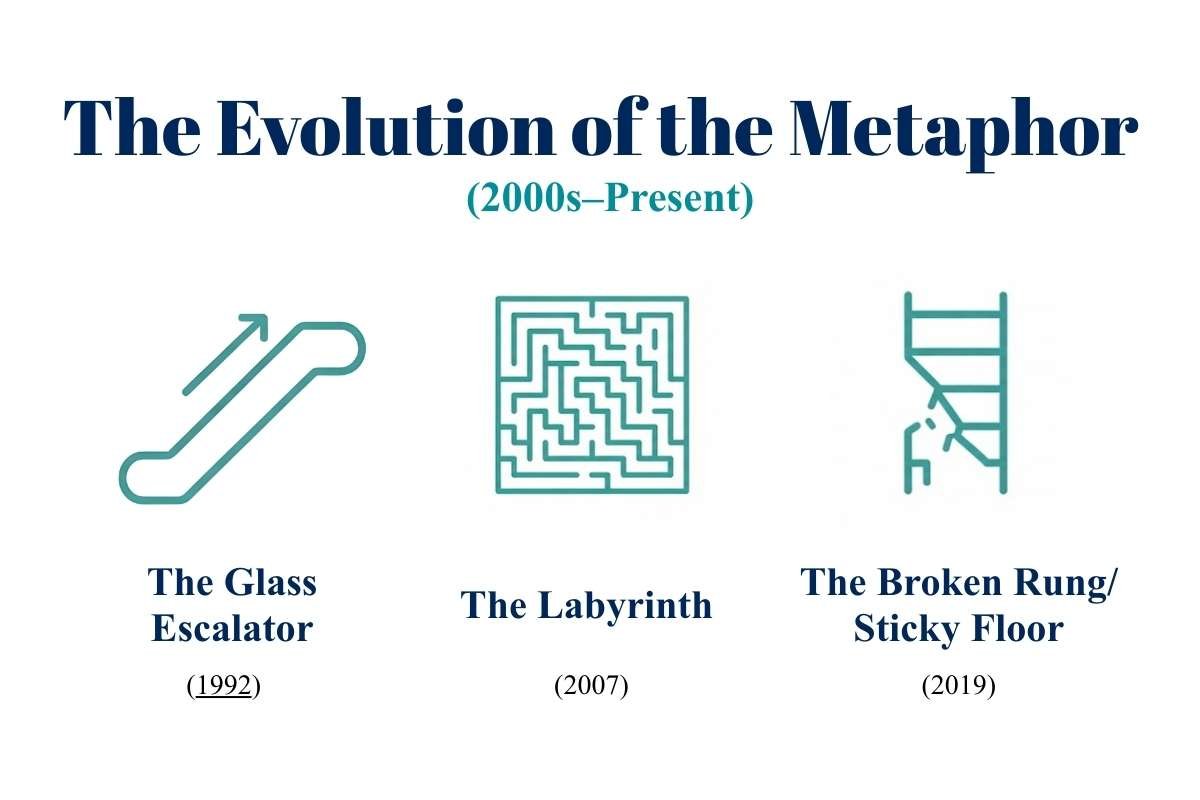
As the conversation matured, researchers realized that a “ceiling” wasn’t the only obstacle women faced. New terms were created to describe more complex hurdles:
- The Glass Escalator (1992): Sociologist Christine Williams noted that men in female-dominated fields (such as nursing or teaching) often get promoted faster than women, as if on an “escalator.”
- The Labyrinth (2007): Alice Eagly and Linda Carli argued that the “ceiling” was too simple. They suggested the “Leadership Labyrinth,” depicting a path full of twists, turns, and dead ends that women must navigate from the very start of their careers.
- The Broken Rung/ Sticky Floor (2019): Recent data from McKinsey & Company highlights that the biggest obstacle isn’t the top of the ladder, but the very first step up to manager. For every 100 men promoted to manager, only about 87 women (and 73 women of color) are promoted.
- Modern Progress and the “Glass Cliff”: In the 21st century, we have seen more women reach the CEO level than ever before, yet a new phenomenon appeared: The Glass Cliff. Research suggests that women are more likely to be appointed to leadership roles during times of crisis or downturn, making their position inherently more precarious and likely to fail compared to their male counterparts.
Today, the focus has shifted from merely “breaking” the glass ceiling effect on women to dismantling the structures that created it.
Now, it is about focusing on intersectionality, recognizing that women of color, LGBTQ+ women, and women with disabilities face even thicker layers of glass.
Here’s a table to simplify these concepts:
| Term | Definition | Primary Impact | Key Characteristic |
|---|---|---|---|
| Glass Ceiling | Invisible barriers that prevent women/minorities from rising to upper-level positions. | Stops mobility at the executive level upward. | You can see the top, but you can’t reach it despite your merit. |
| Glass Cliff | The tendency to appoint women to leadership roles during times of crisis or downturn. | Endangers the leader’s career and reputation. | High risk of failure; the leader is often blamed for a pre-existing mess. |
| Glass Escalator | The rapid promotion of men in female-dominated fields (like nursing or teaching). | Accelerates the careers of men over women. | Men are “pushed” upward into management even when they aren’t seeking it. |
| Glass Walls | Barriers that prevent women from moving laterally into different departments. | Restricts the breadth of experience. | Women are funneled into “support” roles (HR) rather than “line” roles (Finance/Ops). |
| Sticky Floors | Low-wage, entry-level patterns that keep certain groups stuck at the bottom. | Traps workers in low-mobility, dead-end jobs. | Prevents people from even reaching the first “rung” of the career ladder. |
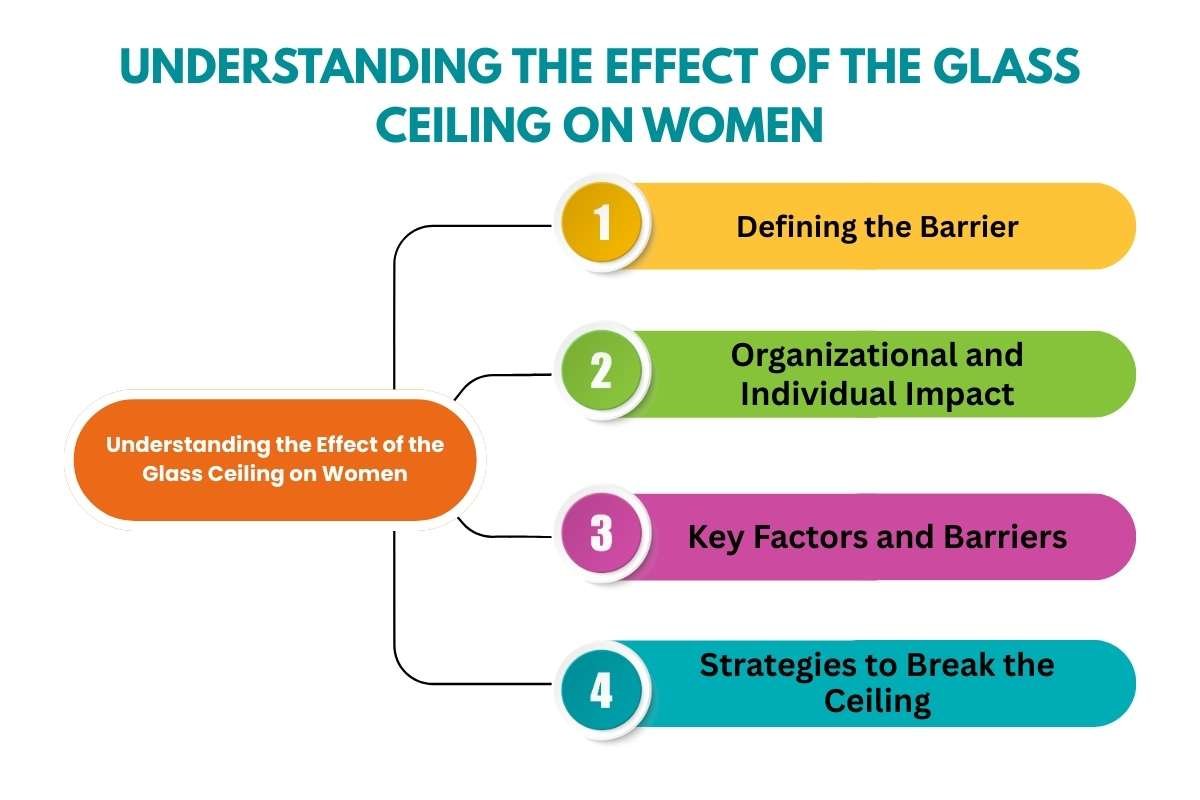
Understanding the Effect of the Glass Ceiling on Women
Now that we know the history of the glass ceiling, let’s talk about the effect experienced by every woman.
1. Defining the Barrier
The glass ceiling is defined as an unspoken, transparent obstacle that prevents women from ascending to the highest levels of corporate and academic leadership (1, 3).
While women often fill the majority of entry-level and middle-management roles, particularly in sectors such as higher education, they remain significantly underrepresented in senior managerial positions (1). This phenomenon is not just a lack of progress; it is a structural stop where women “get stuck” at the top of middle management (5).
2. Organizational and Individual Impact
The glass ceiling effect on women harms the organization as a whole:
- Organizational Performance: Research shows that the presence of a glass ceiling leads to lower employee satisfaction. This dissatisfaction acts as a mediator that ultimately results in below-average organizational performance (5).
- The “Glass Cliff”: Even when women break through the ceiling, they often face a “glass cliff,” where they are appointed to leadership roles during periods of crisis. In these positions, they face 45% higher dismissal rates than men, regardless of performance, and are subject to more intense scrutiny and blame (2).
- Economic Inequality: The barrier contributes to the gender pay gap, where women (especially women of color) earn significantly less than their male counterparts for the same work (2).
3. Key Factors and Barriers
The sources identify several systemic and socio-cultural factors that maintain the ceiling:
- Gender Bias and Male Dominance: Cultural norms often favor a “masculine” perception of leadership, leading hiring committees to favor candidates who resemble existing leaders (1, 2).
- Work-Life Balance: Women often bear a disproportionate burden of family responsibilities, such as child-rearing and domestic duties, which can conflict with traditional corporate expectations (1, 5).
- Lack of Networking and Mentorship: Recruitment for high-level boards is often opaque and non-transparent. Women frequently lack the “sponsors” (senior leaders who actively advocate for their promotion) compared to their male peers (2, 4).
4. Strategies to Break the Ceiling
Breaking the barrier requires a combination of individual resilience and systemic change:
- Mentorship vs. Sponsorship: While mentors provide advice, women need sponsors who will put their reputation on the line to recommend them for high-visibility projects and promotions (2, 4).
- Systemic Accountability: Organizations must measure and track diversity progress, implement inclusive hiring policies (such as diverse hiring panels), and establish zero-tolerance policies for discrimination (4).
- Male Allyship: Achieving gender equality is a community issue. Involving men in forums regarding gender equality and encouraging them to sponsor women is critical for shifting workplace culture (4).
- Flexible Policies: Companies should offer flexible hours and parental leave to support “work-life harmony” rather than forcing a choice between family and career (4).
The glass ceiling effect on women is a persistent conflict in modern organizations. While progress is being made, with women now making up roughly 11% of Fortune 500 CEOs, overcoming this barrier requires dismantling “masculine” leadership myths and fostering environments where merit truly determines advancement.
Key Causes of the Glass Ceiling Effect on Women
While the glass ceiling effect on women is invisible, the factors that build it are very real and deeply embedded in how we work and live. Understanding these causes is the first step toward dismantling them.
Here are the key drivers of the glass ceiling, categorized by how they manifest in the professional world.
The Power of Bias and Networks
At the core of this issue lies a persistent “template” for leadership. Many organizations still subconsciously mirror the “think manager, think male” mindset, where assertive traits are praised in men but viewed as abrasive in women. This creates a likability trap that makes the path to the top much narrower for female professionals.
The “Old Boys’ Club” still functions as a silent gatekeeper. High-level decisions often happen in informal social circles, like specific sports or late-night outings that many women are excluded from. Without these organic connections, women miss out on sponsorship, which is the active advocacy from a senior leader that is required to move from middle management into the executive suite.
Structural Gaps and the “Broken Rung”

The barrier often starts much earlier than the boardroom. Research points to a “broken rung” at the very first step of the career ladder. If women aren’t promoted to their first managerial role at the same rate as men, the talent pool thins out before it even reaches the top.
Furthermore, women are frequently funneled into “support” tracks like HR or Communications rather than “line” roles with Profit and Loss (P&L) responsibility. Since most CEOs are hired from operational or financial backgrounds, this early career steering acts as a structural detour away from the corner office.
The Weight of Domestic Expectations
Societal norms regarding home life continue to bleed into the workplace, creating what is known as the “motherhood penalty.” While fathers are often seen as more stable and committed, mothers frequently face the unfair assumption that they are less dedicated to their careers.
This “double burden” of managing a high-pressure job alongside a disproportionate share of domestic labor can lead to burnout. It also leads to the “glass cliff” phenomenon, where women are finally offered leadership roles only during times of crisis, making their success much harder to achieve and sustain.

Real-World Examples of the Glass Ceiling Effect on Women
Real-world examples of the glass ceiling effect on women show that even in industries where women make up the majority of the workforce, the path to leadership often remains obstructed.
These examples highlight the transition from “seeing” the top to actually “reaching” it.
1. The Automotive Industry: Mary Barra (General Motors)
Before Mary Barra became the CEO of General Motors in 2014, the automotive industry was considered one of the “thickest” glass ceilings in the world, a quintessential male-dominated field.
Barra started at GM as an 18-year-old co-op student and spent over 30 years climbing the ranks. Her appointment was a landmark moment for women in manufacturing.
Interestingly, Barra was appointed during a massive safety crisis (the ignition switch recall). This is a classic example of the Glass Cliff, where women are finally given the reins only when a company is in serious trouble, increasing their risk of failure.
2. The Beverage Giant: Indra Nooyi (PepsiCo)
Indra Nooyi’s tenure as CEO of PepsiCo (2006–2018) is often cited as a masterclass in breaking multiple barriers: she was a woman, an immigrant, and a person of color.
Nooyi has spoken openly about the “double burden,” famously stating that women “cannot have it all” because the clock of family life and the career clock are in total conflict.
Despite these hurdles, she shifted PepsiCo’s strategy toward healthier products (“Performance with a Purpose”), proving that diverse leadership directly influences corporate innovation and long-term sustainability.
3. The Finance Sector: The 52/27 Gap
The finance industry provides a stark statistical example of the glass ceiling in action.
In North America, women make up roughly 52% of the total financial services workforce. However, as you move up the hierarchy, that number drops sharply; women hold only about 27% of C-suite positions.
Studies in finance often point to informal “shadow structures,” such as golf outings or private dinners, where high-level networking happens. Because women are often excluded from these informal spaces, they miss out on the organic sponsorship needed for the highest promotions.
4. The Legal Profession: The Partnership Wall
In law, the glass ceiling effect on women is often felt at the transition from “Senior Associate” to “Partner.”
For years, women have made up about 50% of law school graduates. Yet, they represent only about 20–25% of equity partners at major firms.
This is often attributed to the “billable hour” model, which rewards those who can work extreme, inflexible hours, a structure that often penalizes women who still shoulder the majority of domestic and caregiving responsibilities at home.
How to break the glass ceiling?
Breaking the glass ceiling requires a shift from “helping individuals” to “fixing the system.” Here is how we can dismantle the glass ceiling effect on women through organizational change, leadership action, and individual strategy:
For Organizations (Systemic Change)
- Fix the “Broken Rung”: Target the very first promotion to manager to ensure the talent pipeline doesn’t thin out at the entry level.
- Objective Hiring: Use blind resume screening and standardized interview questions to remove unconscious “affinity bias.”
- Pay and Promotion Transparency: Publicly list salary ranges and the specific criteria required for advancement to eliminate “behind-closed-doors” decision-making.
- Flexibility by Default: Normalize flexible working hours and parental leave for all employees to remove the “motherhood penalty.”
For Leaders (Active Advocacy)
- Move from Mentorship to Sponsorship: Instead of just giving advice, high-level leaders must use their political capital to advocate for women when promotion decisions are being made.
- Diversify “Stretch” Assignments: Actively assign women to high-stakes, high-visibility projects that have direct “Profit and Loss” (P&L) impact.
- Call out Meeting Bias: Allies should intervene when women are interrupted or when their ideas are attributed to someone else in the room.
For Individuals (Strategic Navigation)
- Own the “Hard” Numbers: Seek out operational roles that manage budgets and revenue, as these are the most common paths to the C-suite.
- Build a “Personal Board of Directors”: Assemble a diverse group of mentors (for advice), sponsors (for power), and peers (for support).
- Negotiate Early and Often: Practice “transparent negotiation” by using industry data to advocate for fair market value and clear promotion timelines.
Conclusion:
The glass ceiling effect on women is a structural failure that limits the potential of our global economy. We cannot claim to operate a meritocracy while talented leaders are held back by invisible biases and outdated “old boys’ club” dynamics. Real progress requires moving from awareness towards active sponsorship and addressing the “broken rung” early in the career ladder.
Shattering this glass ceiling is a win for everyone, not just women. When we remove the artificial limits on who can lead, organizations become more innovative, employees become more engaged, and the path to the top will finally reflect the diversity of the world below it.
FAQs
1. What exactly is the glass ceiling?
It is a metaphor for the invisible barriers that prevent women and minorities from rising to upper-level positions in a hierarchy. You can see the top, but an unspoken set of biases and structural hurdles stops you from reaching it, regardless of your qualifications.
2. How does the “glass ceiling” differ from the “glass cliff”?
While the glass ceiling stops women from getting to the top, the glass cliff happens once they break through. It describes the tendency for women to be appointed to leadership roles during a time of crisis or downturn, making their position precarious and their chance of failure much higher than that of their male counterparts.
3. Can men help break the glass ceiling effect on women?
Yes. Because men still hold the majority of executive and board positions, their role as allies and sponsors is critical. Breaking the ceiling requires men to actively pull women into high-stakes projects and call out bias when they see it in the boardroom.
Reference & Sources:
- https://www.eelet.org.uk/index.php/journal/article/view/1653
- https://www.imd.org/blog/leadership/glass-ceiling/
- https://www.researchgate.net/publication/236778636_The_Glass_Ceiling_Effect
- https://www.ssbm.ch/rise-lead-how-women-can-break-the-glass-ceiling/
- https://jdss.org.pk/issues/v3/2/impact-of-glass-ceiling-gc-on-organizational-performance-op-moderating-role-of-employee-satisfaction-es.pdf