
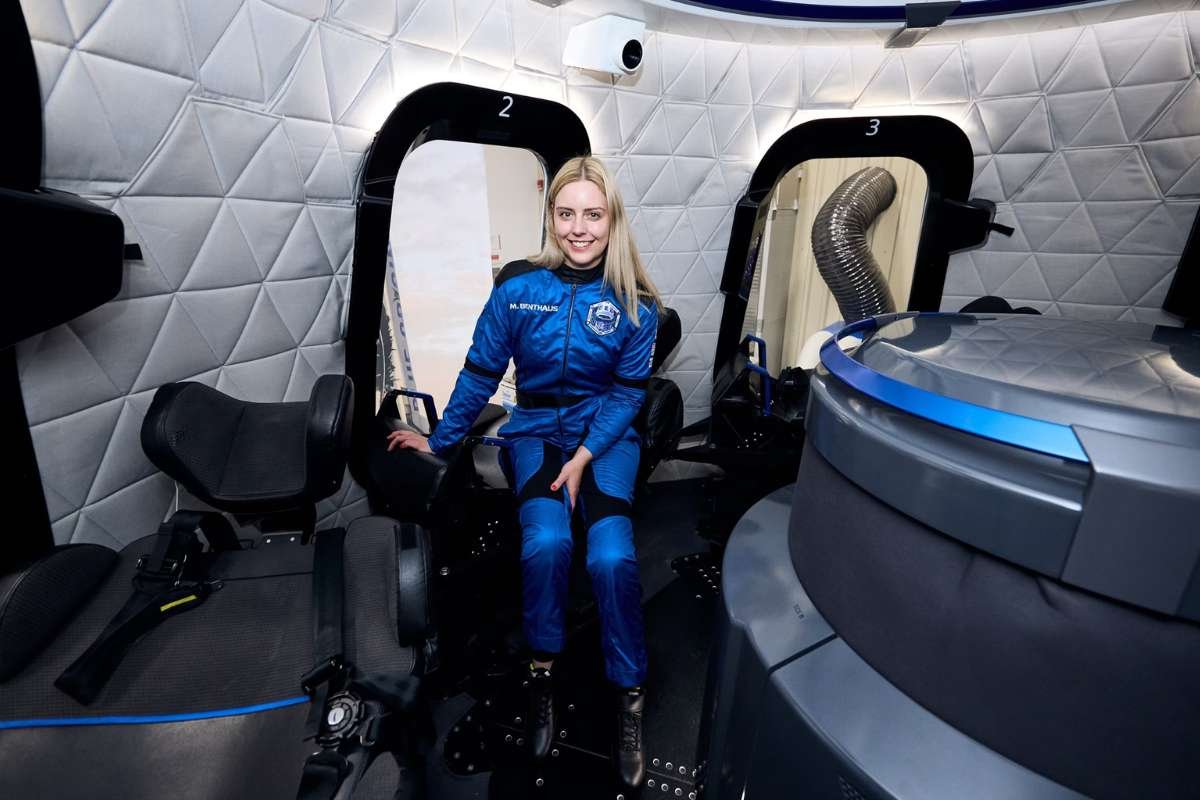
Key Points:
- Historic Milestone: Michaela Benthaus became the first wheelchair user to reach space on Blue Origin’s NS-37 flight.
- Inclusive Participation: Minimal spacecraft adjustments allowed her full involvement, proving accessibility in space missions.
- Inspiring Change: The flight promotes diversity and encourages people with disabilities to pursue STEM and space careers.
Blue Origin marked a historic milestone in commercial spaceflight with a suborbital mission that carried the first wheelchair user beyond Earth’s atmosphere. The flight, known as NS-37, launched from the company’s West Texas site aboard the reusable New Shepard rocket and capsule system. Among the six passengers was Michaela “Michi” Benthaus, a German aerospace and mechatronics engineer who uses a wheelchair, making her the first person with a significant physical disability to cross the internationally recognized boundary of space.
The brief mission lasted around ten minutes, during which the capsule climbed beyond 100 kilometers above Earth, allowing the crew to experience several minutes of microgravity. Passengers were able to unstrap from their seats and float freely while viewing the curvature of the planet against the blackness of space. The capsule then returned safely to Earth, landing under parachutes in the Texas desert, while the booster executed a controlled vertical landing nearby.
Michaela Benthaus later described the experience as deeply emotional and exhilarating, noting that both the powerful ascent and the silence of weightlessness stood out as unforgettable moments. Her participation has been widely seen as a breakthrough for accessibility in space tourism, signaling that spaceflight is no longer limited to those who fit traditional physical expectations.
From Engineering Career to the Edge of Space
Michaela Benthaus’s journey to space was shaped by both technical expertise and personal resilience. An aerospace engineer by training, she previously worked with European space programs and has long been engaged in research related to human spaceflight and accessibility. In 2018, a mountain biking accident left her paralyzed from the waist down, but she continued to pursue her professional ambitions while advocating for greater inclusion in advanced engineering and exploration fields.
In preparation for the mission, Benthaus underwent extensive training alongside her crewmates, including simulations, safety drills, and weightlessness training. Only minimal adjustments were required to support her participation, demonstrating that existing spacecraft systems can already accommodate a wider range of physical abilities than often assumed. These included practical solutions to help her transfer into the capsule and secure herself during launch and landing.
A senior aerospace executive and former rocket engineer on the flight played a key role in supporting her involvement, reinforcing the collaborative nature of the mission. The crew trained together as equals, emphasizing that Michaela Benthaus was selected not as a symbolic gesture, but as a fully capable participant in the demanding environment of spaceflight.
Broader Implications for Commercial Spaceflight
The NS-37 mission represents more than a single personal achievement; it reflects a broader shift in how commercial space companies view access to space. Blue Origin has steadily expanded the diversity of its passenger list, flying scientists, engineers, educators, and private citizens from varied backgrounds. With this mission, the company demonstrated that inclusive design does not necessarily require radical redesign, but thoughtful application of existing technology.
For advocates of disability inclusion, the flight stands as a powerful example of how high-technology industries can rethink long-standing assumptions. Michaela Benthaus has expressed hope that her journey will encourage people with disabilities to pursue careers in science and engineering and to see space as a place where they belong.
As space tourism continues to evolve, missions like NS-37 are likely to influence future spacecraft design, training programs, and policy discussions. The flight underscores a growing consensus within the industry: expanding access to space strengthens innovation, inspires new generations, and reshapes humanity’s vision of who can take part in exploring the final frontier.
Visit CIO Women Magazine to read more.