Promoting a product is only one aspect of modern marketing. Today’s businesses have to simultaneously manage digital channels, customer experiences, brand perception, and service delivery. For this reason, one of the most important frameworks in business strategy is still the 7 P’s of marketing.
This model, which was first created as an extension of the traditional marketing mix, assists businesses in coordinating their teams, customers, and products into a coherent strategy. Knowing this framework can greatly enhance how your brand interacts with consumers, whether you are a business leader, marketing expert, or startup founder.
What Are the 7 P’s of Marketing?
The 7 P’s of marketing are a strategic framework used to design, evaluate, and optimize marketing strategies. They help businesses consider every factor that influences how a product or service reaches and satisfies customers.
The model includes:
- Product
- Price
- Place
- Promotion
- People
- Process
- Physical Evidence
Together, these elements form a complete ecosystem that determines how customers perceive a brand. While earlier marketing theories focused mainly on product and pricing decisions, modern businesses must also consider service delivery, customer interaction, and brand experience.
Marketing scholar Philip Kotler popularized the broader marketing mix concept, which eventually evolved into this more comprehensive model used by companies worldwide.
The Evolution from 4Ps to 7Ps:
In the 1960s, marketers relied on a simpler framework known as the 4Ps of marketing:
Product, Price, Place, and Promotion. This model worked well for traditional product-based businesses, particularly manufacturing and retail.
However, as the global economy shifted toward services, such as hospitality, finance, and technology, the original model became insufficient. Service-based businesses needed to account for additional factors like employee interactions, service delivery systems, and brand experience.
To address these changes, marketing experts expanded the model by adding three new elements:
- People – the employees and teams delivering the service
- Process – the systems used to deliver the product or service
- Physical Evidence – the tangible elements that reinforce brand credibility
This evolution allowed marketers to better understand the full customer journey, especially in industries where experience matters as much as the product itself.
The 7 P’s of Marketing Explained:
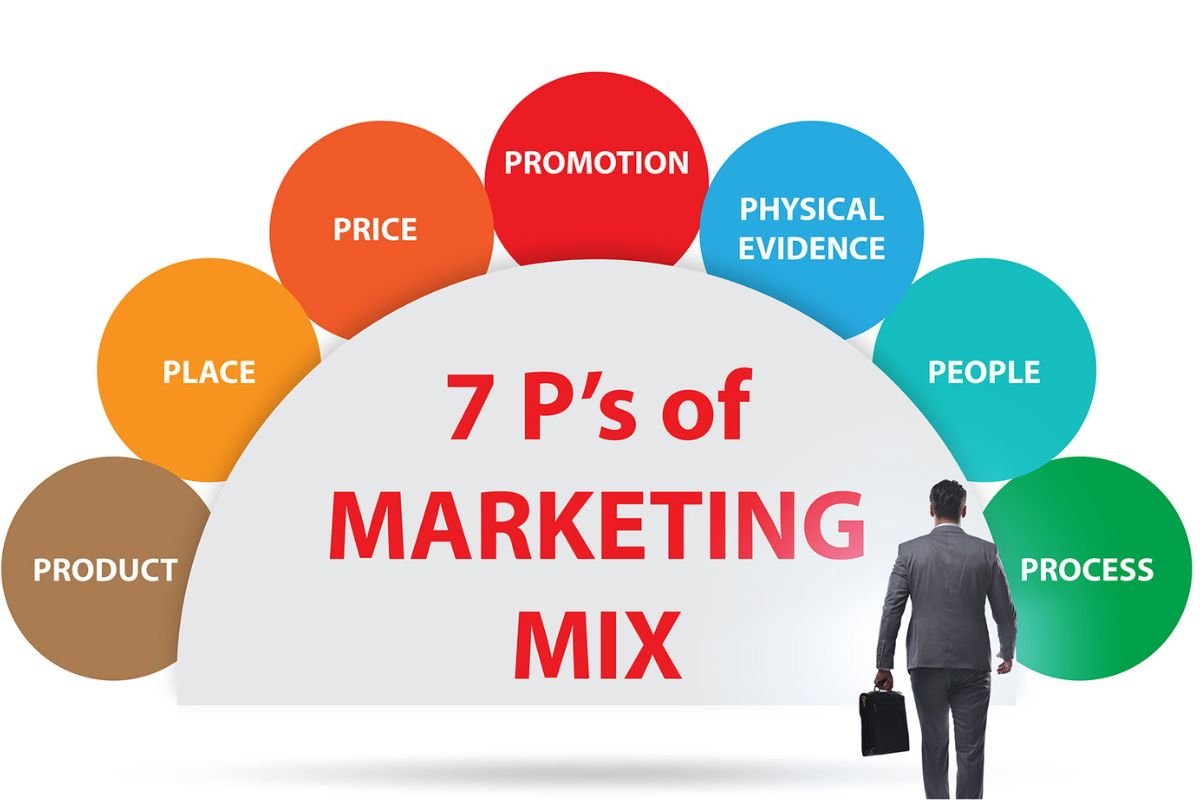
Understanding each component of the 7 P’s of marketing helps businesses create balanced strategies that address both operational and customer-facing aspects of marketing.
1. Product
The product represents the core offering that solves a customer’s problem or fulfills a need. It could be a physical item, a digital platform, or a service.
Key considerations include:
- Quality and features
- Design and branding
- Product lifecycle
- Customer benefits
Companies that consistently innovate their products stay ahead in competitive markets.
2. Price
Price determines how much customers pay and strongly influences purchasing decisions. Pricing strategies may include:
- Premium pricing
- Competitive pricing
- Discount pricing
- Value-based pricing
A well-designed pricing strategy balances profitability with perceived value.
3. Place
Place refers to how and where customers access the product. In the digital age, distribution includes both physical and online channels.
Examples include:
- Retail stores
- E-commerce websites
- Mobile apps
- Global distribution networks
Efficient distribution ensures customers can easily find and purchase your product.
4. Promotion
Promotion includes all communication strategies used to attract customers and build brand awareness.
These may include:
- Advertising
- Content marketing
- Social media campaigns
- Influencer partnerships
- Public relations
Promotion ensures that customers understand why your product matters.
5. People
Employees play a critical role in shaping customer experience. Customer service representatives, sales teams, and support staff all influence brand perception.
Training, culture, and employee engagement can dramatically impact how customers feel about a company.
6. Process
Process refers to the systems and workflows used to deliver the product or service efficiently.
Examples include:
- Checkout systems
- Customer onboarding
- Delivery logistics
- Customer support processes
A smooth process improves customer satisfaction and reduces operational inefficiencies.
7. Physical Evidence
Physical evidence includes the tangible elements that reinforce credibility and brand trust.
This may involve:
- Store design
- Packaging
- Website design
- Customer reviews
- Branded materials
These details help customers evaluate a brand before making a purchase.
Why the 7 P’s of Marketing Are Critical in 2026?

In 2026, marketing has become more integrated, data-driven, and experience-focused than ever before. Businesses no longer compete solely on product features; they compete on the entire customer journey.
The 7 P’s of marketing help companies manage this complexity by aligning strategy across departments.
Several trends make the framework particularly important today:
- Customer Experience Economy: Consumers prioritize seamless experiences across digital and physical platforms.
- Omnichannel Marketing: Brands must coordinate messaging across websites, apps, retail locations, and social media.
- Service-Based Growth: Many industries, from SaaS to hospitality, depend heavily on service quality and operational efficiency.
- Brand Transparency: Customers increasingly evaluate companies based on ethics, culture, and trustworthiness.
Organizations that integrate these elements into a cohesive marketing strategy are far more likely to build lasting customer relationships.
Real-World Example of the 7 P’s in Action:
Consider a global coffee brand expanding internationally.
- Product: Premium coffee blends and specialty beverages
- Price: Mid-to-premium pricing reflecting quality
- Place: Cafés in high-traffic locations plus mobile ordering
- Promotion: Digital campaigns, loyalty programs, and seasonal launches
- People: Highly trained baristas delivering personalized service
- Process: Efficient ordering systems and quick preparation
- Physical Evidence: Signature store design, branded cups, and cozy interiors
When all these elements align, customers receive a consistent and memorable experience.
This is why successful global brands rarely treat marketing as a single department. Instead, they integrate it into product development, operations, and customer service.
Read More: Your Marketing Plan Template For Your Small Business
How Women Leaders Use the 7 P’s to Build Global Brands?
Many of the world’s most successful companies have been shaped by visionary women leaders who understand the importance of holistic marketing.
These leaders often emphasize:
- Customer empathy – understanding real consumer needs
- Experience design – focusing on how customers feel at every interaction
- Brand storytelling – building emotional connections through authentic narratives
By balancing product innovation with strong customer relationships, women executives across industries, from beauty to technology. They have used marketing frameworks to scale brands globally.
Their leadership demonstrates that strategic marketing is not only about selling products but also about shaping culture and community around a brand.
How to Apply the 7 P’s of Marketing in Your Business?

Applying the 7 P’s of marketing effectively requires more than simply listing them in a strategy document. Businesses must actively evaluate each element and ensure they support the overall brand vision.
Here are practical steps to implement the model:
1. Audit your current strategy
Evaluate how each marketing element currently performs.
2. Identify gaps
Look for inconsistencies between customer expectations and brand delivery.
3. Align teams across departments
Marketing, operations, and customer service should work together.
4. Focus on customer experience
Ensure every interaction reinforces brand value.
5. Continuously refine the strategy
Markets evolve quickly, so marketing frameworks must adapt.
Businesses that consistently review and optimize these elements build stronger brands and maintain long-term customer loyalty.
Common Mistakes Companies Make With the 7 P’s:
Even experienced organizations sometimes misuse the marketing mix framework.
Some of the most common mistakes include:
- Ignoring customer experience: Focusing only on product and price while neglecting service quality.
- Inconsistent brand messaging: Promotional campaigns that do not align with the product or brand identity.
- Poor internal coordination: Departments are working in isolation instead of collaborating.
- Neglecting operational processes: Slow or inefficient systems that frustrate customers.
Avoiding these mistakes requires leadership alignment and a strong customer-first mindset.
Conclusion:
Marketing success today requires a balance of strategy, operations, and customer experience. The marketing mix framework, especially the 7 P’s of Marketing, offers a structured way to evaluate all these factors together.
By understanding how each element influences brand perception and customer satisfaction, businesses can design more effective marketing strategies.
Companies that master the 7 P’s of marketing principles are better equipped to build memorable brands, deliver exceptional experiences, and thrive in an increasingly competitive global marketplace.
Thank You For Reading!
See More
13 Tips For Marketing Yourself