
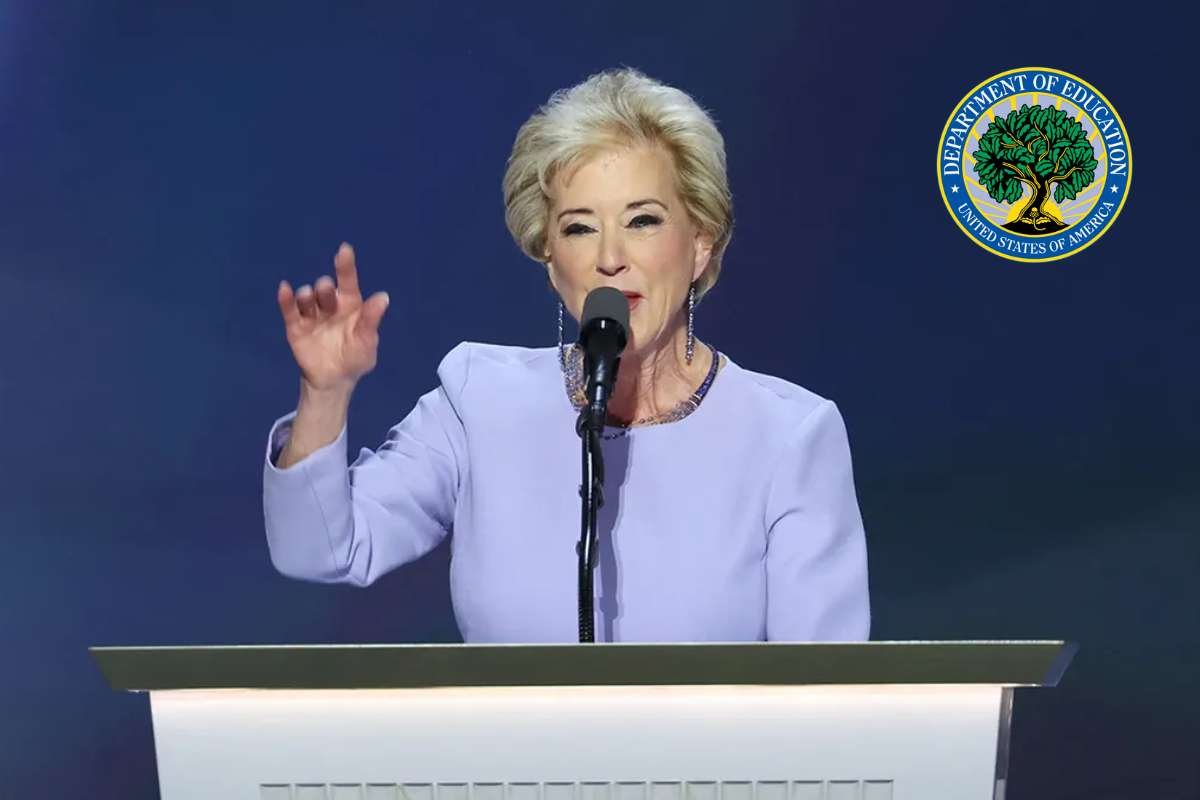
U.S. Education Secretary Linda McMahon has triggered a nationwide debate after delivering an unusually blunt assessment of student performance, warning that American students are struggling significantly in core academic areas. Speaking during a recent media interaction, she described the condition of the education system as deeply concerning, pointing to declining outcomes in foundational subjects such as reading and mathematics.
Her remarks have drawn widespread attention for their directness and urgency. McMahon emphasized that the current system is not adequately preparing students for real-world challenges, particularly in an increasingly competitive global environment. According to her, the gaps in basic skills are not just academic concerns but long-term economic and workforce issues.
The comments reflect growing concern within the administration of Donald Trump, where education has once again become a key policy focus. Officials have increasingly highlighted student performance trends as evidence that structural reforms are needed. Linda McMahon’s candid tone has amplified these concerns, signaling that the administration may take a more assertive approach toward reshaping education policy in the months ahead.
Renewed Push to Reshape Federal Role in Education
The secretary’s remarks come at a time when the administration is actively working to redefine the federal government’s role in education. A central part of this strategy involves reducing the influence of the United States Department of Education and shifting more authority to individual states.
Under Linda McMahon’s leadership, efforts have focused on streamlining operations, cutting administrative complexity, and reconsidering how key education programs are managed. The broader goal is to create a system that is more flexible, efficient, and responsive to local needs. By allowing states greater control, the administration believes education policies can be better tailored to specific communities rather than being governed by a one-size-fits-all federal framework.
This approach aligns with longstanding arguments from conservative policymakers who view federal oversight as a source of inefficiency. They argue that decentralization could encourage innovation, improve accountability at the local level, and ultimately lead to better student outcomes.
However, the path to implementing such changes is far from straightforward. Any major restructuring of the department would require congressional approval, and there are significant legal and logistical challenges involved. Despite this, incremental changes such as redistributing responsibilities and reducing departmental scope are already being pursued as part of a broader reform agenda.
Divided Reactions Reflect Broader Policy Tensions
Linda McMahon’s stark warning has prompted mixed reactions across the political and educational landscape. Supporters of the administration have welcomed her remarks, viewing them as a necessary acknowledgment of long-standing issues. They argue that confronting the reality of declining student performance is the first step toward meaningful reform.
On the other hand, critics have pushed back, arguing that the situation is more complex than the secretary’s comments suggest. They point to a range of contributing factors, including funding disparities, teacher shortages, and socioeconomic inequalities that affect student learning outcomes. For these critics, simplifying the issue risks overlooking deeper systemic challenges.
There is also concern about the potential impact of reducing federal involvement in education. Opponents warn that such moves could weaken support systems that many schools, especially those in underserved communities,s rely on. Federal programs, they argue, play a crucial role in maintaining equity and ensuring that all students have access to quality education, regardless of their background.
The debate ultimately reflects a broader ideological divide over how education should be governed in the United States. While one side emphasizes decentralization and local control, the other underscores the importance of federal standards and oversight in maintaining consistency and fairness.
As the discussion continues, McMahon’s remarks have brought renewed urgency to questions about the future of American education. With student performance under scrutiny and policy changes on the horizon, the issue is likely to remain at the forefront of national debate, shaping decisions that could have lasting implications for generations to come.