
Sustainability is no longer just a responsibility; it is becoming a competitive advantage. Companies that integrate sustainability into their business models are better positioned to reduce costs, manage risks, and build long-term resilience.
The shift is already visible. According to KPMG’s Survey of Sustainability Reporting 2024, 96% of the world’s largest 250 companies now publish sustainability reports, highlighting how ESG has moved from a voluntary initiative to a business priority. Meanwhile, PwC’s Global Investor Survey shows that investors increasingly expect companies to demonstrate measurable sustainability performance. Rising investor expectations, stricter regulations, and changing consumer preferences are pushing companies to rethink how they operate.
A well-planned sustainability strategy for your company can help turn environmental goals into measurable business outcomes, from improving operational efficiency and strengthening supply chains to building customer trust and unlocking new growth opportunities.
But creating an effective strategy requires more than setting sustainability targets. It requires a clear roadmap that aligns sustainability goals with business objectives.
This guide explores how companies can build a sustainability strategy for their company that drives impact, resilience, and long-term value.
What Is a Sustainability Strategy for Your Company?
A sustainability strategy for your company is a structured roadmap that helps businesses integrate environmental, social, and governance (ESG) priorities into their everyday operations while achieving long-term business goals.
Unlike traditional sustainability initiatives that focus only on reducing environmental impact, modern sustainability strategies connect responsible practices with measurable business outcomes. They help companies improve resource efficiency, reduce risks, strengthen stakeholder relationships, and create lasting competitive advantages.
This shift is also reflected in how women-led businesses approach sustainability differently, often balancing environmental goals with innovation, stakeholder engagement, and long-term business growth.
A strong sustainability strategy typically focuses on three core areas:
| Focus Area | Business Impact |
| Environmental sustainability | Reduces emissions, improves resource efficiency, and supports climate resilience |
| Social responsibility | Strengthens employee engagement, workplace culture, and community impact |
| Governance practices | Improves transparency, compliance, and stakeholder trust |
The most effective strategies move beyond standalone green initiatives and become part of how a company makes decisions from supply chain management and product development to hiring practices and financial planning.
For example, investing in renewable energy is not only an environmental decision; it can also reduce long-term operating costs. Similarly, adopting circular economy business models can help companies minimize waste while creating new opportunities for innovation and efficiency.
Ultimately, a sustainability strategy transforms sustainability from a cost center into a growth framework, helping businesses prepare for future challenges while creating value for customers, employees, and investors.
Why Your Company Needs a Sustainability Strategy Today
The business landscape is changing faster than ever. Climate risks, evolving regulations, investor expectations, and shifting customer preferences are making sustainability a strategic priority rather than an optional initiative.
Companies that fail to adapt may face rising operational costs, compliance challenges, and reputational risks. On the other hand, organizations that embed sustainability into their business models can unlock opportunities for innovation, efficiency, and long-term growth.
Here are some key reasons why building a sustainability strategy for your company has become essential:
1. Rising Consumer Expectations Are Reshaping Brand Decisions
Customers are increasingly choosing brands that align with their values. Sustainability is no longer just a brand message; it is influencing purchasing decisions and customer loyalty.
Research from PwC found that 80% of consumers are willing to pay more for sustainably produced or sourced products, showing that responsible business practices can directly impact market competitiveness.
A clear sustainability strategy helps companies build trust by moving beyond sustainability claims and demonstrating measurable action.
2. Investors Are Prioritizing ESG Performance
Investors are increasingly evaluating companies based on their environmental, social, and governance performance. Strong ESG practices can signal better risk management, operational resilience, and long-term value creation.
Businesses with transparent corporate sustainability reporting and measurable sustainability goals are better positioned to meet investor expectations and access future growth opportunities.
As reporting expectations continue to evolve, many organizations also evaluate B Corp certification vs ESG reporting to determine which framework best aligns with their sustainability objectives.
3. Sustainability Helps Reduce Costs and Improve Efficiency
Sustainability is not only about environmental responsibility, but it can also improve financial performance.
Initiatives such as energy efficiency, waste reduction, sustainable supply chains, and resource optimization can help companies lower operating costs while improving productivity.
For example, reducing energy consumption can decrease expenses, while sustainable supply chain practices can improve resilience against disruptions.
4. Regulations Are Making Sustainability a Business Requirement
Governments and regulatory bodies worldwide are introducing stricter climate policies, emissions standards, and sustainability disclosure requirements.
Companies that proactively develop a sustainability roadmap are better prepared to manage regulatory changes and avoid compliance risks.
A well-defined sustainability strategy for your company provides the foundation needed to adapt, innovate, and remain competitive in an increasingly sustainability-focused economy.
Key Components of an Effective Sustainability Strategy
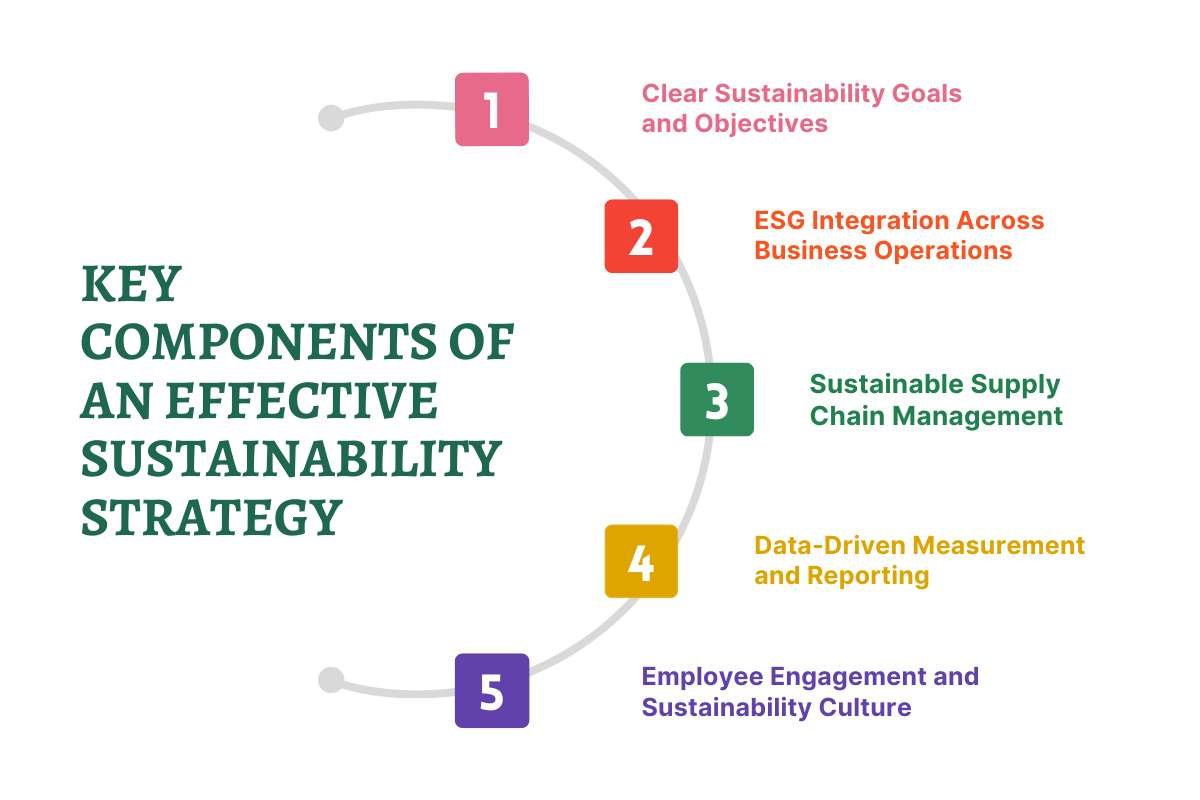
Building a successful sustainability strategy for your company requires more than setting environmental targets. Companies need a structured approach that connects sustainability goals with business priorities, measurable outcomes, and long-term growth plans.
An effective strategy typically combines environmental responsibility, social impact, and strong governance practices to create a balanced framework.
1. Clear Sustainability Goals and Objectives
Every successful sustainability strategy begins with clearly defined goals. Without measurable targets, companies cannot track progress or evaluate impact.
Businesses should set specific objectives around areas such as:
- Reducing carbon emissions
- Improving energy efficiency
- Minimizing waste
For example, instead of setting a broad goal like “becoming more sustainable,” companies can establish measurable targets such as reducing emissions by a specific percentage within a defined timeline.
2. ESG Integration Across Business Operations
Sustainability should not operate as a separate department; it should be integrated into everyday decision-making.
A strong ESG strategy connects sustainability with:
- Business planning
- Financial decisions
- Procurement processes
Companies that embed ESG principles into operations are better equipped to manage risks and identify new opportunities.
3. Sustainable Supply Chain Management
Supply chains often represent a significant portion of a company’s environmental and social impact. Building transparency and accountability across suppliers is therefore a critical part of sustainability planning.
Businesses can improve supply chain sustainability by:
- Working with responsible suppliers
- Reducing transportation emissions
- Improving resource efficiency
Adopting sustainable supply chain management not only reduces environmental impact but also strengthens business resilience against disruptions.
4. Data-Driven Measurement and Reporting
A sustainability strategy is only effective when progress can be measured.
Companies should track sustainability KPIs that provide meaningful insights into environmental, social, and operational performance:
| Sustainability KPI | What It Measures | Why It Matters to Business |
| Carbon emissions | Environmental footprint reduction | Helps identify high-emission operations, reduce compliance risks, and prepare for evolving carbon regulations and investor scrutiny. |
| Energy consumption | Resource efficiency | Reveals opportunities to lower operating costs, improve energy productivity, and strengthen resilience against volatile energy prices. |
| Waste reduction | Operational improvements | Highlights inefficiencies across production and supply chains, helping businesses reduce material costs while supporting circular economy initiatives. |
| Water usage | Resource conservation | Enables companies to manage water-related risks, particularly in water-stressed regions, and maintain long-term operational continuity. |
| Employee engagement | Social impact | Indicates whether sustainability initiatives are embedded in company culture, improving retention, innovation, and employer branding. |
Transparent reporting through corporate sustainability reporting allows businesses to demonstrate accountability and build trust among investors, customers, and employees.
5. Employee Engagement and Sustainability Culture
Sustainability cannot succeed through leadership decisions alone. Employees play a crucial role in implementing sustainable practices across the organization. Encouraging greater participation from professionals involved in women in climate policy and environmental advocacy can also strengthen collaboration and bring diverse perspectives into sustainability initiatives.
Companies can encourage participation through:
- Sustainability training programs
- Employee-led green initiatives
- Internal sustainability goals
When sustainability becomes part of company culture, organizations are more likely to achieve long-term results.
Ultimately, the strongest sustainability strategies are those that combine clear goals, measurable actions, employee involvement, and business alignment, turning sustainability from an initiative into a core growth strategy.
How to Build a Sustainability Strategy for Your Company?

Creating a successful sustainability strategy for your company requires a structured approach that connects environmental responsibility with business performance. While every organization’s priorities may differ, the foundation of an effective strategy remains the same: understand current impact, define clear goals, implement meaningful actions, and measure progress.
Here are the key steps businesses can follow:
1. Assess Your Current Sustainability Performance
Before setting sustainability goals, companies need to understand where they currently stand. A sustainability assessment helps identify areas of improvement, existing challenges, and opportunities for impact.
Businesses should evaluate:
- Carbon emissions and energy consumption
- Waste management practices
- Supply chain impact
- Resource usage
- Employee and community initiatives
This baseline assessment allows companies to create realistic goals and prioritize initiatives that deliver the greatest business and environmental value.
2. Define Measurable Sustainability Goals
A sustainability strategy becomes effective when goals are specific, measurable, and aligned with business objectives.
Instead of vague commitments, companies should establish clear targets such as:
- Reducing greenhouse gas emissions
- Increasing renewable energy adoption
- Improving recycling and waste reduction rates
Measurable goals make it easier to track progress, improve accountability, and demonstrate impact through sustainability KPIs.
3. Align Sustainability Goals With Business Objectives
The most successful sustainability strategies are not separate from business growth; they support it. Companies should identify how sustainability initiatives can create tangible value, such as:
| Sustainability Action | Business Benefit |
| Energy efficiency programs | Lower operational costs |
| Sustainable sourcing | Stronger supply chain resilience |
| Waste reduction | Improved resource efficiency |
| Sustainable product design | Increased customer trust |
By connecting sustainability with profitability and growth, businesses can gain stronger leadership support and long-term commitment.
4. Implement Sustainable Practices Across Operations
Once goals are established, companies need to integrate sustainability into daily operations.
This can include:
- Transitioning to renewable energy
- Improving resource management
- Reducing packaging waste
- Optimizing supply chains
- Investing in sustainable technologies
Many organizations are also adopting circular economy business models that focus on reducing waste, extending product lifecycles, and creating more efficient resource systems.
Many businesses also pursue sustainability certifications to validate their sustainability efforts, strengthen stakeholder confidence, and demonstrate measurable progress.
5. Monitor, Report, and Improve Progress
Sustainability is an ongoing process, not a one-time initiative. Companies must regularly review performance, analyze results, and refine their approach.
Tracking progress through ESG reporting helps organizations:
- Identify improvement areas
- Maintain transparency
- Meet stakeholder expectations
- Build credibility
A continuous improvement approach ensures that a sustainability strategy for your company evolves alongside changing regulations, market expectations, and business priorities.
By following these steps, companies can move beyond sustainability commitments and create a practical roadmap that delivers measurable environmental impact and long-term business value.
Common Mistakes Companies Make While Building a Sustainability Strategy
Creating a sustainability strategy for your company requires more than setting ambitious goals. Many organizations struggle not because they lack commitment, but because they fail to connect sustainability efforts with clear business objectives, measurable outcomes, and long-term planning.
Understanding these common challenges can help companies build strategies that create meaningful and lasting impact.
1. Treating Sustainability as a Separate Initiative
One of the biggest mistakes businesses make is viewing sustainability as a standalone project rather than a core business strategy.
When sustainability is disconnected from operations, finance, and decision-making, it becomes difficult to achieve measurable results. Companies need to integrate sustainability into areas such as procurement, product development, supply chain management, and corporate planning.
A successful strategy ensures that sustainability becomes part of how the business operates—not just an additional program.
2. Setting Goals Without a Clear Implementation Plan
Many companies announce sustainability commitments without defining how they will achieve them.
For example, a goal to reduce carbon emissions requires a detailed roadmap covering:
- Current emission levels
- Reduction strategies
- Required investments
- Timelines
- Progress measurement
Without an actionable plan, sustainability goals can remain unrealistic commitments rather than achievable outcomes.
3. Focusing Only on Environmental Impact
While reducing environmental impact is a major part of sustainability, a complete approach must also address social and governance factors.
A balanced sustainability strategy considers:
- Employee well-being
- Diversity and inclusion
- Ethical business practices
- Community impact
- Transparent governance
Companies that focus only on environmental initiatives may miss opportunities to build stronger workplace cultures and stakeholder relationships.
4. Failing to Measure Progress
A sustainability strategy without measurement is difficult to evaluate.
Businesses need to track relevant sustainability KPIs to understand whether initiatives are delivering results. These metrics can include carbon reduction, energy efficiency, waste management, supplier performance, and employee engagement.
Regular measurement also helps companies improve their strategies and communicate progress through transparent corporate sustainability reporting.
5. Overlooking Employee Involvement
Sustainability transformation cannot happen through leadership decisions alone. Employees play a critical role in turning sustainability goals into everyday actions.
Companies that invest in sustainability training, awareness programs, and employee participation are more likely to build long-term sustainability cultures.
Avoiding these mistakes allows organizations to create a sustainability strategy for their company that is practical, measurable, and aligned with both environmental responsibility and business growth.
How to Measure the Success of Your Sustainability Strategy?

A sustainability strategy is only effective when companies can track its progress and understand its impact. Without clear measurement, businesses may struggle to identify what is working, where improvements are needed, and how sustainability efforts contribute to overall performance.
Measuring success allows organizations to move from sustainability commitments to data-driven decision-making.
1. Track Key Sustainability KPIs
The right metrics help companies evaluate whether their sustainability initiatives are creating meaningful results. Common sustainability KPIs include:
| Sustainability KPI | What It Measures |
| Carbon emissions reduction | Progress toward climate goals |
| Energy efficiency | Reduction in energy consumption and costs |
| Waste reduction | Improvements in resource management |
| Renewable energy usage | Shift toward cleaner energy sources |
| Sustainable sourcing | Environmental and ethical supply chain practices |
| Employee engagement | Participation in sustainability initiatives |
Tracking these KPIs consistently helps organizations evaluate progress, identify improvement opportunities, and make sustainability decisions based on measurable outcomes rather than assumptions.
“The future is not about doing less harm. It’s about doing more good.”- John Elkington, author of the Triple Bottom Line.
This perspective reflects why many sustainability initiatives fail. Long-term impact comes from embedding sustainability into business strategy, operations, and decision-making rather than treating it as a standalone program.
2. Use ESG Reporting for Transparency
Transparent reporting has become a critical part of modern sustainability management. Companies use ESG reporting to communicate their environmental, social, and governance performance to investors, customers, employees, and other stakeholders.
Effective reporting helps organizations:
- Demonstrate accountability
- Build stakeholder trust
- Identify performance gaps
- Compare progress over time
Frameworks such as the Global Reporting Initiative and Task Force on Climate-related Financial Disclosures guide companies looking to improve sustainability disclosures.
3. Connect Sustainability Metrics With Business Outcomes
The strongest sustainability strategies measure more than environmental impact; they also evaluate business value.
For example:
- Reduced energy consumption can lead to lower operating costs
- Sustainable supply chains can improve resilience
- Resource efficiency can increase productivity
- Strong ESG performance can strengthen brand reputation
When sustainability data is connected to business performance, leaders can better understand how sustainability contributes to growth and long-term competitiveness.
4. Continuously Improve the Strategy
Sustainability is an evolving process. Companies must regularly review performance, adapt to new regulations, and respond to changing stakeholder expectations.
Regular assessments help businesses refine their sustainability strategy for their company and ensure that sustainability initiatives continue delivering measurable impact.
By combining accurate measurement, transparent reporting, and continuous improvement, organizations can transform sustainability from a commitment into a strategic advantage.
The Role of Leadership in Driving Sustainability Transformation
A successful sustainability strategy for your company depends on more than policies, targets, or technology; it requires strong leadership commitment. When executives and decision-makers treat sustainability as a business priority rather than a compliance exercise, organizations are better positioned to create meaningful and lasting change.
Leadership plays a critical role in turning sustainability goals into action by aligning teams, allocating resources, and creating accountability across the organization.
1. Making Sustainability Part of Business Strategy
Sustainability initiatives often fail when they operate separately from core business decisions. Leaders must ensure that sustainability is integrated into areas such as:
- Business planning
- Investment decisions
- Product innovation
- Supply chain management
- Risk assessment
When sustainability becomes part of strategic decision-making, companies can identify opportunities for efficiency, innovation, and long-term growth.
2. Building a Culture of Sustainability
Leadership sets the tone for how employees perceive and participate in sustainability efforts.
Companies can build a sustainability-focused culture by:
- Providing employee training
- Encouraging sustainable workplace practices
- Recognizing sustainability contributions
- Creating clear internal goals
A culture-driven approach ensures that sustainability becomes a shared responsibility rather than a top-down initiative.
3. Connecting Sustainability With Business Value
One of the biggest challenges leaders face is gaining organizational support for sustainability investments. The most effective approach is to connect sustainability goals with outcomes that matter to the business.
For example:
- Renewable energy adoption can reduce operational costs
- Sustainable processes can improve efficiency
- Responsible sourcing can reduce supply chain risks
- ESG performance can strengthen investor confidence
Understanding how to pitch sustainability initiatives effectively helps leaders gain support by presenting sustainability as a growth opportunity rather than an expense.
4. Encouraging Innovation and Long-Term Thinking
Sustainability-focused leaders encourage organizations to rethink traditional business models and invest in future-ready solutions.
This includes exploring:
- Clean technologies
- Circular economy business models
- Sustainable product design
- Responsible supply chain practices
Companies that prioritize innovation are better prepared to adapt to changing market expectations and regulatory requirements.
Ultimately, leadership is the foundation of any successful sustainability transformation. By creating accountability, encouraging collaboration, and aligning sustainability with business goals, leaders can ensure that a sustainability strategy for your company delivers measurable impact and long-term value.
Future Trends Shaping Corporate Sustainability

The future of sustainability is evolving rapidly as businesses respond to climate challenges, technological advancements, and changing stakeholder expectations. Companies are moving beyond basic sustainability commitments and adopting strategies that improve resilience, innovation, and long-term competitiveness.
A successful sustainability strategy for your company must adapt to these emerging trends to remain relevant in a changing business environment.
1. AI-Powered Sustainability Management
Artificial intelligence is transforming how companies measure, manage, and improve sustainability performance.
Businesses are using AI to:
- Monitor carbon emissions
- Optimize energy consumption
- Improve resource planning
- Identify operational inefficiencies
- Predict environmental risks
By combining sustainability data with AI-driven insights, companies can make faster and more informed decisions while improving efficiency.
2. Growth of Circular Economy Business Models
Traditional business models often follow a linear approach: produce, use, and dispose. However, companies are increasingly shifting toward circular economy business models that prioritize reuse, recycling, and resource optimization.
Circular strategies help businesses:
- Reduce waste generation
- Extend product lifecycles
- Lower resource dependency
- Create new revenue opportunities
From sustainable packaging to product refurbishment, circularity is becoming a key component of modern sustainability planning.
3. Greater Focus on Sustainable Supply Chains
Supply chains are becoming a major focus area as companies work to reduce environmental impact beyond their own operations.
Future-ready businesses are investing in:
- Supplier transparency
- Ethical sourcing
- Lower-carbon transportation
- Sustainable materials
A resilient, sustainable supply chain management approach helps organizations reduce risks while improving operational performance.
4. Expansion of Green Careers and Sustainability Roles
As sustainability becomes central to business strategy, demand for green jobs and sustainability roles is increasing across industries, creating new opportunities for professionals with ESG, climate, and sustainability expertise.
Emerging career opportunities include:
- ESG specialists
- Sustainability consultants
- Climate risk analysts
- Renewable energy professionals
- Green finance experts
This growth is also creating more opportunities through green finance careers for women, alongside ESG leadership, climate risk, and sustainable investment roles.
5. Stronger Sustainability Reporting and Accountability
Companies are facing increasing expectations to demonstrate measurable sustainability progress. Future sustainability strategies will rely heavily on transparent reporting, accurate data, and clear accountability.
Organizations will need to strengthen areas such as:
- ESG disclosures
- Sustainability KPIs
- Carbon tracking
- Stakeholder communication
Businesses that embrace these trends will be better positioned to create lasting value while responding to the demands of a more sustainability-conscious economy.
The next generation of sustainability strategies will not only focus on reducing impact; they will help companies innovate, grow, and build stronger business models for the future.
Conclusion:
Sustainability is no longer just about reducing environmental impact; it is about building businesses that are more resilient, efficient, and prepared for the future.
A well-planned sustainability strategy for your company helps organizations move beyond short-term initiatives and create measurable value through improved operations, stronger stakeholder relationships, and sustainable growth opportunities.
From setting clear sustainability goals and tracking performance metrics to engaging employees and adopting innovative solutions, companies that integrate sustainability into their core strategy are better positioned to navigate future challenges.
The businesses that succeed will not be those that simply respond to sustainability expectations; they will be the ones that use sustainability as a driver for innovation, competitiveness, and long-term success.
Organizations that embed sustainability into every business function are also contributing to a broader movement of women driving sustainable business, where innovation, responsible leadership, and measurable impact go hand in hand. By treating sustainability as a strategic priority today, companies can build a stronger foundation for tomorrow while creating value for customers, employees, investors, and communities.
FAQs:
1. What is a sustainability strategy for a company?
A sustainability strategy for your company is a structured plan that helps businesses integrate environmental, social, and governance (ESG) priorities into their operations while achieving long-term business objectives. It focuses on reducing environmental impact, improving efficiency, managing risks, and creating value for stakeholders.
2. Why is a sustainability strategy important for businesses?
A sustainability strategy helps companies adapt to changing regulations, meet customer and investor expectations, reduce operational costs, and build long-term resilience. It allows businesses to turn sustainability efforts into measurable business advantages rather than treating them as standalone initiatives.
3. How can a company create a sustainability strategy?
Companies can create an effective sustainability strategy by assessing their current impact, setting measurable goals, aligning sustainability initiatives with business objectives, engaging employees, implementing sustainable practices, and regularly measuring progress through relevant KPIs.
4. What are examples of corporate sustainability strategies?
Examples of corporate sustainability strategies include adopting renewable energy, improving supply chain sustainability, reducing waste, implementing circular economy practices, increasing resource efficiency, improving employee well-being, and strengthening ESG reporting processes.
5. How do companies measure sustainability performance?
Companies measure sustainability performance using metrics such as carbon emissions reduction, energy consumption, waste reduction, renewable energy adoption, sustainable sourcing, and employee engagement. These measurements help organizations track progress and improve their sustainability initiatives over time