
I am not here to teach women how to behave.
That idea alone feels outdated, arrogant, and frankly exhausting. Women have spent generations being told to sit straighter, speak softer, smile more, ask nicely, and wait their turn. The world has never lacked opinions on how women should show up.
This piece didn’t begin as advice. It began as discomfort.
A close friend of mine—sharp, qualified, deeply competent- walked out of a meeting once and laughed it off. She had been interrupted repeatedly, introduced by her first name while her male peers received titles, and later described as “emotional” for pushing back on a flawed assumption. Nothing dramatic happened. No HR complaint. No headline-worthy incident. Just small, ordinary moments. The kind that rarely gets documented.
That’s when it cl,cked. Patriarchy rarely announces itself anymore. It hides in tone. In phrasing. In expectations disguised as “professionalism.”
Curiosity took over as I started digging, not into “business etiquette for women” manuals, but into data, psychology, organizational behavior studies, and workplace research. What I found was uncomfortable and validating at the same time. Decades of research confirm that women often face a double bind: assertiveness earns respect for men and resistance for women; politeness reads as professionalism for some and passivity for others.
So this guide does not attempt to correct women.
Instead, it decodes the unsaid, unwritten rules that already exist; the ones no one formally teaches but everyone quietly enforces. What follows draws from scientific findings, leadership research, and documented workplace patterns. These ten strategies exist to help women navigate systems that still judge them differently, without shrinking themselves or performing respectability.
This is not about changing who you are.
It’s about understanding the game well enough to stop paying invisible penalties.
Why Business Etiquette for Women Still Shapes Power Dynamics at Work? (Top 10)
1. The Psychology of the First Seven Seconds

Psychologists at Princeton University found that the human brain decides your competence within a mere tenth of a second. In a high-stakes environment, you have roughly seven seconds to solidify your authority before you speak a single word. Mastering business etiquette starts with the physical “claim” of space, a psychological signal that you belong in the room.
➤ The Power of Presence Social psychologist Amy Cuddy demonstrates that expansive postures, standing tall with shoulders back, increase testosterone (the confidence hormone) and lower cortisol (the stress hormone). This physical alignment signals unshakeable confidence.
- Instead of: Entering a room with a “scuttling” gait or crossed arms that suggest you are an interloper.
- Use: Walking with purposeful, measured strides and keeping your torso open to the room to project a high-status presence.
➤ The Modern Handshake: The handshake remains the universal seal of a business deal. Modern, gender-neutral rules dictate that the person in the higher position of authority initiates the handshake. However, as an interviewee or visitor, extending your hand first signals a proactive, leadership-oriented mindset.
- Action: Ensure your grip is firm but not crushing. Maintain direct eye contact for at least three seconds to build immediate rapport and trust.
2. Communication Mastery: Ending the “Apology Culture.”

Language acts as a window into your self-perception. Many professionals inadvertently sabotage their authority through “softeners”—linguistic habits that minimize their contributions. Developing the right business etiquette for women requires a conscious shift from tentative to declarative language.
Eliminate the Minimizers
Researchers at the Harvard Business Review identified that women use “just” and “I’m no expert, but…” significantly more often than their male peers.
- Instead of: “I just wanted to check if you saw my email.”
- Use: “I am following up on the email I sent yesterday regarding the project deadline.”
The Art of the Interruption
A study by George Washington University found that men interrupt women 33% more often than they interrupt other men. Etiquette does not mean silence. Use the “bridge and continue” technique. If someone interrupts you, say, “I will finish this point, and then I’d love to hear your thoughts.” This maintains the flow of the meeting while asserting your right to the floor.
3. Digital Decorum: Your Remote Reputation

In a world where 62% of professionals prefer email for primary communication, your digital footprint is your 24/7 business card. Principles of business etiquette for women in the digital age focus on clarity and responsiveness.
Email Excellence
The “Subject Line” is your headline. Use it to provide value. Instead of “Question,” use “Action Required: Budget Approval for Q3.” Forbes recently noted that 71% of remote workers feel disconnected when digital communication lacks professional structure. Always include a clear signature with your full name, title, and LinkedIn profile.
The Virtual Boardroom (Zoom and Teams)
- Camera Placement: Position your camera at eye level. Looking down into a laptop creates a “submissive” angle.
- Mute Management: Stay on mute when not speaking, but use non-verbal cues (nodding, smiling) to show active listening.
- Backgrounds: Use a neutral, professional background. A cluttered room suggests a cluttered mind.
4. Professional Dining: Mastering the Financial Power Play
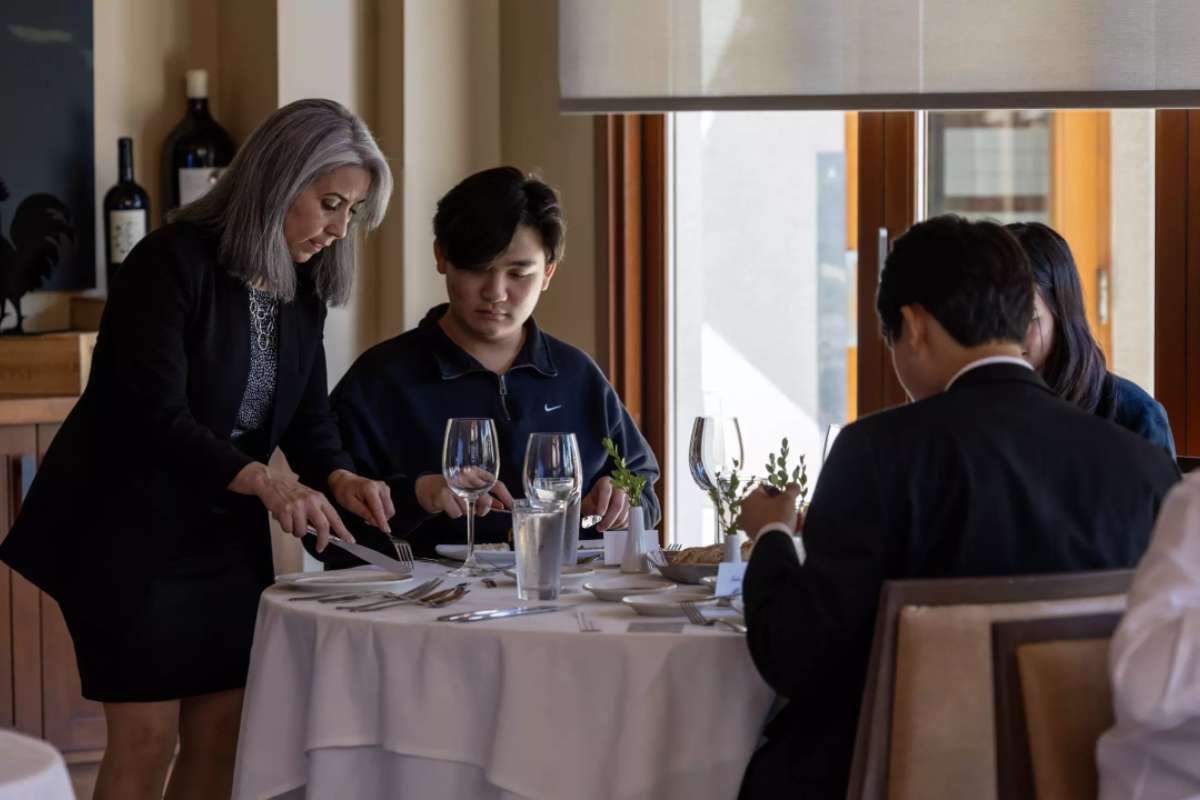
Dining etiquette acts as a silent litmus test for executive presence. In 2026, the archaic “gender-pays” rule has vanished. Modern business etiquette for women dictates that the host, the person who initiated the invitation, always pays. According to a Stanford Graduate School of Business study, 70% of senior executives believe a candidate’s dining manners directly reflect their ability to represent the firm.
➤ The Invisible Payment: To eliminate the awkward “check dance,” use the “Invisible Payment” strategy. Research shows that professionals who lead seamless business meetings are perceived as 45% more capable of handling complex, high-pressure negotiations.
- Instead of waiting for the bill to arrive and then arguing over who pays.
- Use: Provide your credit card to the server before your guest arrives, or use a mobile payment app connected to the restaurant.
➤ Table Manners as Strategy: Your focus should remain 100% on the business conversation, not the mechanics of your meal. Avoid ordering the most expensive item on the menu if you are the guest.
- Action: Avoid “difficult” foods like pasta, ribs, or oversized burgers.
5. Visual Authority: The Strategic Wardrobe

The human brain processes visual data significantly faster than intellectual data. Strategic business etiquette for women involves using your wardrobe as a tool for “Executive Presence” (EP). Sylvia Ann Hewlett, author of Executive Presence, notes that while appearance only accounts for 5% of the total EP equation, it acts as a critical filter for the other 95%.
➤ The “One Step Above” Rule: Always dress one level of formality higher than the standard for your office. This visual distinction subtly marks you as a leader rather than just another member of the staff. Data from the Center for Talent Innovation suggests that “looking the part” is often the prerequisite for being given the opportunity to “do the part.”
- Instead of: Dressing exactly like your peers to “blend in” with a casual office culture.
- Use: Adding a structured blazer or high-quality accessory to a business-casual outfit to signal a higher level of professional responsibility.
➤Quality Over Trends: Avoid overly trendy items that distract from your message. Your clothes should serve as a frame for your expertise, not the main event.
- Action: Invest in tailored pieces that fit perfectly. Poorly fitted clothing, regardless of price, can subconsciously signal a lack of attention to detail.
Decoding Dress Etiquette for Women: A Guide to Elegance and Confidence
Understanding the nuances of dress codes and etiquette not only helps you navigate various situations with ease but also boosts your confidence.
6. Networking Excellence: The 80/20 Listening Rule

Effective networking is less about the “pitch” and more about the “pivot.” The 2025 McKinsey Women in the Workplace report highlights a significant gap: women are less likely to have a sponsor compared to men. Mastering business etiquette for women during networking events turns casual contacts into career advocates by focusing on high-value engagement.
➤ The Listening Lead: Spend 80% of your time listening and 20% speaking. This positions you as a strategic thinker rather than a solicitor.
- Instead of: Launching into a 3-minute elevator pitch about your services.
- Use: Ask, “What is the biggest challenge your department is facing this quarter?”
➤ The 24-Hour Follow-Up: A business card loses its value if you don’t act within a day. A personalized LinkedIn message reinforces your professionalism.
- Action: Mention a specific point from your conversation to prove you were actively listening.
7. Conflict Resolution: The Prioritization Pivot

True authority requires the ability to set boundaries without damaging rapport. In the landmark study The No Club, researchers found that women perform 29% more “non-promotable tasks”—like note-taking or event planning- than their male colleagues. Mastering business etiquette as a woman involves using the “Prioritization Pivot” to decline these low-impact requests.
➤ The Strategic Refusal: Reframing your boundary as a commitment to organizational excellence protects your time. Data proves that professionals who successfully delegate administrative “housework” are 3x more likely to reach strategic roles.
- Instead of: “I’m sorry, I’m too busy to take the notes today.”
- Use: “I want to ensure the Q1 ROI report is perfect, so I cannot take the lead on the notes today. Who else can rotate into that role?”
➤ The Deflection Technique: When someone asks for an immediate favor that disrupts your deep work, use a time-bound alternative.
- Action: Offer a specific time later in the day to discuss the matter, maintaining your schedule while remaining helpful.
8. Navigating Gender-Neutral Professionalism

The modern office is a landscape of evolving identities. High-level business etiquette for women now requires a sophisticated understanding of gender-neutral norms. A 2024 Pew Research Center report found that 20% of Gen Z and Millennial professionals use gender-neutral pronouns or expect inclusive language in the workplace.
➤ Inclusive Honorifics The use of “Ms.” remains the professional default for women, regardless of marital status. However, many organizations now adopt “Mx.” as a gender-neutral option in HR systems.
- Instead of Using “Miss” or “Mrs.” in formal correspondence without knowing the person’s preference.
- Use: Default to “Ms.” or use the person’s full name without a title to remain neutral.
➤ Pronoun Respect Respecting a colleague’s preferred pronouns is a sign of modern professional intelligence. Inclusive leaders report 12% higher team retention and 19% higher innovation scores.
- Action: Check email signatures for pronouns before addressing a new contact.
9. Inclusion and Mentorship: The Multiplier Effect

The highest form of business etiquette for women is the active sponsorship of others. Research from Catalyst shows that women who are mentored by other women are 5 times more likely to be promoted. High-integrity leaders build social capital by lifting their team members into the spotlight.
➤ Public Praise: Always credit your team members for their ideas during meetings. This creates a culture of loyalty and enhances your reputation as a “Level 5 Leader.”
- Instead of: Saying “My team did a great job on this project.”
- Use: “Sarah’s analysis of the market trends was the catalyst for our success on this project.”
➤ Private Critique: Never deliver negative feedback in front of a group. This preserves the individual’s dignity and maintains team morale.
- Action: Schedule a private one-on-one session to discuss improvements, focusing on the behavior rather than the person.
10. Executive Presence: Mastering Gravitas

Visual authority and poise account for a significant portion of leadership perception. Sylvia Ann Hewlett, author of Executive Presence, notes that “Gravitas”—how you act and speak—is the most important pillar, accounting for 67% of the “EP” equation. Understanding business etiquette for women helps you project this calm, unshakeable confidence.
➤ Vocal Authority: Eliminate “uptalking,” which is the tendency to end sentences on a higher pitch, making them sound like questions.
- Instead of: “I think we should move forward with the merger?”
- Use: “I recommend we move forward with the merger.” (Using a steady, downward inflection at the end of the sentence).
➤ The Physical Claim: Stand tall and keep your hands visible. Hiding your hands under a table or in pockets can subconsciously signal untrustworthiness or anxiety.
- Action: Use expansive gestures to emphasize points, which lowers your cortisol and increases your testosterone (the confidence hormone).
People Also Ask (FAQ)
1. What is the “Golden Rule” of business etiquette for women?
The golden rule is “respect over ritual.” Focus on making others feel comfortable while maintaining your own authority. This balance creates a professional environment where deals can flourish.
2. How do I handle a colleague who constantly interrupts me?
Use the “bridge and continue” method. Say, “I will finish this thought, and then I’d love to hear your input.” This remains polite while asserting your right to the floor.
3. Is it still professional to use “Mrs.” in a business setting?
In professional correspondence, “Ms.” is the standard. It removes the focus from your marital status and keeps it on your professional identity.
Conclusion:
If this article feels heavier than a typical etiquette guide, that’s intentional.
Because this conversation was never really about forks, handshakes, or email sign-offs. It was always about power: who gets perceived as credible, who gets interrupted, who gets remembered, and who gets overlooked despite delivering the same results.
Business etiquette for women should not exist as a corrective lens. Ideally, it wouldn’t need to exist at all. But until workplaces evaluate authority without gendered filters, understanding these dynamics becomes a form of self-defense and strategy.
The goal is not perfection. It’s clarity.
When women understand how presence, language, boundaries, and visibility shape perception, they gain leverage without surrendering authenticity. They stop internalizing friction as personal failure and start recognizing it as structural noise. That shift alone changes how confidently someone occupies space.
What I hope this list does is not instruct but validate. Validate the exhaustion of being “almost heard.” Validate the frustration of being capable yet questioned. And most importantly, validate the right to succeed loudly, calmly, and unapologetically.
Etiquette, when stripped of tradition and moral policing, becomes something else entirely:
a tool to remove friction, reclaim authority, and move through professional spaces with intention.
And that isn’t about learning how to behave.
It’s about choosing how high you’re willing to rise, on your own terms.
References & Sources:
- https://www.princeton.edu/news/2006/08/22/snap-judgments-decide-faces-character-psychologist-finds
- https://www.mckinsey.com/capabilities/people-and-organizational-performance/our-insights/women-in-the-workplace
- https://coqual.org/wp-content/uploads/2020/09/26_executivepresence_keyfindings-1.pdf
- https://www.forbes.com/advisor/business/digital-communication-workplace
- https://journals.sagepub.com/doi/abs/10.1177/0261927X14533197