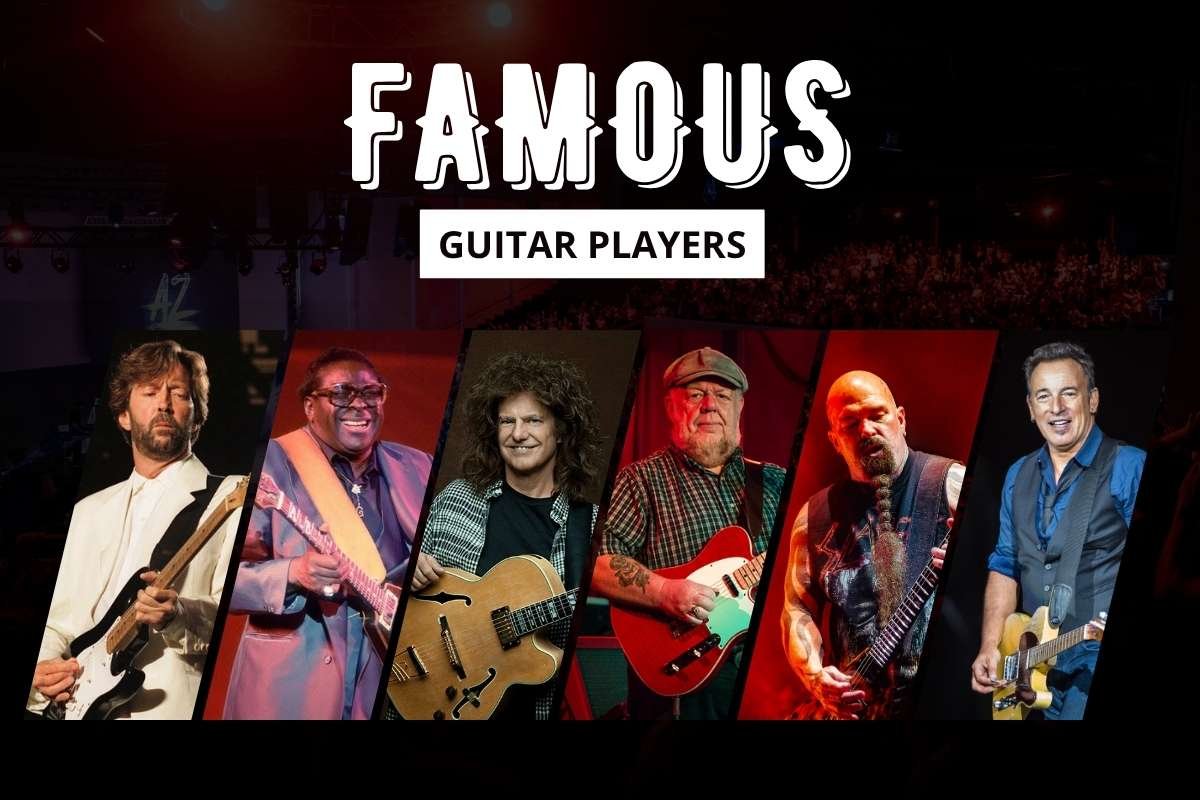
I remember the first time a specific riff actually stuck in my head for days. It wasn’t about the fame or the lights, but how those few notes seemed to understand exactly how I felt.
Most famous guitar players started just like us, stumbling over chords until something finally clicked. They turned a hobby into a way to connect with people they would never even meet.
Standing in a crowd or sitting with headphones on, you really feel that shift in the air when the music takes over. It is less about technical perfection and more about the soul behind the strings.
We follow famous guitar players because they find a way to make a piece of wood sound human. Their songs become the background noise to our own best memories. And today we will look at the 60 of them and their stories.
A Handpicked Selection of 60 Best Guitarists Who Raised the Bar Globally
To decide who is the most famous guitar players of all time. As we all know, fame can be subjective. And how do you even quantify “most famous”? It is an impossible task to undertake.
So, we have searched through each genre and checked out the best and most influential in each.
And with that, these are the most famous guitarists of all time.
| Genre | Artist | Genre/Style | Birth Date | Birthplace |
|---|---|---|---|---|
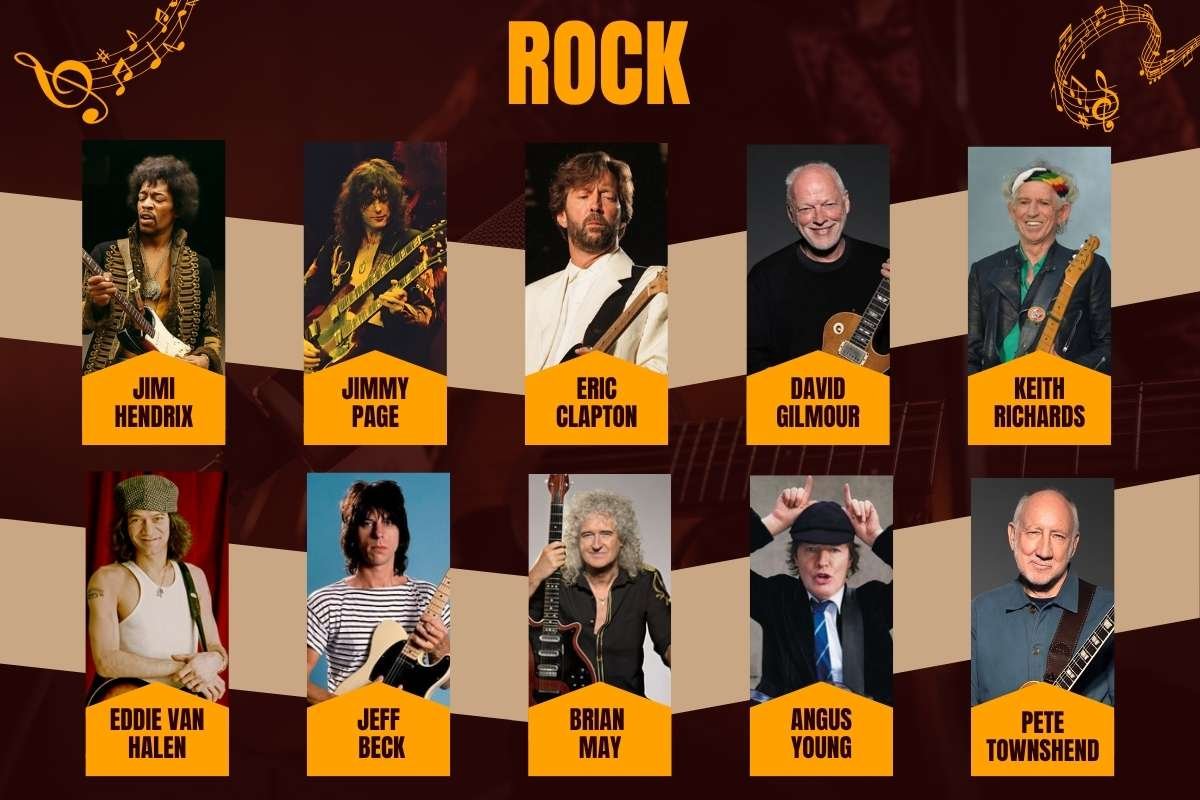
| Rock | Jimi Hendrix | Psychedelic Rock / Blues-rock | 27 Nov 1942 | Seattle, USA |
| Jimmy Page | Hard Rock / Blues-rock | 9 Jan 1944 | London, UK | |
| Eric Clapton | Blues-rock / Electric Blues | 3 Mar 1945 | Surrey, UK | |
| David Gilmour | Progressive Rock | 6 Mar 1946 | Cambridge, UK | |
| Keith Richards | Blues-rock / Rock & Roll | 18 Dec 1943 | Kent, UK | |
| Eddie Van Halen | Hard Rock / Heavy Metal | 26 Jan 1955 | Netherlands | |
| Jeff Beck | Blues-rock / Fusion | 24 Jun 1944 | Surrey, UK | |
| Brian May | Arena Rock / Pop-rock | 19 Jul 1947 | Middlesex, UK | |
| Angus Young | Hard Rock / Heavy Metal | 31 Mar 1955 | Glasgow, UK | |
| Pete Townshend | Hard Rock / Mod Rock | 19 May 1945 | London, UK | |
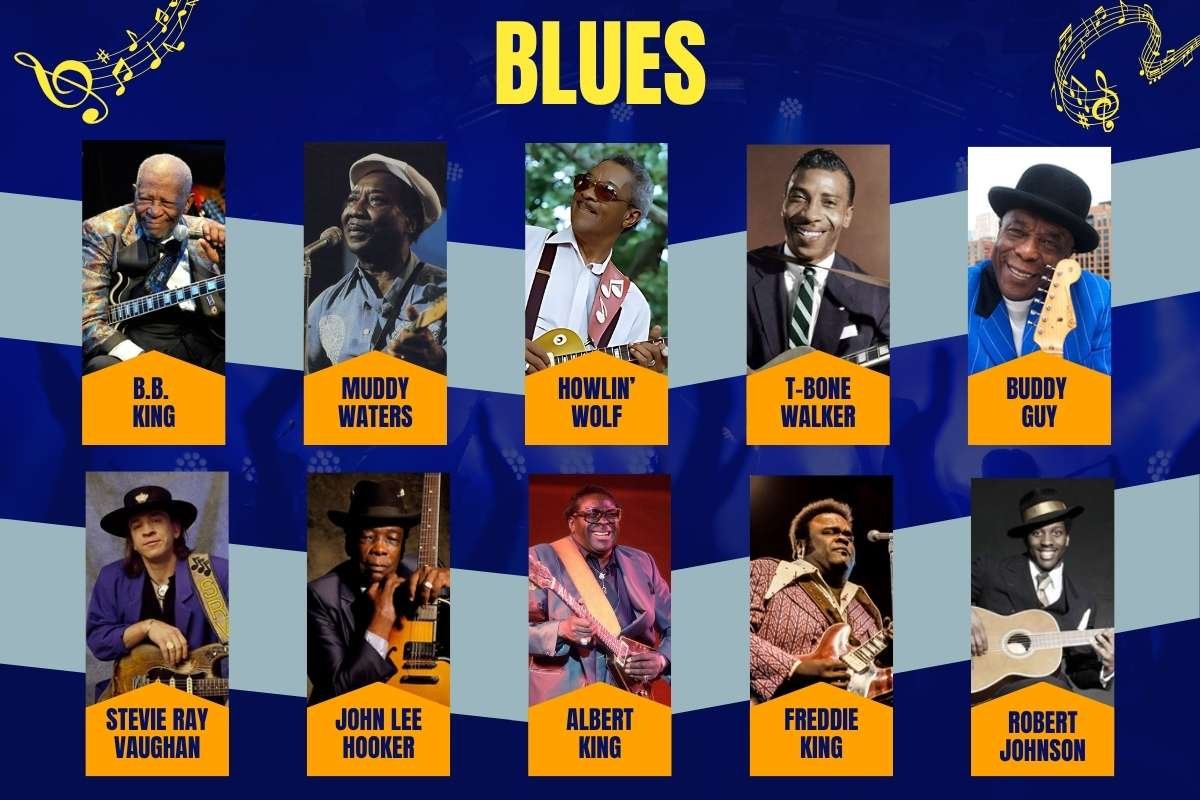
| Blues | B.B. King | Electric Blues | 16 Sep 1925 | Mississippi, USA |
| Muddy Waters | Chicago Blues | 4 Apr 1913 | Mississippi, USA | |
| Howlin’ Wolf | Chicago Blues | 10 Jun 1910 | Mississippi, USA | |
| T-Bone Walker | Texas Blues | 28 May 1910 | Texas, USA | |
| Buddy Guy | Electric Blues | 30 Jul 1936 | Louisiana, USA | |
| Stevie Ray Vaughan | Blues-rock | 3 Oct 1954 | Texas, USA | |
| John Lee Hooker | Electric Blues | 22 Aug 1917 | Mississippi, USA | |
| Albert King | Electric Blues | 25 Apr 1923 | Mississippi, USA | |
| Freddie King | Electric Blues | 3 Sep 1934 | Texas, USA | |
| Robert Johnson | Delta Blues / Country Blues | 8 May 1911 | Mississippi, USA | |
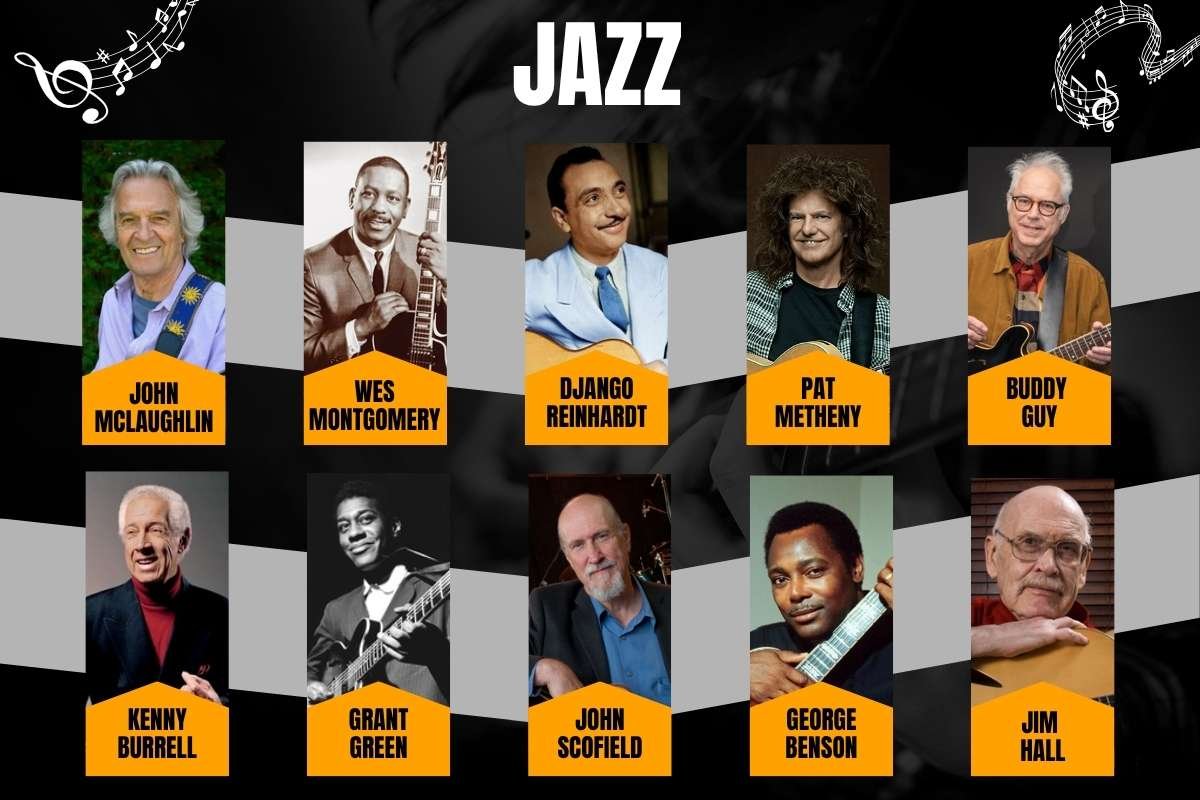
| Jazz | John McLaughlin | Fusion / Jazz-rock | 4 Jan 1942 | England, UK |
| Wes Montgomery | Hard Bop | 6 Mar 1923 | Indiana, USA | |
| Django Reinhardt | Gypsy Jazz | 23 Jan 1910 | Belgium | |
| Pat Metheny | Fusion / Jazz-rock | 12 Aug 1954 | Missouri, USA | |
| Bill Frisell | Americana / Soundtrack Jazz | 18 Nov 1951 | Maryland, USA | |
| Kenny Burrell | Hard Bop / Bebop | 31 Jul 1931 | Michigan, USA | |
| Grant Green | Hard Bop / Soul Jazz | 6 Jun 1935 | Missouri, USA | |
| John Scofield | Fusion | 26 Dec 1951 | Ohio, USA | |
| George Benson | Jazz-pop / Soul Jazz | 22 Mar 1943 | Pennsylvania, USA | |
| Jim Hall | Cool Jazz / Post-Bop | 4 Dec 1930 | New York, USA | |
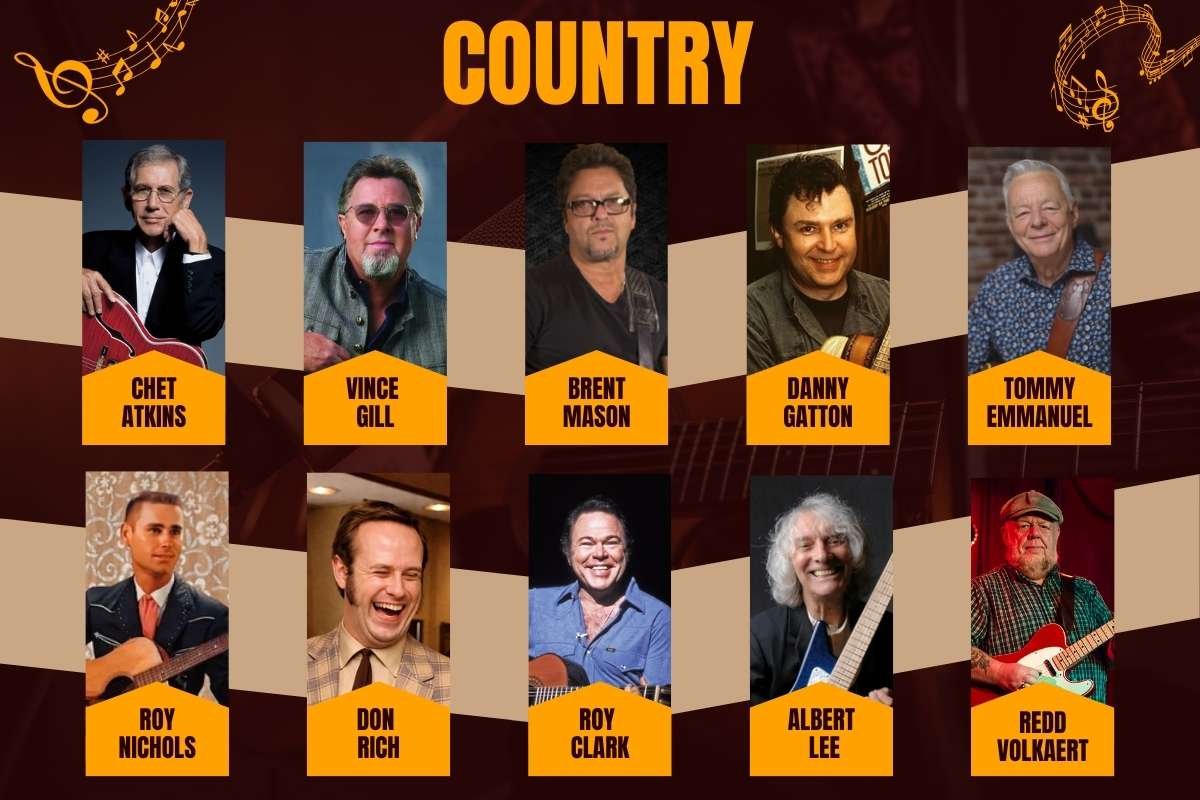
| Country | Chet Atkins | Nashville Sound / Fingerstyle | 20 Jun 1924 | Tennessee, USA |
| Vince Gill | Country-pop | 12 Apr 1957 | Oklahoma, USA | |
| Brent Mason | Session / Electric Country | 16 Aug 1959 | Tennessee, USA | |
| Danny Gatton | Rockabilly / Jazz Country | 4 Sep 1954 | Washington, D.C., USA | |
| Tommy Emmanuel | Fingerstyle / Acoustic | 31 May 1955 | Australia | |
| Roy Nichols | Bakersfield Sound | 1 Jul 1932 | California, USA | |
| Don Rich | Bakersfield Sound | 27 Feb 1941 | California, USA | |
| Roy Clark | Country-pop / Instrumental | 15 Apr 1933 | Virginia, USA | |
| Albert Lee | Country-rock / Americana | 21 Dec 1943 | England, UK | |
| Redd Volkaert | Honky-tonk | 1957 | South Dakota, USA | |
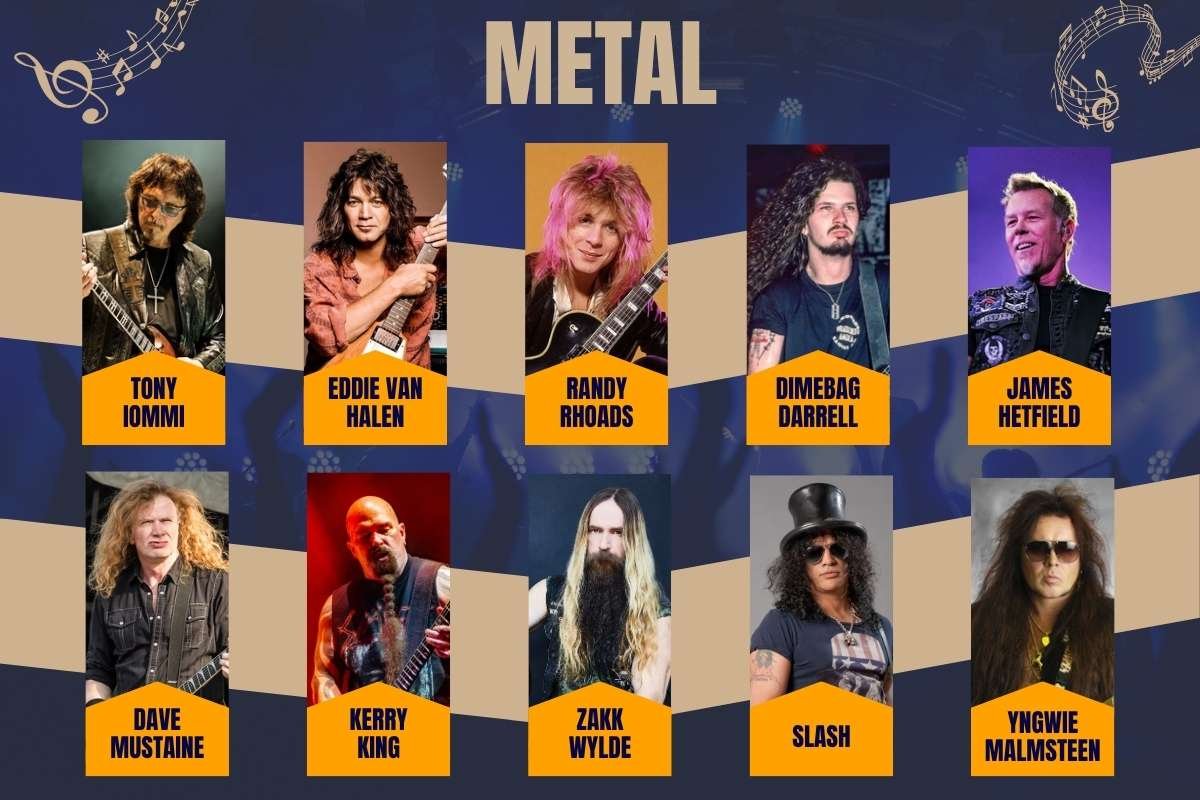
| Metal | Tony Iommi | Heavy Metal | 19 Feb 1948 | Birmingham, UK |
| Eddie Van Halen | Hard Rock / Metal | 26 Jan 1955 | Netherlands | |
| Randy Rhoads | Heavy Metal | 6 Dec 1956 | California, USA | |
| Dimebag Darrell | Groove Metal | 20 Aug 1966 | Texas, USA | |
| James Hetfield | Thrash Metal | 3 Aug 1963 | California, USA | |
| Dave Mustaine | Thrash Metal | 13 Sep 1961 | California, USA | |
| Kerry King | Thrash Metal | 30 Jun 1964 | California, USA | |
| Zakk Wylde | Heavy Metal | 14 Jan 1967 | New Jersey, USA | |
| Slash | Hard Rock / Metal-adjacent | 23 Jul 1965 | London, UK | |
| Yngwie Malmsteen | Neoclassical Metal | 30 Jun 1963 | Sweden | |
| Folk | Bert Jansch | British Folk / Acoustic | 3 Nov 1943 | Scotland, UK |
| John Renbourn | British Folk / Acoustic | 8 Aug 1944 | London, UK | |
| Nick Drake | Folk-rock / Acoustic | 19 Jun 1948 | Myanmar | |
| Richard Thompson | Folk-rock / Electric Folk | 3 Apr 1949 | London, UK | |
| Davey Graham | British Folk / Acoustic | 26 Nov 1940 | London, UK | |
| Joan Baez | Protest Folk | 9 Jan 1941 | New York, USA | |
| Bob Dylan | Folk-rock | 24 May 1941 | Minnesota, USA | |
| Woody Guthrie | Folk-protest | 14 Jul 1912 | Oklahoma, USA | |
| Pete Seeger | Folk-protest | 3 May 1919 | New York, USA | |
| Bruce Springsteen | Folk-rock | 23 Sep 1949 | New Jersey, USA |
1. Jimi Hendrix
Jimi stood on a London stage, a left-handed stranger in a suit that didn’t quite fit. He flipped his guitar upside down, ignored the rules, and started to coax sounds out of the wood that no one had ever heard. It wasn’t just noise; it was a storm of color and emotion. While many of the famous guitar players in the crowd that night watched in stunned silence, Jimi played with his teeth and behind his back.
He treated the amplifier like a living partner, using feedback to create a haunting, melodic roar. By the time he famously set his instrument on fire at Monterey, he had changed the musical landscape forever. He proved that the guitar could be a physical extension of a human soul.
Genre: Psychedelic Rock, Blues-Rock
- Won the Grammy Lifetime Achievement Award for his massive impact on the world of rock.
- Secured a spot in the Rock and Roll Hall of Fame during his first year of eligibility.
- Headlined the historic Woodstock Festival in 1969 with a legendary performance.
- Produced three of the most influential albums in history within a single three-year span.
2. Jimmy Page
Before the stadium lights and the dragon suits, Jimmy Page was a quiet session musician. He spent years in cold London studios, playing exactly what he was told for other people’s hits. But he was secretly building a vision for something much heavier and more cinematic.
When he formed Led Zeppelin, he finally let that vision breathe, using a violin bow to make his strings scream and moan. He layered acoustic folk with thunderous electric riffs, creating a “wall of sound” that felt like a punch to the chest. He turned the blues into a dark, powerful force that defined an entire era of rock.
Genre: Hard Rock, Blues-Rock, Folk-Rock
- Inducted into the Rock and Roll Hall of Fame twice, once for his work in the Yardbirds.
- Created one of the best-selling albums ever, Led Zeppelin IV, which features “Stairway to Heaven.”
- Received an OBE from the Queen for his extensive charity work and services to music.
- Recognized as a master of the studio, producing every single Led Zeppelin record himself.
3. Eric Clapton
In the mid-sixties, “Clapton is God” appeared on a London wall, but the man himself just wanted to play the blues. Eric grew up obsessed with old records from the American South, mimicking every slide and bend until his fingers bled. He moved from band to band, always searching for a deeper, more honest connection to the music.
His style was never about speed; it was about the “woman tone” and the way he could make a single note weep. Even when facing immense personal loss, he retreated into his craft to find peace. He remains a purist who turned technical skill into a raw, emotional language.
Genre: Blues, Rock
- Became the only person to be inducted into the Rock and Roll Hall of Fame three times.
- Won 18 Grammy Awards, including Record of the Year and Album of the Year for Unplugged.
- Founded the Crossroads Centre in Antigua to help people recover from addiction.
4. David Gilmour
David Gilmour didn’t join Pink Floyd to be a star; he joined to save a friend’s band. While his peers were playing fast, David chose to slow down and let the notes breathe. He would stand still on stage, bathed in circular lights, sending soaring melodies into the back of massive stadiums.
His solos feel like a conversation, shifting from a gentle whisper to a powerful shout without ever losing their grace. He mastered the art of “less is more,” proving that silence is just as important as sound. He paints vast, atmospheric landscapes using nothing but six strings and a few well-placed pedals.
Genre: Progressive Rock, Art Rock
- Co-wrote and performed on The Dark Side of the Moon, which stayed on the charts for 741 weeks.
- Inducted into the Rock and Roll Hall of Fame as a key member of Pink Floyd.
- Received a CBE for his musical achievements and his generous donations to various charities.
- Sold his massive guitar collection in 2019 to raise over 21 million dollars for the climate crisis.
5. Keith Richards
Keith Richards didn’t care about being the best technician in the room; he just wanted to find the “riff.” One night, he woke up in a hotel, recorded the opening notes of “Satisfaction” into a portable tape player, and fell back asleep. That moment defined a career built on grit and rhythm rather than flashy solos.
By removing his sixth string and tuning to an open G, he created a signature churn that became the engine of The Rolling Stones. Within the world of famous guitar players, Keith is the ultimate “human riff,” a man who lives for the groove. His longevity is a testament to the enduring power of simple, honest rock and roll.
Genre: Rock and Roll, Blues-Rock
- Wrote dozens of the most recognizable riffs in rock history for The Rolling Stones.
- Inducted into the Rock and Roll Hall of Fame in 1989 for his lifelong career.
- Published a best-selling autobiography titled Life, which won numerous literary awards.
- Performed in front of 1.5 million people during a single free concert in Rio de Janeiro.
Read More Articles:
- You Know Their Songs. But Do You Know Their Stories? Inside the Lives of Female Pop Music Stars
- 30 Best Female Rappers of All Time Who Changed Hip Hop with Power and Style
6. Eddie Van Halen
In a sunny California garage, Eddie Van Halen was busy breaking things. He didn’t like the way standard guitars felt, so he took a chainsaw and some spray paint to create the “Frankenstrat.” He practised until he could tap on the fretboard with both hands, creating a cascading sound that resembled a synthesizer more than a guitar.
When the world first heard “Eruption,” every other player had to go back to the drawing board. He brought a sense of joy and athletic skill to the completely infectious stage. He stayed a tinkerer at heart, always looking for a better way to make a noise.
Genre: Hard Rock, Heavy Metal
- Revolutionized the instrument by popularizing the “two-handed tapping” technique globally.
- Played the iconic guitar solo on Michael Jackson’s “Beat It,” helping it reach number one.
- Patented three different musical inventions, including a support device for the guitar.
7. Jeff Beck
Jeff Beck was a restless soul who hated repeating himself. After leaving the Yardbirds, he could have played safe rock hits for decades, but he chose to chase jazz and fusion instead. He eventually threw away his plectrum entirely, using his thumb and fingers to pull unique tones directly from the strings.
He could make his guitar sound like a human voice, a car engine, or a bird in flight. For those who study the lives of famous guitar players, Beck stands as the guy other professionals went to see when they wanted to be humbled. He never stopped experimenting with new technology and sounds.
Genre: Jazz Fusion, Blues-Rock, Instrumental Rock
- Won eight Grammy Awards, mostly for Best Rock Instrumental Performance throughout his life.
- Inducted into the Rock and Roll Hall of Fame twice, both as a solo artist and a band member.
- Received the Ivor Novello Award for his outstanding contribution to British music.
- Maintained a career that lasted six decades while constantly exploring brand new sounds.
8. Brian May
Brian May’s guitar started as a pile of wood from an 18th-century fireplace. He and his father spent two years carving and wiring the “Red Special” because they couldn’t afford a store-bought model. That homemade instrument gave Queen a regal, orchestral sound that no one else could match.
Brian used a metal sixpence coin instead of a pick, giving his notes a sharp, metallic “clink.” He layered his guitar parts in the studio until they sounded like a choir of angels. He managed to balance his life as an astrophysicist with his life as a stadium rock god.
Genre: Rock, Glam Rock, Hard Rock
- Built his own guitar, the “Red Special,” which he used for every Queen hit and tour.
- Performed on top of Buckingham Palace for the Queen’s Golden Jubilee in 2002.
- Earned a PhD in Astrophysics and later became the Chancellor of Liverpool John Moores University.
- Authored several books on 3D photography and the history of his homemade instrument.
9. Angus Young
Angus Young is proof that you don’t need to change your style if you get it right the first time. For over fifty years, he has stepped on stage in a schoolboy uniform, looking like a kid who just escaped detention. He plays with a frantic, high-voltage energy, duck-walking across the stage while sweating through his blazer.
His riffs are the backbone of AC/DC, built on the pure blues foundations he learned from his older brothers. He doesn’t use fancy effects; he just plugs a Gibson SG into a Marshall amp and turns it up to ten.
Genre: Hard Rock, Blues-Rock
- Led AC/DC to become one of the highest-selling bands in the history of the music industry.
- Inducted into the Rock and Roll Hall of Fame in 2003 with the rest of his bandmates.
- Created the “Highway to Hell” and “Back in Black” albums, which define the hard rock sound.
10. Pete Townshend
Pete Townshend saw the guitar as more than just a musical instrument; he saw it as a tool for a revolution. As the brains behind The Who, he wrote songs that captured the frustration and energy of British youth. He invented the “power chord,” slamming his hand down in a giant windmill motion that looked as explosive as it sounded.
He was the first to realize that smashing a guitar on stage could be a powerful piece of performance art. He is widely considered one of the famous guitar players who pushed the boundaries of what a rock band could achieve. He remains the poet laureate of rock anger.
Genre: Rock, Power Pop
- Invented the “rock opera” concept with the ambitious albums Tommy and Quadrophenia.
- Received a Tony Award for the musical adaptation of his band’s most famous story.
- Inducted into the Rock and Roll Hall of Fame and the UK Music Hall of Fame.
- Received the Kennedy Center Honors for his lifelong contribution to American culture through music.
11. B.B. King
B.B. King didn’t just play the blues; he held a conversation with his guitar, Lucille. Growing up in the Mississippi Delta, he developed a style that focused on the space between the notes. He was famous for a stinging vibrato that sounded like a human voice crying out in the night.
He played over 300 shows a year for decades, bringing his warm smile and soulful sound to every corner of the globe. Many famous guitar players point to his phrasing as the ultimate lesson in musical economy. He proved that you only need one perfect note to tell a whole story.
Genre: Memphis Blues, Electric Blues
- Received the Presidential Medal of Freedom in 2006 for his lifelong contribution to American culture.
- Inducted into both the Rock and Roll Hall of Fame and the Blues Hall of Fame.
- Won 15 Grammy Awards, including a Lifetime Achievement Award in 1987.
- Earned a place on the Polar Music Prize list, often referred to as the “Nobel Prize of Music.”
12. Muddy Waters
Muddy Waters brought the sound of the Delta to the busy streets of Chicago. He traded his acoustic guitar for an electric one so he could be heard over the noise of crowded bars. This simple change helped birth the sound of modern rock and roll.
His slide playing was raw and heavy, mimicking the deep, rhythmic pulse of the river he grew up near. He became a father figure to a whole generation of musicians who were hungry for something real. He remains a cornerstone for anyone studying the roots of famous guitar players today.
Genre: Chicago Blues, Delta Blues
- Won six Grammy Awards and received a Lifetime Achievement Award in 1992.
- Inducted into the Rock and Roll Hall of Fame in 1987, the first year he was eligible.
- Transformed the industry by moving the Mississippi Delta sound to Chicago and plugging it into an amplifier.
- Produced the Complete Plantation Recordings, which were added to the National Recording Registry for their historical importance.
13. Howlin’ Wolf
Howlin’ Wolf was a massive man with a voice that sounded like heavy gravel crunching under a boot. While he was known for his singing, his guitar work provided the jagged, rhythmic foundation for his most haunting tracks.
He moved from Mississippi to Chicago, bringing a wild, unpredictable energy to the stage that intimidated and inspired his peers. He used his instrument to create tension, often staying on a single, hypnotic riff for minutes at a time. His music felt like a force of nature that couldn’t be tamed. He showed that the blues should be felt in the gut as much as the ears.
Genre: Chicago Blues
- Inducted into the Rock and Roll Hall of Fame in 1991 for his foundational role in early rock music.
- Received a posthumous Grammy Hall of Fame Award for the song “Smokestack Lightning.”
- Honored with a U.S. Postage Stamp in 1994 as part of the American Music Legends series.
- Remained a central figure in the Blues Hall of Fame since its very first induction class in 1980.
14. T-Bone Walker
T-Bone Walker was the first person to truly show the world what an electric guitar could do. Before him, the instrument was mostly used for background rhythm. He stepped into the spotlight with a fluid, jazzy style that influenced almost everyone who followed. He was a true showman, often playing the guitar behind his head while performing acrobatic moves on stage.
His elegant tone and sophisticated chord choices bridged the gap between jazz and the blues. Among the early famous guitar players, he was the pioneer who turned the electric guitar into a lead voice.
Genre: West Coast Blues, Jump Blues
- Inducted into the Rock and Roll Hall of Fame in 1987 as an “Early Influence.”
- Won a Grammy Award for Best Ethnic or Traditional Recording in 1971 for Good Feelin’.
- Recognized as the pioneer of modern electric blues for his work in the late 1930s and early 1940s.
- Recorded “Call It Stormy Monday,” which has been inducted into the Grammy Hall of Fame for its lasting impact.
15. Buddy Guy
Buddy Guy is a living bridge between the classic Chicago blues and modern rock. Known for his wild, high-energy performances, he would often walk into the crowd with an incredibly long guitar cable. He influenced icons like Jimi Hendrix with his aggressive bends and distorted tones.
Despite his immense talent, he spent years without a record contract, playing in his own club to keep the music alive. He plays with a raw spontaneity that makes every performance feel brand new. His journey is a testament to the need to stay true to your own sound.
Genre: Chicago Blues
- Received the Presidential National Medal of Arts in 2003 for his outstanding musical career.
- Won eight Grammy Awards and was honored with a Lifetime Achievement Award in 2015.
- Inducted into the Rock and Roll Hall of Fame in 2005, presented by Eric Clapton and B.B. King.
- Honored with a Kennedy Center Award in 2012 for his influence on the American cultural scene.
16. Stevie Ray Vaughan
Stevie Ray Vaughan arrived like a lightning bolt in the 1980s, single-handedly reviving interest in the blues. He used incredibly thick strings to get a massive, bell-like tone that shook the floorboards. Watching him play was an intense experience; he poured every ounce of his physical energy into the fretboard.
He fought through deep personal struggles to reach the top of his craft, becoming a hero to millions. Even today, he is one of the most studied famous guitar players because of his technical power and deep soul. His tragic passing left a hole in the music world that has never quite been filled.
Genre: Texas Blues, Blues-Rock
- Inducted into the Rock and Roll Hall of Fame in 2015, recognizing his role in the 1980s blues revival.
- Won six Grammy Awards and ten Austin Music Awards during his career, and after his passing.
- Received five W.C. Handy Blues Awards, including Entertainer of the Year and Instrumentalist of the Year.
- Honored with a commemorative bronze statue in Austin, Texas, to celebrate his musical legacy.
17. John Lee Hooker
John Lee Hooker didn’t need a band to fill a room with sound. He used his foot to stomp out a heavy, driving beat while his guitar provided a dark, hypnotic boogie. His music was often built around a single chord, creating a trance-like atmosphere that felt ancient and modern all at once.
He had a deep, rumbling voice that perfectly matched his rhythmic, percussive style of playing. He spent years working in Detroit factories by day and playing the blues by night. He proved that a great groove is the most powerful tool a musician can have.
Genre: Delta Blues, Chugging Boogie
- Received a Grammy Lifetime Achievement Award in 2000 for his decades of influential work.
- Inducted into the Rock and Roll Hall of Fame in 1991 for his unique contribution to the genre.
- Won two Grammy Awards for his 1989 comeback album, The Healer, and the track “I’m in the Mood.”
- Awarded a star on the Hollywood Walk of Fame in recognition of his status as a global music icon.
18. Albert King
Albert King was a literal giant who played a Gibson Flying V named Lucy. Being left-handed, he played his guitar upside down and tuned it to a unique, low setting. This allowed him to pull the strings downward with incredible force, creating wide, dramatic bends that no one else could replicate.
His style was stripped-down and powerful, focusing on the emotional impact of every lick. He influenced a whole generation of blues-rockers who tried to mimic his “velvet bulldozer” sound. He remained a commanding presence on stage, proving that power often comes from simplicity.
Genre: Electric Blues, Soul Blues
- Inducted into the Rock and Roll Hall of Fame posthumously in 2013.
- Received a Grammy nomination for San Francisco ‘83 and became a permanent member of the Blues Hall of Fame.
- Created the landmark album Born Under a Bad Sign, which was inducted into the Grammy Hall of Fame.
- Honoured with a marker on the Mississippi Blues Trail, celebrating his birthplace and musical roots.
19. Freddie King
Freddie King was known as the “Texas Cannonball” because of his hard-driving style and powerful stage presence. He used plastic fingerpicks to get a sharp, aggressive attack that cut through any mix. His music blended the soul of the blues with a modern, funky edge that made people want to move.
He was one of the first bluesmen to have a multi-racial backup band, breaking down barriers through the power of his playing. His instrumentals became staples for every young musician learning how to lead a band. He lived to play, touring relentlessly until his final days.
Genre: Texas Blues, Electric Blues
- Inducted into the Rock and Roll Hall of Fame in 2012 for his impact on early rock and blues.
- Became a charter member of the Blues Hall of Fame when it was established in 1982.
- Ranked consistently been ranked as one of the most influential instrumentalists in the history of the electric guitar.
- Received the “Texas Cannonball” title for his driving, high-energy performances that crossed musical boundaries.
20. Robert Johnson
Robert Johnson is the man who started it all, a shadowy figure who reportedly sold his soul at a crossroads for his talent. He only recorded twenty-nine songs in his short life, but those tracks became the foundation of modern music. He played his acoustic guitar like a piano, keeping a steady rhythm with his thumb while playing lead lines with his fingers.
His lyrics were filled with imagery of ghosts and traveling, capturing the lonesome spirit of the Great Depression. Though he died young and in obscurity, his recordings eventually reached the ears of every legend on this list. He is the ultimate ghost in the machine for famous guitar players, a haunting reminder of where the blues began.
Genre: Delta Blues
- Inducted into the Rock and Roll Hall of Fame in 1986 as one of the most significant “Early Influences.”
- Received a Grammy Lifetime Achievement Award in 2006 for his foundational 1930s recordings.
- His album The Complete Recordings won a Grammy for Best Historical Album and sold over one million copies.
- Included in the Library of Congress’s National Recording Registry for the cultural significance of his work.
21. John McLaughlin
John McLaughlin arrived on the scene like a bolt of lightning, merging the world of jazz with the raw power of rock. He famously played with Miles Davis before forming the Mahavishnu Orchestra, where he pushed the limits of speed and spiritual depth.
His double-neck guitar became a symbol of a new era where eastern scales met western electricity. He played with a precision that seemed almost impossible, yet he never lost the emotional fire behind the notes. He showed that the instrument could be a vehicle for a higher level of consciousness.
Genre: Jazz Fusion, World Fusion
- Received the 2018 Grammy Award for Best Improvised Jazz Solo for his work on “Miles Beyond.”
- Won the 2009 Grammy Award for Best Jazz Instrumental Album with the Five Peace Band.
- Played a foundational role in the jazz-rock movement, performing on Miles Davis’s landmark albums In a Silent Way and Bitches Brew.
- Founded the Mahavishnu Orchestra and the acoustic group Shakti, merging jazz with Indian classical music and rock.
22. Wes Montgomery
Wes Montgomery never used a plastic pick; he plucked the strings with the side of his thumb to get a warm, rounded tone. This unique approach gave his music a soft, human quality that felt like a quiet conversation in a late-night club. He was a master of playing in “octaves,” a technique where he played the same note in two different pitches at once.
Even though he couldn’t read music, his natural ear allowed him to create some of the most sophisticated melodies in jazz history. He proved that a gentle touch could be just as powerful as a loud amplifier.
Genre: Hard Bop, Soul Jazz
- Won the 1967 Grammy Award for Best Instrumental Jazz Performance for the album Goin’ Out of My Head.
- Posthumously awarded a Grammy in 1969 for Best Jazz Instrumental Performance for Willow Weep for Me.
- His 1960 masterpiece, The Incredible Jazz Guitar of Wes Montgomery, was selected for preservation in the National Recording Registry.
- Popularized the octave technique, which became a defining sound for generations of players.
23. Django Reinhardt
Django Reinhardt faced a challenge that would have stopped almost anyone else: he lost the use of two fingers in a fire. Instead of giving up, he reinvented how the guitar was played, using his remaining fingers to create a lightning-fast, swinging style. He traveled across Europe in the 1930s, leading an all-string band that defined the “Gypsy Jazz” sound.
His acoustic solos were filled with joy, clever twists, and a sense of constant forward motion. Despite his physical limitations, he is one of those famous guitar players who taught the world that creativity has no boundaries.
Genre: Gypsy Jazz, Swing
- Co-founded the Quintette du Hot Club de France, creating the “Gypsy Jazz” genre.
- His original compositions, including “Nuages” and “Minor Swing,” have become permanent standards in the jazz repertoire.
- Overcame a severe hand injury to develop a completely new fingering technique that redefined technical possibilities.
- Honored with several international music awards named in his memory to celebrate his role in making jazz a global art form.
24. Pat Metheny
Pat Metheny is a musical traveler who refuses to stay in one genre for too long. Since the 1970s, he has used everything from synthesizers to a custom 42-string “Pikasso” guitar to find new sounds. His music often feels like a wide-open landscape, capturing a sense of Americana and wonder.
He has a way of making complex jazz harmonies sound accessible and hummable to the average listener. Whether he is playing a quiet acoustic ballad or a wild avant-garde piece, his voice is always recognizable. He remains a favorite for anyone following the careers of modern legends.
- Genre: Jazz Fusion, Post-Bop, Contemporary Jazz
- Holds the unique distinction of winning 20 Grammy Awards across 10 different categories, the only person to ever do so.
- Named an NEA Jazz Master in 2018, the highest honor bestowed upon a jazz musician in the United States.
- Inducted into the DownBeat Hall of Fame in 2013 as the youngest person ever to receive the honor at that time.
- Received three gold albums and has consistently topped readers’ polls for “Best Guitarist” for over three decades.
25. Bill Frisell
Bill Frisell is the master of space and atmosphere, often using pedals to make his guitar sound like a ghostly orchestra. He grew up in Colorado and brought a love for country, folk, and rock into the traditional jazz world.
He doesn’t play a lot of notes; instead, he waits for the perfect moment to let a single chord ring out and fade. This patient’s approach gives his music a dreamy feel that is entirely his own. Many of the most famous guitar players today look to his work to learn how to play with incredible restraint and taste.
Genre: Jazz, Americana, Avant-Garde
- Named an inaugural Doris Duke Artist in 2012, recognizing him as one of America’s most vital performing artists.
- Won the 2005 Grammy Award for Best Contemporary Jazz Album for Unspeakable.
- His extensive catalog was cited by DownBeat magazine as having the “best recorded output of the decade.”
- Served as a Resident Artistic Director for San Francisco Jazz and a guest curator for Lincoln Center’s Roots of Americana series.
The 20 Most Popular Female Singers Dominating Music in 2026
Meet the popular female singers defining sound and culture in 2025. This blog highlights the top 20 singers leading tours, charting hits, and driving cultural change today. Learn who is making the most significant impact right now.
26. Kenny Burrell
Kenny Burrell is the ultimate “cool” guitarist, known for a sophisticated sound that perfectly balances jazz with a deep sense of the blues. He became a staple of the New York scene in the 1950s, playing on hundreds of albums for legendary labels like Blue Note. His tone is clean and elegant, making every note sound like it was polished to a shine.
He famously collaborated with John Coltrane, proving that his understated style could hold its own next to the most intense saxophone playing. He reminds us that true style never goes out of fashion.
Genre: Hard Bop, Soul Jazz
- Named an NEA Jazz Master in 2005 for his exceptional contributions to the art of jazz.
- Received the 2010 Grammy Salute to Jazz award in recognition of his prolific career as a leader and sideman.
- Recorded 97 albums under his own name and contributed to hundreds more with legends like Billie Holiday and Dizzy Gillespie.
- Established the first regular college course on the life and music of Duke Ellington at UCLA.
27. Grant Green
Grant Green had a “linear” style, meaning he focused on playing single-note melodies that sounded more like a horn than a guitar. He moved from St. Louis to New York and quickly became one of the most recorded guitarists of the 1960s. He had a gritty, rhythmic edge that made him a favorite for funk and soul-jazz sessions.
Unlike many of his peers, he rarely used chords during his solos, preferring to let a catchy line do all the heavy lifting. Among the famous guitar players of the soul-jazz era, he was the master of finding a groove and staying in it all night.
Genre: Soul Jazz, Hard Bop
- Won the DownBeat Critics’ Poll for “Best New Star” in 1962, marking his rapid rise in the New York jazz scene.
- Recorded more sessions for Blue Note Records during the 1960s than almost any other musician on the label.
- His 1963 album Idle Moments is universally recognized by critics as a cornerstone of the soul-jazz genre.
- Became one of the most sampled guitarists in history, with his riffs forming the backbone of numerous hip-hop and acid jazz hits.
28. John Scofield
John Scofield has a “crooked” way of playing that is instantly recognizable; his notes often sound like they are slightly out of step. He spent time playing in Miles Davis’s band in the 1980s, where he learned how to blend jazz with rock and R&B.
His tone often has a bit of “dirt” on it, using a distortion pedal to bridge the gap between genres. He is a master of the “jam band” scene, bringing a high level of jazz vocabulary to a younger, rock-loving audience. He is often looked up to for his ability to stay relevant and experimental throughout a long career.
Genre: Jazz Fusion, Post-Bop, Acid Jazz
- Won three Grammy Awards, including back-to-back wins for Best Jazz Instrumental Album in 2016 and 2017.
- Awarded the French Ordre des Arts et des Lettres for his significant contributions to the arts and music.
- Received the Miles Davis Award at the Montreal International Jazz Festival for his innovations in jazz fusion and funk.
- Honored with an honorary doctorate from the Berklee College of Music for his global influence as a performer and educator.
29. George Benson
George Benson started as a child prodigy singer, but he eventually became one of the most technically gifted jazz guitarists on the planet. He has a fluid picking style that allows him to play incredibly fast lines that perfectly mirror his vocal scatting.
In the 1970s, he became a massive pop star with hits like “Breezin’,” but he never lost his deep jazz roots. He proved that you could be a commercial success without sacrificing your instrumental integrity. He is a key figure among famous guitar players who want to master the art of the melodic, hard-hitting crossover hit.
Genre: Soul Jazz, Crossover Jazz, R&B
- Won 10 Grammy Awards, including Record of the Year in 1977 for the triple-platinum hit “This Masquerade.”
- His 1976 album Breezin’ was the first jazz record in history to be certified platinum.
- Named an NEA Jazz Master in 2009 for his technical brilliance and cross-genre impact on jazz and R&B.
- Honored with a star on the Hollywood Walk of Fame to celebrate his six-decade career as a global music icon.
30. Jim Hall
Jim Hall was often called the “poet” of the guitar because of his gentle, thoughtful approach to the instrument. He treated his guitar like a member of a chamber ensemble, always looking for ways to support the other musicians rather than overshadow them. He was a master of “interaction,” listening intently and responding with subtle, clever choices.
His collaborations with Bill Evans and Sonny Rollins are considered some of the finest examples of musical telepathy ever recorded. He showed that true brilliance often speaks in a whisper and can influence generations of players.
Genre: Cool Jazz, Post-Bop
- Named an NEA Jazz Master in 2004, the first of the modern jazz guitarists to receive the award.
- Won the Danish Jazzpar Prize in 1998, an international honor often considered the highest award in jazz.
- Recorded the landmark album The Bridge with Sonny Rollins, cited as one of the most important jazz recordings of the 20th century.
- Awarded the New York Jazz Critics Circle Award for Best Jazz Composer/Arranger for his sophisticated ensemble works.
31. Chet Atkins
Chet Atkins was known as “Mr. Guitar” because he completely redefined how the instrument was played in Nashville. He used his thumb to maintain a steady bass line while his fingers picked out intricate melodies, making it sound like two people were playing at once.
As a shy kid from Tennessee, he practiced until his fingers were sore, eventually creating the smooth “Nashville Sound” that saved country music from fading away. He proved that a guitar could be as elegant and complex as a grand piano.
Genre: Country, Fingerstyle, Jazz
- Received the Grammy Lifetime Achievement Award in 1993 for his unparalleled influence on the industry.
- Inducted into the Country Music Hall of Fame, the Rock and Roll Hall of Fame, and the Musicians Hall of Fame.
- Won 14 Grammy Awards and was named the CMA Instrumentalist of the Year nine times.
- Credited as a primary architect of the “Nashville Sound,” which helped expand the global appeal of country music.
32. Vince Gill
Vince Gill is often celebrated for his soulful tenor voice, but his guitar playing is just as legendary in the music world. He has a fluid, melodic style that fits perfectly into a heartbreaking ballad or a high-speed bluegrass jam.
He grew up playing in bluegrass bands, which gave him the technical speed to keep up with anyone on a fretboard. Unlike many stars, he is just as happy being a sideman as he is being the lead singer. He makes even the most difficult solos look completely effortless.
Genre: Country, Bluegrass, Country Rock
- Won 22 Grammy Awards, holding the record for the most wins by any male country artist in history.
- Inducted into the Country Music Hall of Fame in 2007 as one of its youngest members.
- Earned 18 CMA Awards, including two trophies for the prestigious Entertainer of the Year.
- Received the BMI Icon Award and the CMA Irving Waugh Award of Excellence for his lifelong musical contributions.
33. Brent Mason
If you have listened to country radio at any point in the last thirty years, you have heard Brent Mason. He is the ultimate session musician, having played on over a thousand hit records behind the scenes in Nashville.
He is a master of the “chicken picking” style, which uses a combination of a pick and his fingers to create a snappy, percussive sound. Within the busy world of famous guitar players, Brent stands out as the one who defined the modern country sound. Every aspiring studio player studies his work to learn how to be versatile and precise.
Genre: Country, Western Swing, Jazz Fusion
- Won a Grammy Award in 2009 for Best Country Instrumental Performance for the track Cluster Pluck.
- Named the ACM Guitarist of the Year a record 12 times and the CMA Musician of the Year twice.
- Inducted into the Musicians Hall of Fame in 2019 and the Country Music Hall of Fame as a “Nashville Cat” in 2023.
- Played on over 1,000 albums and more than 2,000 top-ten hits, making him one of the most recorded musicians in history.
34. Danny Gatton
Danny Gatton was often called “the world’s greatest unknown guitarist” because his talent was almost frightening to behold. He grew up in Washington, D.C., and blended rockabilly, jazz, and country into a style he called “Redneck Jazz.”
He was famous for his “Hellecasters” technique, playing with incredible speed and using common household items such as beer bottles as slides. He didn’t care about fame as much as he cared about the mechanics of the instrument. He could play anything and make it sound like it was easy.
Genre: Rockabilly, Jazz, Country, Blues
- Received a Grammy nomination in 1991 for his critically acclaimed album 88 Elmira St.
- Recognized as the “Master of the Telecaster” by major music publications for his technical virtuosity.
- Named one of the 100 Greatest Guitarists of All Time by Rolling Stone magazine.
- Achieved legendary status for his “Redneck Jazz” style, which blended several American genres into a single sound.
35. Tommy Emmanuel
Tommy Emmanuel doesn’t just play the guitar; he uses it as a drum, a bass, and a lead instrument all at once. Born in Australia, he started touring in a family band when he was only four years old. He is a “Certified Guitar Player,” a title given to him by Chet Atkins himself, and he carries on that fingerstyle legacy with unmatched energy.
Watching him perform is a physical experience, as he taps the body of the guitar to create complex rhythms while never missing a note. He is one of the few famous guitar players who can make a single acoustic instrument sound like an entire orchestra.
Genre: Fingerstyle, Folk, Jazz
- Bestowed with the title of Certified Guitar Player (CGP) by Chet Atkins, an honor held by only a few people worldwide.
- Appointed a Member of the Order of Australia (AM) for his significant services to music and the community.
- Inducted into the Australian Roll of Renown and named “Best Acoustic Guitarist” by Guitar Player magazine multiple times.
- Won the 2024 Grammy Award for Best Arrangement, Instrumental or A Cappella for his version of “Folsom Prison Blues.”
36. Roy Nichols
Roy Nichols was the secret weapon behind Merle Haggard’s legendary band, The Strangers. He helped invent the “Bakersfield Sound,” a gritty and electric alternative to the more polished music coming out of Nashville. His style was built on clean, biting Telecaster tones and sophisticated jazz chords that gave country music a new kind of edge.
He was a quiet man who let his fingers do the talking, often playing short, punchy solos that became as famous as the lyrics themselves. He taught generations of players how to add a bit of “twang” and attitude to a song.
Genre: Country, Western Swing
- Served as the lead guitarist for Merle Haggard’s band, The Strangers, for more than two decades, contributing to 38 hit songs.
- Inducted into the Western Swing Society Hall of Fame for his pioneering work in the genre.
- Nominated for a Grammy Award in 1970 for his original composition “Street Singer.”
- Recognized as a key founder of the Bakersfield Sound, which provided a raw, electric alternative to Nashville’s polished production.
37. Don Rich
Don Rich was the musical right hand of Buck Owens and a key architect of the high-energy Bakersfield sound. His bright, “sparkling” guitar lines were the perfect match for the vocal harmonies he sang with Buck. He had a way of playing that felt like a celebration, full of double-stops and bouncy rhythms that made people want to dance.
Tragically, his life was cut short in a motorcycle accident, but his musical DNA is still found in almost every country band today. To many contemporary famous guitar players, Don remains the gold standard for blending melody with pure optimism.
Genre: Country, Bakersfield Sound
- Served as the musical director for the hit television show Hee Haw during its peak years.
- Acted as the bandleader for the Buckaroos, helping lead the group to seven CMA and ACM awards for Touring Band of the Year.
- Contributed to nearly 20 number-one hits on the country charts alongside Buck Owens.
- Performed a historic set at the White House and recorded several live albums that reached international success.
38. Roy Clark
Roy Clark became a household name as the host of the television show Hee Haw, but beneath the comedy was a world-class musician. He was a multi-instrumentalist who could play the banjo and fiddle just as well as he played the guitar. He was one of the first people to bring virtuosic instrumental playing into millions of living rooms every week.
Whether he was playing a classical piece or a lightning-fast country tune, he did it with a giant smile and incredible speed. He proved that you could be a great entertainer and a serious musician at the same time.
Genre: Country, Bluegrass, Pop
- Inducted into the Country Music Hall of Fame in 2009 for his massive impact as a performer and entertainer.
- Won the CMA Entertainer of the Year award in 1973 and was named the ACM Guitarist of the Year multiple times.
- Hosted the nationally televised variety show Hee Haw for nearly 30 years, reaching millions of viewers weekly.
- Became the first country artist to headline at the Montreux International Jazz Festival, showcasing his cross-genre skill.
39. Albert Lee
Albert Lee is often called “Mr Telecaster” because of his lightning-fast fingerstyle and his mastery of the “B-Bender” guitar. Though he was born in England, he became a pillar of the American country-rock scene, playing with legends like Emmylou Harris and Eric Clapton.
His playing is characterized by “cascading” scales that sound like a waterfall of notes. He has a unique ability to play at incredible speeds while keeping every single note crystal clear and melodic. He is a musician who is deeply loved by his peers for his humility and his relentless dedication to the craft.
Genre: Country Rock, Rock and Roll
- Won a Grammy Award in 2002 for Best Country Instrumental Performance for Foggy Mountain Breakdown.
- Named Guitar Player magazine’s “Best Country Guitarist” for five consecutive years.
- Honored with the Trailblazer Lifetime Achievement Award at the UK Americana Awards in 2017.
- Served as the musical director for the Everly Brothers’ historic reunion concert and toured with Eric Clapton for several years.
40. Redd Volkaert
Redd Volkaert is a master of the Telecaster who spent years playing for the legendary Merle Haggard. Originally from Canada, he moved to Nashville and then Austin, bringing a massive, thick tone and a wicked sense of swing to every show. He is known for his “fat” guitar sound and his ability to blend traditional country with sophisticated jazz licks effortlessly.
He often plays with a dry wit, throwing in musical quotes and surprises that keep the audience on their toes. He is frequently cited as one of the famous guitar players who keep the soul and grit of real honky-tonk music alive today.
Genre: Country, Western Swing, Jazz
- Won a Grammy Award in 2009 for Best Country Instrumental Performance as part of the “Cluster Pluck” collaboration.
- Held the prestigious lead guitar spot in Merle Haggard’s band, The Strangers, for many years.
- Recognized as a “Titan of the Telecaster” for his deep mastery of western swing and honky-tonk styles.
- Maintained a legendary 20-year residency at Austin’s Continental Club, becoming a pillar of the Texas music scene.
41. Tony Iommi
Tony Iommi didn’t just play music; he invented a whole new sound out of necessity. After losing the tips of two fingers in a factory accident, he lowered the tension of his guitar strings and used heavy distortion to make his playing easier. This accidental discovery created the dark, crushing riffs that became the foundation of heavy metal.
As the lead guitarist for Black Sabbath, he wrote the blueprints for every heavy band that followed. His story is one of incredible resilience and creativity. He proved that even a physical setback could lead to a global musical revolution that still thunders today.
Genre: Heavy Metal, Doom Metal
- Received a Grammy Award for Best Metal Performance for “God Is Dead?” with Black Sabbath.
- Inducted into the Rock and Roll Hall of Fame in 2006 for his foundational role in heavy metal.
- Honored with a star on the Birmingham Broad Street Walk of Stars in his hometown.
- Ranked as the greatest metal guitarist of all time by several leading music publications.
42. Eddie Van Halen
In a sunny California garage, Eddie Van Halen was busy breaking things to see how they worked. He didn’t like the standard guitars in stores, so he built his own “Frankenstrat” using spare parts and a chainsaw. He practiced until he could tap on the fretboard with both hands, creating a cascading sound that resembled a synthesizer more than a guitar.
When the world first heard “Eruption,” every other musician had to rethink what was possible. He brought a sense of joy and athletic skill to the completely infectious stage. He remains a favorite among those who study the evolution of famous guitar players.
Genre: Hard Rock, Heavy Metal
- Won a Grammy Award for Best Hard Rock Performance for the album For Unlawful Carnal Knowledge.
- Inducted into the Rock and Roll Hall of Fame in 2007 as a member of Van Halen.
- Holds several patents for musical instrument innovations, including the D-Tuna system.
- Voted the number one guitarist in history by a massive Guitar World reader poll.
43. Randy Rhoads
Randy Rhoads was a quiet teacher who blended the world of classical music with the volume of heavy metal. When he joined Ozzy Osbourne’s band, he brought a level of technical precision and music theory that was rare in the rock scene. He spent his days on the road seeking out local classical guitar teachers to continue his own education.
His solos were carefully composed pieces of art, full of scales that felt both ancient and modern. Though his life was cut short, he left a permanent mark on the industry. He is often cited as one of the most influential famous guitar players for his disciplined and melodic approach to “shredding.”
Genre: Heavy Metal, Neoclassical Metal
- Posthumously inducted into the Rock and Roll Hall of Fame in 2021 with the Musical Excellence Award.
- Won the “Best New Guitarist” award from Guitar Player magazine following his work on Blizzard of Ozz.
- Created the “Jackson Rhoads” guitar, which became one of the most iconic shapes in metal history.
- Honored with a star on the Hollywood RockWalk to celebrate his brief but massive career.
44. Dimebag Darrell
Dimebag Darrell was the heart and soul of the 1990s metal scene, known for his massive “Texas-sized” riffs and his love for the groove. As the guitarist for Pantera, he combined the technical flash of the 80s with a much heavier, rhythmic crunch. He was famous for his “squealing” harmonics and his ability to make a guitar sound like a roaring engine.
Beyond his talent, he was known for his legendary hospitality and his ability to make everyone in the room feel like a friend. He stayed true to his roots and never lost his passion for music. His riffs remain the gold standard for power and attitude in the metal world.
Genre: Groove Metal, Thrash Metal
- Nominated for four Grammy Awards during his career with the ground-breaking band Pantera.
- Inducted into the Hollywood RockWalk posthumously in 2007 for his impact on the genre.
- Designed the Dean Razorback and Stealth guitars, which remain top sellers for metal players.
- Regarded as the “architect of groove metal” for his unique blend of Texas blues and thrash.
45. James Hetfield
James Hetfield is the undisputed master of the “down-pick,” a technique that gives Metallica its chugging, aggressive rhythm. While many focus on solos, James proved that the rhythm guitar could be the most powerful part of the band. He used his instrument like a percussion tool, locking in with the drums to create a wall of sound that defined thrash metal.
His lyrics often explored deep, personal themes, but his right hand was the engine that drove the music forward. He showed that you don’t need to play a solo to be the center of attention on stage. He remains a primary influence for anyone learning how to write a heavy riff.
Genre: Thrash Metal, Heavy Metal
- Won nine Grammy Awards and received 24 nominations throughout his career with Metallica.
- Inducted into the Rock and Roll Hall of Fame in 2009 for his work as a songwriter and performer.
- Headlined the largest concert in history at the “Monsters of Rock” festival in Moscow.
- Received the Polar Music Prize in 2018 for his global influence on the music industry.
46. Dave Mustaine
Dave Mustaine turned his exit from Metallica into a lifelong mission to create something even faster and more complex with Megadeth. He is a technical master of the “spider riff,” a way of playing that allows him to move across the fretboard with incredible speed.
His music is characterized by intricate time signatures and aggressive, snarling vocals that match the intensity of his playing. He has a restless, perfectionist energy that has kept him at the top of the metal scene for decades. In the history of famous guitar players, Dave is respected for his uncompromising vision and his relentless work ethic. He continues to push the limits of technical thrash.
Genre: Thrash Metal, Speed Metal
- Won a Grammy Award for Best Metal Performance in 2017 for the title track of Dystopia.
- Secured 12 Grammy nominations across four decades of technical thrash metal.
- Acted as a founding member of the “Big Four” bands that defined the thrash metal movement.
- Authored a New York Times best-selling autobiography detailing his journey through the metal scene.
47. Kerry King
Kerry King is the architect of the chaotic, high-speed sound of Slayer. He favors a style that is more about raw aggression and speed than traditional melody, often using chromatic scales and dive-bombs to create a sense of pure dread. His tribal tattoos and chain-covered stage gear match the intensity of the music he writes.
He helped define the “big four” of thrash metal with a sound that never slowed down or softened for the mainstream. He remains a pillar of the extreme metal community, staying loyal to the heavy sound he helped build. His influence can be heard in every band that values speed and power above all else.
Genre: Thrash Metal
- Won two Grammy Awards for Best Metal Performance for the songs Eyes of the Insane and Final Six.
- Co-founded Slayer, one of the most influential and aggressive bands in the history of extreme music.
- Received the Golden God award at the Metal Hammer Golden Gods Awards for his career achievements.
- Achieved five gold and two platinum certifications for his work on several landmark metal albums.
48. Zakk Wylde
Zakk Wylde is a powerhouse musician who looks and plays like a Viking warrior. He first gained fame as the young guitarist for Ozzy Osbourne, where he used a signature “bullseye” guitar and a thick, pinch-harmonic style. He eventually formed Black Label Society, where he leaned even further into a heavy, southern-rock-influenced metal sound.
He is known for his massive tone and his incredibly fast, pentatonic-based solos. Despite his tough exterior, he is a dedicated student of the guitar who often practices for hours every day. He is a key name among famous guitar players who blend traditional blues feel with modern metal intensity.
Genre: Heavy Metal, Southern Rock
- Won the 2024 Grammy Award for Best Metal Performance for his work on “72 Seasons” with Metallica.
- Named “Most Valuable Player” by Guitar World magazine for three consecutive years.
- Received the “Golden God” award at the Revolver Golden Gods Ceremony in 2010.
- Inducted into the Hollywood RockWalk for his contributions as a solo artist and long-time sideman.
49. Slash
Slash became a global icon by bringing the raw spirit of the 70s back to the 80s hair-metal scene. With his signature top hat and low-slung Les Paul, he revitalized the image of the “guitar hero” as someone cool, mysterious, and incredibly melodic. His work with Guns N’ Roses is defined by bluesy, soaring solos that people can actually sing along to.
He values the “soul” of a note over the speed of the playing, often taking his time to build tension in a song. He has survived the ups and downs of the rock and roll lifestyle while staying dedicated to his craft. He remains one of the most recognizable figures in music history.
Genre: Hard Rock, Blues-Rock
- Won a Grammy Award for Best Hard Rock Performance for the hit song “Slither.”
- Inducted into the Rock and Roll Hall of Fame in 2012 for his work with Guns N’ Roses.
- Received a star on the Hollywood Walk of Fame in 2012 for his status as a global icon.
- Honored with the Kerrang! Icon Award for his massive influence on the rock and roll lifestyle.
50. Yngwie Malmsteen
Yngwie Malmsteen arrived from Sweden with a mission to merge the speed of the guitar with the complexity of classical violin. He pioneered the “neoclassical” style, using scalloped fretboards to allow for faster playing and wider bends. He famously stated that “more is more,” often playing incredible flurries of notes that left audiences in disbelief.
He treats the guitar like a high-performance machine, pushing it to its absolute physical limits. While his style is polarizing, his technical influence is undeniable. He showed a whole generation of musicians that the guitar could reach the same levels of virtuosity as the finest classical instruments.
Genre: Neoclassical Metal, Power Metal
- Received a Grammy nomination for Best Rock Instrumental Performance for the album Rising Force.
- Inducted into the Swedish Music Hall of Fame in 2015 as a pioneer of neoclassical metal.
- Honored with his own signature Fender Stratocaster, one of the first artists to receive this distinction.
- Ranked among the top 10 fastest shredders of all time by nearly every major guitar publication.
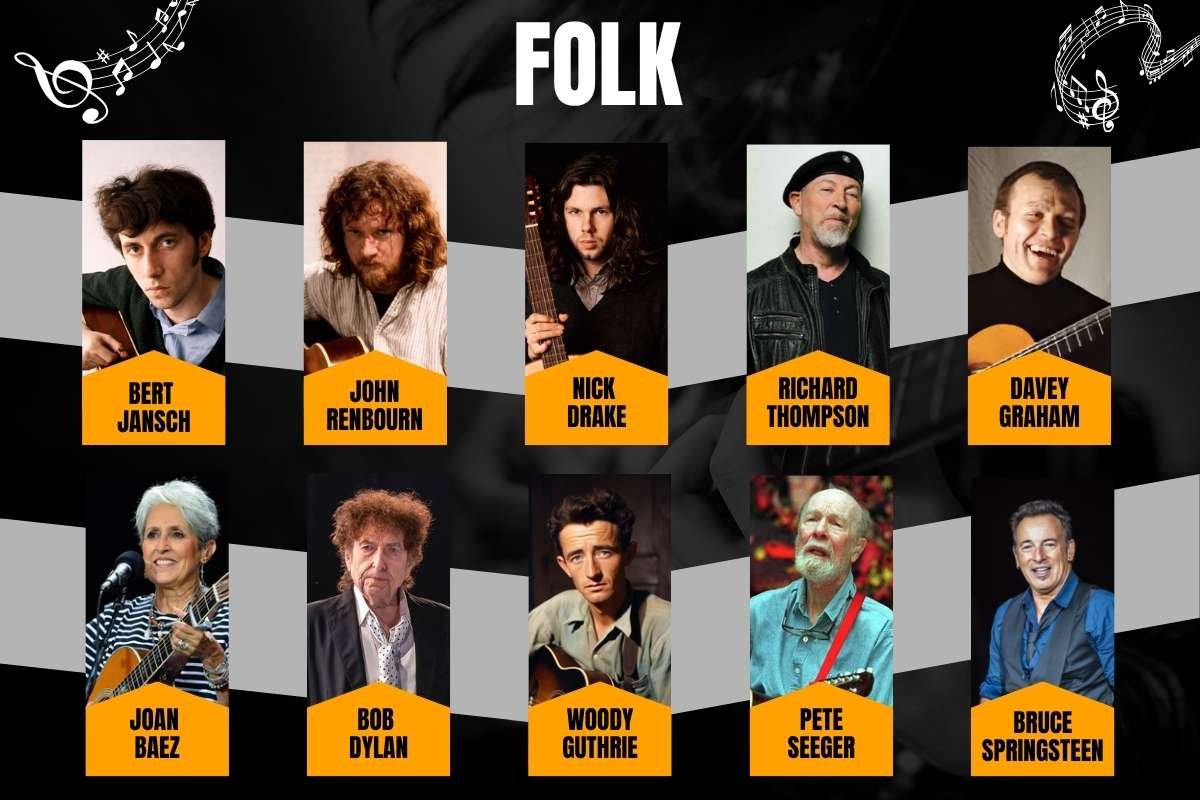
51. Bert Jansch
Bert Jansch was a quiet force who transformed the British folk scene by blending traditional tunes with a touch of jazz and blues. He played with a percussive, claw-hammer style that made his acoustic guitar sound like a living thing. Many fellow musicians would crowd around him just to see how he picked out such complex patterns while keeping a steady rhythm.
He co-founded the band Pentangle, bringing a sophisticated, almost classical edge to folk music. His influence is felt in every player who picks up an acoustic guitar to find something deeper than just chords. He showed that folk could be both ancient and incredibly modern.
Genre: Folk, Folk-Rock, Blue
- Received the Lifetime Achievement Award at the BBC Radio 2 Folk Awards in 2001.
- Honored with the MOJO Merit Award in 2006 for his massive impact on the British music scene.
- Co-founded Pentangle, a band that achieved major chart success and defined the folk-baroque sound.
- Cited as a primary inspiration by icons such as Neil Young, Jimmy Page, and Johnny Marr.
52. John Renbourn
John Renbourn was a musical explorer who loved the sounds of the medieval and Renaissance periods. He often collaborated with Bert Jansch, and together they created a “folk-baroque” style that featured intricate, interlocking guitar parts. John had a gentle, precise touch that made his instrument sound like a lute or a harpsichord from another century.
He wasn’t afraid to mix old English carols with American jazz, creating a bridge between different cultures and eras. For those who study the history of famous guitar players, Renbourn is a masterclass in elegance and musical curiosity. He turned the acoustic guitar into a time machine.
Genre: Folk, Medieval, Jazz
- Received a Grammy nomination in 1988 for Best Traditional Folk Recording for The Ship of Fools.
- Honored with the Lifetime Achievement Award at the BBC Radio 2 Folk Awards in 2003.
- Co-authored several influential instructional books that became the standard for acoustic fingerstyle.
- Performed on dozens of high-charting albums that bridged the gap between medieval and modern jazz.
53. Nick Drake
Nick Drake was a shy, poetic soul who recorded three haunting albums before his life ended far too soon. He used strange, open tunings that gave his music a shimmering, ethereal quality that felt like a quiet autumn afternoon. His fingerpicking was incredibly intricate, yet it sounded effortless and soft, providing the perfect bed for his whispered vocals.
For a long time, his work was largely ignored, but later generations discovered the pure magic in his recordings. He is now celebrated as one of the famous guitar players who could capture a specific mood with just a few well-placed notes. His music remains a secret treasure for many.
Genre: Folk, Chamber Folk
- His 1972 album Pink Moon was inducted into the Grammy Hall of Fame for its lasting cultural value.
- Ranked consistently on the “500 Greatest Albums of All Time” lists by major music publications.
- Achieved massive posthumous success with his catalog, reaching gold and platinum status decades after its release.
- Recognized as a foundational figure for the indie-folk and chamber-pop genres worldwide.
54. Richard Thompson
Richard Thompson is often called a “musician’s musician” because of his incredible skill on both the acoustic and electric guitar. As a founding member of Fairport Convention, he helped create the sound of British folk-rock by mixing traditional melodies with rock energy. He has a unique picking style that involves using a flat pick and his fingers simultaneously, allowing him to play complex rolls and drones.
His solos often take unexpected, jagged turns that keep the listener on the edge of their seat. He remains a powerful songwriter and a tireless performer who continues to influence new generations of players around the world.
Genre: Folk-Rock, British Folk
- Received the Ivor Novello Award for his outstanding contribution to British music as a songwriter.
- Appointed an Officer of the Order of the British Empire (OBE) for his services to the industry.
- Won the Lifetime Achievement Award from the Americana Music Association in 2006.
- Named one of the top 20 guitarists of all time by Rolling Stone magazine in their global rankings.
55. Davey Graham
Davey Graham was a restless traveler who changed the world of folk music when he introduced the “DADGAD” tuning. This specific way of tuning the guitar allowed him to play melodies that sounded like the traditional music of Morocco or India.
He was a pioneer of the “world music” concept long before it had a name, blending blues, jazz, and eastern scales into a single performance. Every folk player who uses an alternate tuning today owes a debt to his adventurous spirit. He showed that the guitar was a universal language that could cross any border or ocean.
Genre: Folk, World, Blues
- Invented the “ADGAD” guitar tuning, which became the standard for modern Celtic and world music.
- Recorded the 1965 album Folk, Blues and Beyond, cited as a cornerstone of the British folk revival.
- Received the BBC Radio 2 Folk Awards’ Lifetime Achievement Award in 2005.
- Recognized for creating “Anji,” one of the most covered acoustic instrumentals in history.
56. Joan Baez
Joan Baez became the “Queen of Folk” in the 1960s, using her powerful, operatic voice to sing songs of protest and social change. While her vocals often took center stage, her steady and rhythmic acoustic guitar playing provided the essential foundation for her message. She had a clear, bright picking style that allowed the lyrics to shine through while keeping a strong, driving beat.
She was a key figure in the civil rights movement, standing on the front lines and using her music as a peaceful weapon. Within the community of famous guitar players, she is respected for her ability to lead a crowd with nothing but six strings.
Genre: Folk, Americana
- Received the Grammy Lifetime Achievement Award in 2007 for her decades of musical excellence.
- Inducted into the Rock and Roll Hall of Fame in 2017 for her massive influence on folk-rock.
- Honored with the 2020 Kennedy Center Honors for her contribution to American culture.
- Played a historic set at the 1969 Woodstock Festival and was a central figure in the 1960s protest movement.
57. Bob Dylan
Bob Dylan arrived in New York with a borrowed guitar and a suitcase full of stories, eventually becoming the voice of a generation. He didn’t aim for technical perfection; instead, he used his guitar as a rhythmic engine for his world-changing lyrics.
Whether he was playing a gentle acoustic ballad or famously “plugging in” at the Newport Folk Festival, he always prioritized the feeling of the song. He showed the world that a guitar player could be a poet, a prophet, and a rock star all at once. His influence on songwriting and performance is so massive that it is almost impossible to measure.
Genre: Folk, Folk-Rock, Rock
- Awarded the Nobel Prize in Literature in 2016 for creating new poetic expressions within the American song tradition.
- Won 10 Grammy Awards and received a Lifetime Achievement Award in 1991.
- Received the Presidential Medal of Freedom in 2012, the highest civilian honor in the United States.
- Inducted into the Rock and Roll Hall of Fame in 1988 during his first year of eligibility.
58. Woody Guthrie
Woody Guthrie was a traveler who walked across America during the Great Depression, writing songs for the working class. He famously painted the words “This Machine Kills Fascists” on his guitar, viewing his music as a tool for justice and equality. His style was simple and direct, built on steady strums and honest melodies that anyone could learn and sing along to.
He wrote thousands of songs, including “This Land Is Your Land,” which became an unofficial anthem for the country. He is an inspiration for many famous guitar players who believe that music should serve a higher social purpose.
Genre: Folk, Country
- Posthumously awarded a Grammy Lifetime Achievement Award in 2000 for his foundational work.
- Inducted into the Rock and Roll Hall of Fame in 1988 as an “Early Influence.”
- His song “This Land Is Your Land” was added to the National Recording Registry for its historic importance.
- Honored with a star on the Hollywood Walk of Fame and his own museum in Tulsa, Oklahoma.
59. Pete Seeger
Pete Seeger was a man who believed in the power of the sing-along to bring people together. He was a master of the banjo and the twelve-string guitar, using his instruments to lead massive crowds in songs of peace and environmental conservation. He spent his life traveling the world, collecting traditional songs and sharing them with anyone who would listen.
He was often blacklisted for his political views, but he never stopped singing or playing for what he believed in. He proved that a simple melody could be a powerful way to build a community and spark a movement.
Genre: Folk, World
- Won three Grammy Awards and was honored with a Lifetime Achievement Award in 1993.
- Received the National Medal of Arts in 1994 for his dedication to the arts and social justice.
- Honored with a Kennedy Center Award in 1994 to celebrate his impact on American culture.
- Inducted into the Rock and Roll Hall of Fame in 1996 for his role in the folk-rock transition.
60. Bruce Springsteen
Bruce Springsteen, known as “The Boss,” uses his guitar to tell the stories of everyday people working hard to get by. His performances are legendary for their length and intensity, often lasting over three hours as he leads the E Street Band through a high-energy rock show. While he is a massive rock star, his roots are deeply buried in the folk tradition of storytelling and acoustic performance.
He can command a stadium with a wall of electric sound or hush a crowd with a single acoustic guitar and a harmonica. He remains a symbol of the enduring power of the American dream and the grit of the working man.
Genre: Rock, Heartland Rock, Folk
- Won 20 Grammy Awards and received two Golden Globes for his work in film and music.
- Inducted into the Rock and Roll Hall of Fame in 1999 for his massive career with the E Street Band.
- Received the Presidential Medal of Freedom in 2016 for his contribution to the arts.
- Won an Academy Award for Best Original Song for “Streets of Philadelphia” in 1994.
Conclusion:
Whether they played on a massive stage or in a quiet room, these artists changed how we hear the world. They took six strings and turned them into a universal language that spans generations and genres.
The stories of these famous guitar players remind us that music is about more than just notes; it is about the soul and passion behind every strum.
While their styles vary from the blues to heavy metal, they all share a common thread of dedication to their craft. Their influence continues to inspire anyone who picks up an instrument for the very first time.
As you listen to your favorite tracks, you can hear the lasting legacy left by these famous guitar players. Their songs remain the heartbeat of our collective musical history.
FAQs
1. What makes a guitar player truly famous?
Most people agree that a mix of unique technical skill, a signature sound, and the ability to write memorable songs creates a lasting legacy.
2. Which genre has produced the most iconic guitarists?
Rock and blues are typically the genres most associated with guitar icons, though jazz and country have contributed many of the world’s finest technicians.
3. Who is considered the famous guitar player of all time?
While it is a matter of personal taste, many fans and critics often name Jimi Hendrix as the most influential figure among famous guitar players.
Thank You For Reading!
See More
How these 42 Iconic ‘80s Outfits Shaped Pop Culture; And Why You Need to Know Them?