“Whenever, wherever, we’re meant to be together.”
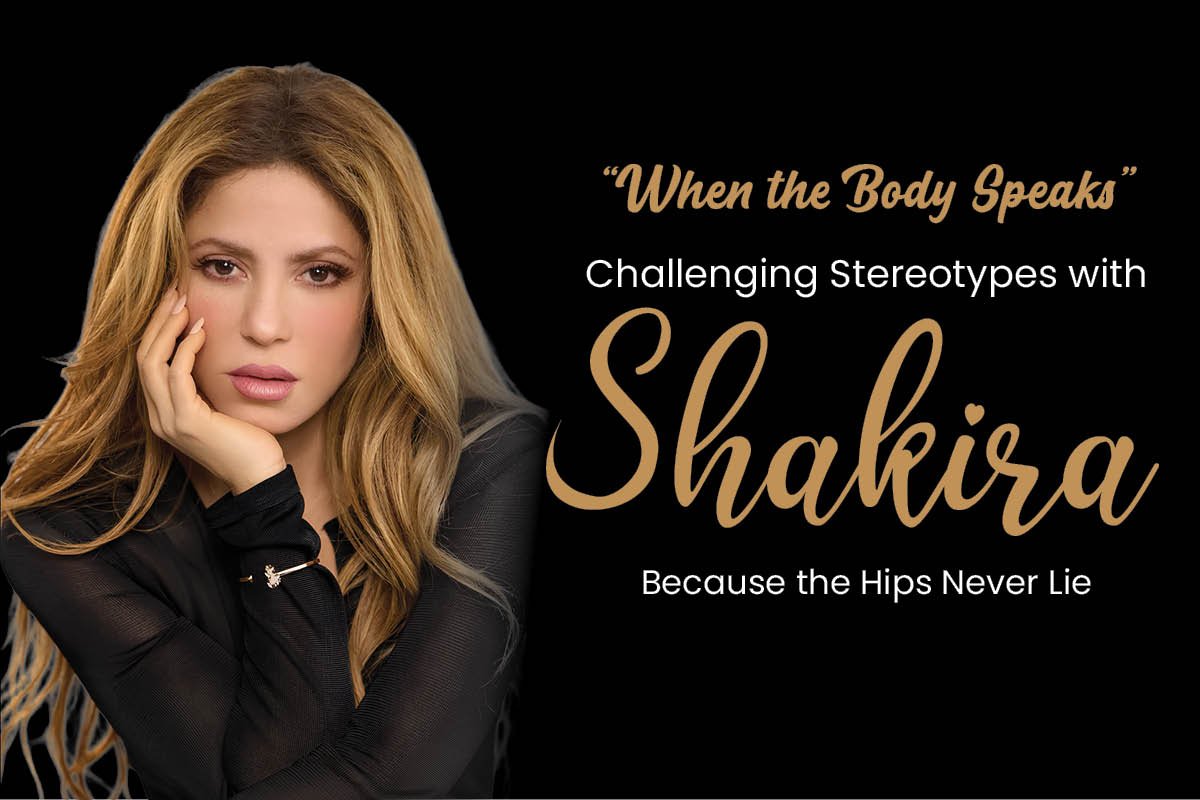
Few artists have lived that lyric as completely as Shakira Isabel Mebarak Ripoll; wherever culture moves, she arrives as a force rather than a guest.
For over three decades, Shakira has done more than survive the entertainment industry; she has bent it. In an industry that often demands reinvention at the expense of authenticity, she has managed to remain unmistakably herself while evolving with precision, intelligence, and intent. Today, she stands as a global pop icon and a symbol of female resilience, strategic reinvention, and influence that extends far beyond music.
The road from Barranquilla to the world- hips, hearts, and heritage
“Underneath your clothes there’s an endless story.”
Sounds playful, right? But what sounded playful was, in hindsight, an early assertion of agency.
Born in Barranquilla, Colombia, to a Lebanese father and a Colombian mother, Shakira grew up in a household shaped by migration, music, and memory. She wrote her first song at eight, signed her first record deal as a teenager, and faced early commercial failure before most artists ever tasted success. Instead of folding, she recalibrated.
Her breakthrough albums, Pies Descalzos and Dónde Están los Ladrones? positioned her as a serious songwriter, political, emotional, and fiercely individual. When she later crossed into English-language pop with Laundry Service, she didn’t dilute her identity to fit global markets. She carried it with her.
Shakira didn’t assimilate. She translated culture on her own terms.
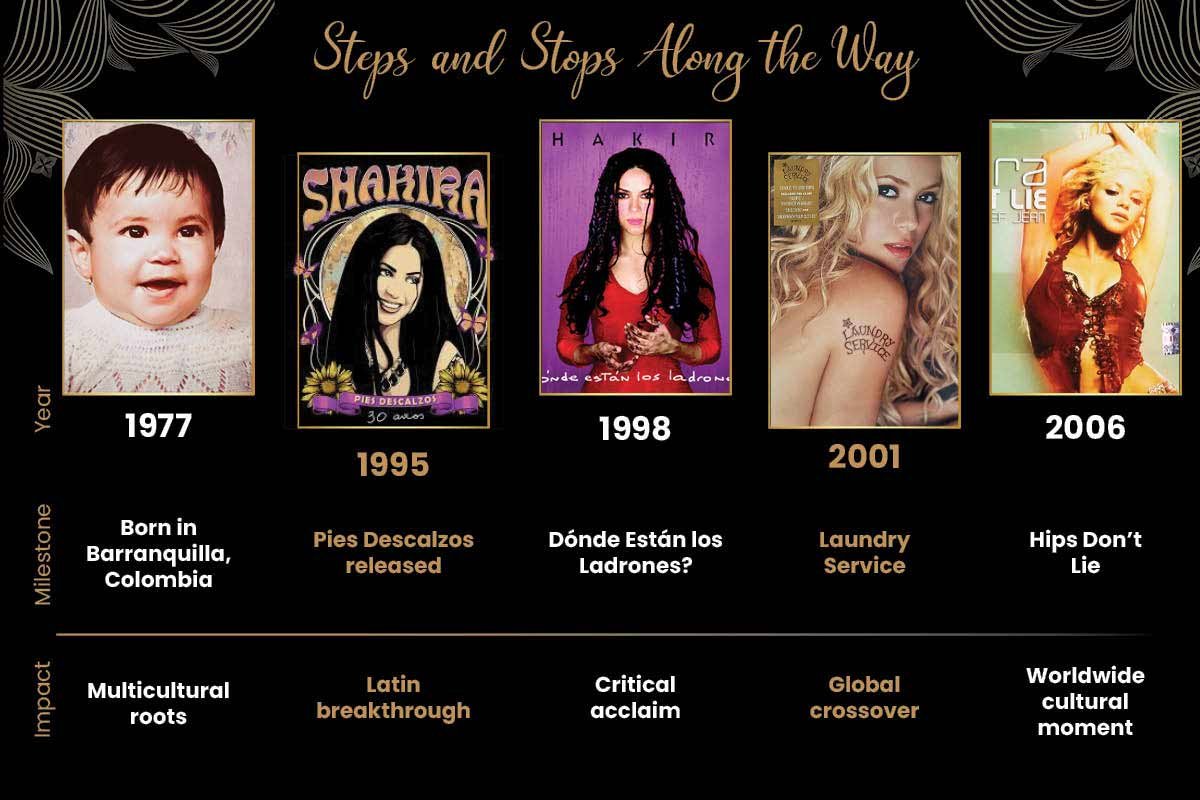
| Steps and Stops Along the Way | ||
|---|---|---|
| Year | Milestone | Impact |
| 1977 | Born in Barranquilla, Colombia | Multicultural roots |
| 1995 | Pies Descalzos released | Latin breakthrough |
| 1998 | Dónde Están los Ladrones? | Critical acclaim |
| 2001 | Laundry Service | Global crossover |
| 2006 | Hips Don’t Lie | Worldwide cultural moment |
“I NEVER REALLY KNEW SHE COULD DANCE LIKE THIS”– Reinvention Without Erasure
The world learned quickly and kept learning.
Shakira’s career is defined by controlled evolution across eras. Rock-inflected vulnerability transitioned into global pop dominance, later merging with reggaeton, electronic experimentation, and deeply personal storytelling. Each shift reflected cultural change alongside personal growth.
Her achievements are historic: multiple Grammy and Latin Grammy Awards, over 95 million records sold, one of the most-watched Super Bowl halftime performances of all time, and consistent relevance across three decades. But her most radical achievement may be this: she never disappeared to be rediscovered.
At a point when the industry often sidelines women, Shakira returned sharper, more self-authored, and economically clear-eyed. “Women don’t cry anymore, women cash in,” she sang, turning vulnerability into ownership and heartbreak into autonomy.
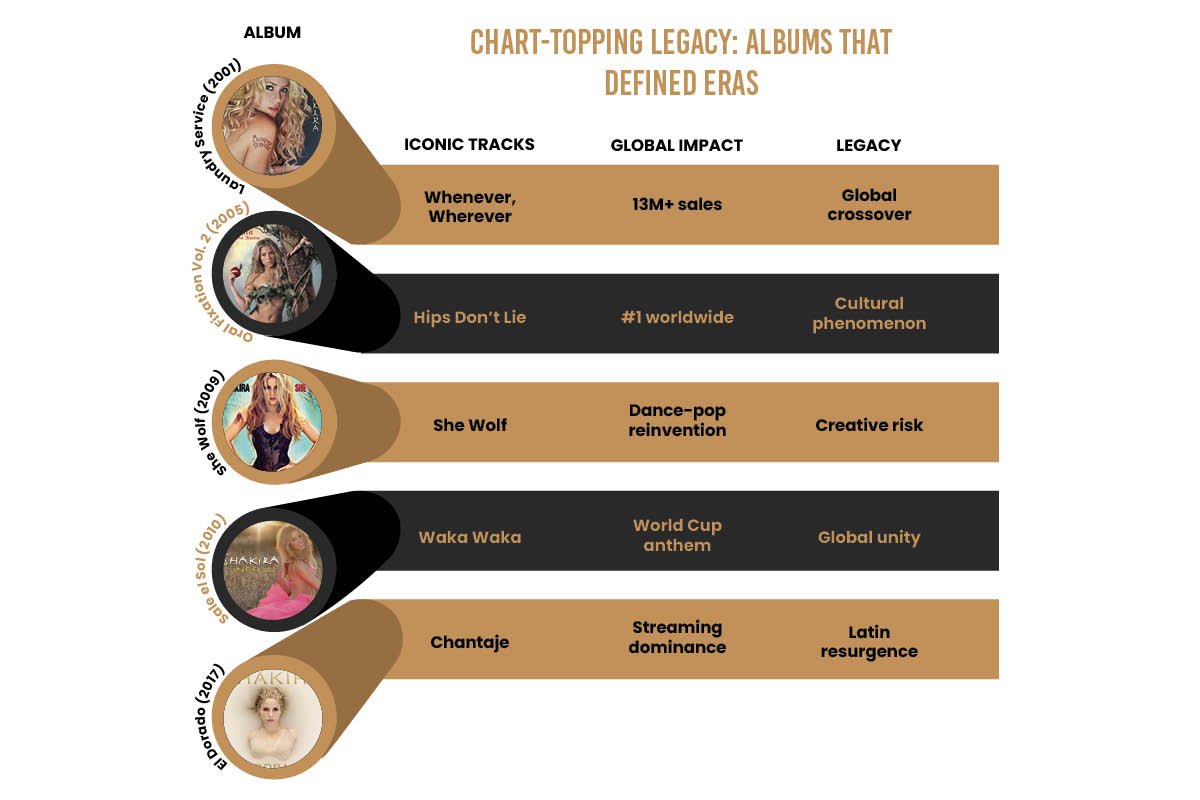
| Chart-Topping Legacy: Albums That Defined Eras | |||
|---|---|---|---|
| Album | Iconic Tracks | Global Impact | Legacy |
| Laundry Service (2001) | Whenever, Wherever | 13M+ sales | Global crossover |
| Oral Fixation Vol. 2 (2005) | Hips Don’t Lie | #1 worldwide | Cultural phenomenon |
| She Wolf (2009) | She Wolf | Dance-pop reinvention | Creative risk |
| Sale el Sol (2010) | Waka Waka | World Cup anthem | Global unity |
| El Dorado (2017) | Chantaje | Streaming dominance | Latin resurgence |
Education is and as power – the purpose beyond performance (PBP)
“Try everything.”
Shakira did, but she also built institutions.
In 1997, long before celebrity philanthropy became fashionable, she founded the Barefoot Foundation (Fundación Pies Descalzos) to support education, nutrition, and infrastructure for children in Colombia’s most underserved communities. This wasn’t symbolic charity; it was a structural intervention.
The foundation has built and supported schools serving thousands of children, integrating education with community development. Shakira’s advocacy earned her the role of UNICEF Goodwill Ambassador, where she works at a policy level, pushing early childhood education as a global economic and social imperative.
She doesn’t speak about education as compassion alone but as a strategy. Invest early, or pay later. It’s a message she has delivered at global forums, including addresses to world leaders.
Shakira’s Humanitarian Impact.
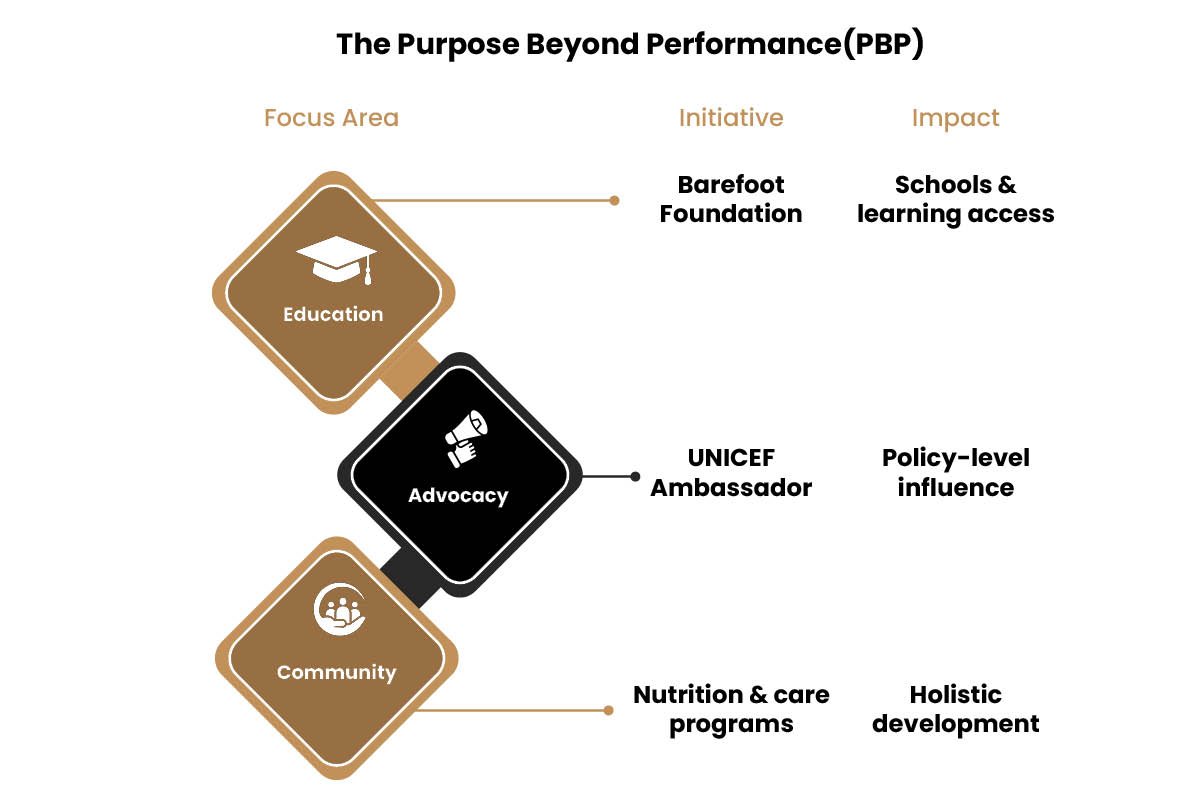
| The Purpose Beyond Performance(PBP) | ||
|---|---|---|
| Focus Area | Initiative | Impact |
| Education | Barefoot Foundation | Schools & learning access |
| Advocacy | UNICEF Ambassador | Policy-level influence |
| Community | Nutrition & care programs | Holistic development |
Influence without noise: politics through policy
Shakira’s political presence is measured rather than performative. She avoids partisan spectacle and social-media theatrics, choosing instead to exert influence where it compounds over time: education reform, child welfare advocacy, and international policy dialogue. Her authority does not come from slogans, but from sustained engagement and credibility earned across decades.
She has met heads of state, addressed global institutions such as the United Nations and the World Economic Forum, and repeatedly argued that education, especially for girls, is the most effective long-term economic intervention a society can make. Shakira frames education as infrastructure: a system that determines labor participation, health outcomes, and intergenerational mobility.
What distinguishes her approach is fluency. She speaks the language of policymakers as comfortably as she speaks to fans, grounding her advocacy in research, economic reasoning, and lived experience. She understands that influence is most powerful when it reshapes frameworks rather than headlines.
At a time when celebrity politics often relies on outrage or alignment, Shakira’s restraint is radical. She demonstrates that women do not need to raise their voices to raise standards, and that clarity, when paired with consistency, travels farther than volume.
Feminine power, fully integrated
“There’s a she-wolf in disguise coming out tonight.”
The disguise, perhaps, was ever thinking she needed one.
Shakira embodies a femininity that refuses to be simplified. She is sensual without apology, intellectual without detachment, maternal without disappearance, and ambitious without justification. She dances, negotiates, advocates, and reinvents all without asking permission.
Her career dismantles the industry myth that women must choose between relevance and depth, between beauty and authority, between emotion and intelligence. Shakira insists on all of it.
A legacy still in motion

Shakira built more than a career; she cultivated cultural fluency. She invited global audiences to listen across languages, move with unfamiliar rhythms, and recognize identity as layered rather than fixed. Years before “globalization” turned into a marketing trope, she practiced it in real time.
Her legacy resists nostalgia and refuses confinement to any single phase. Relevance, for her, comes from continuity in the discipline of growth without repetition. Each chapter extends the one before it, adding depth rather than erasure. That sustained relevance defines endurance, not survival-driven reinvention.
More importantly, her influence extends beyond charts and stages. It lives in classrooms built, policies influenced, and narratives reshaped about what women, especially women from the Global South, can achieve without surrendering their complexity.
And perhaps that is her greatest achievement of all:
She didn’t just make the world dance.
She taught it how to endure.
Thank You For Reading!
See More
Rihanna: Hits, Empires, and the Billion-Dollar Legacy Beyond Music