
It’s almost 2:00 a.m., and your mind is still working. Your body lies still, but your thoughts stay busy. You replay conversations, mentally rewrite tomorrow’s to-do list, and feel a quiet pressure in your chest that no amount of scrolling can distract away. Nothing is technically wrong. And yet, everything feels heavy. You’re tired, yet somehow alert. Calm feels close, but never quite reachable.
For many women, this has become normal.
Stress today rarely arrives as one dramatic breaking point. It builds slowly through expectations, emotional labor, and the pressure to stay strong without showing strain. Over time, your body learns to stay “on,” even when nothing is wrong.
That’s why real Stress-Relief Techniques for Women need to feel realistic and not idealistic. They must work within full schedules, changing hormones, and busy minds.
This guide draws from science, psychology, and real-life patterns to help you ease stress where it actually lives: your nervous system, your routines, and your thoughts—so calm starts feeling possible, again.
The Female Biology of Burnout
Women process stress differently due to the complex interplay between cortisol and estrogen. While cortisol prepares the body for “fight or flight,” estrogen modulates how the brain handles fear and anxiety. When estrogen levels fluctuate during menstrual cycles, pregnancy, or menopause, your sensitivity to stressors increases.
Research from the Cleveland Clinic notes that women often experience physical manifestations of stress that men do not, such as severe migraines, irregular menstrual cycles, and a higher incidence of Irritable Bowel Syndrome (IBS). Chronic activation of the HPA (Hypothalamic-Pituitary-Adrenal) axis can lead to autoimmune issues and reproductive challenges.
“It’s not stress that kills us; it is our reaction to it.”
Hans Selye, Father of Stress Research.
By mastering specific Stress-Relief Techniques, you effectively “reprogram” your nervous system to return to a state of calm.
Top 4 Science-Backed Stress-Relief Techniques for Women to Reclaim Your Calm
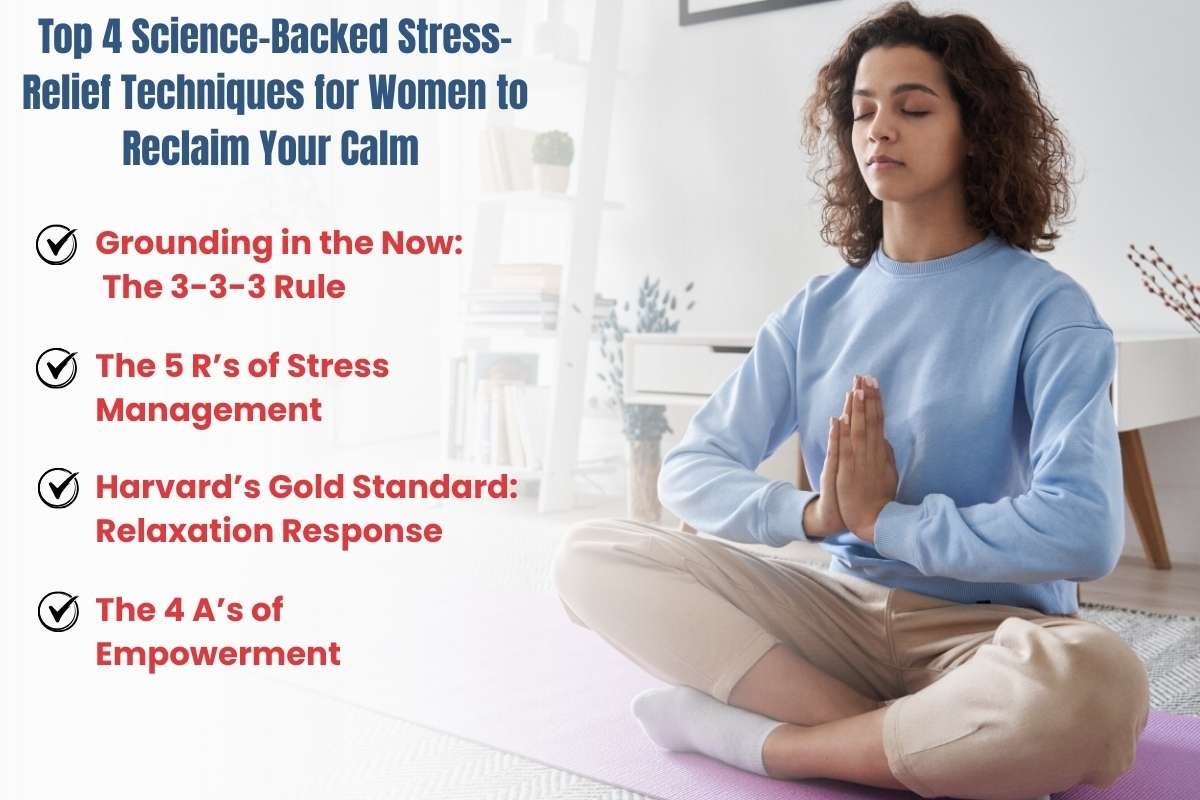
1. Grounding in the Now: The 3-3-3 Rule
When anxiety spirals, you lose touch with the physical world. The 3-3-3 rule serves as an immediate “emergency brake” for your nervous system. This technique forces your brain to shift from internal ruminations to external sensory input.
- See: Identify three objects around you (e.g., a blue pen, a green leaf, a coffee mug).
- Hear: Listen for three distinct sounds (e.g., the hum of the fridge, a distant car, your own breathing).
- Move: Activate three different body parts (e.g., roll your shoulders, wiggle your toes, circle your wrists).
This simple sequence breaks the feedback loop of the amygdala, providing a fast-acting cognitive reset.
Read More: What Women Need to Know About Coping with Anxiety?
2. The 5 R’s of Stress Management
To move from survival to stability, many clinical psychologists recommend the 5 R’s framework. This structured approach helps you reorganize your life to prevent future burnout.
| The “R” | Actionable Step | Benefit |
| Refuel | Prioritize nutrient-dense foods and hydration. | Stabilizes blood sugar and mood. |
| Resolve | Identify and eliminate the root cause of one recurring stressor. | Reduces the mental load. |
| Relax | Practice deep breathing or meditation for at least 5 minutes. | Lowers heart rate and blood pressure. |
| Release | Engage in physical movement to “burn off” excess cortisol. | Releases feel-good endorphins. |
| Reorganize | Declutter your physical workspace or digital life. | Improves focus and reduces anxiety. |
Integrating these Stress-Relief Techniques for Women into your weekly routine ensures that minor irritations don’t snowball into major health crises.
3. Harvard’s Gold Standard: Relaxation Response
Harvard Health highlights six powerful relaxation techniques that trigger the “relaxation response,” the physical opposite of the stress response.
- Breath Focus: Practice long, slow, deep breaths while mentally disengaging from distracting thoughts.
- Body Scan: Mentally traverse your body, noticing areas of tension and consciously releasing them.
- Guided Imagery: Close your eyes and visualize a “safe place”—a beach, a forest, or a childhood memory, focusing on the sensory details.
- Mindfulness Meditation: Sit comfortably and focus on the present moment without judgment.
- Yoga and Tai Chi: These practices combine rhythmic breathing with physical postures to improve “Heart Rate Variability” (HRV), a key marker of resilience.
- Repetitive Prayer: For those with a spiritual practice, silently repeating a short prayer or mantra can anchor the mind and induce calm.
4. The 4 A’s of Empowerment
Sometimes, you cannot change the situation, but you can change your response. Help Guide suggests the 4 A’s to help you manage unavoidable stressors.
- Avoid: Learn to say “no.” Avoid people or environments that consistently drain your energy.
- Alter: Communicate your needs clearly. If a task feels overwhelming, ask for help or suggest a different approach.
- Adapt: Reframe the problem. Ask yourself, “Will this matter in five years?”
- Accept: Some things are beyond your control. Practice forgiveness and move on rather than dwelling on the uncontrollable.
Protecting Your Heart: Why It Matters?
High stress levels aren’t just an emotional burden; they are a cardiac risk. Johns Hopkins Medicine warns that chronic stress raises blood pressure and heart rate, which, over time, increases the risk of stroke and heart attacks. Younger women with a history of heart issues must be particularly vigilant.
Women often experience “stress cardiomyopathy” (Broken Heart Syndrome) at higher rates than men. Regular physical activity, such as walking or dancing, serves as a natural mood lifter that also strengthens the cardiovascular system.
Natural and Quick Stress-Relief Tactics

When you only have two minutes between meetings, try these immediate Stress-Relief Techniques for Women:
- Eat Dark Chocolate: A small square of dark chocolate regulates cortisol levels and stabilizes metabolism.
- The Power of Scent: Light a lavender candle or use essential oils. Your olfactory system connects directly to the emotional centers of your brain.
- Cuddle a Pet: Interacting with animals boosts oxytocin and eases the “sting” of social rejection.
- Squeeze a Stress Ball: Physical tension release through your hands can instantly calm a pounding heart.
- Cold Water Splash: Splashing cold water on your face stimulates the vagus nerve, forcing your body to slow down your heart rate.
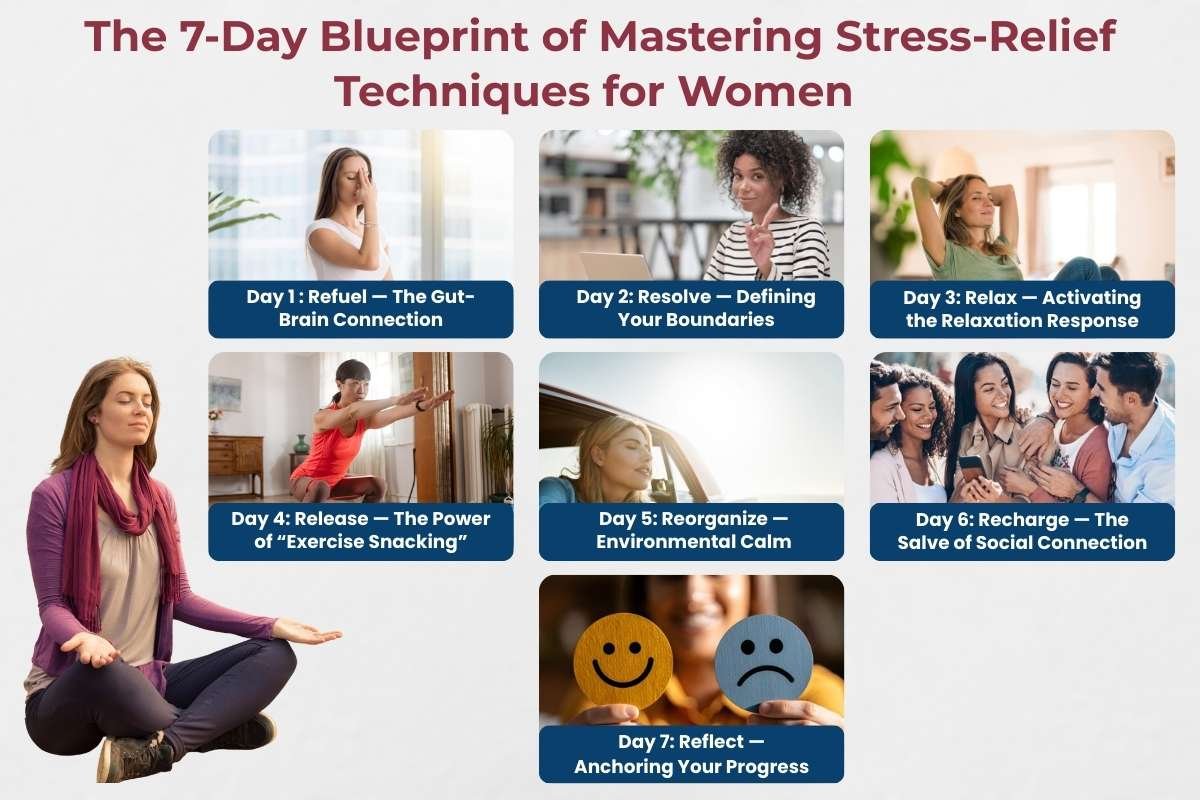
The 7-Day Blueprint of Mastering Stress-Relief Techniques for Women
In 2026, the term “stress” feels inadequate to describe the high-velocity cognitive load women carry. You don’t just feel tired; you feel wired. This constant biological pressure demands more than occasional self-care. It requires a systematic, evidence-based intervention.
Data from the American Psychological Association (APA) indicates that women report significantly higher stress levels than men, with 68% of women citing “the future of the nation” and “financial stability” as primary triggers. To combat this, you need a structured plan. This 7-day blueprint integrates the most effective Stress-Relief Techniques for Women into your actual life, transforming your biology from the inside out.
The Physiology of the Female Stress Response
Before you can fix the problem, you must understand your hardware. Women possess a unique hormonal feedback loop. When stress hits, the hormone oxytocin mixes with estrogen to drive a “tend-and-befriend” response. While this builds community, it also leads to “compassion fatigue” if you don’t set boundaries. Chronic high cortisol levels eventually suppress estrogen, leading to the “Superwoman Burnout” characterized by brain fog, weight gain, and sleep disruption.
Research from the Mayo Clinic highlights that consistent movement and mindful breathing are the fastest ways to lower systemic cortisol. By using the following Stress-Relief Techniques for Women, you reclaim your hormonal balance.
Day 1: Refuel — The Gut-Brain Connection
Your nervous system starts in your gut. Approximately 90% of your serotonin, the “calm” neurotransmitter, resides in your digestive tract. Today, you focus on stabilizing your internal environment.
- Morning Anchor: Start with Nadi Shodhana (Alternate Nostril Breathing) for 5 minutes. This ancient practice balances the left and right brain hemispheres and reduces immediate anxiety.
- Nutritional Shift: Eliminate inflammatory processed sugars. Opt for “brain foods” like walnuts, blueberries, and fatty fish.
- Expert Opinion: “The gut-brain axis is the highway of stress. If the gut is inflamed, the mind cannot find peace,” notes nutrition expert Dr. Elizabeth Boham.
By choosing nutrient-dense foods, you apply the first of many Stress-Relief Techniques for Women to your daily routine.
Day 2: Resolve — Defining Your Boundaries
Burnout often stems from “dangerous overcommitment.” Today, you use the 4 A’s of Stress Management (Avoid, Alter, Adapt, Accept) to audit your schedule.
- The Audit: Identify one recurring task that drains you. Can you avoid it by saying no? Can you alter it by delegating?
- The Midday Reset: Practice the 3-3-3 rule. Identify three things you see, three things you hear, and move three body parts. This breaks the “mental loop” of a stressful workday.
- Evening Task: Clear your digital space. Unsubscribe from high-stress news alerts and social media accounts that trigger comparison.
Day 3: Relax — Activating the Relaxation Response
Harvard Health research suggests that the “relaxation response” serves as the physical opposite of the fight-or-flight reflex. Today, you train your body to find its “pause” button.
- Progressive Muscle Relaxation (PMR): Before bed, tense and then release every muscle group, starting from your toes and moving to your jaw. This systematic release flushes physical tension from the fascia.
- Guided Imagery: Spend 10 minutes visualizing a “safe space.” Research shows that the brain processes vivid visualization similarly to real-world experience, lowering blood pressure instantly.
Mastering these Stress-Relief Techniques allows you to fall asleep faster and improve the quality of your REM cycles.
Day 4: Release — The Power of “Exercise Snacking”
In 2026, we have moved past the “hour-at-the-gym” requirement. New studies from the CDC advocate for “exercise snacking”—short, 10-minute bursts of movement throughout the day.
- Morning: 5 minutes of dynamic stretching or yoga (Cat-Cow and Child’s Pose).
- Afternoon: A 10-minute brisk walk in nature. Sunlight exposure helps regulate your circadian rhythm, making you more resilient to stressors later in the evening.
- The Result: These short bursts lower cortisol by approximately 8–12% per session.
Integrating movement into small windows makes these Stress-Relief Techniques for Women sustainable for even the busiest professional.
Day 5: Reorganize — Environmental Calm
Your physical environment reflects your mental state. A cluttered desk or home creates “visual noise” that keeps the brain in a state of low-level alarm.
- The 15-Minute Declutter: Choose one area; bedside table, your car, or your inbox. Clear it.
- Sensory Sovereignty: Use aromatherapy. Lavender, bergamot, and sandalwood have clinically proven effects on the limbic system, reducing the perception of stress.
- Tech Break: Implement a “Digital Sunset.” Turn off all screens 60 minutes before bed to prevent blue light from suppressing your natural melatonin production.
Day 6: Recharge — The Salve of Social Connection
Isolation amplifies stress. As social animals, women find profound relief in meaningful connection. However, this day isn’t about “networking”—it’s about “play.”
- Connection: Call a friend for a non-work-related conversation. Johns Hopkins experts emphasize that supportive relationships powerfully promote resilience.
- The “Play” Factor: Engage in a hobby with zero productivity goals. Whether it’s painting, dancing in your kitchen, or playing with a pet, “analog play” regulates the nervous system.
Shared laughter serves as one of the most effective, yet underrated, Stress-Relief Techniques for Women.
Day 7: Reflect — Anchoring Your Progress
The final day focuses on “Reflecting” to ensure these habits stick. You move from “doing” to “being.”
- Gratitude Journaling: Write down three specific things that went well this week. This “rewires” the brain’s negativity bias, forcing you to scan for the positive.
- The 4-8 Breathing Technique: Practice deep belly breathing; inhale for 4 seconds, hold for 4, and exhale for 8. This activates the vagus nerve, the “on-switch” for your body’s recovery system.
Overcoming the “Self-Care Guilt”
Many women hesitate to implement these Stress-Relief Techniques for Women because they feel selfish. The data suggests the opposite is true. When you manage your stress, your cognitive empathy increases, your decision-making sharpens, and your physical health improves.
According to a 2025 study, women who practiced daily mindfulness for eight weeks showed a 23% increase in productivity and a 30% reduction in reported burnout symptoms. You aren’t just helping yourself; you are becoming a more effective leader, parent, and partner.
Building Your Personal Resilience Toolkit
Effective stress management requires a multifaceted approach. Use the table below to select the right tool for your current situation.
Stress Management Tool Selection
| Situation | Best Technique | Why it Works |
| Acute Panic/Anxiety | 3-3-3 Rule | Immediate sensory grounding. |
| Persistent Worry | Journaling / CBT | Challenges the accuracy of worried thoughts. |
| Physical Tension | Progressive Muscle Relaxation | Systematically releases stored body stress. |
| Burnout/Exhaustion | The 4 A’s & “Me Time” | Restores boundaries and energy reserves. |
| Relationship Stress | Social Connection | Talking through issues provides new perspectives. |
The Role of Nutrition and Sleep

You cannot meditate your way out of a poor diet or chronic sleep deprivation. Women need roughly 7–9 hours of quality sleep to regulate the hormones that govern stress.
Avoid relying on alcohol, caffeine, or smoking as coping mechanisms. While they provide temporary relief, they ultimately increase systemic inflammation and make the underlying problem worse. Instead, focus on a diet rich in Omega-3 fatty acids and magnesium, which support brain health and muscle relaxation.
Conclusion:
Stress doesn’t fade just because life slows down. It fades when your body feels safe enough to rest.
Every technique shared here serves that purpose. The most effective Stress-Relief Techniques for Women don’t ask you to change who you are or overhaul your life. They fit into small moments like before sleep, between tasks, during pauses you already have.
Think back to the version of you lying awake at night, wondering why rest feels so hard. She isn’t failing. Her nervous system simply hasn’t had the chance to reset.
With steady practice, stress loosens its grip. Your thoughts settle. Your energy returns in quieter, steadier ways. Over time, calm becomes familiar again.
Peace doesn’t arrive all at once.
It grows slowly, gently, each time you choose to take care of yourself without guilt.
FAQ:
Q: Can these techniques help with hormonal shifts like menopause?
A: Absolutely. Techniques like deep breathing and consistent movement help stabilize the autonomic nervous system, which can mitigate the intensity of hot flashes and mood swings associated with hormonal fluctuations.
Q: I don’t have 15 minutes. What is the one thing I should do?
A: Use the 3-3-3 rule. It takes less than 60 seconds and can be done anywhere—in a meeting, in your car, or while making dinner. It is the “MVP” of Stress-Relief Techniques for Women.
Q: Is “stress-eating” always bad?
A: Not necessarily. If you choose foods high in magnesium (spinach, almonds) or dark chocolate, you actually support your body’s chemical needs during high-stress periods. The key is intentionality rather than mindless consumption.
References & Scientific Citations
To ensure you receive the most accurate and trustworthy information, we have compiled the research, clinical studies, and expert data cited in this guide. These sources validate the effectiveness of the Stress-Relief Techniques for Women discussed above.
- https://www.deloitte.com/content/dam/assets-shared/docs/collections/2025/deloitte-women-at-work-2025-a-global-outlook.pdf?dlva=1
- https://www.cignaglobal.com/blog/thought-leadership/cigna-healthcare-vitality-study-2023
- https://my.clevelandclinic.org/health/articles/5545-women-and-stress
- https://pmc.ncbi.nlm.nih.gov/articles/PMC1361287
- https://www.helpguide.org/mental-health/stress/stress-management
- https://www.healthline.com/health/333-rule-anxiety
- https://www.cdc.gov/physical-activity-basics/guidelines/adults.html