

When we talk about the early stages of almost every major business decision, whether it’s a startup chasing its first round of funding or a corporation weighing a billion-dollar acquisition, there’s always a document that determines the outcome.
It doesn’t get headlines. It isn’t presented with flair. But it matters more than most things in the room. It’s a financial model.
On paper, the answer to what are financial models sounds straightforward: structured representations of a company’s financial performance, built using data and assumptions. But in reality, they do something far more practical and far more human. They help people make decisions when the future is still uncertain.
Because no matter how experienced a founder or how seasoned an executive, every big move comes down to the same challenge: making a call without knowing exactly how things will unfold.
Financial models don’t eliminate that uncertainty. But they give it shape. They turn instinct into something measurable, and in doing so, they make risk feel a little less like a gamble.
Introduction to Financial Modeling
Most people view finance as a rearview mirror, a way to see where the money went through accounting. Financial modeling flips the car around. It uses the past to illuminate the windshield, allowing leaders to steer through uncertainty with quantified confidence. It is the bridge between a raw, ambitious idea and a funded, operational reality. When we strip away the jargon, we find that this discipline is about creating a sandbox where we can test every possible future before it happens.
What is Financial Modeling?
To define the concept at its core, what are financial models? They are numerical representations of some or all aspects of a company’s operations. Think of a model as a sophisticated “what-if” machine built in software like Excel. It takes historical data, integrates educated assumptions about the future, and spits out a forecast of financial performance. According to the Corporate Finance Institute, a professional model summarizes a company’s expenses and earnings so planners can calculate the impact of a future event or decision. It is a translation of business strategy into the language of mathematics.
Why Financial Modeling is Important?
Modern business leaders do not make multi-million dollar bets on “gut feelings” anymore. Decisions require a rigorous “stress test” that only a model can provide.
- Capital Raising: Investors demand to see a three-statement model before they wire funds. They need to see how their capital creates a return.
- Risk Mitigation: Models reveal the “break-even” point where a project starts losing money, allowing managers to pivot before a crisis hits.
- Strategic Planning: Companies use models to decide whether to launch a new product, enter a new market, or acquire a competitor.
- Valuation: You cannot sell a business if you cannot prove what its future cash flows are worth today. Financial models provide the evidence for that price tag.
Key Components of a Financial Model
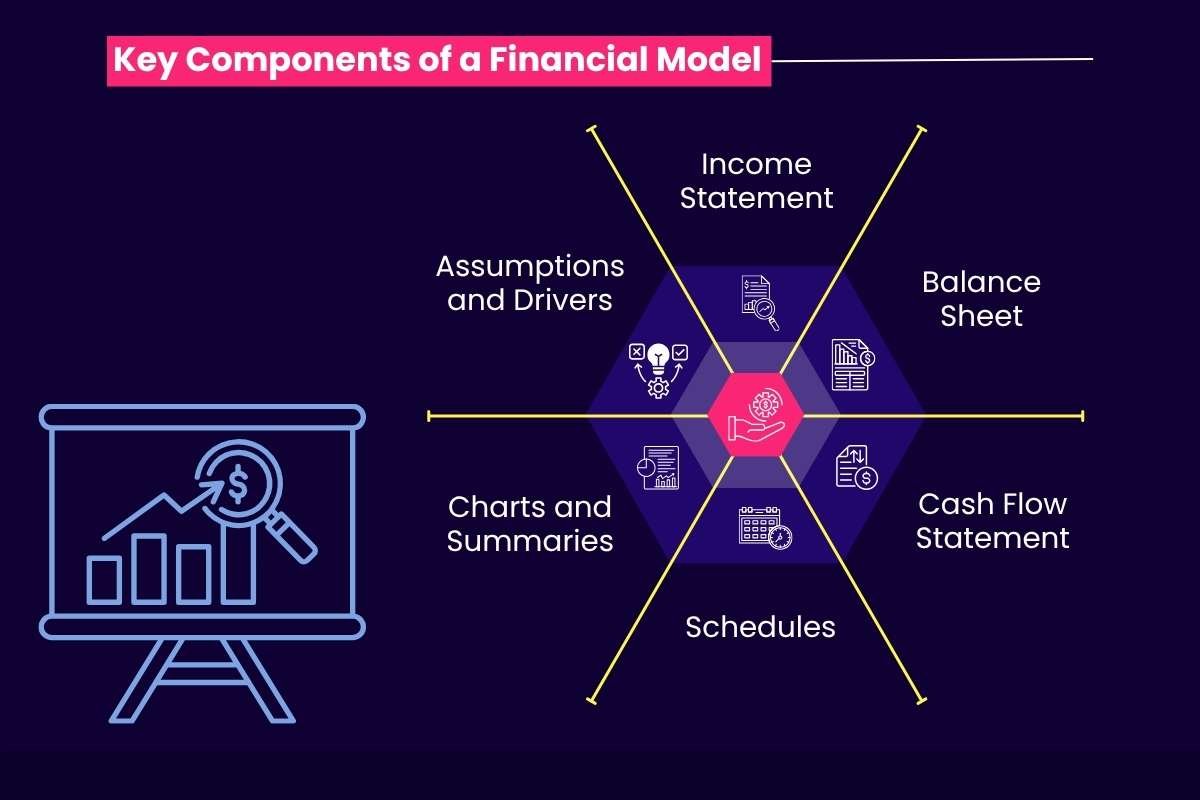
A professional model is not just a messy spreadsheet; it is a structured organism. Every elite model contains specific layers that ensure accuracy and auditability:
- Assumptions and Drivers: These are the “input” variables. This section contains the “levers” you can pull, such as sales growth, inflation, or raw material costs.
- Income Statement: This shows the profit and loss over a specific period, detailing how revenue turns into net income.
- Balance Sheet: This documents the company’s financial position at a point in time, balancing assets against liabilities and equity.
- Cash Flow Statement: This is the most critical part, tracking the actual “green” moving in and out of the bank.
- Schedules: Supporting tabs that handle complex calculations like depreciation, debt amortization, and working capital.
- Charts and Summaries: The visual “executive dashboard” that translates thousands of cells into a single, understandable story for stakeholders.
Types of Financial Models: The Specialist’s Toolkit
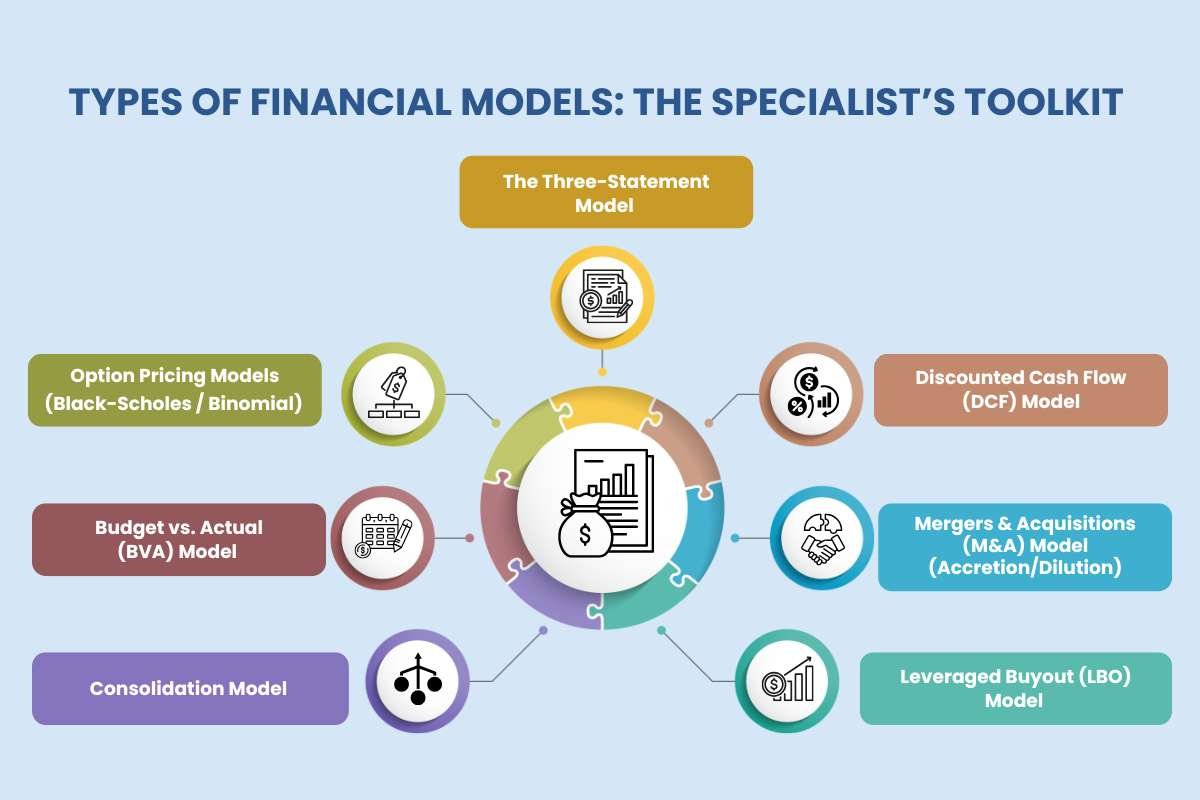
1. The Three-Statement Model
This is the “DNA” of all financial modeling. It is the most fundamental version because it dynamically links the Income Statement, Balance Sheet, and Cash Flow Statement. If you change a single assumption, like increasing “Days Sales Outstanding,” the model automatically updates the cash balance on the Balance Sheet and the interest income on the Income Statement.
- Best For: General corporate planning and as a base for more complex models.
- Key Driver: The “Plug” (usually a debt or cash sweep) that ensures the Balance Sheet stays in balance.
2. Discounted Cash Flow (DCF) Model
The DCF is the primary tool for intrinsic valuation. It operates on the principle of the “Time Value of Money.” By forecasting a company’s “Unlevered Free Cash Flow” and discounting it back to the present day using a Weighted Average Cost of Capital (WACC), analysts determine what a business is actually worth today, regardless of its current stock price.
- Best For: Equity research, long-term investment analysis, and fair-value assessments.
- Expert Insight: According to Mergers & Inquisitions, the DCF is highly sensitive; a 1% change in the “Terminal Growth Rate” can swing a valuation by millions.
3. Mergers & Acquisitions (M&A) Model (Accretion/Dilution)
When one company buys another, the board needs to know if the deal will increase (accrete) or decrease (dilute) the earnings per share (EPS) for the existing shareholders. This model integrates the financials of two separate entities into one “Pro Forma” set of statements, accounting for synergies, new debt, and the “goodwill” created by the purchase.
- Best For: Investment banking buy-side and sell-side mandates.
- Key Focus: Synergies (cost savings) and the “sources and uses” of capital.
4. Leveraged Buyout (LBO) Model
LBO models are notoriously complex and are used primarily by Private Equity firms. The goal is to determine the maximum price an investor can pay for a company while still achieving a specific “Internal Rate of Return” (IRR), typically 20% or higher. These models focus heavily on debt repayment schedules and “exit multiple” assumptions.
- Best For: Private Equity acquisitions and debt capacity analysis.
- Fact: In an LBO, the company’s own cash flow is used to pay down the debt used to buy it, making the cash flow forecast the most scrutinized part of the model.
5. Consolidation Model
For a multinational corporation with 50 subsidiaries, a consolidation model acts as a “Grand Summary.” It aggregates multiple departmental or regional models into one master view. It must account for “intercompany eliminations,” ensuring that a sale from the US branch to the UK branch isn’t counted twice as revenue for the global parent.
- Best For: Corporate FP&A (Financial Planning & Analysis) for large-scale enterprises.
6. Budget vs. Actual (BVA) Model
This is the “performance tracker.” It compares the original budget created at the start of the year against the actual results as they come in month-by-month. It highlights “variances,” allowing managers to see exactly where they are overspending or where revenue is lagging.
- Best For: Monthly operational management and departmental accountability.
7. Option Pricing Models (Black-Scholes / Binomial)
Unlike the other models that rely on accounting logic, these are purely mathematical and based on probability. They are used to value financial derivatives, stock options, and warrants by looking at variables like volatility, time to expiration, and the “risk-free” interest rate.
- Best For: Quantitative trading, hedge funds, and HR departments issuing employee stock options.
Why Diversity in Models Matters?
When someone asks what are financial models, the answer depends entirely on the “Exit” they are looking for. You wouldn’t use a hammer to turn a screw; similarly, you wouldn’t use a Three-Statement model to value a complex derivative. Master modelers understand that the “Type” of model dictates the “Transparency” required.
For instance, an M&A model must be extremely transparent because it will be audited by lawyers and rival bankers. Conversely, a startup’s internal “Burn Rate” model might be more flexible and “dirty,” as its primary purpose is survival, not a formal valuation.
Understanding what are financial models across these various types ensures that you choose the right mathematical lens for the problem at hand. High-E.E.A.T. content creators emphasize that a model is only as good as its “Appropriateness” to the task. If you use a DCF to value a pre-revenue startup with no predictable cash flows, your model is technically correct but practically useless.
By categorizing and expanding on these types, we bridge the gap between “knowing about” finance and “executing” in finance. Mastering the nuances of each ensures that when you are asked what are financial models, you can provide a strategic answer that leads to a closed deal.
Financial Modeling Techniques

The most decorated writers and analysts follow the FAST Standard (Flexible, Appropriate, Structured, Transparent). A model that no one else can read is a liability, not an asset.
- Sensitivity Analysis: This involves changing one variable (like price) to see its direct result on the bottom line.
- Scenario Analysis: This means building “Base Case,” “Best Case,” and “Worst Case” versions of the entire business plan to prepare for market volatility.
- Modular Design: Analysts build logic in self-contained blocks. This prevents “spaghetti code” in Excel, where one error breaks the entire file.
Tools Used for Financial Modeling
While new fintech software emerges daily, the industry remains loyal to a few heavy hitters that offer the flexibility required for custom logic:
- Microsoft Excel: Still the undisputed king. Its grid system and vast library of functions remain unmatched for bespoke business logic.
- Google Sheets: Gaining massive ground for real-time collaboration among remote startup teams and venture capitalists.
- Tableau/Power BI: These are the “Visualizers.” They ingest model data to create interactive reports for board meetings.
- Oracle/SAP: Large multinational firms use these ERP systems to feed real-time raw data into their forecasting models.
Step-by-Step Process of Building a Financial Model
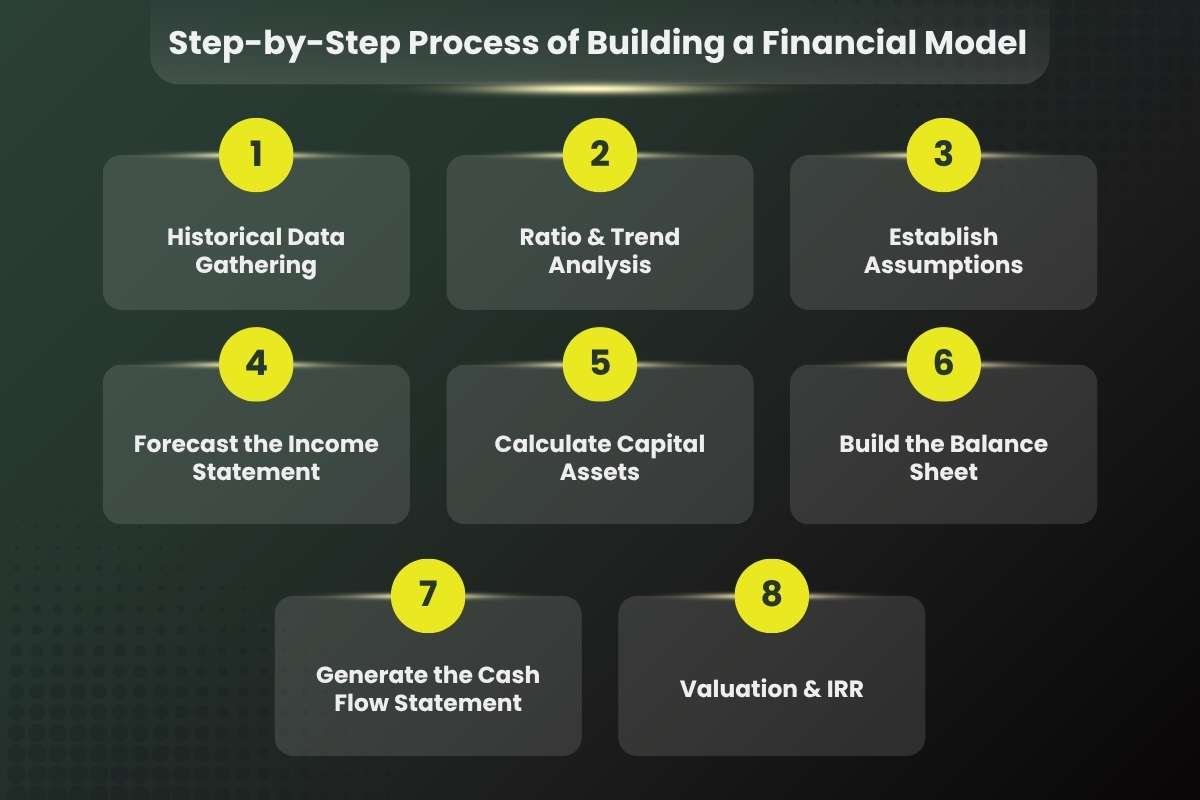
Building a model is a linear journey from the past into the future. Follow this veteran’s workflow:
- Historical Data Gathering: Gather three to five years of audited financial statements. Clean this data to remove “one-time” anomalies.
- Ratio & Trend Analysis: Calculate historical margins, growth rates, and inventory turnover. This tells you what the company is actually capable of.
- Establish Assumptions: Decide on your future growth rates. High-quality modelers remain conservative here to avoid “hockey stick” projections that lack credibility.
- Forecast the Income Statement: Start with Revenue and work down through COGS and Operating Expenses to reach EBITDA.
- Calculate Capital Assets: Model your depreciation and Capital Expenditure (CapEx) schedules based on the company’s growth needs.
- Build the Balance Sheet: Forecast working capital (Accounts Receivable/Payable) and ensure your “Assets = Liabilities + Equity” check works perfectly.
- Generate the Cash Flow Statement: Derive the actual cash movement from the net income and balance sheet changes.
- Valuation & IRR: Use the resulting Free Cash Flow to calculate the Net Present Value (NPV) and Internal Rate of Return (IRR).
Real-World Applications of Financial Modeling
Consider a landmark case study: When Netflix decided to pivot from a DVD-by-mail service to a streaming giant, spending $17 billion annually on original content, they didn’t guess. They built a model to predict how many new subscribers each show would attract versus the massive cost of production. This is exactly what are financial models in action, turning a creative, high-stakes gamble into a calculated, data-driven investment. Without this model, their debt-heavy strategy would have been a blind leap off a cliff.
Advantages of Financial Modeling

- Absolute Clarity: It forces you to put a specific number on your vague business goals. You cannot hide behind adjectives in an Excel cell.
- Operational Agility: When the market crashes or a competitor enters the fray, you can update your model in seconds to see the immediate damage and respond.
- Professional Communication: A clean, audited model speaks a universal language that bankers, investors, and boards of directors trust implicitly.
Skills Required for Financial Modeling
You do not need to be a theoretical mathematician, but you do need a specific blend of technical and business acumen:
- Deep Accounting Knowledge: You must understand how the “Debit and Credit” world functions. If you don’t know how a change in inventory affects the cash flow statement, your model will fail.
- Excel Mastery: You should use “Index-Match,” “XLOOKUP,” and “Pivot Tables” without touching your mouse. Speed is a prerequisite in investment banking.
- Business Intuition: You need the experience to know if a 40% annual growth rate is realistic for a mature industry or if it’s a “fat finger” error.
- Obsessive Attention to Detail: One broken cell reference or a circularity error can ruin a billion-dollar deal and destroy your professional reputation.
Common Financial Modeling Mistakes

Even the most senior analysts fall into these traps if they aren’t careful:
- Hard-coding Variables: Never type a number directly into a formula (e.g., =A1*1.05). Always use a dedicated “Input” cell so you can change the assumption easily.
- Over-complexity: If a board member cannot understand your logic in 60 seconds, your model is a failure. Simplicity is the ultimate sophistication.
- Ignoring Seasonality: Many retail or travel businesses fail because their model assumes the same revenue in December as in July. Always account for the “rhythm” of the business.

Common Financial Mistakes You Are Probably Making
50% of businesses make these top financial mistakes. If you want to make sure that your business is not one of them, then you need to take steps to avoid them today, so you can look to a more positive future.
Expert Opinions and Industry Data
“The goal of a model is not to be exactly right about the future; that’s impossible,” says a senior analyst at Wall Street Prep. “The goal is to provide a framework for logical decision-making.” Industry data suggests that 88% of corporate spreadsheets contain significant errors, which is why institutional investors hire professional modelers to “vouch” for the numbers before an acquisition.
(FAQ) Frequently Asked Questions
Q: Are financial models 100% accurate?
A: No. A model is a map, not the terrain itself. It provides a direction based on the best available data at the time of construction.
Q: Can I learn this without a finance or math degree?
A: Absolutely. While a finance background helps, many top-tier analysts use resources like Investopedia and hands-on boot camps to master the logic.
Q: What are financial models used for in the startup world?
A: Startups use them primarily for “Burn Rate” analysis and “Cash Runway” projections. They need to know exactly how many months they have before they need a new round of funding.
Conclusion: Why You Must Master the Model
When we ask what are financial models, we find they are the ultimate storytellers of the business world. They tell the story of where a company wants to go and identify the specific hurdles it must jump to get there. By mastering this craft, you gain the ability to predict the future, or at least, to be the best-prepared person in the room when that future arrives.
Every successful merger you read about in the news, every massive IPO, and every major corporate pivot relied on these mathematical structures. Now that you understand what are financial models, you can stop guessing and start calculating. The market respects data, but it rewards the people who can interpret that data through a well-built, resilient model. Look at any successful business around you; you are looking at the result of a model done right. Mastering this skill ensures you never walk into a boardroom unarmed. It gives you the keys to the kingdom. Now, go build yours.
Sources and References:
- $3.84B Market, 13% CAGR
- 75% AI Adoption
- Software $2.5B
- CFI: What Is Financial Modeling?
- Wall Street Prep Modeling
- Mergers & Inquisitions
- HDFC Merger Analysis
- Netflix 10-K
- Damodaran Valuation
- EuSpRIG 88% Error Rate
Thank You For Reading!
See More
Financial Problems And How To Overcome Them?