
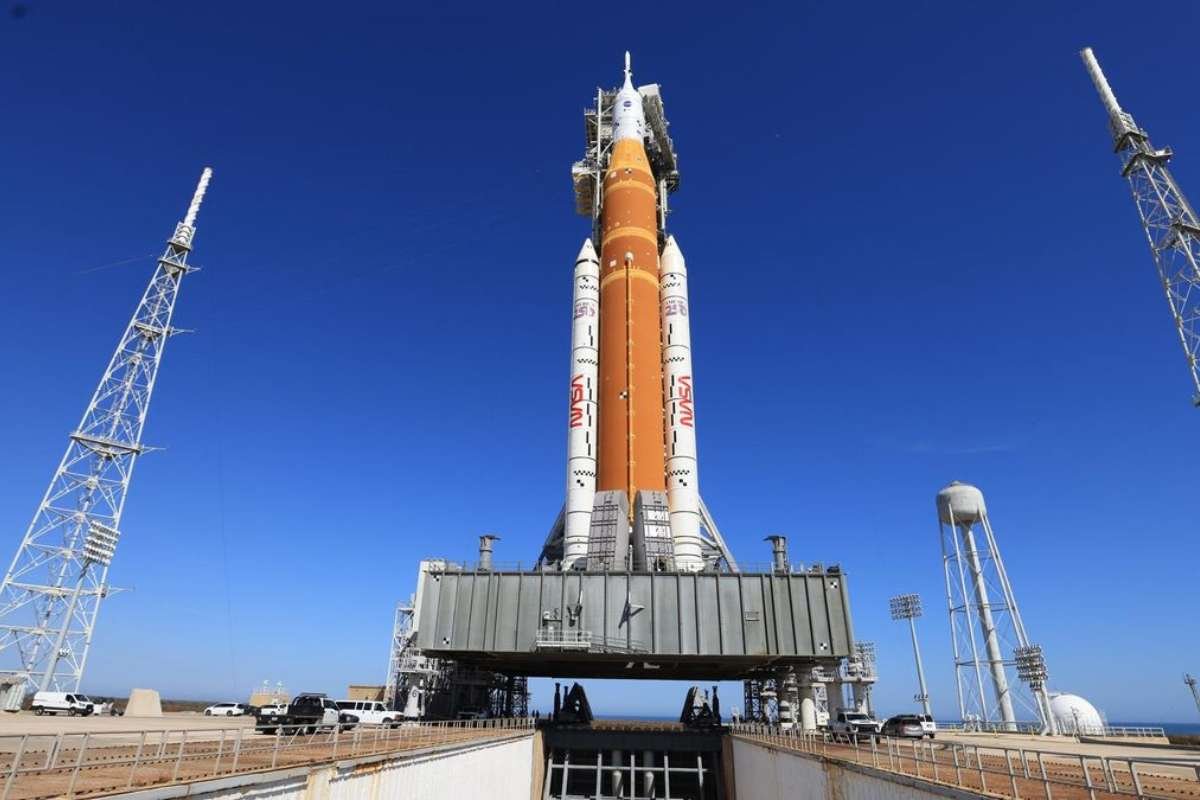
NASA is approaching a defining milestone in human space exploration as Artemis II enters its final pre-launch phase. Scheduled for April 1, 2026, the mission will mark the first time in more than 50 years that astronauts travel beyond low Earth orbit, signaling a powerful return to deep space exploration and setting the foundation for future lunar landings.
The mission will launch from Launch Complex 39B at Kennedy Space Center in Florida aboard the Space Launch System (SLS), a next-generation heavy-lift rocket designed to carry humans farther into space than ever before. Atop the rocket will be the Orion spacecraft, carrying a crew of four astronauts on a planned 10-day journey around the Moon.
The crew includes NASA astronauts Reid Wiseman, Victor Glover, and Christina Koch, along with Canadian Space Agency astronaut Jeremy Hansen. Their participation reflects both international collaboration and historic milestones in human spaceflight. Christina Koch is expected to become the first woman to travel toward the Moon, while Victor Glover will be the first Black astronaut to undertake a deep space mission beyond Earth orbit. Jeremy Hansen will also become the first Canadian astronaut to travel on a lunar mission of this scale.
In the final days leading up to launch, mission teams have been completing detailed system checks, safety validations, and integrated tests of the rocket and spacecraft. Weather conditions at the Florida launch site have remained largely favorable, contributing to growing confidence that the mission will lift off within the planned window.
Mission Architecture: A Lunar Flyby to Test Human Readiness
Unlike a lunar landing mission, Artemis II is designed as a critical test flight that will send astronauts around the Moon without landing on its surface. The Orion spacecraft will follow a free-return trajectory, a carefully calculated flight path that uses the Moon’s gravity to guide the spacecraft back toward Earth after its closest approach.
Once launched, the SLS rocket will first place Orion into Earth orbit. Shortly after, a powerful upper-stage burn will propel the spacecraft out of Earth’s gravitational influence and toward the Moon. Within approximately 24 hours, the crew will leave Earth’s immediate vicinity and begin their deep space journey.
During the mission, Orion will travel nearly 400,000 kilometers from Earth, pushing farther into space than any human mission since Apollo 17. The spacecraft will loop around the Moon, passing behind its far side, giving astronauts direct exposure to a region never visible from Earth without relay support.
The mission is expected to last about 10 days, ending with Orion’s return trajectory toward Earth and a high-speed re-entry followed by a splashdown in the Pacific Ocean. This return phase will test one of the most critical components of the spacecraft: its heat shield, which must withstand extreme temperatures generated during atmospheric re-entry at lunar return speeds.
Throughout the mission, astronauts will continuously evaluate Orion’s life-support systems, navigation systems, communication links, and propulsion performance. These tests are essential for validating the spacecraft’s ability to support humans in deep space for extended durations.
In addition to engineering objectives, the crew will conduct scientific observations and biomedical studies to better understand how deep space travel affects the human body. Exposure to increased radiation levels, prolonged microgravity, and isolation will provide valuable data for future long-duration missions, including potential journeys to Mars.
Artemis II builds directly on the success of previous uncrewed missions, which demonstrated the basic functionality of the Orion spacecraft. This crewed flight now transitions the program into operational human testing, bridging the gap between robotic validation and future lunar surface exploration.
Global Significance and the Future of Lunar Exploration
Artemis II has captured global attention as it prepares to send humans back into deep space for the first time since the Apollo era. Public anticipation continues to rise, with widespread viewership expected across global livestreams and space agencies’ digital platforms. The mission represents not only a technological achievement but also a symbolic return to human exploration beyond Earth’s orbit.
The flight is a foundational step in NASA’s broader Artemis program, which aims to establish a sustainable human presence on and around the Moon. Following Artemis II, Artemis III is expected to attempt a lunar landing, while subsequent missions will focus on building infrastructure, conducting long-term science operations, and testing systems for future deep space exploration.
Beyond its immediate objectives, Artemis II also plays a crucial role in preparing for future missions to Mars. The spacecraft systems, crew operations, and life-support technologies tested during this mission will help determine how humans can safely survive and operate in deep space environments for extended periods.
The mission also reflects a broader international effort, with multiple space agencies and commercial partners contributing to the Artemis program. This collaborative approach is shaping the next era of exploration, where lunar missions serve as stepping stones for interplanetary travel.
As the countdown continues, Artemis II stands as a historic bridge between the legacy of Apollo and the future of sustained lunar exploration. It represents humanity’s renewed capability to travel beyond Earth orbit and signals the beginning of a new chapter in space exploration, where the Moon becomes not just a destination, but a gateway to the wider solar system.