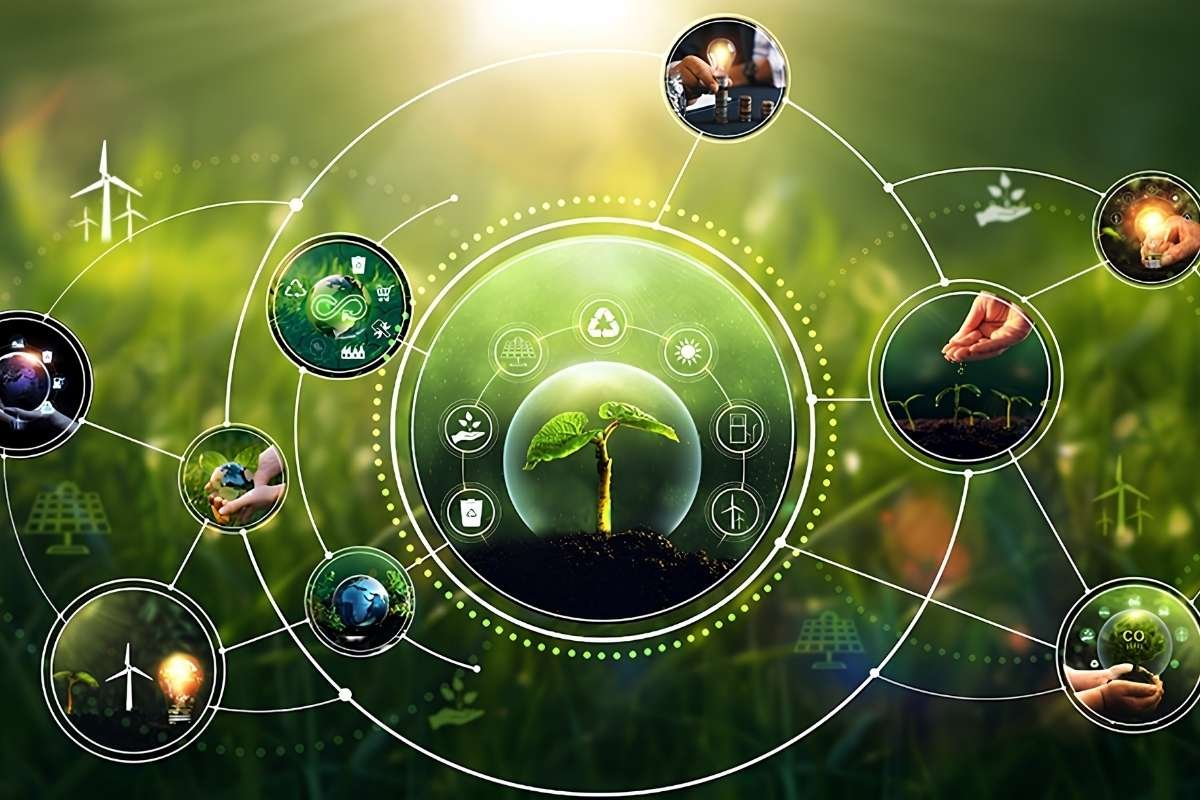
The world consumes over 100 billion tonnes of materials each year, yet only 7.2% are cycled back into the economy, according to the Circularity Gap Report 2024. At the same time, UNEP projects global waste will reach 3.8 billion tonnes by 2050, while rising material costs and stricter sustainability regulations continue to reshape how businesses operate.
The traditional “take, make, dispose” model is no longer built for long-term growth. Businesses are now turning to circular economy business models to reduce waste, optimize resources, lower costs, and build more resilient supply chains. Circular economy business strategies are evolving from a sustainability project to a competitive advantage for companies looking to create long-term profit.
In this guide, you’ll learn how circular economy business models work, their key benefits, practical implementation strategies, real-world examples, and how they can strengthen your broader sustainability strategy for your company.
What Are Circular Economy Business Models?
The traditional take, make, dispose economy is becoming increasingly unsustainable. Rising resource costs, supply chain disruptions, and growing regulatory pressure are pushing businesses to rethink how they create value. This is where circular economy business models come in.
Circular economy business models aim to prolong the life of products, materials, and resources, in contrast to linear models that produce trash once a product is used. Businesses may eliminate waste, cut expenses, and maximize the value of every resource by using solutions including reuse, repair, refurbishing, remanufacturing, and recycling.
The business case is compelling. According to the Ellen MacArthur Foundation, transitioning to a circular economy could generate $4.5 trillion in economic benefits by 2030, making circularity a strategic growth opportunity rather than just a sustainability initiative.
Linear Economy vs. Circular Economy
| Linear Economy | Circular Economy |
| Take → Make → Dispose | Reduce → Reuse → Regenerate |
| Uses virgin resources | Prioritizes renewable and recycled materials |
| Short product lifecycles | Extends product lifecycles |
| Generates significant waste | Minimizes waste and recovers resources |
| One-time product sales | Creates recurring value through services and reuse |
The Three Principles Behind Circular Economy Business Models
Successful circular economy business models are built on three core principles:
| Design out waste | Create products that are durable, repairable, and recyclable from the outset. |
| Keep products and materials in use. | Extend product life through reuse, refurbishment, remanufacturing, and recycling. |
| Regenerate natural systems | Shift to renewable resources and practices that restore rather than deplete the environment. |
Successful circular economy business models are built around three interconnected principles that help businesses balance sustainability with long-term profitability.
1. Design Out Waste and Pollution
Circularity starts at the design stage. Products are developed to use fewer resources, generate less waste, and be easier to repair, upgrade, or recycle. This reduces environmental impact while lowering production costs over time.
2. Keep Products and Materials in Use
Rather than replacing products after a single use, businesses maximize their value through maintenance, reuse, refurbishment, remanufacturing, and recycling. Extending product lifecycles not only conserves resources but also creates new revenue opportunities through resale, subscriptions, and product-as-a-service models.
3. Regenerate Natural Systems
Beyond reducing waste, circular businesses aim to restore the natural systems they depend on. This includes using renewable materials, improving biodiversity, adopting regenerative sourcing practices, and reducing carbon emissions across the value chain.
Together, these principles enable businesses to move beyond compliance and build resilient, future-ready operations. As organizations increasingly integrate circularity into their broader sustainability strategies, the next question becomes clear: why are circular economy business models gaining so much momentum today? This growing relevance is driven by a combination of economic, regulatory, and consumer forces that are reshaping the global business landscape.
7 Types of Circular Economy Business Models
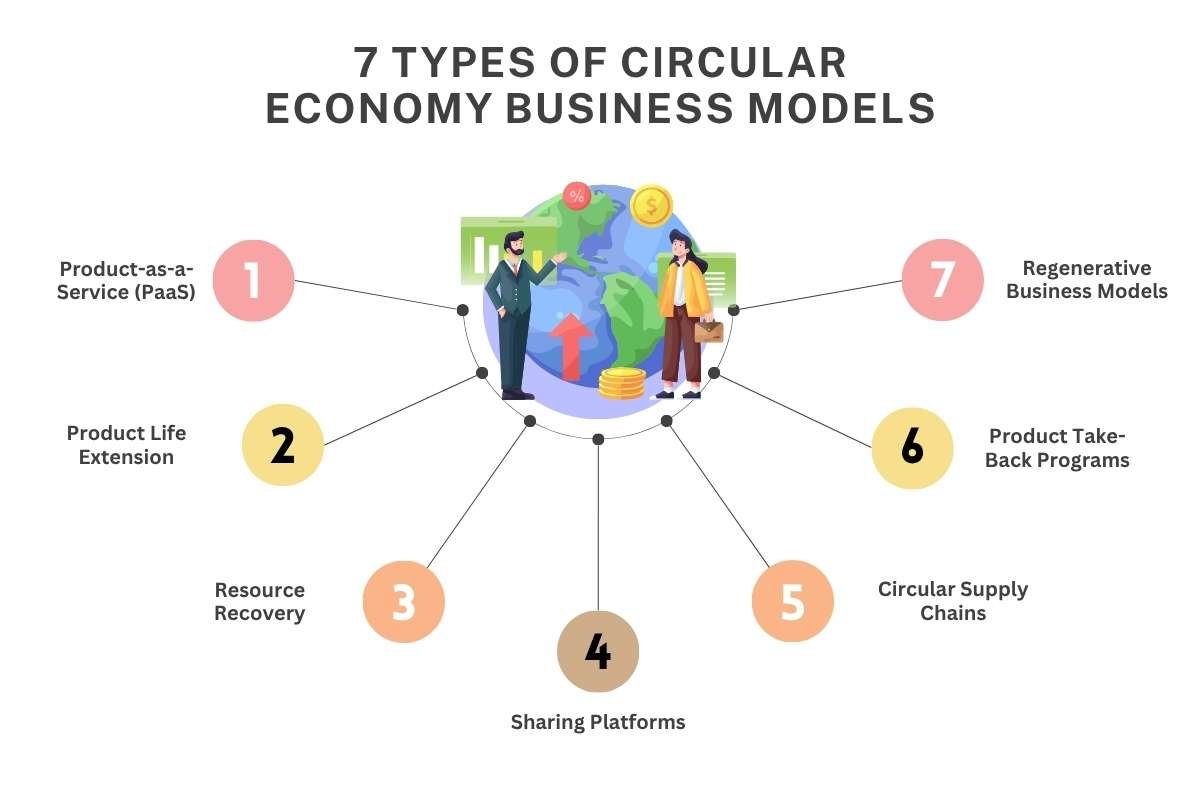
There is no single path to circularity. Depending on their products, clients, and sector, businesses use several business models. While each model takes a different approach, all share the same goal: keeping products and materials in use for longer, reducing waste, and creating lasting business value.
According to the Ellen MacArthur Foundation, circular business models help companies unlock new revenue streams, reduce costs, and build resilience while reducing their reliance on finite resources. In Europe alone, circular markets could be worth €1.5 trillion by 2040.
Comparison of Circular Economy Business Models
While each of these business models follows a different approach, they all aim to eliminate waste, maximize resource efficiency, and create long-term business value. The table below compares their primary objectives, how they create value, and the industries where they’re most commonly adopted.
| Business Model | Primary Goal | Common Industries |
| Product-as-a-Service | Recurring revenue through access | Manufacturing, Healthcare |
| Product Life Extension | Increase product lifespan | Fashion, Electronics |
| Resource Recovery | Recover valuable materials | Manufacturing, Packaging |
| Sharing Platforms | Maximize asset utilization | Mobility, Real Estate |
| Circular Supply Chains | Reduce dependence on virgin resources | Retail, Manufacturing |
| Product Take-Back | Recover products for reuse or recycling | Electronics, Retail |
| Regenerative Business Models | Restore natural systems | Agriculture, Food |
Circular economy business models can take many forms, depending on an organization’s products, customers, and sustainability objectives. While each model creates value differently, they all focus on keeping products and materials in use for longer, reducing waste, and driving sustainable business growth.
1. Product-as-a-Service (PaaS)
Instead of selling ownership, businesses sell access. Customers pay through subscriptions, leasing, or pay-per-use models, while the company retains ownership of the product. This incentivizes manufacturers to design products that are durable, repairable, and easier to upgrade, extending their lifecycle and reducing waste.
The Product-as-a-Service model also creates predictable recurring revenue and stronger customer relationships. According to the European Environment Agency (EEA), these access-based models are already well established in sectors such as healthcare, hospitality, and industrial equipment, where long-term contracts improve both economic viability and resource efficiency.
- Example: Philips’ Lighting as a Service allows customers to pay for lighting performance instead of purchasing lighting systems.
- Best for: Manufacturing, healthcare, industrial equipment, and technology.
2. Product Life Extension
One of the most effective circular economy business models is extending a product’s useful life through repair, refurbishment, remanufacturing, upgrades, and resale. Every additional year a product remains in use reduces demand for new raw materials while preserving the value already embedded in manufacturing.
This approach is gaining momentum across industries. The European Commission estimates that European consumers lose around €12 billion every year by replacing products instead of repairing them. Keeping products in circulation helps businesses reduce production costs while creating additional revenue through repair and refurbishment services.
- Example: Patagonia’s Worn Wear program repairs and resells used garments, extending product life while strengthening customer loyalty.
- Best for: Fashion, electronics, automotive, and consumer goods.
3. Resource Recovery
Rather than treating waste as a cost, resource recovery views it as a valuable input. Businesses recover metals, plastics, textiles, packaging, or industrial by-products and reintroduce them into production, reducing dependence on virgin resources.
According to the OECD, resource recovery closes material loops, helping businesses lower raw material costs while improving resource security in increasingly volatile supply chains.
- Example: Electronics manufacturers recover valuable metals such as gold, copper, and cobalt from discarded devices to manufacture new products.
- Best for: Electronics, manufacturing, mining, packaging, and construction.
4. Sharing Platforms
Many products spend most of their lives sitting idle. Sharing platforms increase utilization by allowing multiple users to access the same asset, reducing unnecessary production and improving resource efficiency.
The opportunity is significant. Research cited by the OECD found that the average European car is parked 92% of the time and typically carries only 1.5 passengers when in use. Sharing platforms help unlock this unused capacity while reducing costs for consumers.
- Example: Car-sharing, equipment rental, coworking spaces, and peer-to-peer marketplaces.
- Best for: Mobility, real estate, construction, and consumer services.
5. Circular Supply Chains
Circular supply chains replace finite raw materials with renewable, recycled, or recovered inputs while designing closed-loop systems that continuously recover materials after use. This reduces exposure to volatile commodity prices and strengthens operational resilience.
According to the Ellen MacArthur Foundation, businesses adopting circular supply chains reduce dependence on virgin materials while improving resilience against resource scarcity and future regulatory changes.
- Example: IKEA is increasing its use of renewable and recycled materials across its product portfolio as part of its circular transition.
- Best for: Manufacturing, retail, consumer goods, and construction.
6. Product Take-Back Programs
Product take-back programs encourage customers to return products once they’ve reached the end of their useful life. Businesses then repair, refurbish, remanufacture, or recycle returned products, recovering valuable materials while reducing landfill waste.
Beyond environmental benefits, take-back programs create new opportunities for refurbishment, resale, and stronger customer engagement. According to the Ellen MacArthur Foundation, these models help businesses recover value that would otherwise be lost while reducing reliance on new raw material extraction.
- Example: Dell Technologies collects used electronics through global take-back and recycling programs to recover components and critical materials.
- Best for: Electronics, appliances, automotive, and retail.
7. Regenerative Business Models
The most advanced circular economy business models don’t just reduce environmental harm; they actively restore natural systems. These models invest in regenerative agriculture, renewable resources, biodiversity restoration, and carbon sequestration to create long-term environmental and business value.
As highlighted by the Ellen MacArthur Foundation, regenerative business models represent the third principle of the circular economy: restoring nature while decoupling business growth from resource extraction.
Many of these regenerative approaches are also influenced by women in climate policy and environmental advocacy, whose work continues to shape sustainable policy, resource management, and environmental decision-making.
- Example: Food and agriculture companies adopting regenerative farming practices to improve soil health, biodiversity, and long-term supply chain resilience.
- Best for: Agriculture, food production, forestry, and natural resource industries.
Why Circular Economy Business Models Matter More Than Ever
Circularity is no longer just an environmental goal; it’s a business strategy. As organizations face rising material costs, stricter regulations, and increasing stakeholder expectations, business models are becoming essential for building resilience and maintaining a competitive edge.
According to the World Economic Forum, global material extraction has more than tripled since 1970 and could increase by another 60% by 2060 if current consumption patterns continue. At the same time, consumers, investors, and regulators are placing greater emphasis on sustainable business practices, making resource efficiency a strategic priority rather than a choice.
Here’s why more organizations are investing in circular economy business models:
| Lower operating costs | Reducing waste and reusing materials decreases raw material and production expenses. |
| Stronger supply chains | Recovering and reusing resources reduces dependence on volatile global supply chains. |
| Regulatory readiness | Circular practices help businesses stay ahead of evolving ESG and environmental regulations. |
| New revenue opportunities | Services like leasing, refurbishment, resale, and product take-back programs create recurring income streams. |
| Improved brand trust | Consumers increasingly prefer brands that demonstrate measurable sustainability commitments. |
| Better ESG performance | Circular initiatives strengthen Corporate sustainability reporting and support long-term sustainability goals. As businesses expand these initiatives, they are also creating new ESG careers for women across sustainability reporting, compliance, risk management, and corporate strategy. |
Businesses that embrace circularity today aren’t simply reducing their environmental footprint; they’re creating more efficient operations, improving profitability, and positioning themselves for long-term growth. The next step is understanding the different circular economy business models organizations are using to turn these opportunities into measurable business results.
Benefits of Circular Economy Business Models
Adopting these business models isn’t just about reducing waste; it’s about building a more resilient, efficient, and profitable business. By keeping products and materials in use for longer, organizations can lower costs, unlock new revenue streams, and strengthen their competitive advantage in an increasingly resource-constrained world.
According to the World Business Council for Sustainable Development (WBCSD), circular business practices help organizations improve resource productivity, reduce operational risks, and enhance long-term value creation. Similarly, Accenture estimates that circular economy strategies could unlock $4.5 trillion in additional economic output by 2030, underscoring their growing business potential.
Here are the key benefits of implementing circular economy business models:
| Benefit | Business Impact |
| Lower operating costs | Reduces spending on raw materials by increasing reuse, repair, and recycling. |
| Stronger supply chain resilience | Decreases dependence on finite resources and minimizes disruption from material shortages and price volatility. |
| New revenue opportunities | Generates recurring income through leasing, refurbishment, resale, maintenance, and product-as-a-service models. |
| Improved ESG performance | Supports stronger corporate sustainability reporting and helps organizations meet regulatory and investor expectations. |
| Greater customer loyalty | Builds trust among environmentally conscious consumers who increasingly prefer sustainable brands. |
| Enhanced innovation | Encourages product redesign, sustainable materials, and new business models that create long-term value. |
| Competitive advantage | Positions businesses ahead of evolving regulations and market trends while strengthening brand reputation. |
For businesses, the message is clear: circular economy business models are no longer simply an environmental initiative; they are a strategic investment in long-term growth, resilience, and profitability. The next challenge is understanding how to successfully implement these models within an organization, regardless of its size or industry.
How to Implement Circular Economy Business Models?
Transitioning to circular economy business strategies doesn’t happen overnight. It requires rethinking how products are designed, sourced, used, and recovered across their entire lifecycle. The good news is that businesses don’t need to transform everything at once. Many successful organizations begin with small, measurable initiatives before scaling circular practices across their operations.
1. Assess Your Current Resource Flow
Start by understanding where materials enter, move through, and exit your business. Identify areas where waste is generated, resources are underutilized, or products have short lifecycles.
According to the Ellen MacArthur Foundation, mapping material flows is the first step toward identifying opportunities to eliminate waste and improve resource efficiency.
2. Redesign Products for Longevity
Products designed to last longer are easier to repair, upgrade, refurbish, and recycle. Prioritizing durability and modular design not only reduces waste but also lowers lifecycle costs.
The European Environment Agency (EEA) highlights eco-design as a key enabler of circular business models, helping businesses reduce material consumption while improving product value.
3. Choose the Right Circular Business Model
Not every organization needs the same approach. Select the circular economy business model that aligns with your products, customers, and business goals—whether it’s Product-as-a-Service, product life extension, take-back programs, or resource recovery.
Starting with one high-impact initiative often delivers faster results and builds momentum for broader transformation.
4. Collaborate Across the Value Chain
Circularity depends on collaboration. Work closely with suppliers, logistics partners, recyclers, and customers to recover materials, improve traceability, and create closed-loop supply chains.
According to the World Economic Forum, cross-value-chain collaboration is critical to scaling circular solutions and building resilient supply networks.
As circular initiatives continue to expand, businesses are also creating opportunities across both social impact careers vs corporate sustainability roles, reflecting the growing demand for sustainability expertise across industries.
Successful circular initiatives also benefit from collaborative leadership, reflecting how women-led sustainability approaches sustainability differently by prioritizing long-term partnerships, stakeholder engagement, and resilient business systems.
5. Measure What Matters
Track metrics such as material recovery rates, waste diversion, recycled content, product lifespan, and carbon emissions to evaluate progress. These insights not only improve decision-making but also strengthen corporate sustainability reporting and demonstrate measurable business impact.
Consistently monitoring these sustainability KPIs helps businesses evaluate progress, identify improvement opportunities, and communicate measurable outcomes with confidence.
6. Scale and Continuously Improve
Circularity is an ongoing process, not a one-time initiative. As technologies evolve and customer expectations change, businesses should regularly refine their products, processes, and partnerships to unlock new efficiencies and revenue opportunities.
A Practical Circular Economy Roadmap
| Step | Key Action | Business Outcome |
| Assess | Map resource and waste flows | Identify efficiency opportunities |
| Redesign | Build durable, repairable products | Extend product lifecycle |
| Select | Adopt the right circular business model | Maximize business value |
| Collaborate | Engage suppliers and partners | Strengthen supply chain resilience |
| Measure | Track sustainability KPIs | Improve performance and reporting |
| Scale | Expand successful initiatives | Drive long-term growth |
Implementing circular economy business models is less about making a single large investment and more about embedding continuous improvement into everyday business operations. Organizations that take a structured approach are better positioned to reduce costs, strengthen resilience, and create sustainable competitive advantage. The next step is seeing how leading companies have already turned circularity into measurable business success through real-world examples.
Real-World Examples of Circular Economy Business Models
Across industries, leading companies are proving that circular economy business models can deliver measurable business value alongside environmental impact. From extending product lifecycles to recovering valuable materials, these organizations have successfully turned circularity into a competitive advantage.
1. Patagonia: Extending Product Lifecycles
- Circular Model: Product Life Extension
- Business Benefit: Higher customer loyalty and reduced textile waste
Outdoor apparel brand Patagonia has made product longevity a core part of its business strategy through its Worn Wear program. Customers can repair, trade in, or purchase refurbished clothing instead of buying new products.
This approach reduces textile waste, extends product life, and strengthens customer loyalty while creating an additional revenue stream from refurbished products. It also reinforces Patagonia’s reputation as a leader in sustainable business.
2. Philips: Selling Performance Instead of Products
- Circular Model: Product-as-a-Service
- Business Benefit: Recurring revenue and longer product lifecycles
Rather than selling lighting equipment, Philips introduced Lighting as a Service, where customers pay for lighting performance while Philips retains ownership of the equipment.
Because the company remains responsible for maintenance and upgrades, products are designed to last longer, consume fewer resources, and be recovered at the end of their lifecycle.
3. IKEA: Building Circular Supply Chains
- Circular Models: Circular Supply Chain, Product Take-Back
- Business Benefit: Lower resource dependency and improved material recovery
IKEA is transitioning toward becoming a fully circular business by increasing the use of renewable and recycled materials, designing products for disassembly, and expanding furniture buy-back and resale programs.
The company’s goal is to use only renewable or recycled materials across its products while helping customers extend product lifecycles through repair and reuse.
4. Dell Technologies: Recovering Valuable Resources
- Circular Models: Resource Recovery, Product Take-Back
- Business Benefit: Reduced raw material costs and closed-loop manufacturing
Dell Technologies operates global take-back and recycling programs that recover plastics, precious metals, and electronic components from used devices. Many of these recovered materials are incorporated into new products, reducing dependence on virgin resources.
This closed-loop approach lowers material costs while supporting the company’s broader sustainability commitments.
5. Michelin: Tires as a Service
- Circular Model: Product-as-a-Service
- Business Benefit: Predictable recurring revenue and improved resource efficiency
Instead of selling tires outright to commercial fleet operators, Michelin offers usage-based contracts where customers pay based on distance traveled. Michelin remains responsible for maintenance, retreading, and end-of-life recovery.
This model extends tire lifespan, reduces waste, and creates recurring revenue while lowering customers’ total operating costs.
Future Trends Shaping Circular Economy Business Models
As businesses accelerate their sustainability efforts, circular economy business strategies are evolving beyond waste reduction into technology-driven strategies that improve efficiency, resilience, and long-term value creation. Emerging innovations, supportive regulations, and growing investor expectations are making circularity a core component of future business strategy.
Here are the key trends shaping the next generation of circular economy business models:
1. AI-Powered Resource Optimization
Artificial intelligence is helping businesses predict demand, optimize inventory, reduce material waste, and improve product maintenance. By analyzing large datasets, AI enables organizations to use resources more efficiently while lowering operational costs.
According to the World Economic Forum, digital technologies like AI are accelerating the transition to more resource-efficient and circular industries.
2. Digital Product Passports
Digital Product Passports (DPPs) provide detailed information about a product’s materials, origin, repairability, and recyclability throughout its lifecycle. As part of the European Union’s Ecodesign for Sustainable Products Regulation (ESPR), DPPs are expected to improve transparency and make product repair, reuse, and recycling more efficient.
For businesses, this means greater traceability, stronger compliance, and improved resource recovery.
3. Reverse Logistics Becomes a Competitive Advantage
As product take-back and refurbishment programs expand, efficient reverse logistics is becoming essential. Companies are investing in smarter collection, repair, and redistribution networks to recover products and valuable materials more effectively.
This not only reduces waste but also creates additional revenue opportunities through resale and remanufacturing.
4. Circular Supply Chains Powered by Data
Businesses are increasingly using IoT sensors, blockchain, and real-time analytics to monitor material flows across the supply chain. These technologies improve traceability, verify sustainable sourcing, and help organizations recover resources more efficiently.
According to the World Business Council for Sustainable Development (WBCSD), digital transparency will play a critical role in scaling circular supply chains globally.
5. Stronger Regulations and ESG Expectations
Governments worldwide are introducing stricter policies around waste management, producer responsibility, and sustainable product design. At the same time, investors are placing greater emphasis on companies that demonstrate measurable sustainability outcomes.
This makes corporate sustainability reporting (T2) and transparent circularity metrics increasingly important for attracting investment and maintaining stakeholder trust.
The growing investment in circular business models is also increasing demand for green finance careers for women, particularly in sustainable investing, climate finance, and ESG analysis.
Conclusion:
The shift toward circular economy business models is no longer driven solely by sustainability goals; it’s a business imperative. As resource constraints, evolving regulations, and stakeholder expectations grow, businesses that embrace circularity are reducing costs, strengthening supply chains, and building long-term resilience.
From extending product lifecycles to recovering valuable materials and adopting service-based models, circular economy business strategies help organizations create more value with fewer resources. Rather than requiring a complete transformation overnight, businesses can start with targeted initiatives and scale their impact over time.
When integrated with a strong Sustainability strategy for your company and supported by Corporate sustainability reporting, circularity becomes more than an environmental commitment; it becomes a lasting competitive advantage. As these initiatives evolve, businesses often assess B Corp certification vs ESG reporting to strengthen governance, transparency, and stakeholder trust.
As the global economy shifts toward resource efficiency, organizations investing in circular economy business models today will be better positioned to lead tomorrow. These changes reinforce why women driving sustainable business continue to shape how organizations create lasting environmental, social, and economic value.
Frequently Asked Questions (FAQs)
1. What are circular economy business models?
Circular economy business strategies are strategies that keep products and materials in use through reuse, repair, refurbishment, remanufacturing, and recycling, reducing waste while creating long-term business value.
2. Why are circular economy business strategies important?
They help businesses lower costs, improve resource efficiency, strengthen supply chains, meet ESG expectations, and create new revenue opportunities.
3. What are the main types of circular economy business models?
The most common circular economy business strategies include Product-as-a-Service, Product Life Extension, Resource Recovery, Sharing Platforms, Circular Supply Chains, Product Take-Back Programs, and Regenerative Business Models.
4. Which industries benefit the most from circular economy business strategies?
Manufacturing, automotive, fashion, electronics, retail, construction, healthcare, and agriculture are among the industries benefiting most from circular business practices.
5. How can businesses implement circular economy business models?
Start by assessing resource use, reducing waste, redesigning products, selecting the right circular model, collaborating across the supply chain, and tracking progress through Sustainability KPIs and Corporate sustainability reporting.
Source: