

Sustainability has become a defining factor in business performance, not just reputation. According to PwC’s 2024 Global Investor Survey, 71% of investors expect companies to integrate sustainability directly into their corporate strategy, while 62% say they would increase their investment in organizations that effectively manage sustainability risks and opportunities. At the same time, the World Economic Forum continues to rank environmental risks among the most significant long-term threats facing businesses, making transparent ESG disclosure more important than ever.
As expectations from investors, regulators, customers, and employees continue to grow, corporate sustainability reporting has evolved from a voluntary disclosure into a strategic business priority. It enables organizations to measure and communicate their environmental, social, and governance (ESG) performance, demonstrate accountability, strengthen stakeholder trust, and stay ahead of evolving regulatory requirements.
This guide explains what corporate sustainability reporting is, why it matters, the leading ESG reporting standards, mandatory disclosure requirements, best practices for creating effective reports, and the common mistakes businesses should avoid to deliver credible and transparent sustainability disclosures.
What is corporate sustainability reporting?
Corporate sustainability reporting is the process of measuring and disclosing a company’s environmental, social, and governance (ESG) performance alongside its financial results. It helps businesses communicate how they manage sustainability risks, reduce environmental impact, support social responsibility, and create long-term value for stakeholders.
Its importance continues to grow as sustainability becomes a key factor in business decisions. According to Deloitte’s 2024 CxO Sustainability Report, 85% of business leaders increased their sustainability investments over the past year, reflecting the growing role of transparent ESG reporting in corporate strategy. Meanwhile, the Global Reporting Initiative (GRI) notes that standardized sustainability reporting enables organizations to improve accountability, build stakeholder trust, and make better-informed business decisions.
Financial reporting vs. Corporate sustainability reporting:
| Financial Reporting | Corporate Sustainability Reporting |
| Reports financial performance | Reports environmental, social, and governance (ESG) performance |
| Focuses on profits and financial health | Focuses on long-term business resilience and sustainability |
| Primarily serves investors and regulators | Serves investors, customers, employees, regulators, and other stakeholders |
| Follows accounting standards like IFRS or GAAP | Follows ESG reporting standards such as GRI, ISSB, SASB, and TCFD |
Rather than replacing financial reporting, corporate sustainability reporting complements it by showing how a company creates value responsibly while managing ESG risks and opportunities.
What is the main purpose of sustainability reporting?
The primary purpose of sustainability reporting is to provide a transparent and measurable account of how a business manages its environmental, social, and governance (ESG) impacts. It gives stakeholders a clearer understanding of an organization’s sustainability performance, helping them make informed decisions based on credible, comparable data rather than broad commitments.
Beyond disclosure, sustainability reporting enables companies to identify risks, measure progress, improve operational efficiency, and align sustainability initiatives with long-term business objectives. According to McKinsey & Company, organizations that effectively integrate ESG into their growth strategy can strengthen resilience, improve operational performance, and create long-term value for shareholders.
As stakeholder expectations continue to evolve, sustainability reporting delivers benefits that extend beyond compliance.
Why does corporate sustainability reporting matter?
| Builds investor confidence | Transparent ESG disclosures help investors evaluate long-term risks and opportunities alongside financial performance. |
| Strengthens stakeholder trust | Customers, employees, regulators, and business partners increasingly expect companies to report measurable sustainability outcomes instead of broad claims. |
| Supports better decision-making | Tracking sustainability metrics helps organizations identify inefficiencies, allocate resources effectively, and make data-driven strategic decisions. |
| Improves regulatory readiness | Businesses with established reporting processes are better prepared to comply with evolving ESG disclosure requirements across different markets. |
| Reduces greenwashing risks | Reporting against recognized frameworks with measurable KPIs improves credibility and demonstrates accountability. |
However, reporting alone is not enough. Organizations achieve better long-term outcomes when reporting is supported by a well-defined sustainability strategy for your company that aligns ESG goals with business objectives and measurable action plans.
Ultimately, corporate sustainability reporting is no longer just about communicating what a company has achieved; it’s about showing how sustainability contributes to business resilience, responsible growth, and long-term value creation.
What are the four pillars of sustainability reporting?
Corporate sustainability reporting is built around four key pillars that help organizations measure, manage, and communicate their long-term impact. Together, these pillars provide stakeholders with a balanced view of a company’s sustainability performance beyond financial results.
| Pillar | What It Covers |
| Environmental | Carbon emissions, energy use, water consumption, waste management, biodiversity, and climate action |
| Social | Employee well-being, diversity and inclusion, human rights, workplace safety, and community engagement |
| Governance | Board oversight, ethics, compliance, anti-corruption, executive accountability, and data privacy |
| Economic | Long-term value creation, responsible growth, innovation, sustainable investments, and financial resilience |
1. Environmental
The environmental pillar evaluates how a business manages its impact on the planet. Companies typically report metrics such as greenhouse gas (GHG) emissions, renewable energy adoption, water consumption, waste reduction, and resource efficiency. These disclosures help stakeholders assess a company’s progress toward climate goals and environmental responsibility.
2. Social
The social pillar focuses on how an organization supports its people and communities. It includes workforce diversity, employee health and safety, training and development, labor practices, human rights, customer well-being, and community investment. Reporting these metrics demonstrates a company’s commitment to creating positive social outcomes alongside business growth.
Many organizations also recognize the growing influence of women in climate policy and environmental advocacy, whose leadership continues to shape corporate sustainability priorities, stakeholder engagement, and climate action.
3. Governance
Governance measures how an organization is managed and held accountable. It covers board diversity, executive compensation, business ethics, anti-corruption policies, cybersecurity, data privacy, regulatory compliance, and risk management. Strong governance is often viewed as the foundation of credible ESG performance because it ensures sustainability commitments are backed by effective oversight.
4. Economic
The economic pillar highlights how sustainability contributes to long-term business success. It includes responsible investment, innovation, supply chain resilience, financial performance, and sustainable value creation. Rather than focusing only on profitability, this pillar demonstrates how organizations balance economic growth with environmental and social responsibility.
Together, these four pillars form the foundation of corporate sustainability reporting, enabling businesses to communicate their ESG performance in a structured, transparent, and measurable way. Many leading reporting frameworks use these pillars to help organizations produce consistent and decision-useful sustainability disclosures.
Measuring performance across these pillars requires clearly defined sustainability KPIs, enabling organizations to monitor progress, benchmark performance, and demonstrate measurable improvements across environmental, social, governance, and economic goals.
What are ESG reporting standards?

ESG reporting standards provide a structured framework for measuring, managing, and disclosing sustainability performance. They help companies report ESG data consistently, making it easier for investors, regulators, customers, and other stakeholders to compare performance across organizations and industries.
As sustainability disclosures become more regulated, adopting recognized reporting standards has become increasingly important. According to the IFRS Foundation, the International Sustainability Standards Board (ISSB) was established to create a global baseline for sustainability-related financial disclosures, helping improve the consistency and comparability of ESG reporting across capital markets.
Today, businesses often align their reports with one or more globally recognized frameworks, depending on their industry, geography, and stakeholder expectations.
| Reporting Standard | Primary Focus | Best For |
| GRI (Global Reporting Initiative) | Broad sustainability impacts across environmental, social, and governance topics | Organizations reporting to a wide range of stakeholders |
| ISSB (IFRS Sustainability Disclosure Standards) | Sustainability-related financial disclosures for investors | Companies seeking globally comparable ESG reporting |
| SASB (Sustainability Accounting Standards Board) | Industry-specific ESG metrics | Investor-focused reporting by sector |
| TCFD (Task Force on Climate-related Financial Disclosures) | Climate-related risks and opportunities | Organizations reporting climate-related financial impacts |
| CDP (Carbon Disclosure Project) | Environmental performance, including climate, forests, and water | Companies responding to investor and customer environmental requests |
Rather than choosing a single framework, many large organizations combine multiple standards to meet regulatory requirements and stakeholder expectations. For example, a company may use GRI to communicate its broader sustainability impact while applying ISSB or SASB standards for investor-focused disclosures and TCFD recommendations for climate-related reporting.
Selecting the right reporting framework depends on factors such as industry, business objectives, geographic regulations, and the information stakeholders expect to see. Regardless of the framework used, the goal remains the same: to produce transparent, reliable, and decision-useful sustainability disclosures that build trust and support long-term business resilience.
Many organizations also pursue recognized sustainability certifications alongside ESG reporting to independently validate their environmental and social commitments while strengthening stakeholder confidence.
Is ESG reporting mandatory?
Whether ESG reporting is mandatory depends on where a company operates, its size, and whether it is publicly listed. While many organizations initially adopted sustainability reporting voluntarily, governments and regulators worldwide are increasingly introducing mandatory disclosure requirements to improve transparency and accountability.
According to the IFRS Foundation, jurisdictions representing more than half of global GDP are taking steps to adopt or align with the ISSB’s sustainability disclosure standards, reflecting a growing global push toward standardized ESG reporting.
Here’s how ESG reporting requirements vary across major markets:
| Region | Current Requirement |
| European Union | Mandatory for companies covered under the Corporate Sustainability Reporting Directive (CSRD). |
| India | Mandatory for the top 1,000 listed companies through the Business Responsibility and Sustainability Reporting (BRSR) framework. |
| United Kingdom | Many large companies must disclose climate-related information aligned with TCFD recommendations. |
| United States | ESG reporting requirements continue to evolve, with climate-related disclosures expanding for certain public companies and industries. |
Even where reporting is not legally required, many private companies and SMEs choose to publish sustainability reports voluntarily. This is often driven by investor expectations, customer demand, supply chain requirements, and access to sustainable finance.
For many businesses, preparing for ESG reporting before it becomes mandatory offers a competitive advantage. It allows organizations to establish reliable data collection processes, improve governance, and build stakeholder confidence while staying ahead of changing regulations.
Tip: Businesses that integrate reporting into a broader sustainability strategy for your company are often better prepared to respond to changing regulations, improve governance, and create long-term business value.
Which organizations are required to file an ESG report?
The organizations required to file an ESG report vary by country and regulatory framework. In general, mandatory reporting applies to large publicly listed companies, financial institutions, and organizations with significant economic or environmental impact. However, voluntary reporting is becoming increasingly common as investors, customers, and supply chain partners demand greater transparency.
The following organizations are typically required or strongly encouraged to publish ESG or sustainability reports:
- Publicly listed companies: Many stock exchanges and regulators require listed businesses to disclose ESG-related information to investors.
- Large corporations: Companies exceeding specific thresholds for revenue, assets, or employee count may fall under mandatory sustainability reporting regulations, depending on their jurisdiction.
- Financial institutions: Banks, insurers, and asset managers often have additional ESG disclosure obligations due to their role in managing financial and climate-related risks.
- Multinational companies: Organizations operating across multiple countries frequently align with global reporting standards to meet varying regulatory and stakeholder expectations.
- Businesses within large supply chains: Even when not legally required, suppliers are increasingly expected to share ESG data to help larger organizations meet their own reporting obligations.
The scope of ESG reporting continues to expand. As regulations evolve and stakeholder expectations increase, more organizations, including private companies and small and medium-sized enterprises (SMEs), are adopting sustainability reporting to improve transparency, strengthen stakeholder trust, and remain competitive.
Did you know? According to the CDP, more than 24,800 companies disclosed environmental data through its global disclosure platform in 2024, highlighting the growing adoption of sustainability reporting well beyond mandatory compliance.
What makes a good ESG report?
A good ESG report goes beyond presenting sustainability data; it tells a clear, evidence-based story about how an organization manages its environmental, social, and governance impacts. The most effective reports are transparent, measurable, and aligned with recognized reporting standards, enabling stakeholders to evaluate both progress and areas for improvement.
According to PwC’s Global Investor Survey 2024, 94% of investors believe corporate sustainability reports should include evidence that sustainability issues are embedded into a company’s strategy, highlighting the growing demand for meaningful and decision-useful disclosures.
An effective ESG report should include the following elements:
1. Clear Sustainability Goals
Define measurable short- and long-term sustainability objectives that align with the company’s overall business strategy. Clearly stating these goals helps stakeholders understand what the organization aims to achieve and how success will be measured.
2. Material ESG Issues
Focus on the ESG topics that have the greatest impact on the business and its stakeholders, such as climate change, workforce diversity, supply chain responsibility, or data privacy. Prioritizing material issues makes reporting more relevant and credible.
3. Measurable Sustainability KPIs
Support every claim with quantifiable data. Tracking sustainability KPIs such as greenhouse gas emissions, renewable energy usage, employee diversity, workplace safety, and waste reduction helps demonstrate progress over time and enables year-on-year comparisons.
4. Transparent Reporting
Present both achievements and challenges honestly. Reporting setbacks alongside progress builds credibility and reduces the risk of greenwashing.
5. Alignment with Recognized Standards
Use established frameworks such as GRI, ISSB, SASB, or TCFD to improve consistency, comparability, and stakeholder confidence.
6. Regular Performance Tracking
Sustainability reporting should be an ongoing process rather than an annual exercise. Monitoring ESG performance throughout the year enables organizations to identify gaps early, refine their strategies, and continuously improve their sustainability outcomes.
Ultimately, a strong ESG report is not defined by its length but by the quality, accuracy, and transparency of the information it provides. Reports backed by reliable data, meaningful sustainability KPIs, and recognized reporting standards are far more likely to build trust with investors, regulators, customers, and employees.
What is a good ESG score?

There is no universal ESG score. Different ESG rating agencies use their own methodologies, weightings, and evaluation criteria, which means a company may receive different scores from different providers. Instead of focusing solely on a numerical rating, businesses should prioritize consistent improvement, transparent disclosures, and measurable ESG performance.
Some of the leading ESG rating providers include MSCI, Sustainalytics, S&P Global, and ISS ESG, each assessing factors such as environmental impact, social responsibility, governance practices, and risk management.
While scoring systems vary, organizations with strong ESG performance generally share these characteristics:
- Transparent and consistent reporting aligned with recognized ESG standards.
- Measurable sustainability KPIs that demonstrate year-on-year progress.
- Strong governance practices, including ethical leadership, board oversight, and regulatory compliance.
- Effective management of environmental and social risks, from carbon emissions to workforce well-being.
- Clear sustainability goals supported by credible data rather than broad claims.
According to McKinsey & Company, companies that effectively manage ESG risks are often better positioned to build long-term resilience and create sustainable value. This reinforces the idea that ESG reporting should focus on continuous improvement rather than achieving a perfect score.
Ultimately, a good ESG score is not just about meeting external benchmarks; it’s about demonstrating measurable progress, maintaining transparency, and building long-term trust with stakeholders.
What is greenwashing in ESG?
Greenwashing occurs when a company exaggerates, misrepresents, or makes unsubstantiated claims about its environmental, social, or governance (ESG) performance to appear more sustainable than it actually is. Whether intentional or not, misleading sustainability claims can damage a company’s reputation, erode stakeholder trust, and attract regulatory scrutiny.
As sustainability reporting becomes more widespread, regulators are taking a stronger stance against greenwashing. According to PwC’s 2024 Global Investor Survey, 87% of investors believe corporate reporting should clearly explain how sustainability claims are supported by measurable actions and outcomes, underscoring the growing demand for credible and transparent disclosures.
Common Signs of Greenwashing
- Vague sustainability claims without supporting evidence or measurable data.
- Selective disclosure that highlights achievements while omitting significant ESG challenges.
- No alignment with recognized reporting standards such as GRI, ISSB, or SASB.
- Lack of measurable sustainability KPIs to demonstrate progress over time.
- Unverified environmental or social claims without third-party assurance or credible evidence.
The most effective way to avoid greenwashing is through transparent, evidence-based reporting. Companies should disclose both successes and areas for improvement, use recognized ESG reporting standards, and support sustainability claims with measurable data. Honest reporting not only strengthens stakeholder confidence but also helps businesses build long-term credibility in an increasingly sustainability-focused market.
Understanding B Corp certification vs ESG reporting helps organizations determine whether third-party certification, ESG disclosure, or a combination of both best supports their sustainability goals while reducing the risk of greenwashing.
What are the 5 C’s of sustainability?
The 5 C’s of sustainability are guiding principles that help organizations embed sustainability into their business strategy and reporting practices. Together, they ensure that sustainability efforts are measurable, transparent, and aligned with long-term business objectives.
| The 5 C’s | Why They Matter |
| Commitment | Establishes clear sustainability goals backed by leadership support. |
| Compliance | Ensures adherence to ESG regulations, reporting standards, and legal requirements. |
| Collaboration | Encourages employees, suppliers, investors, and other stakeholders to work toward shared sustainability goals. |
| Communication | Promotes transparent reporting of ESG performance, progress, and challenges. |
| Continuous Improvement | Uses data and stakeholder feedback to refine sustainability strategies and improve outcomes over time. |
These principles form the foundation of effective corporate sustainability reporting. For example, a company committed to reducing carbon emissions must not only set measurable targets but also communicate its progress transparently through recognized reporting frameworks. Likewise, continuous improvement ensures that sustainability reports evolve with changing regulations, stakeholder expectations, and business priorities.
By incorporating the 5 C’s into their reporting process, organizations can produce more credible ESG disclosures, strengthen stakeholder trust, and demonstrate that sustainability is embedded in their long-term strategy rather than treated as a one-time initiative.
What are the 7 r’s of sustainability?
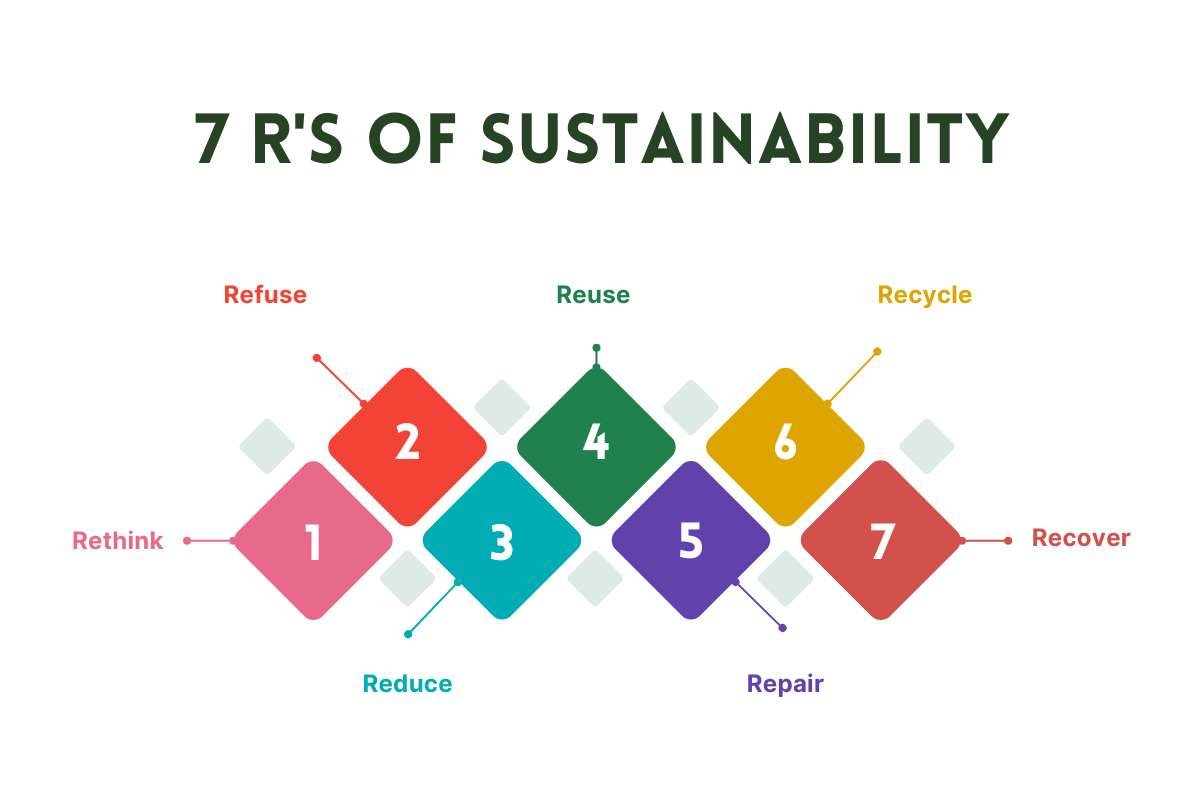
The 7 R’s of sustainability provide a practical framework for reducing resource consumption, minimizing waste, and supporting a circular economy. Increasingly, organizations are incorporating these principles into their business operations and reporting them through sustainability disclosures to demonstrate measurable environmental progress.
| The 7 R’s | What They Mean |
| Rethink | Design products, processes, and business models to reduce environmental impact from the outset. |
| Refuse | Avoid unnecessary or unsustainable materials, products, and packaging. |
| Reduce | Minimize the use of energy, water, raw materials, and other resources. |
| Reuse | Extend the life of products and materials by using them multiple times. |
| Repair | Maintain and repair products instead of replacing them prematurely. |
| Recycle | Convert waste into new materials, reducing landfill and resource extraction. |
| Recover | Recover energy or valuable resources from waste that cannot be reused or recycled. |
These principles play a growing role in corporate sustainability reporting because they provide measurable ways to demonstrate environmental performance. For example, companies often disclose reductions in waste generation, improvements in recycling rates, increased use of recycled materials, and initiatives that support circular economy business models. Reporting these outcomes helps stakeholders evaluate how effectively an organization is managing resources and reducing its environmental footprint.
Many organizations also adopt circular economy business models to keep materials in use for longer, reduce waste, and improve resource efficiency, making these initiatives easier to measure within sustainability reports.
By integrating the 7 R’s into everyday operations and tracking progress through clear sustainability KPIs, businesses can strengthen their ESG performance, support long-term resilience, and build greater trust with investors, customers, and regulators.
Conclusion:
Corporate sustainability reporting has evolved into a critical component of responsible business management. As investors, regulators, customers, and employees demand greater transparency, organizations can no longer rely on sustainability commitments alone; they must demonstrate measurable progress through credible, data-driven disclosures.
By adopting recognized ESG reporting standards, tracking meaningful sustainability KPIs, and reporting transparently across environmental, social, and governance pillars, businesses can strengthen stakeholder trust, improve decision-making, and stay ahead of evolving regulatory requirements. Equally important, avoiding greenwashing and embedding sustainability into long-term business strategy helps organizations build resilience and maintain a competitive advantage.
Ultimately, effective corporate sustainability reporting is about more than meeting compliance obligations. It’s about showing how a business creates lasting value for both its stakeholders and the planet. Companies that prioritize transparent, consistent, and evidence-based reporting today will be better positioned to navigate future challenges and lead in an increasingly sustainability-driven economy.
Corporate sustainability reporting is only one part of building a responsible and resilient organization. For a broader perspective on how reporting, ESG initiatives, sustainable leadership, and long-term business strategy work together, see our guide on women driving sustainable business.
Frequently asked questions (FAQs):
1. What is corporate sustainability reporting?
Corporate sustainability reporting is the process of measuring and disclosing a company’s environmental, social, and governance (ESG) performance to improve transparency, accountability, and stakeholder trust.
2. Is ESG reporting mandatory?
It depends on the country and the organization’s size. Many jurisdictions require ESG reporting for large listed companies, while others encourage voluntary disclosures.
3. What are ESG reporting standards?
ESG reporting standards are frameworks such as GRI, ISSB, SASB, TCFD, and CDP that help organizations measure and report sustainability performance consistently.
4. What makes a good ESG report?
A good ESG report includes measurable sustainability goals, material ESG issues, reliable data, recognized reporting standards, and transparent disclosure of both achievements and challenges.
5. What is the main purpose of sustainability reporting?
The main purpose of sustainability reporting is to communicate a company’s ESG performance, manage sustainability risks, build stakeholder trust, and support informed decision-making.