

International experience can be a stepping stone to executive leadership. Managing overseas operations, leading cross-border teams, and understanding international markets can strengthen a professional’s position for senior roles. Yet, Global Assignment Opportunities for Women remain disproportionately limited.
According to Mercer’s 2026 Long-Term Assignment Policies and Practices Survey, women account for approximately 25% of long-term international assignees on average, with a median of 20%. The imbalance reflects a wider leadership gap. LinkedIn’s 2026 State of Women in Leadership report found that women represent 44% of the global workforce but hold only 31% of leadership positions.
The gap raises an important question: Are women less interested in international careers, or are organizations overlooking qualified candidates during the selection process?
Global Assignment Opportunities for Women and the Roles They Miss
International assignments extend beyond relocating employees to overseas offices. They include several career-development opportunities:
- Long-term international assignments: Relocating for one to five years to manage overseas operations or business units.
- Short-term assignments: Working on international projects, market launches, and business transformations.
- International leadership rotations: Moving across regional offices to develop strategic and managerial experience.
- Cross-border projects: Collaborating with global teams on acquisitions, product launches, and business expansion.
- Regional leadership positions: Managing operations and teams across multiple countries.
These opportunities expose women to international decision-makers, strategic responsibilities, and leadership networks. Missing them can also mean missing experiences that organizations value when considering candidates for senior positions.
Why Women Miss Global Assignment Opportunities
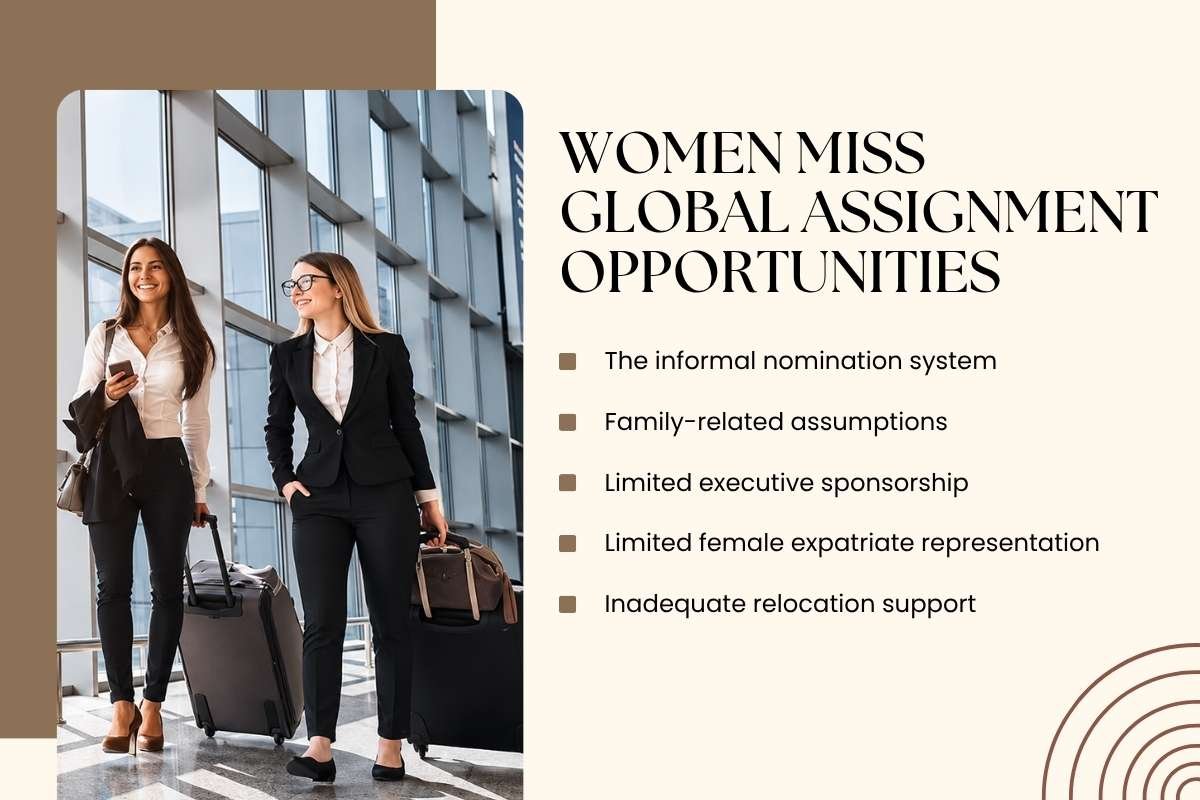
The barriers to Global Assignment Opportunities for Women often begin before employees are invited to apply.
1. The informal nomination system
International assignments are frequently offered through managerial recommendations and internal networks. When decision-makers repeatedly select employees they already know, qualified women outside these circles can be overlooked.
2. Family-related assumptions
Managers may assume that women with children or caregiving responsibilities will not relocate. However, these assumptions do not necessarily reflect an individual’s career ambitions or family arrangements.
3. Limited executive sponsorship
Women without senior advocates may have fewer opportunities to enter global talent pipelines. Mentors can offer career advice, but sponsors actively recommend employees for international projects and leadership positions.
4. Limited female expatriate representation
When fewer women occupy overseas leadership positions, organizations have fewer visible female role models. This can reinforce the perception that international assignments are traditionally suited to male employees.
5. Inadequate relocation support
Concerns about partner employment, childcare, healthcare, local safety, and dependent visas can make relocation difficult. Without appropriate organizational support, otherwise suitable assignments may become less accessible.
Research Shows Women Are Less Nominated – Bias, Assumptions and the Evidence
Research published in the Human Resource Management Journal in 2023, titled Female Expatriates on the Move? Gender Diversity Management in Global Mobility, examined 31 in-depth interviews with professionals involved in global mobility.
The study identified how gender stereotypes and gender-blind mobility policies can reinforce women’s underrepresentation in international assignments.
Three findings are particularly relevant:
- Assumed lack of interest: Managers may believe women are less willing to relocate because of family responsibilities without asking about their actual preferences.
- The host-country assumption: Concerns about how women will be received in certain cultures can influence selection decisions before their professional suitability is assessed.
- Unequal access to networks: Male-dominated decision-making networks can limit women’s visibility when international candidates are identified.
The study also highlighted a disconnect between corporate gender-diversity initiatives and global mobility policies. Organizations may promote women’s leadership while overlooking gender-related barriers in international assignment decisions.
Mercer’s 2026 findings reinforce the scale of the issue: women account for only one-fifth of long-term assignees at the median.
Therefore, improving Global Assignment Opportunities for Women requires examining not just who applies, but also who gets nominated, shortlisted, and selected.
How Organizations Can Close the Gender Mobility Gap

Addressing the challenges surrounding women and global mobility requires organizations to make international assignments more transparent, accessible, and inclusive. Beyond diversity commitments, companies must examine how women are identified, nominated, and supported for overseas roles. Five measures can help:
- Publish international vacancies: Advertise overseas positions internally instead of relying exclusively on informal recommendations.
- Conduct mobility assessments: Ask employees about relocation preferences during annual career discussions rather than assuming their availability.
- Modernize relocation packages: Include childcare assistance, partner career support, healthcare, and dependent relocation benefits.
- Introduce flexible assignments: Offer short-term placements, rotational programmes, commuter assignments, and virtual international projects.
- Strengthen executive accountability: Track nominations, selections, and assignment completion by gender. Include equitable talent development in leadership performance reviews.
These measures can make Global Assignment Opportunities for Women more accessible while strengthening the organization’s international talent pipeline.
How Women Can Evaluate Global Assignments Using the FIV Framework
Securing an international role is only one part of the decision. Women must also assess whether the opportunity supports their career ambitions and personal requirements.
The Family, Impact and VISA (FIV) framework offers three areas to evaluate:
1. Family (30%)
Assess childcare, eldercare, partner employment, dependent relocation, housing, healthcare, and local safety.
2. Impact (40%)
Evaluate leadership responsibilities, international exposure, decision-making authority, compensation, and post-assignment career progression.
3. VISA (30%)
Check work authorization, dependent visas, employer sponsorship, renewal requirements, and repatriation arrangements.
For example, a higher-paying overseas role may offer limited leadership responsibility and inadequate family support. Comparing both opportunities through FIV helps women assess the overall career value rather than focusing only on salary.
This framework makes Global Assignment Opportunities for Women easier to evaluate against professional goals, family requirements, and immigration security.
Global Mobility Challenges and Organizational Solutions

| Barrier | Organizational solution |
| Low nomination rates | Transparent selection criteria |
| Family-related assumptions | Direct mobility preference assessments |
| Partner relocation concerns | Dual-career assistance |
| Perceived leadership risk | Objective evaluation frameworks |
| Limited female role models | Executive sponsorship programmes |
| Rigid relocation policies | Flexible assignment structures |
Business Perspective: Excluding women from international assignments can weaken succession planning and restrict access to qualified leadership talent. Organizations that improve nomination practices and relocation support can build stronger global talent pipelines while creating more equitable career opportunities.
Conclusion:
Global Assignment Opportunities for Women must be driven by professional merit, leadership potential, and career ambitions rather than gender-based assumptions. Transparent selection processes, executive sponsorship, and inclusive relocation support can help organizations ensure that qualified women have equal access to international assignments and the leadership opportunities they create.
FAQs
1. What are global assignment opportunities for women?
These include overseas placements, international leadership rotations, cross-border projects, and regional management roles that provide women with global exposure and career development.
2. Why are women underrepresented in international assignments?
Managerial assumptions, informal nomination networks, limited sponsorship, and inadequate relocation support can restrict women’s access to international positions.
3. How does gender bias affect international assignment nominations?
Managers may assume women are less willing to relocate or face greater family-related constraints. These assumptions can influence candidate selection without considering individual preferences or capabilities.
4. How can women prepare for international assignments?
Women can build cross-cultural leadership skills, communicate mobility preferences, develop global networks, and negotiate relocation benefits before accepting an overseas position.
5. What should organizations do to improve women’s global mobility?
Organizations should introduce transparent nominations, track gender representation, provide family-inclusive relocation support, and connect women with senior sponsors.