

A board seat can give a woman professional the opportunity to contribute to strategy, risk, growth, governance, and major business decisions. But finding a board role often requires a different approach from searching for a traditional job.
Understanding how to find open board positions as a woman professional starts with knowing where organizations look for directors and what expertise they need.
Women held 28.3% of global board seats in 2025, according to MSCI. In India, women represented 20.4% of directors at BSE 100 companies in 2025, showing continued progress alongside an ongoing representation gap. Finding open board positions as a woman professional can help more qualified women enter these opportunities.
For women professionals, the goal is not simply to locate a vacancy. It is to identify boards where their experience addresses a genuine governance or business need.
Where can women find open board positions?
Open board positions as a woman professional are not always advertised like traditional jobs. Women can uncover potential openings through:
- Board networks and platforms: Organizations such as NACD and BoardProspects connect professionals with companies seeking directors.
- LinkedIn and professional associations: These can help women connect with directors, executives, founders, and governance professionals who may know about upcoming opportunities.
- Nonprofit organizations: Board-matching programs and professional networks can provide opportunities to gain governance experience.
- Direct outreach: Research organizations that interest you, identify where your expertise could add value, and contact relevant leaders about potential board opportunities.
6 ways to find board opportunities as a woman professional
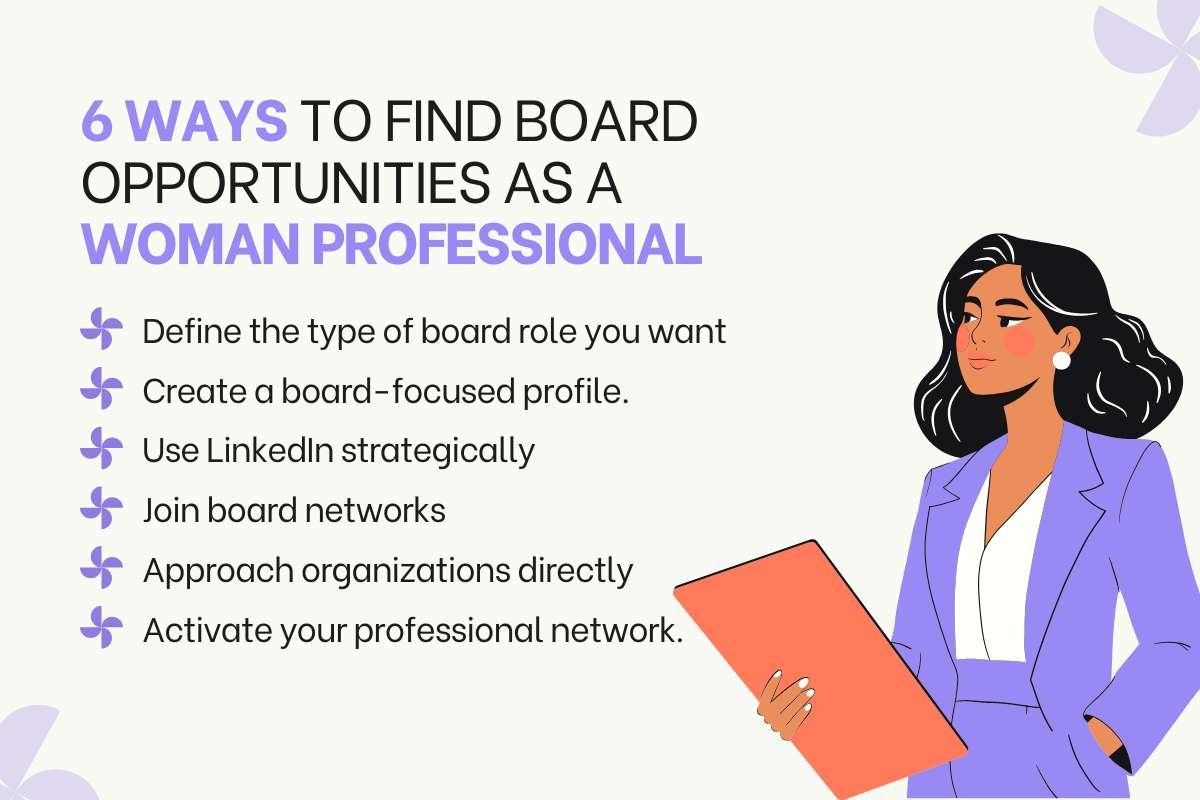
The first step in finding open board positions as a woman professional is to identify the type of board role that matches your experience.
1. Define the type of board role you want
Start by deciding which opportunities fit your experience:
- Public company boards
- Private company boards
- Startup or advisory boards
- Nonprofit boards
- Industry associations
- Family-owned businesses
Then identify the expertise you can bring. If you are pursuing your first opportunity, understanding how to get your first board seat as a woman can help you define the right targets and position your experience clearly.
2. Create a board-focused profile.
Your executive résumé is not automatically a board résumé.
Highlight experiences that demonstrate strategic judgment, risk oversight, financial responsibility, transformation, stakeholder management, and leadership.
Instead of simply saying you “led digital transformation,” show the scale and governance relevance of the work, such as managing technology investment, operational risk, or enterprise-wide change.
3. Use LinkedIn strategically
Your LinkedIn profile can act as a public board profile.
Highlight advisory roles, committee experience, nonprofit involvement, and specialist expertise. If appropriate, mention your interest in board service in your headline or About section.
You can also research board chairs, governance committee members, and directors at organizations that interest you.
4. Join board networks
Board networks can widen access to opportunities outside your existing circle.
For nonprofit roles, BoardSource recommends board-matching programs, professional associations, and community networks. For corporate opportunities, organizations such as NACD and BoardProspects can help connect potential directors with companies.
5. Approach organizations directly
If an organization aligns with your experience, do not assume you must wait for a vacancy to be posted.
Study its current board and identify possible expertise gaps. Then make a concise introduction explaining your experience, the value you could contribute, and your interest in board service.
6. Activate your professional network.
Tell trusted colleagues, former managers, clients, and industry contacts that you are pursuing board opportunities.
Be specific.
Instead of saying, “I am looking for a board role,” explain that you are interested in, for example, private-company boards where your expertise in technology transformation, cybersecurity, or scaling operations could be useful.
How to identify the right board position?
Knowing how to find open board positions as a woman professional is only the first step. Women professionals should also understand what board directors actually do and how women on corporate boards contribute to governance, strategy, and oversight. This can help them assess whether a board is a good match for their experience and goals.
Consider:
| What to check | Why it matters |
| Board type | Public, private, and nonprofit boards have different expectations |
| Skills needed | Your expertise should address an actual board requirement |
| Company stage | Different stages require different capabilities |
| Time commitment | Meetings, committees, and preparation can require significant time |
| Conflicts of interest | Existing roles or investments may create conflicts |
| Financial position | Understand the organization’s financial health and risks |
For nonprofit roles, also examine the organization’s mission, financial position, board structure, and expectations before accepting a seat.
How women can make their board profiles more visible?

A senior job title alone does not always communicate board readiness. Knowing how to build a board profile that gets you noticed can help women present their experience in a way that is relevant to board-level opportunities.
Women should highlight experiences that demonstrate judgment, oversight, and strategic leadership, all of which connect closely to the roles and responsibilities of women on corporate boards , such as:
- Managing significant budgets or P&L responsibility
- Leading enterprise transformation
- Handling regulatory or compliance issues
- Managing cybersecurity or technology risk
- Leading acquisitions or investments
Specialized expertise can also matter. Technology, AI, cybersecurity, sustainability, and financial
expertise are among the skills most valued in board directors, particularly when they address a board’s current needs.
Can women get board positions without previous board experience?
Yes. Previous board service helps, but it is not the only pathway. Women can build relevant governance experience through nonprofit boards, advisory roles, professional associations, strategic committees, and other leadership positions involving oversight.
Board readiness programs for women can also help professionals understand board expectations and prepare for director opportunities.
In 2025, women accounted for 47% of first-time S&P 500 director appointments, according to Spencer Stuart.
Finding open board positions as a woman professional is not just about prior board experience, but also about the expertise and perspective a woman can bring to a board’s current needs.
How to check whether a board opportunity is legitimate?

Not every message offering a board position represents a genuine opportunity.
Before sharing sensitive information or paying any fee, verify:
- The organization’s legal identity and website
- Existing directors and leadership
- The board’s responsibilities
- The reason for the vacancy
- Expected time commitment
- Compensation and expenses
- Conflicts-of-interest requirements
- The appointment process
Be especially cautious about unsolicited offers promising a guaranteed board seat in exchange for an upfront payment.
Conclusion:
Knowing how to find open board positions as a woman professional involves more than searching job listings. Board networks, LinkedIn, professional associations, nonprofit organizations, and direct outreach can all create pathways into the boardroom.
For women building a board career, the strongest starting point is to define the expertise they offer, make that expertise visible, and connect with organizations where those capabilities match a genuine board need.
FAQs
1. How do I find open board positions?
Use board networks, LinkedIn, professional associations, nonprofit matching programs, and executive search firms. Direct outreach can also uncover opportunities that are never publicly advertised.
2. Can I get a board position without board experience?
Yes. Nonprofit, advisory, committee, and leadership experience can demonstrate relevant skills, while specialized executive expertise may address a board’s specific needs.
3. Are board positions usually advertised?
Not always. Some are posted publicly, while others are sourced through professional networks, referrals, search firms, and board-matching services.
4. Do women get paid for board positions?
It depends on the board. Corporate directors are generally compensated, while nonprofit board roles are often unpaid. Compensation varies by organization and role.
5. How do I know if a board opportunity is legitimate?
Research the organization, its directors, governance structure, and appointment process. Ask about responsibilities, compensation, time commitment, and conflicts before accepting the role.