
A strong executive track record does not always prove board readiness. A CEO may grow sales, lead teams, and drive profits. Yet, a board director must ask harder questions about risk, governance, and long-term value.
Imagine a nomination committee choosing between two experienced women executives. One excels at business growth. The other combines growth experience with financial insight and independent judgment. The committee must assess which skills match its board’s needs.
These skills are most valued in board directors and extend beyond daily management. They include strategic judgment, financial oversight, and constructive challenge. For women seeking board seats, showing these skills matters as much as gaining senior experience.
The G20/OECD Principles of Corporate Governance highlight independent judgment, risk oversight, and strategic guidance as key board responsibilities.
For aspiring women directors, this guide examines what skills are most valued in board directors, how they shape decisions, and how professionals can show board-level readiness.
Why do board director skills differ from executive skills?
A strong executive knows how to drive results. A board director must judge whether those results support long-term value. This difference shapes the skills most valued in board directors.
Executives manage daily work, budgets, and teams. Directors review management decisions and challenge plans when risks arise. They must also respect the line between oversight and daily control. These skills are most valued in board directors.
For example, an executive may propose an AI investment to cut costs. A director should ask about data risks, capital needs, business value, and accountability. The goal is not to run the project. It is to test whether management has made a sound choice.
Directors also bring finance, legal, technology, and industry expertise. Yet, their value grows when they apply that knowledge to shared board decisions. They must weigh short-term gains against resilience, stakeholder needs, and future risks.
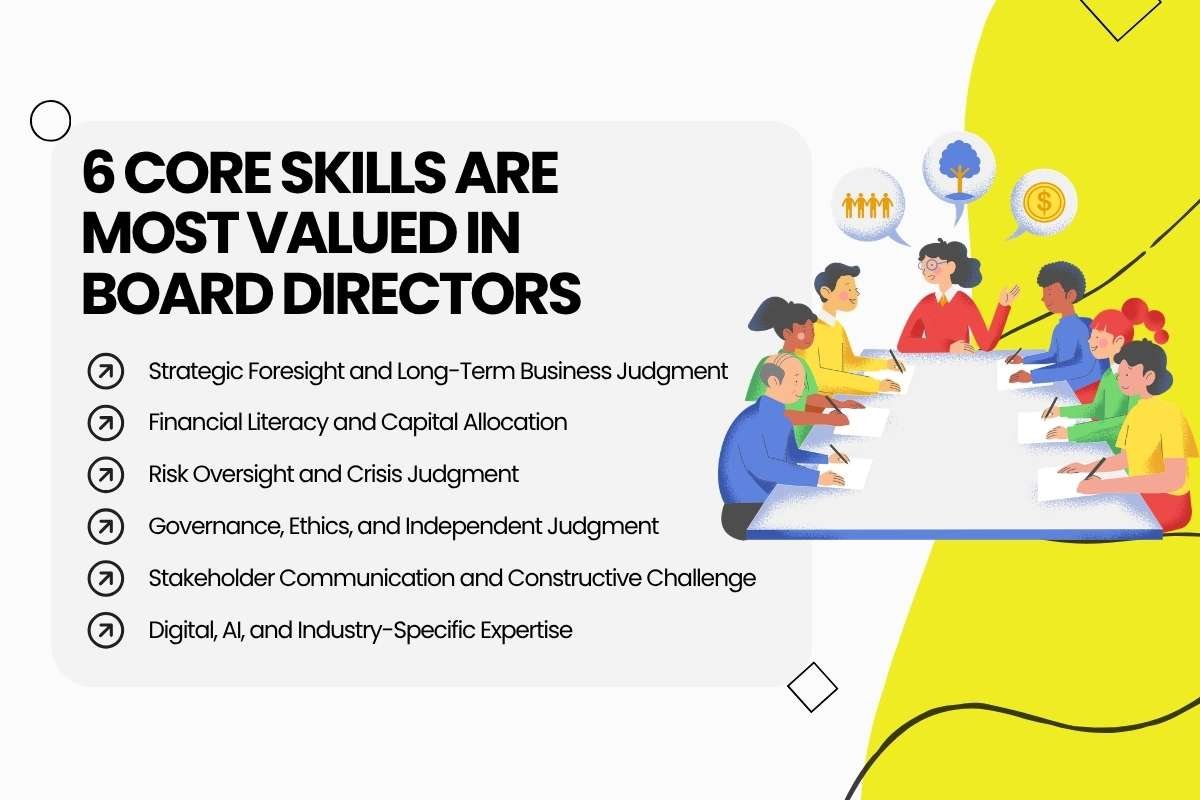
These 6 core skills are most valued in board directors
A boardroom needs more than senior leaders with strong business records. Directors must assess choices, question risks, and protect long-term company value. The skills most valued in board directors often depend on the company’s needs, board structure, and industry.
For women professionals, this means looking beyond job titles. Your experience in finance, operations, technology, or law can add value. The key lies in applying that experience to oversight and collective decisions.
The following six competencies show what board-level contribution looks like in practice.
1. Strategic foresight and long-term business judgment
A director must test whether a company’s strategy can last. Strong presentations alone cannot prove that a plan will work.
Consider an Indian company planning expansion into a new state. A director should question customer demand, capital needs, local rules, and operational strain. They must also assess whether growth targets rest on sound evidence.
The goal is not to reject ambitious plans. It is to test their assumptions and weigh growth against resilience. This makes strategic judgment skills are most valued in board directors.
2. Financial literacy and capital allocation
Financial literacy helps directors understand what business numbers really mean. A profitable company may still face cash shortages or rising debt.
Directors should review cash flow, forecasts, capital spending, and borrowing exposure. They should ask questions such as:
- What supports the projected revenue growth?
- How would higher borrowing costs affect this plan?
- Can cash generation support the proposed expansion?
A director need not hold an accounting qualification. However, they should read financial reports and challenge weak assumptions. Financial judgment helps the board assess whether investment choices match company capacity.
3. Risk oversight and crisis judgment
Every business faces risk. Directors must understand which risks could harm strategy, finances, or trust.
A cyberattack offers one practical example. Directors should ask about customer impact, recovery plans, reporting duties, and communication. They do not need to manage the incident themselves.
Strong risk judgment means making sound choices with incomplete information. It also means checking whether management tracks material risks and follows the company’s risk appetite. India’s RBI guidance for regulated entities highlights board oversight of cybersecurity, business continuity, and information security.
4. Governance, ethics, and independent judgment
Good governance depends on directors who can question decisions fairly. They must understand conflicts of interest, confidentiality, and their legal duties.
A director may support a popular proposal yet request more evidence. They may also disclose a personal connection to a related-party transaction. These actions show independence through conduct, not just formal status.
For Indian listed companies, SEBI’s governance framework addresses independent judgment, financial information, and related-party transactions. Legal duties vary by company type and jurisdiction, so candidates should study the rules that apply to their prospective board.
5. Stakeholder communication and constructive challenge
Board communication involves more than speaking with confidence. Directors must ask clear questions, listen well, and raise concerns at the right time.
Imagine a board reviewing a weak quarterly result. One director may ask about falling demand. Another may question the forecast and recovery plan. Their combined questions can improve the board’s understanding without turning the meeting into an operational review.
Constructive challenge helps directors test assumptions without creating needless conflict. The goal is better collective judgment, not winning every debate.
6. Digital, AI, and industry-specific expertise
Technology knowledge becomes valuable when it supports better oversight. Directors should understand how digital systems affect costs, customers, data, and risk.
A woman with experience in India’s fintech sector, for example, may bring useful insight into digital payments and fraud controls. She need not build an AI model. However, she should ask about data quality, model accountability, privacy, and business value.
The RBI has highlighted board questions around AI bias, cybersecurity, third-party risks, and consumer protection in banking. This shows how technology expertise can support board-level judgment.
The key takeaway: These skills are most valued in board directors, depending on how professionals apply expertise. Strong candidates connect their experience to strategic choices, risk oversight, and accountable decisions.
How women can demonstrate these skills to get board-ready?

Strong experience matters more when you can show its board-level value. A woman executive should connect past decisions to governance, risk, and long-term outcomes. So, how to build a board profile? Let’s talk about it
For example, a technology leader should move beyond saying, “I led digital transformation.” A board-focused profile might show how she assessed technology risk, funding needs, data controls, and business value.
A similar approach works for finance, operations, legal, and regulatory experience. Record the scale of each project, the trade-offs you faced, and the results you achieved. Keep company information confidential.
Next, match your skills to actual board needs. An audit committee may value financial reporting experience. A technology committee may need expertise in AI, data, or cybersecurity. Your profile should show the connection clearly.
Independent thinking also needs clear evidence. Note moments when you challenged assumptions, weighed risks, or supported difficult choices.
Director education and governance training can help build knowledge. Board observation opportunities may also improve your understanding of meeting dynamics. However, completing a course cannot guarantee a board appointment.
As you prepare, focus on why these skills are most valued in board directors and document relevant proof. You can then develop these skills more strongly and with more efficiency.
Which skills should an aspiring woman director develop first?
There is no single skill set that fits every board. Start with your strongest expertise and test it against the board’s actual needs.
A finance leader may need deeper governance knowledge and industry risk insight. A technology leader may need stronger financial literacy and board oversight skills. An entrepreneur may need more experience with formal governance, risk, and independent challenge.
The board type also matters. A listed company may face stricter reporting and regulatory demands. A startup may need capital judgment and scale expertise. A family business may need governance and succession insight.
Review the board’s industry, strategy, committees, and risk profile first. Then choose development areas that close clear gaps. Board readiness programs for women can provide structured paths for building these capabilities.
How board skills are evaluated during director selection?

A strong résumé alone cannot show whether someone fits a board’s needs. Nomination committees review experience, governance knowledge, and gaps in existing board expertise.
A board skills matrix helps map the knowledge and experience across current directors. It also shows where the board needs stronger capabilities.
In India, women held around 21% of board seats and 28% of independent directorships as of February 2026, according to data reported by the National Institute of Securities Markets from Prime Database. Representation, however, does not remove the need to match each appointment with specific board requirements. So, the entire thing comes down to which skills are most valued in board directors regardless of sex and gender.
For example, a company entering regulated overseas markets may need expertise in compliance, international operations, finance, and technology risk. The committee may compare these needs with current board strengths and succession plans.
Selection also depends on legal eligibility, director duties, and company structure. Listed companies, private businesses, and nonprofits may follow different rules.
Women preparing for board appointments should build evidence around the skills they offer. Learning how to get your first board seat as a woman can help candidates understand how to present this evidence during the selection process.
Conclusion:
Many of these skills are most valued in board directors because they extend beyond seniority or executive success. Strategic judgment, financial literacy, risk oversight, governance knowledge, and constructive challenge help directors make sound decisions. However, each skill’s value depends on the company’s strategy, industry, and oversight needs.
Women on corporate boards can strengthen board readiness by documenting relevant experience. They can be developing governance knowledge and studying the needs of their target boards. The practical next step is to identify your strongest board-level skills. Then find clear evidence of them, and address the gaps that may affect your contribution to a specific board.
Frequently asked questions:
1. What skills are most valued in board directors?
Key skills include strategic judgment, financial literacy, risk oversight, governance awareness, and clear communication. The right mix depends on the company’s needs and board duties.
2. What skills should women develop to become board directors?
Women should build governance knowledge, financial understanding, risk awareness, and strategic oversight skills. Industry expertise should match the needs of their target boards.
3. Is financial knowledge necessary for a board director?
Yes, directors need basic financial literacy to assess performance, cash flow, capital allocation, and financial risks. They do not need to qualify as professional accountants.
4. How does technology expertise help board directors?
Technology expertise supports oversight of AI, cybersecurity, data governance, and digital strategy. It also helps directors assess technology investments and related risks.
5. How can women demonstrate board-level skills?
Women can show relevant executive experience, governance training, and committee exposure. They should also share examples of strategic decisions, risk judgment, and constructive challenge.