
A seat on a corporate board can be an important next step for an experienced woman leader. But becoming a board director requires more than reaching a senior position or spending years managing a business. Directors need to understand governance, financial performance, risk, strategy, executive oversight, and their legal responsibilities.
This is where board readiness programs for women can play an important role. These programs are designed to help experienced women understand how boardrooms work, identify the expertise they can bring to a board, and develop the skills needed to contribute effectively.
The opportunity is growing, but the representation gap has not disappeared. Women held 28.3% of board seats globally in 2025, according to MSCI. At the same time, women continued to be underrepresented in board leadership roles.
For women considering a board career, preparation should therefore go beyond simply securing a seat. The goal should be to enter the boardroom with the knowledge, confidence, and judgment needed to make a meaningful contribution.
What Are Board Readiness Programs for Women?
Board readiness programs for women are structured learning and development programs that prepare experienced women for corporate board responsibilities.
Unlike traditional leadership programs, which often focus on managing teams or growing a business, board programs focus on governance and oversight.
Participants may learn how to:
- Understand directors’ duties and responsibilities
- Read and question financial statements
- Evaluate corporate strategy
- Assess business and emerging risks
- Understand the relationship between the board and CEO
- Participate effectively in board discussions
- Handle conflicts of interest
- Prepare for board interviews and nominations
- Build a credible board profile
- Develop relationships within the board and governance ecosystem
The best programs do not promise a board seat simply because someone completes a course. Instead, they help women translate their existing leadership experience into skills that are relevant at board level.
That distinction is important. Being a successful executive and being an effective director require overlapping but different capabilities.
An executive is generally involved in running the business. A director, as explained in what board directors actually do, is responsible for overseeing management, challenging important decisions, and protecting the long-term interests of the company and its stakeholders.
Why Do Women Need Board Readiness?
Women are making progress in board representation, but the numbers show that there is still room to grow.
The OECD reported that women held around 29% of board positions across the jurisdictions covered in its 2024 data. However, women occupied only around 10% of board chair positions at large listed companies. These representation trends are also shaped by board diversity mandates around the world in 2026, which are influencing how companies approach board composition and gender diversity.
In India, women held 19.4% of listed-company board positions in 2024, according to OECD data.
These figures highlight an important point: getting more women into boardrooms is only one part of the equation. Preparing women to participate, influence decisions, and eventually take on board leadership roles matters too.
Women entering the boardroom may also be moving into an environment that differs considerably from their previous leadership roles. A senior executive may be accustomed to having direct authority over budgets, teams, and business decisions. A director instead works through oversight, questioning, judgment, and collective decision-making.
Board preparation can help make that transition clearer.
It can also help women identify the expertise they already possess. A woman with years of experience in finance, technology, operations, marketing, cybersecurity, sustainability, or international expansion may have highly relevant board expertise but may not know how to present it in a board context.
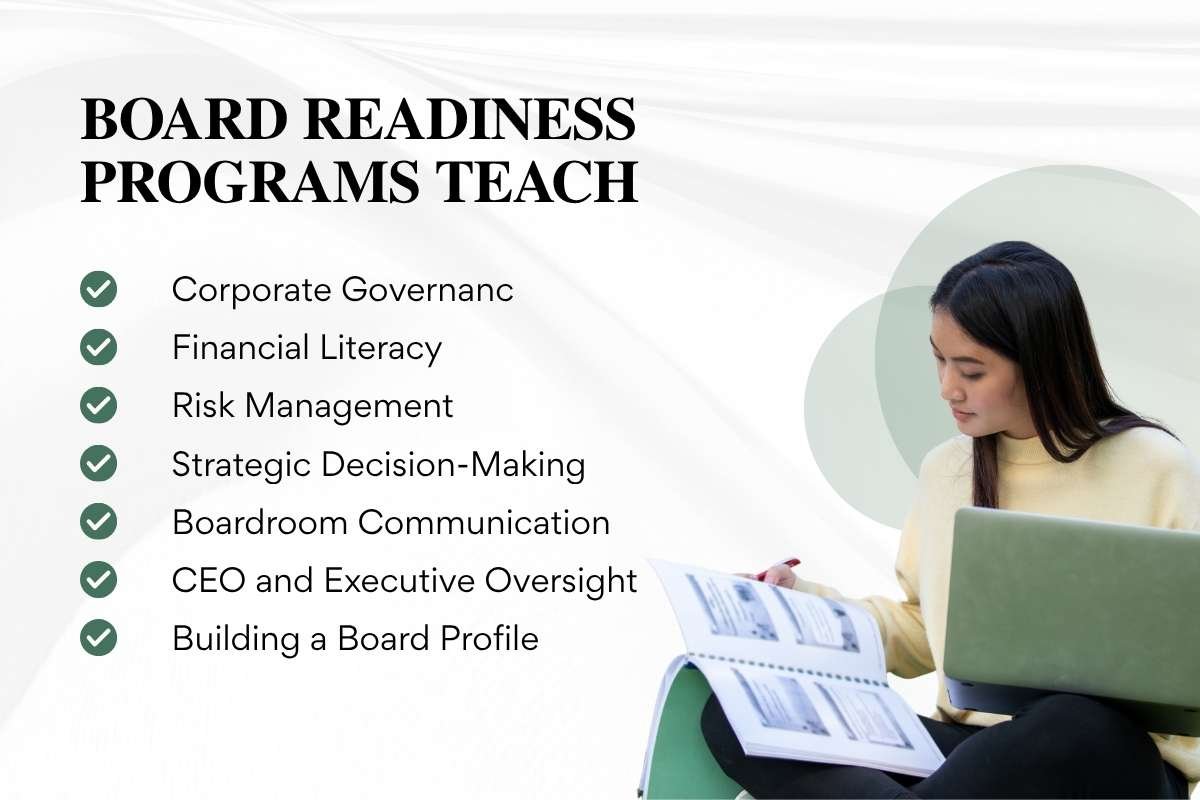
What Do Board Readiness Programs Teach?
The exact curriculum differs between programs, but several areas are particularly important for women preparing for board roles. Understanding how boards function and the broader landscape of women on corporate boards can also help women see where their expertise fits within today’s boardroom.
1. Corporate Governance
Governance is the foundation of board work.
Women preparing for a board seat need to understand how boards are structured, how committees function, how decisions are documented, and what responsibilities directors have.
This can include learning about:
- Fiduciary duties
- Director independence
- Conflicts of interest
- Shareholder interests
- Board committees
- Regulatory obligations
- Confidentiality
- Corporate accountability
Understanding these principles helps women approach board discussions with greater clarity and confidence.
2. Financial Literacy
A director does not necessarily need to be a finance professional, but financial literacy is essential.
Board members should be able to read financial statements and understand the company’s financial position well enough to ask meaningful questions.
For example, directors may need to understand:
- Revenue and profitability trends
- Cash flow
- Debt levels
- Capital allocation
- Financial risks
- Major investments
- Cost pressures
A board readiness program can help women become more comfortable with financial information and identify the questions they should ask before approving major decisions.
3. Risk Management
Boards have an important role in overseeing risk.
Today’s directors may need to consider traditional financial and operational risks alongside cybersecurity, data privacy, geopolitical uncertainty, regulatory changes, climate-related risks, and emerging technology.
Women preparing for board roles should learn to ask not only, “What is the risk?” but also:
How significant is it? Who owns it? What controls are in place? And what happens if those controls fail?
That shift from identifying problems to evaluating management’s response is an important part of board-level thinking.
4. Strategic Decision-Making
Directors are expected to look beyond immediate business performance.
They need to consider whether the company’s strategy can support sustainable growth over the long term.
Board readiness programs for women can help women develop this perspective through case studies and strategic scenarios.
The focus is less on telling management what to do and more on testing the assumptions behind important decisions.
5. Boardroom Communication
Being qualified is not enough. Directors also need to contribute effectively in the boardroom.
Women may need to challenge a CEO, question financial assumptions, disagree with another director, or raise an uncomfortable concern.
Effective board communication should be clear, evidence-based, and constructive.
For women who have spent most of their careers in executive roles, learning how to challenge without moving into operational control can be particularly valuable.
6. CEO and Executive Oversight
The board and CEO have different roles.
The CEO is generally responsible for managing the company’s operations, while the board provides oversight and holds management accountable.
A board may evaluate the CEO’s performance, oversee succession planning, and make significant governance decisions. Understanding the broader roles & responsibilities of women on corporate boards can help first-time directors distinguish these oversight responsibilities from the operational duties of executives. However, individual directors should generally avoid becoming involved in day-to-day management.
Understanding this boundary is one of the most important lessons for a first-time director.
7. Building a Board Profile
An executive résumé and a board profile are not the same thing. For women preparing for board service, building a board profile that gets you noticed means translating executive achievements into the expertise, strategic judgment, and industry perspective a board needs. A detailed guide on how to build a board profile that gets you noticed can help women make that transition more effectively.
For example, instead of simply saying that a woman led a technology division, her board profile could highlight experience in digital transformation, cybersecurity oversight, technology strategy, and managing technology-related business risks.
This makes her expertise easier for nomination committees and board search professionals to understand.
What Skills Should Women Build Before Joining a Board?
There is no single checklist that guarantees board readiness. However, several capabilities are particularly valuable, and understanding the skills most valued in board directors can help women identify where their existing experience is strongest and where they may need further development.
- Strategic judgment: Directors must understand how today’s decisions affect the company several years from now.
- Financial understanding: Women should be comfortable discussing financial performance, capital allocation, and financial risks.
- Governance knowledge: A director needs to understand the responsibilities that come with the position.
- Risk oversight: The ability to identify material risks and question management’s response is essential.
- Industry expertise: Specialized knowledge can make a candidate particularly valuable when it matches a board’s capability gaps.
- Communication: Directors need to communicate clearly and make concise, well-supported contributions.
- Constructive challenge: Effective directors should be comfortable asking difficult questions without turning disagreement into conflict.
- Technology awareness: AI, cybersecurity, data, and digital transformation are increasingly relevant to board-level discussions.
- Crisis judgment: Directors may need to make decisions during periods of financial, regulatory, reputational, or operational pressure.
A woman does not need to master every area before pursuing a board seat. Instead, she should understand her strongest contribution and continue developing areas where her board knowledge is limited.
How Much Power Does a Board of Directors Have?
Understanding board authority is essential for anyone considering board service.
The board generally oversees the company’s direction, governance, and management. The CEO, on the other hand, is responsible for running the company within the authority delegated by the board.
Depending on the company’s structure and applicable law, the board may appoint or remove the CEO, approve major strategic decisions, oversee financial performance, approve significant transactions, and monitor major risks.
However, directors should not confuse oversight with management.
A board member should not normally be instructing employees, managing departments, or making everyday operational decisions.
This distinction is particularly important for first-time directors because moving from executive authority to board oversight requires a different mindset.
What Should Board Members Not Do?
A strong board director understands both what to do and what to avoid.
Board members should not:
- Micromanage management
- Interfere with everyday operations
- Ignore conflicts of interest
- Make decisions without adequate information
- Share confidential board information
- Treat the board position as an honorary title
- Avoid difficult conversations
- Allow personal relationships to influence independent judgment
For women entering boards, confidence should not mean speaking the most. It should mean being willing to ask the right question when it matters.
A director’s responsibility is not to prove that she knows everything. It is to exercise informed and independent judgment.
What Are the Risks of Being a Board Director?

Board membership can provide valuable professional opportunities, but it also carries responsibility.
Directors can face legal, financial, and reputational risks depending on the company, jurisdiction, and circumstances.
Before accepting a board position, women should examine:
- The company’s financial health
- Pending litigation
- Regulatory issues
- Major business risks
- Existing conflicts of interest
- Expected time commitment
- Committee responsibilities
- Director and officer insurance
- Indemnification provisions
- The company’s governance history
A board seat should never be accepted solely because the title sounds prestigious. Board readiness programs for women can also help prospective directors assess the questions to ask before accepting a board seat, from governance and financial health to time commitment and potential conflicts of interest. Women should conduct their own due diligence and understand what they are taking responsibility for.
How Can Women Choose the Right Board Readiness Program?
Not every program will provide the same value. Women considering one should look beyond the certificate.
1. Look at the curriculum.
A strong program should cover governance, financial oversight, risk, strategy, board dynamics, and directors’ responsibilities.
2. Check the faculty
Experienced directors, board chairs, governance professionals, and senior executives can bring practical insight into how boards actually operate.
3. Look for practical exercises.
Case studies, simulations, and boardroom exercises can help participants practise asking questions and handling difficult decisions.
4. Evaluate the network
A strong peer and alumni network can create relationships that remain useful throughout a board career.
5. Consider mentoring
Access to experienced board members can help women understand the realities of board service beyond what is covered in a classroom.
6. Examine the board pathway.
A program should ideally help participants understand how board appointments happen, how to position their expertise, and how to approach potential opportunities.
Most importantly, women should avoid choosing a program simply because it promises quick access to a board seat. No legitimate program can guarantee an appointment.
How Can Women Become Board-Ready Beyond a Program?

For women ready to move from preparation toward appointment, how to get your first board seat as a woman provides the next step in understanding how to position your experience, build visibility, and pursue appropriate board opportunities.
Women can continue preparing by developing governance experience, strengthening financial knowledge, and building relationships with people involved in board appointments.
They can also:
- Build a board-focused profile: Highlight strategic impact, specialized expertise, and governance-relevant experience.
- Develop a clear board value proposition: Know exactly what expertise they can bring to a board.
- Expand their network: Connect with experienced directors, board chairs, investors, governance professionals, and executive search specialists.
- Understand emerging board priorities: Technology, AI, cybersecurity, sustainability, risk, and geopolitical issues can all influence board requirements.
- Consider appropriate advisory or nonprofit experience: Nonprofit board experience can provide exposure to governance and collective decision-making, although it does not automatically substitute for corporate board experience.
- Research companies carefully: Women should understand a company’s strategy, leadership, financial position, and risks before pursuing or accepting a seat.
The goal is not to collect as many credentials as possible. It is to build a credible combination of experience, expertise, and judgment.
Are Board Directors Paid?
Yes, board directors can be compensated, although the amount varies significantly by company, market, board role, and responsibilities.
Independent directors may receive annual retainers, meeting fees, committee fees, equity compensation, or a combination of these.
In India, board compensation has increased in recent years. Spencer Stuart reported significant growth in average remuneration for independent directors and independent board chairs among BSE 100 companies between 2019 and 2025.
For women considering board readiness programs for women, compensation should not be the only factor when evaluating a board opportunity.
A well-paid board position can still be a poor choice if the company has significant governance concerns, an unreasonable workload, conflicts of interest, or risks that the prospective director has not adequately assessed.
What Does Board Readiness Look Like for Women?
Board readiness can be viewed as a progression:
Seat → Participation → Influence → Leadership
The first step is securing a board position.
The second is becoming an active and informed participant.
The third is developing enough credibility that other directors value your judgment and perspective.
The fourth is taking on greater leadership responsibility, such as chairing a committee, becoming a lead independent director, or eventually serving as board chair.
This progression matters because the goal should not simply be to increase the number of women sitting around a board table.
Women should have the opportunity to participate meaningfully, influence decisions, and take on board leadership roles.
A woman does not need to represent all women in the boardroom. She needs to bring relevant expertise, independent judgment, and a willingness to contribute to the company’s long-term success.
Conclusion:
Board readiness programs for women can provide a structured path for experienced women who want to move toward corporate board service.
The most valuable programs go beyond certification. They help women understand governance, strengthen financial and strategic skills, practise boardroom communication and clearly articulate the expertise they can bring to a board.
But readiness does not end when a program does.
Women who want to build lasting board careers should continue developing their expertise, understanding governance, expanding their networks and carefully evaluating every board opportunity.
A board seat is not simply another leadership title. It is a position of responsibility, judgment, and accountability.
For women aspiring to the boardroom, the real objective should be more than getting a seat. It should be entering that room prepared to ask better questions, challenge constructively, and contribute with confidence.
FAQs
1. What are board readiness programs for women?
Board readiness programs for women are structured programs that prepare experienced women for board service through governance education, financial training, boardroom practice, networking, and board-profile development.
2. Who should join a board readiness program?
Senior executives, entrepreneurs, business leaders, and experienced professionals with expertise relevant to board-level decision-making can benefit from these programs.
3. Do I need to be a CEO to become a board director?
No. Boards need expertise across areas such as finance, technology, cybersecurity, law, operations, marketing, sustainability, risk, and international business. CEO experience is valuable but is not the only pathway.
4. How do I know if I am board-ready?
You are more likely to be board-ready when you have relevant expertise, strategic judgment, financial understanding, governance knowledge, and the ability to contribute independently to board discussions.
5. Can a board readiness program guarantee a board seat?
No. A strong program can improve your skills, knowledge, profile and network, but it cannot guarantee a board appointment. Board selection depends on the company’s needs, the candidate’s expertise, governance requirements, and the overall nomination process.