

A woman can have a seat at the board table without having a meaningful voice at it. That is why understanding the roles & responsibilities of women on corporate boards matters as representation grows worldwide.
Women held 28.3% of board seats at large- and mid-cap companies globally in 2025, according to MSCI. Yet representation in senior board leadership continues to lag. The focus is therefore shifting from how many women hold board seats to how effectively they contribute and influence decisions.
The roles & responsibilities of women on corporate boards are the same as those of other directors: overseeing strategy, financial performance and risk, challenging management, supporting succession planning, and protecting long-term interests. Committee assignments and specialist expertise can further strengthen a director’s influence.
Understanding these responsibilities means looking beyond representation to how women can contribute, influence, and lead in the boardroom.
Where women can shape corporate decisions?
Boards shape strategy, risk, leadership, and long-term growth. Women bring diverse expertise and perspectives that can challenge assumptions, identify risks, and fill critical capability gaps. Their value comes from expertise, experience, independence, and judgment, not gender alone.
| Board Area | Potential Contribution |
| Corporate strategy | Challenge assumptions, evaluate growth opportunities, and consider long-term competitiveness |
| Capital allocation | Scrutinize investments, acquisitions and financial priorities |
| Risk management | Examine enterprise, cybersecurity, regulatory and emerging risks |
| Technology and AI | Assess digital transformation, AI adoption and data governance |
| Talent and succession | Evaluate leadership pipelines and CEO succession |
| Governance | Strengthen accountability, independence and board effectiveness |
| Sustainability | Examine material environmental, social and governance risks |
The OECD reported that women held 29% of board positions on average across covered jurisdictions in 2024, while only 10% of large listed companies had a female board chair.
That gap highlights an important next step: moving from representation to meaningful influence and leadership.
What does a woman director actually do?
At its most basic level, a woman director does what every effective corporate director should do: oversee, question, evaluate, and exercise independent judgment. These are also the fundamentals of what board directors actually do across different types of companies and governance structures.
A woman director may be expected to:
- Review and challenge corporate strategy
- Assess financial performance and capital allocation
- Monitor material business risks
- Evaluate CEO and senior executive performance
- Participate in executive succession planning
- Review major transactions and strategic proposals
- Monitor governance and compliance
The exact responsibilities depend on the company’s legal structure, jurisdiction, listing status, board model, and committee framework.
Board governance is not management
One of the most important distinctions for a new director to understand is the difference between governance and management.
Management runs the business. The board oversees management.
A CEO and executive team may develop a five-year strategy, for example. The board’s responsibility is not to write the strategy for management or decide how individual departments should execute it. Instead, directors should examine whether the strategy is credible, whether the assumptions behind it are reasonable, whether the risks are understood, and whether management has the capabilities and resources to execute it.
This distinction is especially important for accomplished executives transitioning into board roles. A director’s previous operating experience is valuable, but the boardroom requires a different mindset, particularly when understanding the difference between independent and executive directors.
The question changes from:
“How would I run this?”
To:
“Is management’s approach sufficiently rigorous, and what are we missing?”
Understanding this distinction is central to the roles & responsibilities of women on corporate boards because effective directors must provide oversight without crossing into management.
Core roles & responsibilities of women on corporate boards
The formal roles & responsibilities of women on corporate boards are rooted in the same governance standards that apply to other directors.
While specific legal duties differ by jurisdiction, a board director generally has responsibilities covering oversight, judgment, accountability, and the long-term interests of the company.
10 Core governance responsibilities
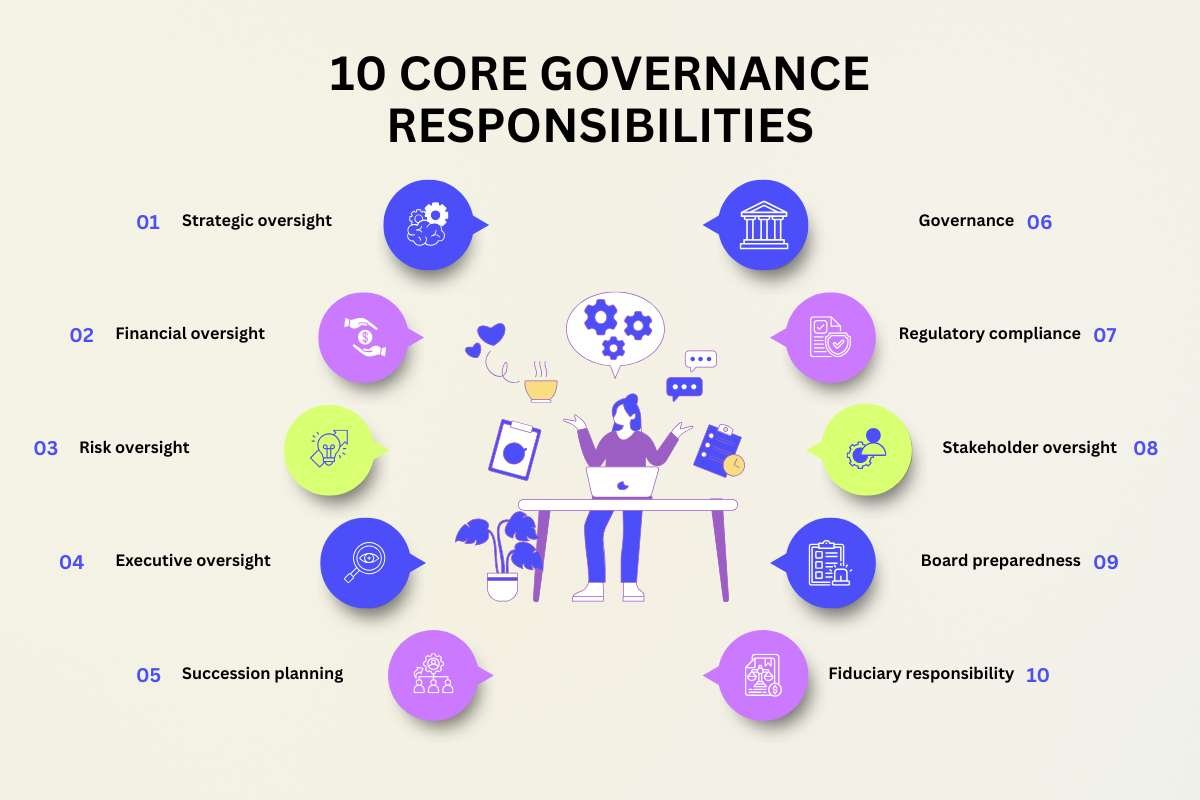
| Responsibility | What It Means at Board Level |
| 1. Strategic oversight | Evaluate long-term strategy and challenge management’s assumptions |
| 2. Financial oversight | Review financial performance, capital allocation, and internal controls |
| 3. Risk oversight | Monitor material financial, operational, cyber, and emerging risks |
| 4. Executive oversight | Evaluate CEO and senior leadership performance |
| 5. Succession planning | Ensure leadership continuity and evaluate succession pipelines |
| 6. Governance | Protect board independence, ethics and effective decision-making |
| 7. Regulatory compliance | Oversee adherence to applicable laws, regulations and listing requirements |
| 8. Stakeholder oversight | Consider material effects on shareholders and other relevant stakeholders |
| 9. Board preparedness | Review board materials carefully and arrive prepared to challenge and decide. |
| 10. Fiduciary responsibility | Exercise appropriate care, judgment, loyalty, and diligence within the applicable legal framework |
1. Strategic oversight
Boards must understand where the company is going and whether its strategy is realistic.
A strong woman director does not simply approve a strategy because it appears ambitious.
She may ask:
- What assumptions underpin the growth forecast?
- What could cause this strategy to fail?
- Does management have the required capabilities?
- How does the strategy respond to technological disruption?
- What happens if market conditions change?
The goal is not to oppose management. It is to make the strategy stronger through disciplined questioning.
2. Financial oversight
Financial literacy is essential for board effectiveness, alongside strategic thinking, risk awareness, leadership, and other skills most valued in board directors.
Directors should understand the company’s financial statements, cash flows, capital structure, major investments, financial risks, and performance indicators.
A woman director does not need to be a former CFO to contribute meaningfully. But she should be able to recognize the financial implications of major strategic decisions and ask informed questions about performance.
3. Risk oversight
Boards oversee risks including cybersecurity, AI, geopolitical disruption, supply chains, regulation, climate, and reputation. Directors must ensure material risks are identified, controlled, and addressed effectively.
4. CEO and executive oversight
Directors evaluate executive performance, align incentives with long-term goals, and address performance concerns when necessary.
5. Succession planning
Boards must maintain a strong leadership pipeline and prepare for unexpected executive departures. Women directors can contribute through expertise in leadership, talent, and organizational transformation.
6. Governance and compliance
Directors oversee ethics, conflicts of interest, independence, compliance, disclosures, and effective board processes. Independent directors must be willing to challenge management and fellow directors when necessary.
7. Board preparedness
Effective board influence starts before the meeting. Directors should review materials, understand key numbers, identify gaps, and ask informed questions. The goal is not to speak the most, but to improve the quality of decisions.
Board roles and where women can build influence
Not every board position carries the same responsibilities or influence. A director may begin as a board member and eventually take on committee or board leadership responsibilities.
Understanding how these positions fit into the roles & responsibilities of women on corporate boards can help women identify opportunities that support long-term board leadership.
Board role breakdown
| Role | Primary Governance Focus |
| Independent Director | Provides objective oversight and independent judgment |
| Executive Director | Combines board responsibilities with an executive role |
| Committee Member | Provides focused oversight within a specialized governance area |
| Committee Chair | Leads committee discussions, agendas, and recommendations |
| Lead Independent Director | Coordinates independent directors and supports board independence |
| Board Chair | Leads board effectiveness, meetings, agenda-setting, and board-management relationships |
For women, this progression can be particularly important because representation at board level does not automatically translate into representation in leadership positions.
The role of board committees
Committees allow directors to develop deeper expertise and take responsibility for specific areas of governance.
- Audit Committee: Oversees financial reporting, internal controls, audit matters, and financial risk.
- Risk Committee: Addresses enterprise risk, cybersecurity, geopolitical disruption, operational resilience, and emerging threats.
- Nomination and Governance Committee: Influences board composition, succession, director evaluation, and governance practices.
- Remuneration Committee: Oversees executive compensation and whether incentives support sustainable long-term performance.
- ESG and Sustainability Committee: Where established, oversees material sustainability risks, disclosures, environmental exposure, and resilience.
Women should not be directed automatically toward a particular committee. Assignments should reflect expertise, board needs, and strategic priorities.
Why a board seat does not automatically mean influence?

A board appointment creates access. It does not guarantee influence.
A director may attend every meeting and still have limited impact if she rarely challenges assumptions, lacks preparation, or is excluded from strategically important conversations.
A useful way to think about board progression is:
Seat → Participation → Influence → Leadership
| Seat | You have been appointed. |
| Participation | You contribute meaningfully to discussions and decisions. |
| Influence | Other directors and management value your judgment and seek your perspective. |
| Leadership | You shape agendas, lead committees, or eventually lead the board. |
Committee assignments can be particularly important in this progression. MSCI’s 2025 research found that women held a higher share of committee seats than board seats overall, while noting the importance of nomination committees in influencing future board and executive appointments.
This makes committee leadership more than an additional title. It can become a pathway to broader governance influence.
The distinction between a seat and influence is central to the roles & responsibilities of women on corporate boards because formal representation alone does not determine a director’s impact.
Challenges women may face in the boardroom
Women may face barriers to influence even after reaching the boardroom. Understanding these challenges can help them move from representation to leadership.
- Tokenism: Being the only woman can create pressure to represent all women. Directors should be able to challenge decisions as individuals, without being treated as speaking for their gender.
- Being Heard Without Being Stereotyped: Women may face competing expectations around assertiveness and collaboration. Credibility comes from preparation, evidence, sound judgment, and consistency, not conforming to a particular personality.
- Being Expected to Own “Women’s Issues”: Women directors should not automatically become responsible for diversity, employee experience, or gender-related issues. These are board responsibilities shared by all directors.
These challenges can affect how the roles & responsibilities of women on corporate boards are experienced in practice, even when formal duties are identical across directors.
Evaluate the company before accepting a board seat
A board appointment is a two-way evaluation. Before accepting a seat, assess the company’s financial health, governance quality, legal exposure, director protections, potential conflicts of interest, and expected time commitment.
Prestige alone should never outweigh poor governance. Knowing the questions to ask before accepting a board seat can help first-time directors identify risks and make a more informed decision.
How women can build influence after joining?
Once appointed, the objective shifts from getting the seat to making the seat count.
The most effective approach to the roles & responsibilities of women on corporate boards is not to speak more simply to increase visibility, but to contribute where the board most needs informed judgment.
1. Ask better questions
Strong directors do not need to speak the most.
They ask questions that expose assumptions, risks, and consequences.
Instead of:
“Why are we doing this?”
ask:
“What assumptions need to hold for this strategy to deliver the expected return, and what happens if one of them fails?”
2. Connect functional expertise to enterprise consequences
A technology director should connect cybersecurity to financial and reputational exposure. A people leader should connect succession to strategy execution. A finance expert should connect capital allocation to long-term competitiveness.
Board influence comes from connecting the dots.
3. Challenge withouttaking over
Directors are not there to run management’s jobs. Constructive challenge means testing decisions while respecting the CEO’s responsibility to execute.
4. Become excellent at one committee
Committee expertise can become a source of credibility. Deep knowledge in audit, remuneration, risk, nomination, cybersecurity, or sustainability can establish a clear area of boardroom value.
5. Develop a strategic specialty
AI governance, cybersecurity, geopolitical risk, sustainability, digital transformation, and resilience are increasingly relevant areas of board oversight.
The goal is not to become a specialist in everything. It is to develop a distinctive capability that complements the board’s existing skills while maintaining an enterprise-wide perspective.
From director to boardroom leader
The long-term career path for women should not end at the first directorship.
A potential progression looks like this:
Director → Committee Member → Committee Chair → Lead Independent Director → Board Chair
Each step requires a different kind of leadership.
| Stage | Primary capability |
| Director | Independent judgment and enterprise oversight |
| Committee Member | Deep governance expertise |
| Committee Chair | Agenda-setting and committee leadership |
| Lead Independent Director | Board dynamics and CEO oversight |
| Board Chair | Strategic leadership of the entire board |
This progression matters because the biggest representation gap increasingly appears at the top.
The OECD reports that while women’s board representation has improved, female representation at board-chair level remains much lower, with women holding only 10% of board chair positions among large listed companies in 2024.
For women, therefore, the next frontier is not simply more seats.
It is more authority within those seats.
The progression from director to board chair shows how the roles & responsibilities of women on corporate boards (pillar) can evolve from individual oversight to broader governance and leadership responsibilities.
Board-readiness checklist for women

Before pursuing a board position, ask yourself:
☐ Can I explain my board value proposition in 30 seconds?
☐ Do I have enterprise-level leadership experience?
☐ Can I confidently read and discuss financial statements?
☐ Do I understand fiduciary and governance responsibilities?
☐ Can I challenge a CEO constructively?
If most answers are yes, the next step is not applying everywhere. It is identifying the right board, the right governance need, and the right pathway to the appointment. Where gaps remain, board readiness programs for women can help strengthen governance knowledge and boardroom skills before pursuing a directorship.
This checklist can help women assess whether they are prepared to take on the full roles & responsibilities of women on corporate boards rather than pursuing a directorship based solely on title or status.
Common mistakes women should avoid
- Treating the Seat as the Destination: The first appointment is a milestone, not the end of the journey.
- Becoming the Unofficial “Women’s Issues” Director: Bring your perspective when it is relevant, but remember that your mandate covers the entire enterprise.
- Staying Silent to Avoid Being Seen as Difficult: Constructive challenge is part of good governance. Silence is not neutrality when a material issue needs scrutiny.
- Micromanaging Management: A director should oversee and challenge, not take over execution.
- Relying Only on Functional Expertise: Boards need enterprise thinkers. Your functional background should be the foundation of your contribution, not the boundary of it.
Conclusion:
The question is no longer simply whether women have a seat on corporate boards; it is what influence they have once they get there.
The roles & responsibilities of women on corporate boards extend from strategy, risk, and financial oversight to succession, governance, and executive accountability. But true progress goes beyond representation. It means creating pathways from director to committee leader to board chair.
For women, that means choosing board opportunities strategically, building a strong governance value proposition, and turning every seat into meaningful influence. As more women move from representation into positions of authority, women reshaping board governance in 2026 reflects the broader shift toward influence, accountability, and leadership. For companies, it means measuring not just representation, but who leads, who decides, and who shapes the future.
FAQs:
1. What are the roles and responsibilities of women on corporate boards?
Women directors oversee strategy, financial performance, risk, governance, executive accountability, succession planning, and major corporate decisions.
2. Why are women on corporate boards?
Women bring diverse expertise and perspectives that can strengthen board discussions, challenge assumptions, and support better governance.
3. Do women directors have different responsibilities from male directors?
No. Women directors have the same legal and fiduciary responsibilities as other board members. Their value comes from their expertise, judgment, and experience