

Women are making steady progress into corporate boardrooms, but representation remains uneven, particularly at the highest levels of governance. The issue for women on corporate boards is no longer simply about how many women hold board seats, but whether they have meaningful influence over strategy, risk, succession, and long-term business decisions.
For women executives pursuing opportunities for women on boards, securing a board seat requires more than an impressive career history. It requires a clear board value proposition, governance knowledge, strategic networking, and the ability to identify the right opportunity.
This guide examines why women on corporate boards matter, how global quotas are changing representation, what directors actually do, and how women can position themselves for their first and future board seats.
Why Boards Need Women: The Business & Governance Case
The argument for women on corporate boards should go beyond representation for representation’s sake. A strong board needs people who bring different experiences, professional backgrounds, expertise, and approaches to complex decisions.
Gender diversity is one part of that broader diversity equation.
1. Cognitive Diversity & Strategic Risk Mitigation
Boards operate in environments where certainty is rare. Directors must challenge assumptions, examine competing scenarios, and identify risks that management may overlook.
A board composed of people with similar career paths, networks, and experiences can develop blind spots, which is why women on corporate boards can add valuable challenges. Adding directors with different perspectives, including experienced women on corporate boards, can widen the range of questions being asked before major decisions are made.
Women do not automatically possess a particular “female” approach to governance. Nor should women directors be expected to represent all women. The stronger argument is that women bring their own combination of professional expertise, industry knowledge, lived experience, and leadership perspective.
That distinction is important.
A woman who has led cybersecurity transformation can bring a different risk lens from a traditional finance director. A woman with international M&A experience may identify integration risks that others miss. A former technology executive may challenge assumptions about AI investment. A leader who has built consumer businesses may bring a deeper understanding of changing customer behaviour.
The value of women on corporate boards comes from the individual’s expertise and perspective, not from gender stereotypes.
Diversity can also strengthen board discussions by reducing the risk of groupthink. When directors feel comfortable challenging the prevailing view, boards have a better opportunity to test strategic assumptions before committing significant capital or taking major risks.
For women seeking opportunities on women on corporate boards, this creates an important positioning lesson: do not sell gender diversity as your primary qualification. Sell the business problem you know how to solve.
2. The “30% Critical Mass Rule”: Moving Beyond Tokenism
One woman on a board can change the composition of a board statistically without necessarily changing its dynamics.
Research on boardroom “critical mass” has highlighted meaningful differences between boards with one, two, and three or more women. Harvard Business Review’s research involving women directors and senior executives found that boards with at least three women experienced substantially different dynamics from boards where women were isolated as a small minority.
The broader principle is often associated with the idea of a 30% critical mass: once women constitute a meaningful minority, they are less likely to be perceived as tokens and have greater opportunity to influence discussion.
The exact threshold should not be treated as a universal mathematical rule. Board size, culture, individual personalities, and governance structures all matter.
What matters is the underlying principle: one woman should not have to carry the burden of representing an entire gender.
Tokenism can create several problems. A lone female director may experience heightened visibility, be expected to speak on issues affecting women regardless of her expertise, or feel greater pressure to prove her competence.
A board with multiple women can instead make gender less salient and expertise more important.
This is why companies should not stop at appointing their first woman director or treating women on corporate boards as a one-time milestone. A sustainable pipeline requires multiple women at director, committee chair, and chair levels.
3. Financial Performance: Disentangling Correlation vs. Causation
The financial case for board diversity is compelling, but it needs to be presented responsibly.
Several studies have found associations between greater gender diversity and stronger financial outcomes. MSCI’s analysis, for example, found that U.S. companies that began the 2011–2016 period with at least three women directors experienced median gains in ROE of 10 percentage points and EPS of 37%, compared with companies that began with no female directors. However, MSCI explicitly noted that the analysis did not establish a causal relationship.
More recent MSCI research found that companies in the MSCI ACWI Index with at least 30% female directors generated cumulative returns 18.9% higher than companies without that level of representation between July 2019 and September 2024. Again, MSCI cautions that correlation does not establish causation.
Why does this distinction matter?
Companies with diverse boards may already have stronger governance systems, more progressive leadership cultures, or other characteristics that contribute to performance.
Therefore, the strongest business case is not:
“Women on boards automatically increase profits.”
It is:
“Boards benefit when they combine relevant expertise, independent challenge, and diverse perspectives, and women are an essential part of building that capability.”
That is a more credible and defensible argument.
Global Board Representation Metrics & Benchmarks

Progress in women’s board representation has accelerated, but the picture differs considerably by market.
MSCI reported that women held 28.3% of board seats globally at large- and mid-cap companies in 2025, up one percentage point from the previous year. Nearly 48.7% of companies had reached at least 30% female representation.
Deloitte’s broader global dataset, covering more than 18,000 companies across 50 countries and geographies, found women held 23.3% of board seats in 2023.
The difference between datasets reflects differences in company populations, markets, and methodologies. It is therefore better to use them as benchmarks rather than treat every global figure as directly interchangeable.
| Benchmark | Women’s representation |
| Global board seats, MSCI large- and mid-cap companies, 2025 | 28.3% |
| Companies reaching at least 30% women, MSCI 2025 | 48.7% |
| Global board seats, Deloitte 2023 dataset | 23.3% |
| Global women board chairs, Deloitte | 8.4% |
| Global women CEOs, Deloitte | 6% |
| India board seats, Deloitte 2023 | 18.3% |
Sources: MSCI and Deloitte.
The most important pattern for women on corporate boards is not simply the number of women directors. It is the leadership gap.
Women are entering boards faster than they are reaching the chair or CEO positions. Deloitte found that women chaired only 8.4% of boards globally, compared with 23.3% of board seats held by women.
That means the next phase of women on boards must focus on influence, committee leadership, succession, and chairs, not just seats.
Global Quotas and Regulatory Mandates: What’s Working
Governments have increasingly intervened to accelerate board diversity because voluntary progress has often been uneven. These requirements vary considerably across markets, making board diversity mandates around the world in 2026 an important consideration for companies and women pursuing board opportunities.
The OECD’s Corporate Governance Factbook found that 15 of 49 jurisdictions had mandatory quotas for women on listed-company boards. Four—France, Iceland, Italy, and Norway required at least 40% women, while other jurisdictions applied lower thresholds or requirements such as at least one female director.
Comparing Quota Models: 40-40-20, EU Directives, India Mandates
Different markets have adopted different approaches.
The 40:40:20 model aims for approximately 40% women, 40% men, and 20% flexibility for either gender. It was developed as a practical representation target, recognising that boards are often small and exact 50:50 splits may not always be possible.
The European Union’s Women on Boards Directive sets a target for listed companies to have at least 40% of non-executive director positions held by the underrepresented sex by 2026. Member states may instead apply a 33% target covering all director positions. The rules also require transparent, objective selection procedures where targets are not achieved.
India uses a different model.
Under India’s Companies Act, prescribed classes of companies must have at least one woman director. SEBI’s listing framework also requires listed entities to have a woman director, while the top 1,000 listed entities must have at least one woman independent director.
These models demonstrate that there is no single global formula for board diversity.
Voluntary Targets vs. Legal Mandates: Efficacy & Pipeline Impact
Mandatory quotas can produce faster change for women on corporate boards because they alter the incentives surrounding appointments.
The OECD found that jurisdictions with binding quotas had the highest average levels of gender diversity, although jurisdictions using targets and other measures also made substantial progress.
However, a quota can solve the access problem without automatically solving the influence problem.
India provides an important example. Research examining the country’s board mandate found that the number of women directors increased after quota requirements were introduced, but also identified evidence of women serving on multiple boards around compliance periods and examples of symbolic inclusion.
This highlights a crucial distinction:
Representation is the starting point. Inclusion and influence are the outcome.
Companies should therefore measure more than the number of women directors. They should examine:
- Who chairs the board?
- Who chairs the audit committee?
- Who sits on nomination and remuneration committees?
- Who participates in strategic decisions?
- Who is considered for succession?
How many women move from director to chair?
How many women are appointed to their first board rather than repeatedly recycling a small group of directors?
For women executives considering opportunities on corporate boards, this also means that the board market can create opportunities, but candidates should evaluate whether the opportunity represents genuine governance responsibility or simply compliance.
Demystifying Corporate Board Roles & Architectures
A board seat is not simply an extension of an executive position.
Directors do not run the company day-to-day. Management does.
The board’s role is to provide oversight, challenge management, approve major strategic decisions, and protect the long-term interests of the company and its shareholders. Understanding what board directors actually do is essential for executives considering their first directorship, particularly because board responsibilities differ significantly from day-to-day executive management.
What Board Directors Actually Do: Strategy, Oversight & CEO Succession
Board responsibilities commonly include:
- Reviewing and approving corporate strategy
- Monitoring financial performance
- Overseeing major risks
- Evaluating management
- Selecting and overseeing the CEO
- Planning CEO succession
- Approving significant transactions
- Overseeing compliance and governance
- Reviewing capital allocation
- Monitoring organisational culture and stakeholder risks
These responsibilities form the foundation of effective governance, but the specific expectations attached to a seat can vary by company and appointment type. Understanding roles and responsibilities of women on corporate boards can help prospective directors assess where their expertise fits within the wider board structure.
A director therefore needs to think beyond her own functional speciality.
A CFO joining a board cannot simply be “the finance person.” A technology executive cannot focus only on technology. Every director is expected to contribute to the broader governance of the enterprise.
Public vs. Private vs. Advisory Boards
Not all opportunities for women on corporate boards provide the same experience.
Public-company boards typically involve significant regulatory, fiduciary, and reputational responsibilities. They can also provide high visibility and substantial compensation.
Private-company boards can offer meaningful strategic influence, particularly in founder-led, family-owned, or private-equity-backed businesses. The experience of serving on private vs. public company boards can differ significantly in terms of governance requirements, shareholder structure, disclosure, and expectations.
Advisory boards can be useful entry points for executives who want governance exposure. However, an advisory board is generally different from a statutory board of directors. Understanding the differences between advisory boards vs. corporate boards is important because advisory members may provide expertise without possessing the same legal responsibilities or authority as directors.
Compensation is another factor to consider when evaluating board opportunities. Understanding the difference between paid board seats and unpaid advisory roles can help candidates assess the responsibilities, authority, time commitment, and professional value associated with each opportunity.
That difference matters when building a board portfolio.
Executive vs. Independent Directors
The distinction between independent vs. executive directors is important when evaluating a board opportunity. An executive director is involved in the company’s management, while an independent director is expected to provide objective oversight without being part of management or having relationships that compromise independence.
For experienced women executives, independent directorships can create meaningful opportunities for women on corporate boards while allowing leaders to apply their expertise across organisations without taking on a full-time operating role.
But independence also brings accountability.
A board candidate should understand the legal requirements, conflict-of-interest rules, time commitment, committee responsibilities, and insurance protections associated with the specific appointment.
The 4-P Framework: How Women Can Get a Seat on a Corporate Board
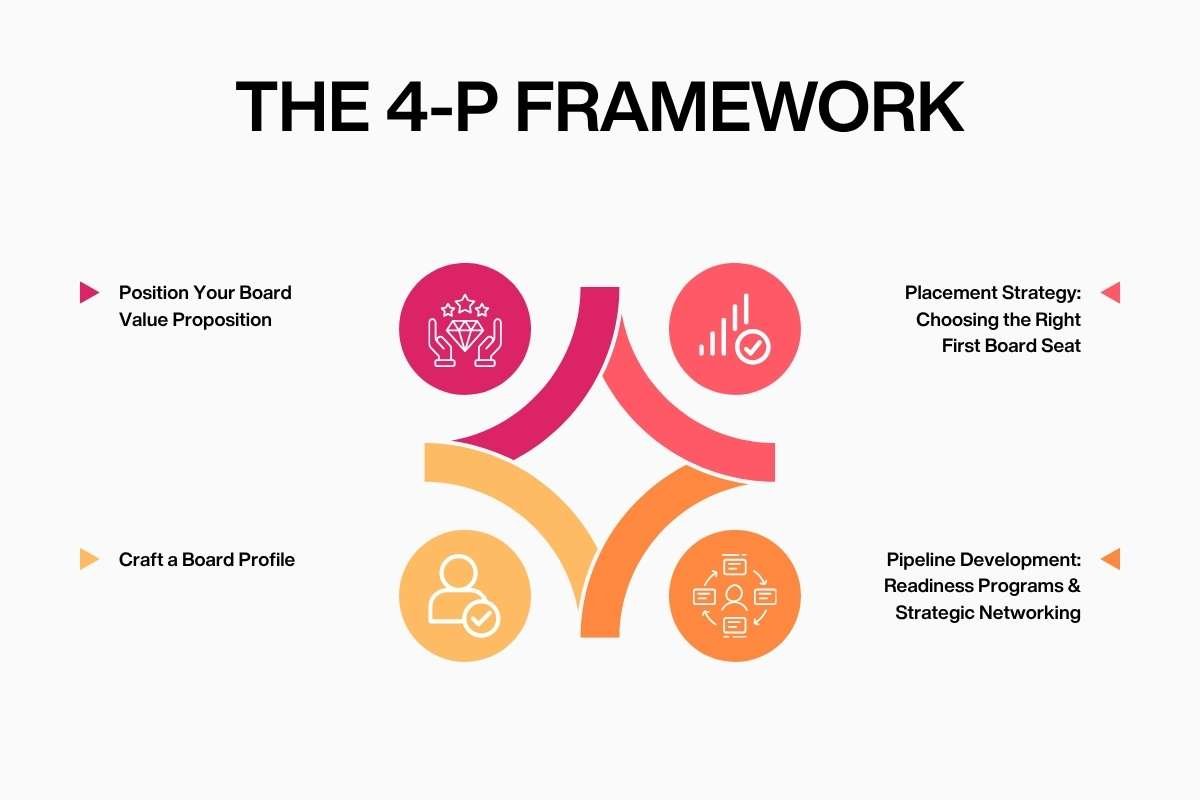
Getting a place among women on corporate boards is rarely the result of simply applying to a vacancy.
Board appointments are often relationship-driven and capability-driven. Companies look for people who can solve specific governance needs.
For women executives, a practical approach is the 4-P Framework: Position, Profile, Pipeline, and Placement. If you’re beginning your board journey, our guide on how to get your first board seat as a woman breaks down the practical steps involved in building readiness, positioning your expertise, and pursuing the right opportunities.
1. Position Your Board Value Proposition
The first question is not:
“Why should I be on board?”
It is:
“What board-level problem can I help this company solve?”
Your answer should be specific.
Possible board value propositions include:
| AI and technology | You understand AI adoption, digital transformation, technology investment, data governance, or technology risk. |
| Cybersecurity | You have experience managing cyber risk, resilience, privacy, or enterprise security. |
| ESG and sustainability | You understand climate risk, sustainable business models, regulatory reporting, or stakeholder expectations. |
| M&A | You have led acquisitions, integrations, restructuring, or post-merger transformation. |
| International expansion | You have entered new markets and managed multinational operations. |
| Financial transformation | You understand capital allocation, financial controls, restructuring, or investor expectations. |
| Consumer strategy | You bring deep knowledge of customers, brands, retail, digital commerce, or changing consumption patterns. |
The strongest positioning combines functional expertise + strategic impact + industry relevance. Understanding the skills most valued in board directors can help you identify which parts of your experience are most relevant to a board’s current needs.
Instead of saying:
“I am an experienced technology leader.”
Say:
“I help boards evaluate technology investments, manage cyber risk, and translate AI opportunities into measurable business value.”
The second statement tells a nomination committee why your experience matters.
2. Craft a Board Profile
Your executive résumé and your board profile are not the same thing. A strong board profile should clearly communicate your governance expertise and the value you can bring to a board. Learn more about how to build a board profile that gets you noticed before approaching chairs, nomination committees, or executive search firms.
An executive résumé answers:
What did you manage?
A board profile answers:
What governance value can you provide?
| Executive Résumé | Board Profile |
| Lists operational achievements | Highlights strategic and governance impact |
| Focuses on career progression | Focuses on board-relevant expertise |
| Detailed responsibilities | Concise leadership positioning |
| Job-by-job chronology | Enterprise-level value proposition |
| Functional accomplishments | Strategy, risk, governance and oversight |
| Designed for hiring managers | Designed for boards, chairs and search firms |
Your board bio should highlight:
- Board-relevant expertise
- Enterprise leadership
- Industry experience
- Transformation experience
- Risk expertise
- Financial understanding
- Stakeholder management
- International exposure
- Governance experience
- Committee experience
- Relevant certifications
Avoid turning the board bio into a three-page career history.
A strong board profile should allow a chair or nomination committee member to understand your potential value quickly.
3. Pipeline Development: Readiness Programs & Strategic Networking
Opportunities for women on corporate boards often emerge through networks long before they become public. Knowing how to find open board positions as a woman is therefore only one part of the process; many opportunities are identified through existing directors, board chairs, investors, and executive search firms. That makes relationship-building a strategic activity rather than a social exercise.
That makes relationship-building a strategic activity rather than a social exercise.
Start by mapping your existing network:
- Who knows your work?
- Who knows your leadership reputation?
- Who already sits on a board?
- Who works with board chairs?
- Who advises companies on governance?
- Who works in executive search?
Potential relationship groups include:
- Current and former CEOs
- Board directors
- Investors
- Private-equity professionals
- Executive search consultants
- Lawyers
- Management consultants
- Industry associations
- Governance institutes
- Former colleagues
- University and alumni networks
But networking should not begin with “Can you get me a board seat?”
Instead, build credibility around your board thesis.
For example:
“I am beginning to focus my next leadership chapter on board work, particularly companies navigating AI governance and digital transformation. I would value your perspective on where those capabilities are becoming most important.”
That creates a professional conversation rather than a transactional request.
Board readiness programs for women, director education, and governance certifications can also help executives understand fiduciary duties, board processes, and committee responsibilities. However, credentials should support experience, not replace it.
However, credentials should support experience, not replace it.
4. Placement Strategy: Choosing the Right First Board Seat
Your first opportunity as a woman on corporate boards should be selected strategically.
The biggest opportunity is not necessarily the most prestigious company.
A strong first board can provide:
- Genuine governance responsibility
- Experienced fellow directors
- Committee exposure
- Strategic decision-making experience
- A respected chair
- Strong governance processes
- A credible reference for future appointments
Consider the board’s existing skills matrix.
If the board already has three former CEOs, two investment bankers, and a lawyer, another generalist CEO profile may add less value.
But a leader with cybersecurity, AI, international expansion, or consumer expertise could fill a meaningful gap.
This is where women candidates can differentiate themselves.
Board-readiness should be evaluated by capability, not title alone.
Board Readiness Self-Assessment Checklist
Question Yes / No
Can I explain my board value in 30 seconds? ☐
Do I have enterprise-level leadership experience? ☐
Am I confident with financial statements and fiduciary duties? ☐
Can I challenge a CEO constructively? ☐
Do I have a clear area of board-level expertise? ☐
Is my board bio tailored beyond my executive résumé? ☐
Have I built relevant board-level relationships? ☐
Have I assessed conflicts, liability, and D&O insurance? ☐
Can I commit the required time? ☐
Have I assessed the company, board composition, and committee fit? ☐
Does this seat strengthen my long-term board portfolio? ☐
If most answers are “yes,” the next step is not sending hundreds of applications.
It is targeted placement.
Leveraging Nonprofit & Subsidiary Experience Strategically
Women do not always need to wait for a listed-company appointment to develop governance experience.
Nonprofit board experience, industry associations, educational institutions, foundations, and subsidiary boards can provide valuable exposure to governance. The key is to treat this experience strategically and document the specific responsibilities and decisions you governed.
The key is to treat the experience strategically.
Do not simply list:
“Board Member, XYZ Foundation.”
Instead, document what you actually governed.
Did you oversee a budget?
Approve strategy?
Chair a committee?
Review risk?
Participate in CEO or executive succession?
Oversee an audit?
Manage regulatory obligations?
Lead a transformation?
These experiences demonstrate governance capability.
Subsidiary boards can be particularly useful for executives working in large organisations. They can provide exposure to formal board processes, financial oversight, risk management and stakeholder governance while building experience within a controlled environment.
The goal is to translate these experiences into evidence that you can operate effectively at board level.
Vetting & Evaluating Your First Board Seat
A board appointment for women on corporate boards is a two-way decision. The company is assessing you, but you must assess the company too. Before accepting an appointment, review the questions to ask before accepting a board seat to evaluate governance quality, financial health, liability, conflicts, and time commitment.
A prestigious logo should never compensate for poor governance.
The Executive Due Diligence Checklist

Before accepting a seat, examine:
- Financial health: Review financial statements, debt levels, cash flow, profitability, major liabilities, and material changes in financial performance.
- Governance: Understand board composition, committee structure, meeting frequency, decision-making processes, and relationships between directors and management.
- D&O insurance: Directors and Officers insurance can provide important protection against certain claims arising from board service. Coverage varies, so candidates should review the actual policy and its exclusions rather than assuming they are protected.
- Legal liability: Understand the duties and liabilities attached to the directorship under the relevant jurisdiction.
- Conflicts: Check whether the appointment creates conflicts with your current employer, existing board roles, investments, or clients.
- Time commitment: Do not assess time only by counting scheduled meetings. Preparation, committee work, crises, and travel can substantially increase the commitment.
Spotting Red Flags & Avoiding Token Positions
Some warning signs should make candidates pursuing women on corporate boards pause.
Be cautious if:
- The company appears to want your gender more than your expertise.
- The board has no clear expectations for your contribution.
- Financial information is difficult to obtain.
- The chair discourages questions.
- Directors rarely challenge management.
- The company has unresolved regulatory issues.
- Board minutes and governance processes appear weak.
- You are repeatedly asked to provide visibility without meaningful authority.
- The board expects you to serve primarily as the “woman’s perspective.”
- D&O protection is unclear.
- The company is under significant financial or legal pressure without adequate disclosure.
A particularly important question is:
“Why is the company hiring me?”
The strongest answer is one tied to strategy, risk, or capability.
If the answer is simply “we need a woman on the board,” the role deserves deeper scrutiny.
Balancing Board Service With a C-Suite Executive Role
For women currently holding C-suite positions, board service can accelerate leadership development, but it can also create conflicts. Understanding how to balance a board seat with a full-time executive role is particularly important when managing time commitments, confidentiality requirements, competitor relationships, and potential conflicts of interest.
Before accepting an appointment, review your employment agreement and company policies.
Pay particular attention to:
- Outside directorship restrictions
- Competitor relationships
- Confidentiality
- Intellectual property
- Time commitments
- Industry conflicts
- Investment restrictions
- Disclosure requirements
Board service also changes how executives think.
A C-suite leader is accountable for execution. A director is accountable for oversight.
That means a director must resist the instinct to solve operational problems personally.
The board’s role is to ask whether management has the right strategy, resources, controls, and leadership to solve the problem.
For an executive, learning that distinction is one of the most important transitions into governance.
The Future of Board Governance: From Seats to Board Chairs

The next frontier of women on corporate boards is not simply getting more women into boardrooms. It is getting more women into positions of governance authority. This reflects the broader role of women reshaping board governance in 2026, particularly as more women move into committee leadership and other positions of influence.
The global gap is striking. Deloitte found that women represented 23.3% of board seats in its 2023 global dataset but only 8.4% of board chairs.
That means the pipeline cannot end with appointments.
Women need pathways from:
Director → Committee Member → Committee Chair → Lead Independent Director → Board Chair
Committee leadership can be an important stepping stone because it demonstrates the ability to lead governance discussions beyond an individual area of expertise.
Emerging Board Competencies & The Next Generation of Female Chairs
The boards of the future will need expertise in areas that were once considered purely operational.
AI governance, cybersecurity, climate risk, geopolitical exposure, data privacy, digital transformation, human capital, and stakeholder expectations are increasingly board-level issues.
This creates an opportunity for women leaders who have built careers in these areas.
But the next generation of female chairs will need more than functional expertise.
They will need:
- Strategic judgment
- Financial fluency
- Risk oversight
- CEO succession experience
- Stakeholder management
- Crisis leadership
- Governance expertise
- The ability to challenge constructively
- The ability to build consensus without suppressing disagreement
The objective should therefore be to create a deep female governance pipeline, not a small group of women repeatedly occupying the same seats.
MSCI’s 2025 research shows that women already have a growing presence on nomination committees, particularly in emerging markets. Because nomination committees can influence future director appointments, this could become an important lever for building more diverse boards.
The boardroom question is gradually moving from:
“Can women get a seat?”
to:
“Who is developing the next generation of women directors and chairs?”
Conclusion:
Greater representation of women on corporate boards is only the beginning. The next goal is meaningful influence and a stronger pipeline of women progressing from directors to committee chairs and board chairs.
For women pursuing board careers, the path can be simplified into four steps: Position your board expertise, Profile yourself for governance opportunities, Pipeline relationships strategically, and Place yourself on the right first board.
The strongest board career is not built around collecting titles. It is built around becoming the director a company genuinely needs.
FAQs:
1. Why are women important on corporate boards?
Women bring diverse perspectives, expertise, and leadership experiences that can strengthen board discussions, governance, and decision-making.
2. How can women get their first corporate board seat?
Build a strong board profile, define your board value proposition, develop strategic networks, and target boards where your expertise fills a specific need.
3. What skills are valued in women on corporate boards?
Key skills include strategic leadership, finance, risk management, technology, AI, cybersecurity, ESG, M&A, and stakeholder management.
4. What is an independent board director?
An independent director provides objective oversight without being part of company management or having relationships that compromise their independence.
5. How can women progress to board chair positions?
Women can progress by gaining governance experience, leading committees, strengthening strategic expertise, and building a strong reputation among boards and fellow directors.