

A board seat can look like the next natural step in a senior leadership career. But becoming a director is not simply about attending quarterly meetings, reviewing reports, or offering advice to the CEO. What board directors actually do is much broader: they help govern the company, oversee management, evaluate major risks and decisions, and protect the organisation’s long-term interests.
That distinction matters for women entering the boardroom. Women held 28.3% of board seats globally in 2025, according to MSCI, yet representation remains less balanced at the most influential levels.
Understanding what board directors actually do therefore means looking beyond the title. A strong director needs to know where her responsibility begins, where management’s authority begins, and how she can contribute without crossing the line into day-to-day operations.
What board directors actually do?
The simplest way to understand the role is this: management runs the company, while the board oversees how it is run.
Board directors typically help:
- Set and oversee long-term strategy
- Monitor financial performance
- Assess major business risks
- Oversee the CEO and senior leadership
- Review succession plans
- Monitor governance and compliance
- Approve major transactions and strategic decisions
- Protect shareholder and, where applicable, broader stakeholder interests
- Challenge management when decisions raise concerns
- Help ensure the company is building sustainable long-term value
The board does not normally make everyday operating decisions. Directors are not there to tell employees how to do their jobs or manage individual departments.
Instead, directors ask whether management has the right strategy, resources, controls, and leadership to achieve the company’s goals.
Knowing what board directors actually do also helps women distinguish between board-level accountability and executive responsibilities before accepting a seat.
For women taking on a first board position, this distinction is especially important. The ability to contribute strategically without becoming involved in management is one of the foundations of effective board service.
What are the 7 directors’ duties?
The exact legal duties of directors vary by jurisdiction and company structure, but seven broad responsibilities are central to effective board service.
Understanding what board directors actually do starts with knowing these core duties and how they apply to board-level decision-making.
1. Duty of care
This is an important part of understanding what board directors actually do, because directors must engage with important decisions rather than simply approve management recommendations. That means reading board materials, asking questions, and understanding major decisions before voting.
2. Duty of loyalty
Directors should put the interests of the company ahead of personal interests and manage conflicts appropriately.
3. Good-faith decision-making
Directors should act honestly and genuinely in the interests of the company rather than pursuing hidden personal or outside interests.
4. Acting in the company’s best interests
A director’s responsibility is not simply to support management. She must consider whether decisions serve the company’s legitimate interests.
5. Managing conflicts of interest
Directors need to identify potential conflicts and disclose or manage them according to applicable law and company policy.
6. Maintaining confidentiality
Board discussions often involve sensitive financial, strategic, and personnel information. Directors must protect confidential information.
7. Exercising independent judgment
Directors are expected to bring their own judgment to the boardroom. Independence does not mean opposing management for the sake of it. It means being willing to question assumptions and make an informed decision.
Understanding what board directors actually do is therefore more important than simply having an impressive executive résumé. The role requires directors to understand their responsibilities, exercise independent judgment, and remain accountable for board-level decisions. A board seat comes with accountability, and directors need to understand that responsibility before accepting the appointment.
What are the 10 basic responsibilities of a board member?
The day-to-day work of directors can be grouped into 10 broad areas:
| Responsibility | What it involves |
| Strategy | Reviewing and challenging the company’s strategic direction |
| Financial oversight | Monitoring financial health, budgets, and major investments |
| Risk | Identifying and overseeing material business risks |
| CEO oversight | Evaluating the CEO and senior leadership |
| Succession | Planning for future leadership needs |
| Governance | Ensuring appropriate policies, controls and accountability |
| Compliance | Monitoring legal and regulatory obligations |
| Stakeholders | Considering relevant shareholder and stakeholder interests |
| Board effectiveness | Evaluating whether the board itself is functioning well |
| Long-term value | Keeping decisions focused on sustainable performance |
These responsibilities show what board directors actually do in practice and why board service requires more than experience in one functional area. Understanding the roles and responsibilities of women on corporate boards is also important when preparing for board service.
Directors need the skills most valued in board directors, including commercial, financial, and governance knowledge, to understand the company’s most important decisions.
For women building toward board service, this broader view is valuable. A strong executive background may open the door, but effective directors need to demonstrate that they can think beyond their own function and evaluate the company as a whole.
How much power does a board of directors have?

A board can have significant authority, but its power is collective rather than personal.
The board typically has authority over matters such as corporate strategy, major transactions, CEO appointment or removal, executive oversight, and other decisions reserved for the board under applicable law or company governance documents.
A single director generally cannot act as though she owns the company or independently instruct management.
This is one of the most important distinctions to understand when considering what board directors actually do. Their influence comes from collective oversight and informed decisions rather than from managing employees directly.
A board’s power also depends on the company’s legal structure, jurisdiction, shareholder arrangements, and governing documents.
Who is higher: the CEO or the board of directors?
The CEO and board have different roles rather than simply occupying two levels of the same management hierarchy. Understanding the distinction between independent board directors and executive directors is also important because their responsibilities, relationships with management, and expectations of independence can differ.
The CEO is generally responsible for running the company and executing its strategy. The board provides oversight, governance, and accountability.
In many corporate structures, the board appoints and evaluates the CEO and can take action concerning the CEO’s appointment when necessary.
That does not mean directors should manage the CEO’s daily work. A healthy relationship involves appropriate challenge from the board and operational leadership from management.
For women considering a board role, understanding this boundary is critical. The boardroom is a place to question, evaluate, and decide, not to become another layer of operational management.
Can the board override the CEO?
Yes, within the authority given to it by corporate law and the company’s governance structure.
A board can reject management proposals, require changes to strategy, approve or reject certain major transactions and, where appropriate, appoint or remove the CEO.
However, boards should not use that authority to micromanage executives.
Effective directors know when to challenge management and when to allow management to manage.
That balance is particularly important when a woman joins a board for the first time. Strong board participation does not require being the loudest person in the room. It requires asking the questions that improve the quality of the decision.
What should board members not do?
Understanding what directors should not do is just as important as understanding their responsibilities.
Board members should not:
- Micromanage employees or executives
- Give individual employees operational instructions
- Make unilateral decisions on behalf of the board
- Bypass the CEO or management structure without a legitimate governance reason
- Ignore conflicts of interest
- Disclose confidential board information
- Use board information for personal benefit
- Remain silent when serious risks require attention
- Treat board discussions as a networking or status exercise
A director’s role is to provide oversight and judgment rather than become an unofficial executive.
For women entering the boardroom, knowing these boundaries can make it easier to contribute confidently without feeling pressure to prove their value by becoming involved in every operational detail.
What are the risks of being on a board of directors?
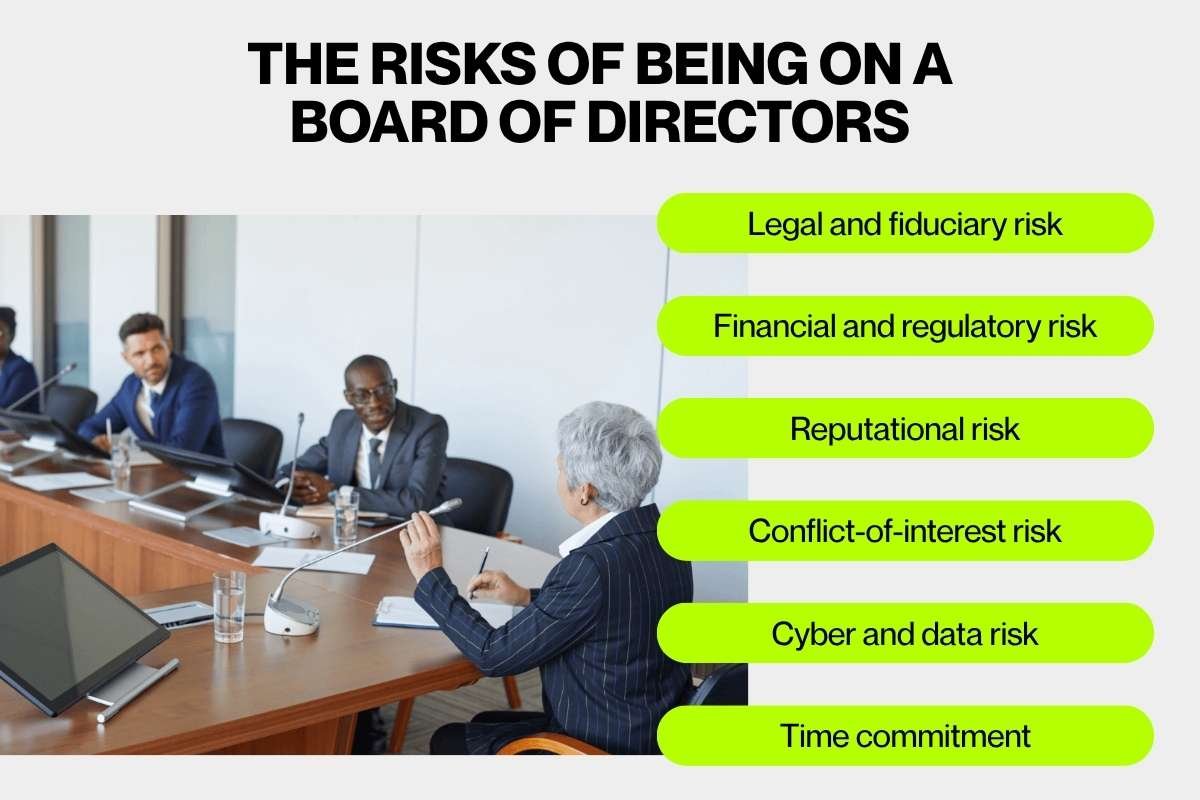
A board seat can be valuable for a woman’s career, but it also carries real responsibility.
Potential risks include:
- Legal and fiduciary risk: Directors can face consequences if they fail to meet their legal duties.
- Financial and regulatory risk: Poor oversight of financial reporting, compliance, or major transactions can expose directors and companies to significant consequences.
- Reputational risk: A director’s professional reputation can be affected by serious governance failures at the organisation.
- Conflict-of-interest risk: Directors may encounter situations where personal, professional or financial interests overlap with their board responsibilities.
- Cyber and data risk: Boards increasingly need to understand cybersecurity, technology and data governance risks.
- Time commitment: Board service can involve preparation, committee work, special meetings, crisis response and engagement beyond scheduled board meetings.
This is why women should conduct due diligence before accepting a board position. A prestigious company name does not automatically make a board seat a good opportunity.
Understanding the organisation’s finances, governance culture, D&O insurance, conflicts, board dynamics, and expectations is part of being board-ready.
Do people get paid to be on a board of directors?
Yes. Directors of many for-profit companies receive compensation for their work.
Compensation can include:
- Annual cash retainers
- Equity or stock awards
- Committee fees
- Additional compensation for lead directors
- Additional compensation for board chairs
- Other benefits depending on the company
The amount varies considerably by company size, industry, geography, and board position.
For example, Spencer Stuart’s 2025 U.S. Board Index reported average total compensation of $336,352 for S&P 500 directors, excluding compensation for independent chairs. Stock awards represented the largest part of director compensation.
Compensation is only one part of understanding what board directors actually do. The responsibilities, risks, preparation, and time commitment should be evaluated alongside the financial package.
How much do board directors get paid?
There is no universal board-director salary.
A director at a large publicly listed company may receive substantially more than someone serving on the board of a smaller private company or nonprofit.
In India, the board landscape is also evolving. Spencer Stuart’s 2025 India Board Index found that women represented 20.4% of directors in BSE 100 companies, up from 16.3% in 2019. It also reported substantial increases in remuneration for independent directors and independent board chairs since 2019.
For women evaluating a board opportunity, compensation should be considered alongside time commitment, liability, committee responsibilities, D&O insurance, and the strategic value of the role.
The financial package should answer one question: does the compensation reasonably reflect the responsibilities and risks attached to the seat?
What are the signs that a board of directors is dysfunctional?
A board can have impressive names around the table and still be ineffective.
Warning signs include:
- Directors rarely challenge management
- The CEO dominates every discussion
- Important information reaches directors too late
- Meetings focus heavily on presentations rather than decisions
- Directors avoid difficult conversations
- Conflicts are not disclosed or managed
- Committee responsibilities are unclear
- Directors lack sufficient independence
- Board members do not understand the company’s major risks
- There is little discussion about succession or long-term strategy
A woman considering a board seat should pay attention to these dynamics before accepting an appointment.
The quality of the boardroom matters as much as the title attached to the seat. A director cannot contribute effectively if the culture discourages questions, disagreement, or independent judgment.
Who has power over the board of directors?
The answer depends on the company’s legal and ownership structure.
In many public companies, shareholders have important powers, including electing directors.
Corporate law, securities regulations, listing requirements, and the company’s governance documents also define what boards can and cannot do.
The board itself then exercises collective authority over matters assigned to it.
This means the board is not simply “above” everyone else. It operates within a system of accountability involving shareholders, regulators, corporate law, and the company’s governing documents.
What women should look for before accepting a board seat?
For women building governance experience, non-profit board experience can also provide exposure to board meetings, committees, oversight, and fiduciary responsibilities.
For women still working toward their first appointment, how to get your first board seat as a woman provides the practical foundation for understanding the path from executive experience to board service.
Before saying yes, women should assess their own preparedness as well. Board readiness programs for women can help prospective directors strengthen their understanding of governance, fiduciary responsibilities, and boardroom expectations.
Why is the seat available?
A normal board refresh is very different from a sudden vacancy caused by governance, financial, or leadership problems.
What will the company expect from the director?
Understand the board’s expectations, meeting schedule, committee responsibilities, and preparation requirements.
What is the financial and legal position of the company?
Review relevant financial information, litigation, regulatory matters, and material risks.
What D&O protection is available?
Directors should understand the company’s directors’ and officers’ liability insurance and indemnification arrangements.
How does the board actually operate?
Look beyond the company’s formal governance policies. Does the board encourage disagreement? Do directors receive information early enough to make informed decisions?
Will the director have meaningful access to information?
Independent judgment is difficult when directors do not receive sufficient information.
What committee role will she have?
Committee assignments can significantly shape a director’s influence. Audit, compensation, nomination, and risk committees can involve substantial responsibilities.
Women considering a first board seat should also ask whether the role provides a genuine opportunity to contribute rather than simply adding a woman’s name to the board’s diversity statistics.
For a deeper checklist, women can also review questions to ask before accepting a board seat before making a decision.
How women can move from board participation to board influence?

Getting appointed is only the first stage.
A useful progression is:
Seat → Participation → Influence → Leadership
At the Seat stage, the priority is understanding the company, governance framework, and board responsibilities.
At the Participation stage, the director becomes an active contributor by asking informed questions, preparing thoroughly, and bringing relevant expertise.
At the Influence stage, her perspective begins shaping strategic discussions, risk oversight, and important board decisions.
At the Leadership stage, she may take on committee leadership, become a lead director, or eventually move toward the board chair role.
This progression matters because simply increasing the number of women on boards does not automatically create gender parity in board leadership.
The OECD reported that women held 29% of board positions on average in 2024, but only 10% of large listed companies had a female board chair. These representation trends are also being shaped by board diversity mandates around the world in 2026, which are changing expectations around board composition.
That gap shows why the conversation needs to move from representation to influence.
For women pursuing their first appointment, understanding what board directors actually do can also help them identify the skills they need to demonstrate during the selection process. This means showing more than executive success. A strong board profile that gets you noticed should demonstrate governance expertise, strategic judgment, and the ability to contribute at the board level.
Why understanding board responsibilities matters for women?
For women considering women on corporate boards, understanding what board directors actually do can make the difference between accepting a prestigious title and building a meaningful governance career. The role requires strategic thinking, financial understanding, independent judgment, and the confidence to challenge management when necessary.
It also requires knowing when not to intervene.
Women should not have to imitate a particular leadership style to become effective directors. The strongest board contribution comes from preparation, relevant expertise, sound judgment, and the willingness to ask questions that improve decisions.
As women’s representation on boards grows, the next opportunity is to strengthen their participation in committees, chair roles, and strategic decisions that shape corporate governance.
Conclusion:
Understanding what board directors actually do starts with recognising that they do not run the company day-to-day. They govern, oversee, challenge and guide it.
Their responsibilities include strategy, financial oversight, risk management, executive accountability, governance and long-term value creation. Their authority can be significant, but it is exercised collectively and within the boundaries of corporate law and governance structures.
For women considering a board seat, understanding these responsibilities is essential. The goal should not simply be to earn a place at the table. It should be to understand the role well enough to contribute, exercise independent judgment, and build meaningful influence once you are there.
FAQs:
1. What are the main responsibilities of a board director?
Board directors oversee strategy, financial performance, risk, governance, and executive leadership. Understanding what board directors actually do helps clarify that their role is focused on oversight, not daily management.
2. What skills do women need to become effective board directors?
Strategic thinking, financial literacy, risk management, communication, governance knowledge, and sound judgment are essential. Industry expertise and leadership experience can also strengthen a woman’s board profile.
3. How can women increase their influence on a corporate board?
Women can build influence by preparing well, asking informed questions, contributing to key discussions, and using evidence to support their views. Consistent, valuable participation builds credibility over time.
4. Do board directors make day-to-day business decisions?
No. Board directors focus on strategy, governance, risk, and accountability, while management handles day-to-day operations and executes the company’s strategy.
5. How can women prepare for their responsibilities as board directors?
Women can prepare by developing knowledge of governance, finance, risk, strategy, and fiduciary duties. Understanding what board directors actually do also helps them contribute more confidently in board discussions.