
Key Takeaways
- AMD is evolving from a chipmaker into a full-stack AI infrastructure provider.
- Microsoft’s backing strengthens AMD’s credibility in the AI market.
- The AI hardware race is shifting from chips to complete AI systems.
AMD has strengthened its position in the rapidly growing artificial intelligence (AI) infrastructure market with the launch of Helios, its first rack-scale AI computing platform, marking one of the company’s most significant efforts yet to challenge Nvidia’s dominance in AI hardware. The announcement reflects the industry’s accelerating shift toward integrated AI systems as cloud providers and enterprises race to build infrastructure capable of supporting increasingly advanced generative AI models.
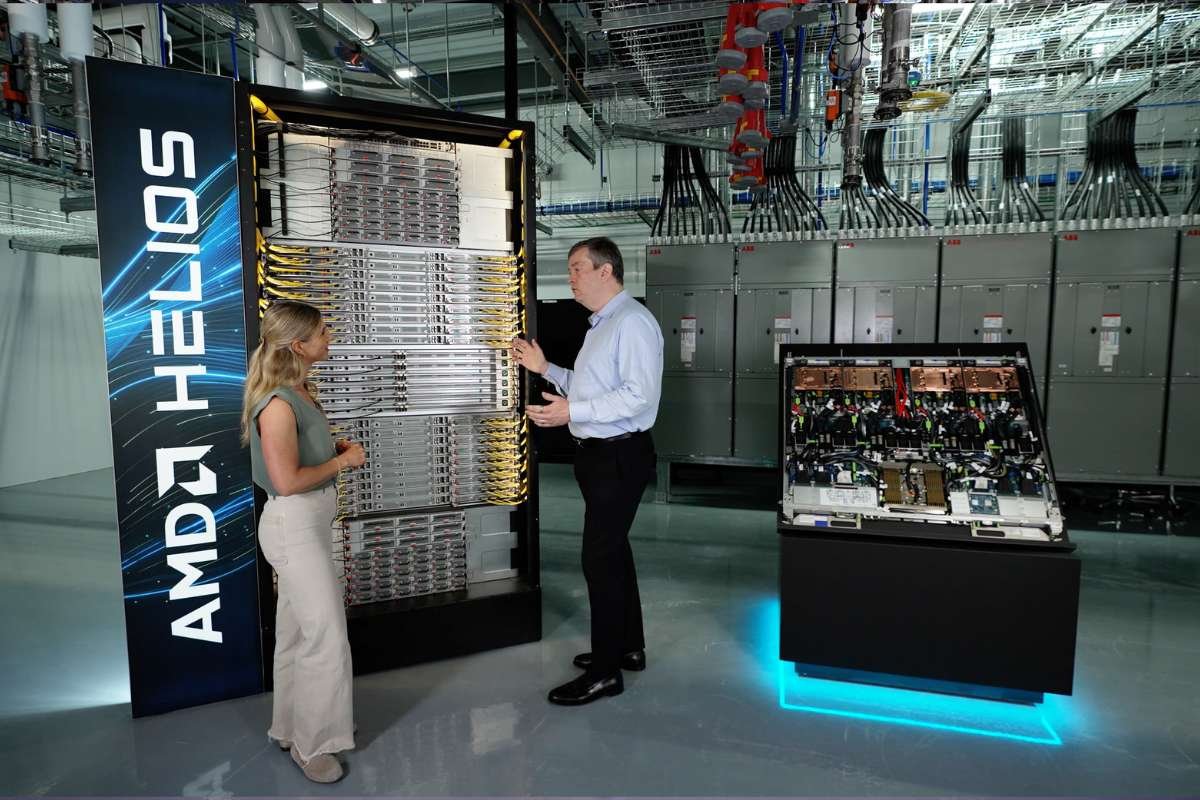
Rather than focusing solely on individual AI chips, AMD’s AI strategy is now positioning itself as a provider of complete AI infrastructure. Helios combines the company’s latest Instinct AI accelerators, EPYC processors, Pensando networking technology, and ROCm open software into a unified rack-scale platform. The integrated design is intended to improve performance, simplify deployment, and deliver greater efficiency for organizations running large-scale AI training and inference workloads.
The launch comes at a time when demand for AI computing continues to surge. Enterprises are investing heavily in AI-ready data centers, while hyperscale cloud providers are expanding infrastructure to meet growing customer demand for generative AI services. As AI models become larger and more computationally intensive, the market is increasingly shifting away from standalone processors toward fully integrated hardware and software ecosystems.
Microsoft Backs AMD’s Growing AI Ecosystem
A major highlight of the announcement was Microsoft’s decision to deploy Helios within its Azure cloud platform, further expanding the companies’ long-standing partnership. The move represents an important endorsement of AMD’s AI strategy and reinforces Microsoft’s efforts to diversify the hardware powering its AI services.
The Helios platform is expected to support a wide range of Azure AI workloads, including large language model training, inference, and enterprise AI applications. While Microsoft has worked extensively with Nvidia to power many of its AI offerings, the latest collaboration signals a broader strategy of building a more diverse AI infrastructure ecosystem that can better meet rising demand while reducing dependence on a single supplier.
Industry analysts view the partnership as more than a conventional supply agreement. Instead, it reflects growing confidence in AMD’s AI strategy and ability to deliver a complete AI platform that integrates hardware, networking, and software into a single solution. Such integrated systems are becoming increasingly important as organizations seek infrastructure that is easier to deploy, scale, and optimize for AI workloads.
Microsoft is not the only technology company embracing AMD’s AI strategy and latest AI platform. AMD has also announced support from several major AI and cloud companies, including OpenAI, Meta, and Oracle. These partnerships suggest that large technology firms are increasingly exploring alternative AI infrastructure providers as they continue expanding data center capacity and AI services worldwide.
The growing customer base also highlights the increasing demand for competition within the AI hardware market. With AI adoption accelerating across industries, cloud providers are seeking multiple technology partners to improve supply chain resilience, ensure greater flexibility, and maintain access to high-performance computing resources.
AI Infrastructure Competition Moves Beyond Chips
AMD’s Helios launch underscores a broader transformation taking place across the semiconductor industry. While Nvidia continues to hold a commanding lead in AI accelerators, competition is increasingly centered on delivering complete AI infrastructure rather than individual processors. Chipmakers are now competing across an entire ecosystem that includes compute, networking, memory, cooling, and software optimization.
This evolution is largely being driven by the growing complexity of generative AI models, which require thousands of interconnected processors working together efficiently. As a result, customers are placing greater emphasis on rack-scale systems that can maximize performance while simplifying deployment across large AI clusters.
For AMD’s AI strategy, Helios represents a strategic milestone in its ambition to become a full-stack AI infrastructure provider. The company is no longer competing solely on chip performance but is instead offering an integrated platform designed to meet the evolving needs of hyperscale cloud providers, enterprises, and AI developers.
Investors responded positively to the announcement, viewing Microsoft’s expanded partnership as a strong validation of AMD’s long-term AI strategy. The collaboration is expected to strengthen AMD’s credibility in a market that has been largely dominated by Nvidia, while also expanding opportunities for future enterprise and cloud deployments.
Although Nvidia remains the industry’s leading AI hardware supplier, AMD’s latest announcement signals that the competitive landscape is becoming increasingly dynamic. As organizations continue investing billions of dollars in AI infrastructure, demand for alternative platforms capable of delivering high performance, scalability, and flexibility is expected to grow.
With Helios, AMD is betting that the future of AI computing lies not only in faster processors but in fully integrated infrastructure designed to power the next generation of artificial intelligence. Backed by Microsoft’s support and a growing roster of major technology customers, the company is positioning itself as a stronger contender in one of the semiconductor industry’s most important and fastest-growing markets.
Visit CIO Women Magazine for the latest business and technology insights.