
You can have the strongest argument in the room and still weaken it with the way you deliver it.
A hesitant voice, nervous smile, or immediate retreat after making an offer can make a confident statement sound uncertain. On the other hand, calm eye contact, an open posture, and a deliberate pause can reinforce the same words.
That is where body language and negotiation intersect.
The issue is particularly relevant for women because negotiation does not always happen on a level playing field. In 2024, women in the U.S. earned 85% of men’s median hourly earnings, according to Pew Research Center. While negotiation is only one factor behind the gender pay gap, the ability to advocate for compensation, promotions, and opportunities remains an important part of career advancement.
Research also shows that women can face a complicated perception problem when negotiating for themselves. A Harvard Business School analysis of more than 2,500 negotiators found that women who negotiated assertively could experience backlash and, in some situations, worse outcomes or no agreement.
That does not mean women should make themselves smaller. Strong negotiation skills for women are not about appearing less assertive; they are about communicating value with clarity and confidence.
It means confidence needs to be communicated strategically.
What is body language and negotiation?
Body language and negotiation refer to the way nonverbal signals influence communication during a negotiation. These signals include posture, eye contact, facial expressions, gestures, physical distance, and movement.
Harvard’s Program on Negotiation notes that these behaviors can help establish rapport and build trust, although research specifically examining body language in negotiation is still relatively limited.
That limitation is important.
Body language is not a mind-reading tool.
A person crossing their arms is not automatically rejecting your proposal. Looking away does not prove that someone is lying. A serious expression does not necessarily mean disagreement.
Instead, nonverbal behavior should be treated as contextual information.
This is an important distinction in body language and negotiation: observation can provide context, but it should never replace direct communication.
Your own body language, however, is something you can control.
And that is where it can become a practical negotiation skill.
Why body language matters for women?
Women do not need a different set of negotiation rules. But they may encounter different expectations while negotiating.
Research by Emily Amanatullah and Michael Morris found that women negotiating for themselves anticipated greater social backlash than women negotiating on behalf of someone else. Women negotiating on their own behalf also made lower counteroffers in the study. The researchers linked this behavior to concerns about violating gender expectations around assertiveness.
A separate Harvard Business School study found that women who felt more powerful at the negotiation table could face greater backlash when negotiating assertively.
This creates an uncomfortable double bind.
If a woman is too accommodating, she may fail to advocate for her interests.
If she is highly aggressive, she may risk being judged more harshly.
This makes body language and negotiation particularly important for women who need to communicate confidence without creating an unnecessarily confrontational impression.
The solution is not to search for the perfect performance of confidence.
It is to develop calm, evidence-based assertiveness and understand how women can negotiate their interests without unnecessarily weakening their position.
That means your posture does not need to communicate dominance. Your expression does not need to look intimidating. Your voice does not need to become louder.
Your overall presence simply needs to support the message you are delivering.
The most effective body language for negotiation

1. Maintain natural eye contact
Eye contact can communicate attention and engagement.
Harvard’s Program on Negotiation cites research suggesting that people ideally maintain eye contact for roughly 60%–70% of conversation time, while typical adults may maintain it for less.
The goal in body language and negotiation is not to stare or maintain constant eye contact. It is to create a sense of attention and engagement without making the interaction uncomfortable.
Instead, maintain comfortable eye contact when making an important point, listening to the other person, or responding to a challenge.
For example:
“Based on the expanded scope of my role and the results I’ve delivered, I’d like to discuss a compensation adjustment.”
Look at the other person.
Say it clearly.
Then stop.
You do not need to immediately soften the statement.
2. Keep your posture open
An upright, relaxed posture can help you appear engaged and composed.
That does not mean sitting rigidly or deliberately taking up excessive space.
Keep your shoulders relaxed. Sit comfortably. Avoid repeatedly shrinking inward when the other person challenges your proposal.
Imagine hearing:
“That’s considerably higher than what we had budgeted.”
Instead of immediately leaning back and saying, “Oh, okay, I understand,” stay composed.
Try:
“I understand. What range would be possible within the current budget?”
Your posture and words communicate the same thing: the discussion is still open.
3. Control nervous movements
Negotiations create pressure.
You may fidget, tap a pen, adjust your clothing, or repeatedly shift in your chair without realizing it.
You do not need to eliminate every movement. Natural gestures are part of communication.
The objective is to reduce movements that distract from your message.
Before a high-stakes conversation, practice your opening statement. Familiarity can make it easier to remain physically composed when the real negotiation begins.
4. Use deliberate gestures
Gestures can help emphasize important information, particularly when explaining:
- Business results
- Increased responsibilities
- Financial figures
- Project timelines
- Alternative proposals
But excessive movement can compete with your message.
Use your hands naturally, then allow them to rest when you make your most important point.
Effective body language and negotiation are not about constant movement. They are about using gestures when they help clarify or reinforce the point you are making.
The strongest gesture may sometimes be no gesture at all.
5. Let silence work
One of the most valuable elements of body language and negotiation is something you do not do.
In body language and negotiation, silence can communicate confidence because it shows that you are comfortable allowing your proposal to stand on its own.
After making an offer, pause.
Suppose you say:
“I believe $115,000 is appropriate based on the scope of the position and my experience.”
Then stop.
Do not immediately add:
“But I’m flexible.”
“I understand if that’s too much.”
“I’m open to anything.”
The other person may need time to process the proposal.
Silence gives them that space.
More importantly, it gives you space to avoid negotiating against yourself.
6. Match energy without copying
During a negotiation, people can naturally begin to mirror aspects of one another’s posture, gestures, and tone. This type of nonverbal convergence can sometimes support rapport without requiring deliberate imitation. Harvard’s Program on Negotiation notes that this type of behavioral convergence can contribute to rapport.
But deliberate imitation is unnecessary. Nonverbal signals can also vary across cultures, which is why understanding cultural differences in negotiation can help you interpret eye contact, silence, physical distance, and conversational style more carefully.
Instead, adapt to the conversation.
If the other person is speaking slowly and analytically, slow down and focus on evidence.
If the discussion becomes more conversational, you can relax your delivery.
The goal is connection, not mimicry.
What not to do when negotiating?
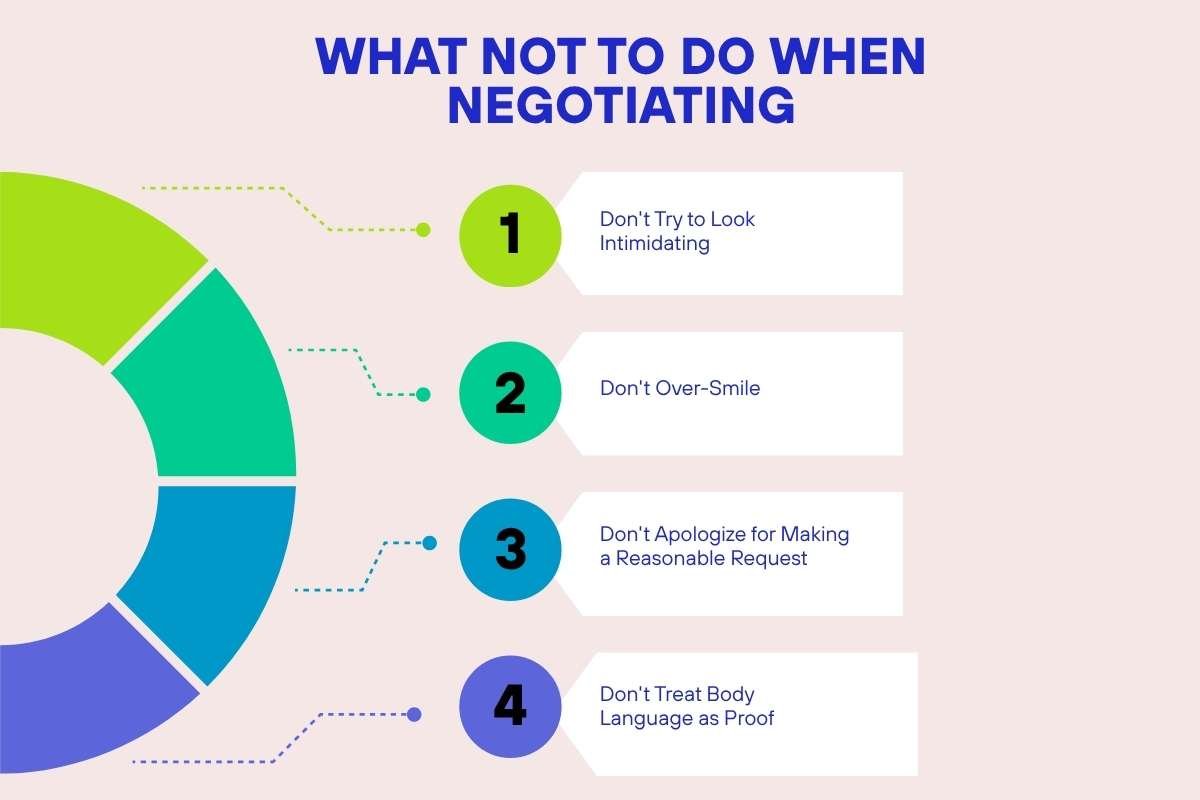
Knowing what to avoid is just as important as knowing what works. In body language and negotiation, small habits can sometimes weaken an otherwise strong message. Recognizing these patterns makes it easier to stay composed when the conversation becomes difficult.
1. Don’t try to look intimidating
A common misconception is that a powerful negotiator must appear physically dominant.
Research does not support that as a universal strategy.
A 2026 review from Harvard’s Program on Negotiation examined research suggesting that dominant physical displays can backfire under certain conditions. In particular, a dominant posture paired with an unfair offer could actually increase the likelihood of rejection.
Confidence and intimidation are not interchangeable.
For women, deliberately adopting an aggressive physical presence can also create an unnecessary risk of reinforcing negative perceptions.
Aim for composure, not dominance.
2. Don’t over-smile
Smiling can create warmth and rapport, but it should not become a reflex for softening every difficult statement.
Consider the difference:
“I’d like to discuss a salary adjustment.” Nervous smile.
And:
“I’d like to discuss a salary adjustment based on the additional responsibilities I’ve taken on.” Calm expression.
The second does not sound hostile.
It simply sounds certain.
3. Don’t apologize for making a reasonable request
Avoid opening negotiations with unnecessary apologies:
- “I’m sorry to ask…”
- “I hate to bring this up…”
- “I know this is probably a lot…”
- “I don’t want to be difficult…”
Instead:
“I’d like to discuss my compensation.”
Or:
“I’d like to revisit the scope of my role and title.”
This approach is particularly useful when negotiating job title and role scope, where expanded responsibilities, decision-making authority, and measurable results can strengthen your case.
The objective is not to remove politeness.
It is to remove unnecessary self-doubt from the message.
4. Don’t treat body language as proof
Crossed arms, a frown, or lack of eye contact is not enough to determine someone’s intentions.
Research discussed by Harvard’s Program on Negotiation found that people are generally poor at detecting deception from nonverbal cues alone.
So if a manager looks uncomfortable after hearing your proposal, do not assume the answer is no.
Ask:
“What concerns you most about the proposal?”
Their response gives you actionable information. This is also where the 70/30 rule in negotiation can be useful: listening carefully before responding gives you more information about the other party’s priorities and concerns.
This is one of the most important principles of body language and negotiation: observe nonverbal signals, but verify their meaning through conversation.
What not to say in a negotiation?
Strong body language becomes more effective when the language itself is clear. Having a few prepared negotiation scripts women can use can also make it easier to stay composed when the conversation becomes uncomfortable.
| Avoid | Use instead |
| “I was just wondering if…” | “I’d like to discuss…” |
| “I’m sorry to ask…” | “I’d like to revisit…” |
| “I know this may be too much…” | “Based on the scope of the role…” |
| “Whatever works for you.” | “Here are two options we could consider.” |
| “I don’t know if this is possible.” | “Would you be open to discussing…” |
| “I can probably make that work.” | “I could agree to that if…” |
This is especially important when negotiating compensation, promotions, or how to negotiate flexible work arrangements.
Instead of:
“I was hoping there might be some flexibility in the salary.”
Try:
“Based on my experience, the scope of the position, and the value I can bring, I’d like to discuss a salary of $X.”
Then allow the other person to respond.
Do not immediately negotiate against yourself.
Four negotiation styles and the right body language

Negotiation styles can influence how body language and negotiation look depending on the objective, relationship, and level of conflict involved. The right nonverbal approach should support the negotiation style you are using rather than follow a fixed formula.
The most effective approach to body language and negotiation is to use physical signals that reinforce your objective, rather than trying to perform confidence in a particular way.
| Negotiation style | Main focus | Body language to emphasize |
| Competitive | Claiming value | Controlled gestures and steady eye contact |
| Collaborative | Finding mutual value | Open posture and active listening |
| Accommodating | Preserving relationships | Warmth combined with clear boundaries |
| Avoiding | Delaying or exiting | Calm, neutral presence |
The important distinction is between collaboration and accommodation.
Being collaborative does not mean accepting whatever the other party proposes.
For example:
“I want to find an arrangement that works for the team, but the expanded responsibilities also need to be reflected in my compensation.”
The statement is collaborative.
The boundary remains clear.
When should you walk away?
Body language can tell you that a negotiation is becoming uncomfortable.
It cannot decide whether you should accept the deal.
That requires preparation.
Before negotiating, identify:
- Your ideal outcome
- Your minimum acceptable outcome
- Your priorities
- What you are willing to trade
- Your BATNA, or best alternative to a negotiated agreement
These preparation principles also apply to B2B negotiation tactics, where understanding priorities, alternatives, and trade-offs can help negotiators avoid accepting unfavorable terms simply to close a deal.
If the other party refuses to meet a critical requirement, repeatedly changes agreed terms,s or becomes disrespectful, walking away may be the right decision.
But do not walk away simply because someone looks serious.
Likewise, do not accept a poor offer because the conversation feels friendly.
Read the room, but make the decision based on your interests.
Seven Rules for Body Language and Negotiation

For women preparing for an important negotiation, these seven principles turn body language and negotiation into a practical skill rather than a performance of confidence.
1. Prepare your position first.
Confidence is easier when you know your numbers, evidence, and alternatives.
2. Make your words and body language agree.
A confident message should not be accompanied by visibly uncertain behavior.
3. Choose composure over dominance.
You do not need to intimidate the other person.
4. Maintain natural eye contact.
Stay engaged without turning eye contact into a performance.
5. Use silence strategically.
Make your request and give the other person space to respond.
6. Observe without assuming.
Nonverbal cues are information, not definitive answers.
7. Do not sacrifice your position to appear likable.
Warmth and assertiveness can coexist.
Conclusion:
The strongest use of body language and negotiation is not about learning how to look powerful.
It is about making sure your physical presence does not undermine what your words are already saying.
For women, that distinction matters. Research shows that women can face social penalties for assertive self-advocacy, making the negotiation challenge more complicated than simply “asking for more.”
But the answer is not to become quieter, tougher, or more intimidating.
It is to become clearer.
Walk into the conversation prepared. Sit comfortably. Maintain natural eye contact. Listen carefully. Keep your gestures intentional. Do not apologize for making a reasonable request. And when you state your number or expectation, resist the urge to immediately soften it.
Your body language cannot negotiate the deal for you.
But it can make sure your confidence, preparation, and value are visible when the conversation matters most.
FAQs
1. What is the most effective body language in negotiation?
Calm eye contact, an open and relaxed posture, deliberate gestures, attentive facial expressions, and strategic pauses are among the most useful forms of nonverbal communication. They are most effective when combined with strong preparation and clear verbal arguments.
2. What body language should women avoid during negotiations?
Women should avoid excessive nervous movements, constant apologetic smiling, shrinking their posture, over-nodding, and deliberately aggressive displays. The goal is confident and composed communication rather than intimidation.
3. Does eye contact make you a better negotiator?
Natural eye contact can support engagement and rapport, but it is not a guarantee of negotiation success. Harvard’s Program on Negotiation cites research suggesting that eye contact during roughly 60%–70% of conversation can be appropriate, while prolonged staring can feel uncomfortable or aggressive.
4. Can you tell if someone is lying through their body language?
Not reliably. Nonverbal behavior can provide clues, but research shows that people are generally poor at detecting deception from body language alone. Look for inconsistencies and ask direct questions rather than assuming that a gesture proves dishonesty.
5. How can women appear confident without seeming aggressive?
Focus on calm, evidence-based communication. Maintain natural eye contact, use a relaxed posture, avoid unnecessary apologies, and state your request directly. Research on women and negotiation suggests that connecting an assertive request to organizational or shared interests can also help address concerns around backlash.