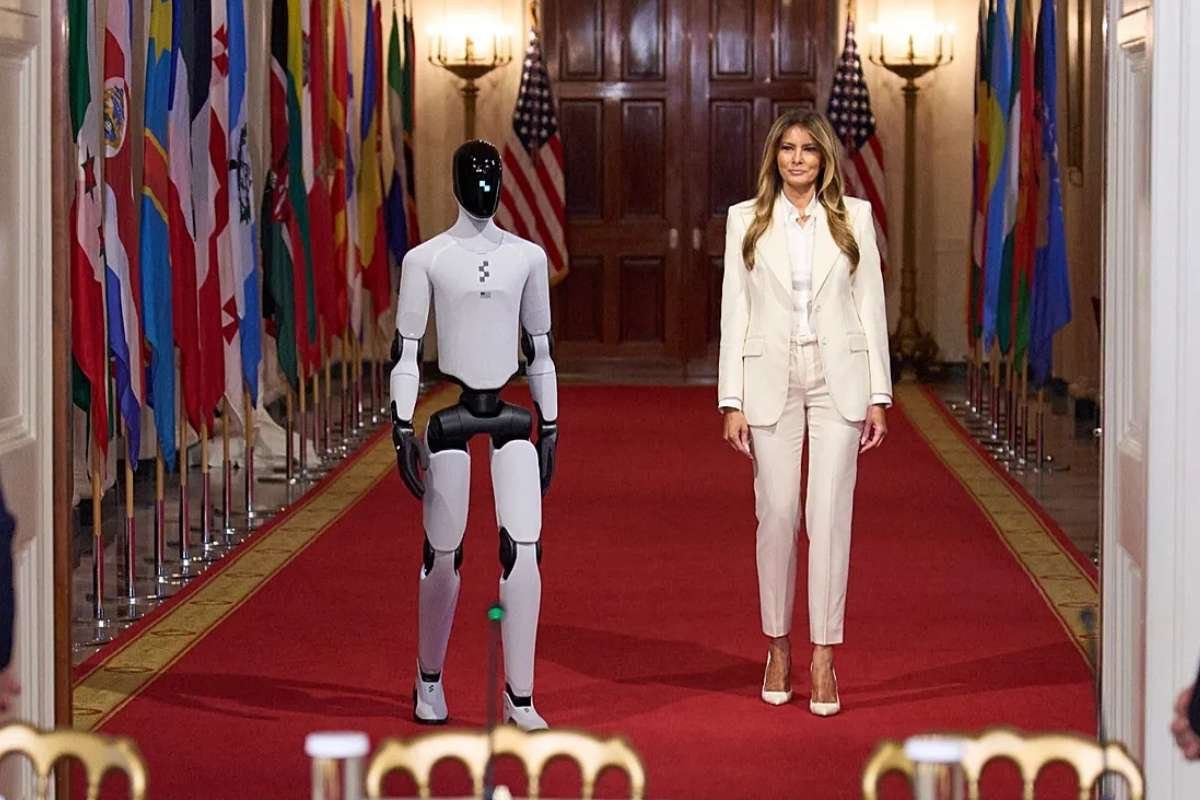
First Lady Melania Trump drew significant global attention after appearing at a White House education and technology summit accompanied by a humanoid robot developed by Figure AI, a U.S.-based robotics company. The robot was presented as a symbolic demonstration of how rapidly artificial intelligence and robotics are evolving and entering mainstream society.
During the event, the humanoid robot interacted with attendees, greeted guests, and demonstrated coordinated, human-like movements. Its presence marked a striking visual moment at the summit, reflecting how advanced robotics has moved beyond laboratories into public-facing and policy-driven discussions.
The summit itself gathered international guests, including spouses of global leaders, policymakers, and technology industry representatives. The central theme revolved around how emerging technologies, especially AI and robotics, could influence education systems, workforce readiness, and future classroom environments. While the robot is primarily designed for real-world assistance tasks in industrial and domestic environments, its appearance in a high-level government event emphasized its symbolic role in the future of learning and human-machine collaboration.
AI-Driven Education Vision and “Robot Tutors” Concept
At the core of the summit, Melania Trump highlighted the transformative potential of artificial intelligence in reshaping global education systems. She emphasized that AI tools could revolutionize learning by offering personalized education pathways tailored to each student’s pace, abilities, and learning style.
A key concept discussed was the idea of AI-powered “robot tutors,” envisioned as intelligent systems capable of delivering real-time instruction, answering student queries instantly, and adapting lessons dynamically based on individual performance. This forward-looking model suggests a future where education is not confined to traditional classroom structures but instead becomes more interactive, responsive, and technology-driven.
She also underscored the importance of responsible innovation, stressing that AI should function as a supportive tool rather than a replacement for human educators. According to the vision shared at the event, teachers would remain central to the learning process, while AI systems would enhance their capabilities by assisting with instruction, evaluation, and personalized content delivery.
The Melania Trump discussion aligned with broader educational initiatives that encourage digital literacy and early exposure to emerging technologies. Increasingly, policymakers and educators are exploring how AI can be integrated into classrooms to improve engagement, reduce administrative workloads, and provide scalable learning solutions in under-resourced regions.
Proponents argue that such systems could help bridge educational inequality by giving students access to high-quality instruction regardless of geographic or economic limitations. The idea of combining human teaching with machine intelligence represents a major shift in how education is conceptualized in the digital era.
Rising Debate Over AI’s Role in Classrooms
Despite the optimism surrounding AI-powered education, the showcase also intensified global debate about the implications of introducing advanced robotics into learning environments. Critics argue that while technology can enhance education, excessive reliance on AI could reduce essential human interaction between teachers and students, an element widely considered fundamental to child development and emotional learning.
Education experts and labor representatives have raised concerns about potential disruptions to the teaching profession, particularly if automation begins to take over responsibilities such as tutoring, grading, and curriculum planning. Questions around job displacement, ethical boundaries, and data privacy have become central to the ongoing discussion.
There are also broader concerns about how much decision-making power should be given to AI systems when it comes to shaping young minds. Critics caution that algorithms, no matter how advanced, may lack the cultural sensitivity, emotional intelligence, and moral judgment required in education.
On the other hand, Melania Trump supporters of AI integration argue that these tools are not meant to replace educators but to empower them. They point out that AI can significantly reduce administrative burden, allowing teachers to focus more on mentoring and student engagement. In overcrowded classrooms or regions with limited access to skilled educators, AI-based learning assistants could provide critical support and improve educational access.
The presence of a humanoid robot at a prominent government-led education summit has therefore become more than a technological demonstration; it has sparked a broader global conversation. As artificial intelligence continues to evolve, governments, educators, and technology leaders face the challenge of finding a balance between innovation and human-centered learning.
The debate ultimately highlights a defining question of the digital age: how to integrate powerful emerging technologies into education without losing the human connection that lies at the heart of learning.
Explore CIO Women Magazine for the latest insights and updates.