
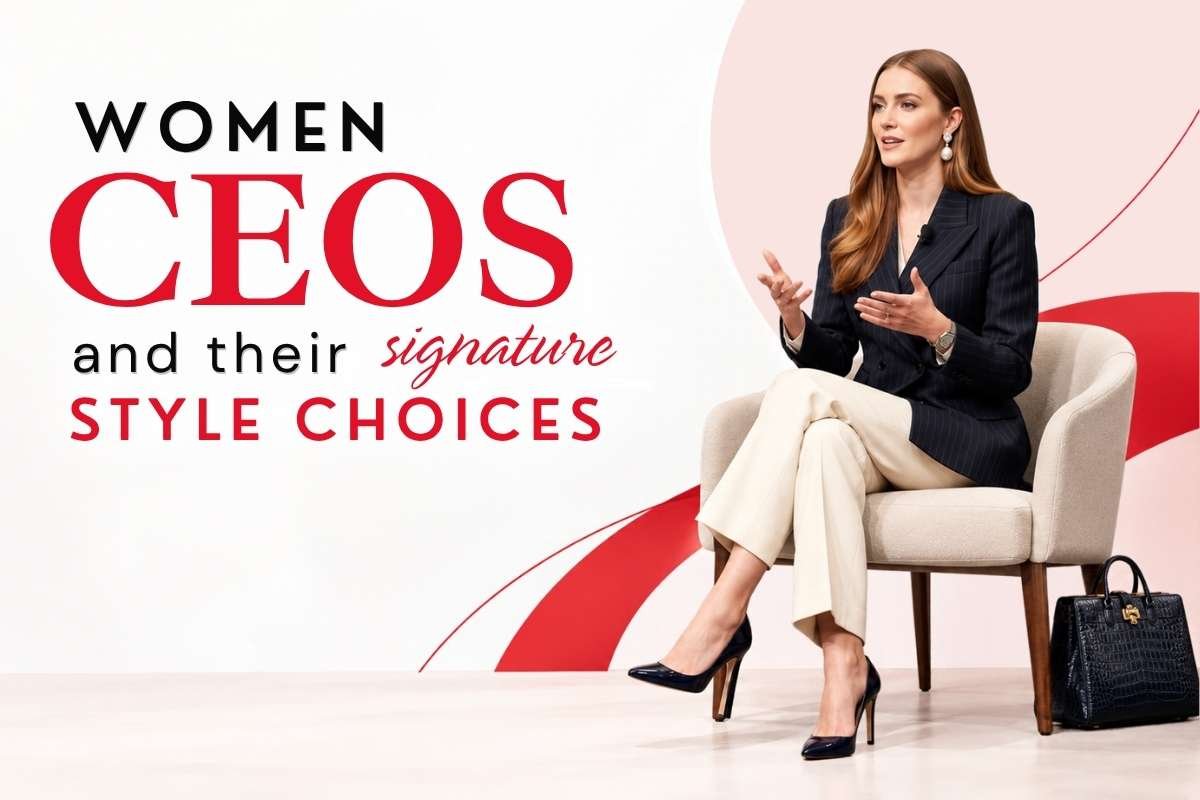
A CEO wardrobe is not a leadership qualification, but women CEOs and their signature style choices can influence how leaders communicate identity and presence in highly visible roles. In 2026, 55 women led Fortune 500 companies, representing 11% of the list, its highest share in 72 years. Yet women remain underrepresented at the top. McKinsey’s 2025 Women in the Workplace report found that women hold 42% of manager roles but just 29% of C-suite positions, with only 93 women promoted to manager for every 100 men.
Their wardrobes are not formulas for success, but examples of how women leaders use tailoring, color, accessories, and personal style to maintain a polished presence while expressing individuality.
Why Signature Style Matters for Women Leaders
A signature style is not about wearing the same outfit repeatedly. It is about developing recognizable elements that make dressing easier and more consistent.
These can include:
- A preferred color palette
- A particular blazer or jacket silhouette
- Tailored dresses
- Statement jewelry
- Distinctive footwear
- A recognizable handbag
- Cultural or personal details
There is also research suggesting that clothing can affect first impressions.
A study published in Nature Human Behaviour involved 399 participants across six studies and found that people were judged as more competent when photographed in clothing perceived as more economically affluent. In some experiments, participants viewed the images for only 130 milliseconds, yet the clothing effect remained.
That does not mean women need expensive clothing to appear competent. In fact, that would be an unhelpful conclusion. The more practical takeaway is that clothing can influence rapid judgments, making fit, context, and visual consistency worth considering.
Research published in the Journal of Applied Psychology has also examined the broader impact of clothing in workplace settings, reviewing evidence on how attire can influence perceptions and workplace interactions.
For women, the goal should therefore be intentional professional dressing, not dressing for approval.
Women CEOs and Their Signature Style Choices
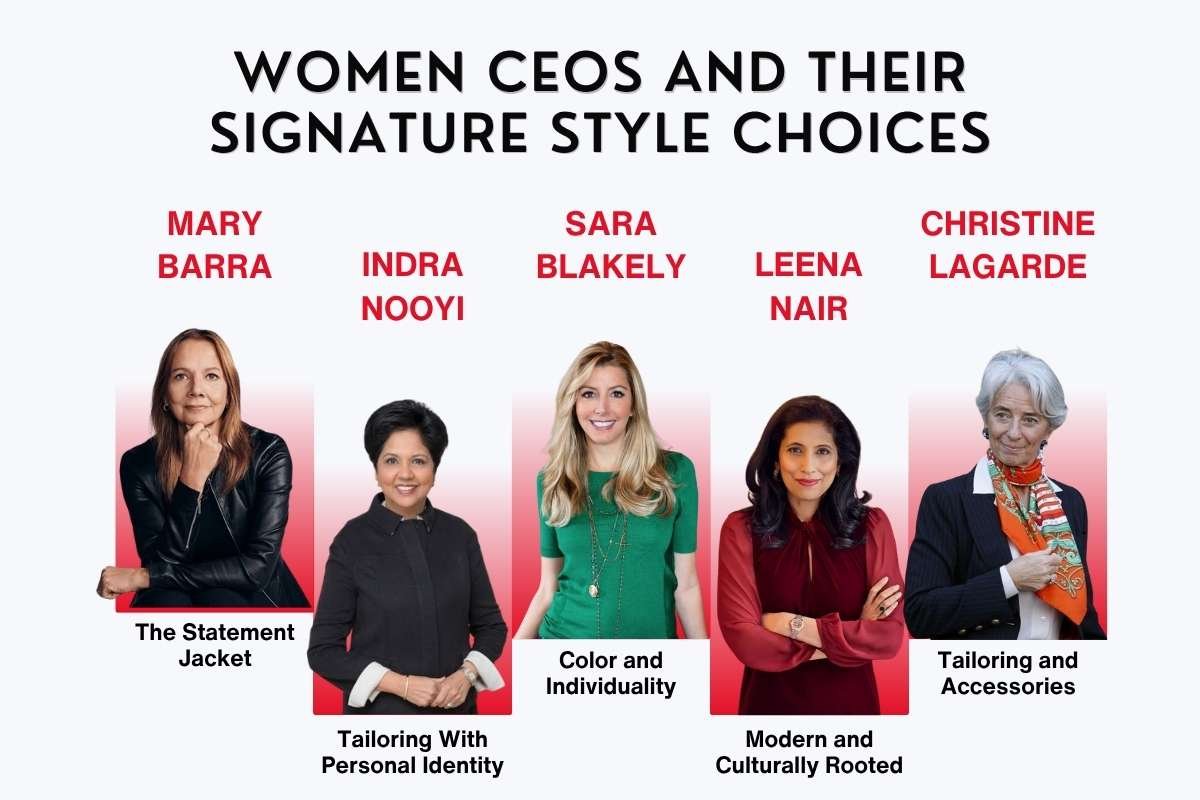
The clearest way to understand executive style is to look at women leaders who have developed recognizable approaches.
1. Mary Barra: The Statement Jacket
General Motors CEO Mary Barra is strongly associated with leather jackets. Fortune has documented her wearing them at shareholder meetings, media appearances, product
launches, and other high-profile events. She even wore a hot-pink leather jacket at Davos.
The significance is not the leather itself.
Barra demonstrates how one distinctive garment can become a recognizable part of a leader’s visual identity.
For women building their own professional wardrobe, the equivalent could be a structured blazer, statement earrings, colorful shoes, or a distinctive watch.
Your signature piece does not need to be dramatic. It simply needs to feel consistent with you.
2. Indra Nooyi: Tailoring With Personal Identity
Former PepsiCo CEO Indra Nooyi provides another perspective on women CEOs and their signature style choices.
Her public style has included tailored clothing and distinctly feminine elements, demonstrating that women do not need to abandon femininity to project authority.
Her story also provides a useful reminder that professional identity is influenced by culture and personal background. In a Vogue essay, Nooyi described growing up in India surrounded by women wearing colorful saris, reflecting how clothing and identity were closely connected from an early age.
That makes her approach particularly relevant for women who want their professional wardrobes to retain elements of their cultural identity.
3. Sara Blakely: Color and Individuality
Spanx founder Sara Blakely represents a much more playful approach.
In a Vogue profile, Blakely described her personal style as feminine and unconventional and said she shops for color and shape rather than focusing on designer labels.
That is an important lesson for women because it challenges the idea that executive style has to be neutral or traditionally corporate.
A woman can build a professional identity around color, distinctive silhouettes, or playful accessories while still dressing appropriately for her role.
4. Leena Nair: Modern and Culturally Rooted
Chanel CEO Leena Nair represents another version of executive style: modern, polished, and connected to her cultural background.
Her career also highlights the broader progress women are making into senior leadership, while showing that professional identity does not require removing cultural influences from how a woman presents herself.
For women building their own wardrobes, this can mean incorporating culturally meaningful colors, jewelry, fabrics, or silhouettes when appropriate for the workplace.
5. Christine Lagarde: Tailoring and Accessories
Christine Lagarde is another recognizable example of feminine executive dressing, frequently combining structured clothing with distinctive accessories.
Her approach illustrates how accessories can become part of a professional signature without dominating the outfit.
A scarf, necklace, brooch, watch, or pair of earrings can provide continuity across different outfits.
What Can Women Learn From These CEO Wardrobes?
The most useful lesson from women CEOs and their signature style choices is that there is no universal CEO uniform.
Their approaches can be summarized like this:
| CEO style approach | What women can take from it |
| Statement jackets | Develop one recognizable piece |
| Tailored clothing | Prioritize fit and structure |
| Color | Use color as part of your identity |
| Feminine silhouettes | Authority does not require masculine dressing |
| Cultural details | Personal identity can remain visible |
| Accessories | Small details can create consistency |
The goal is not imitation.
A woman working in finance may need a different wardrobe from a technology founder, creative executive, or nonprofit leader. Context should always come before copying another person’s style.
Which Colors Work Best for a CEO Wardrobe?
There is no scientifically established “CEO color” that makes a woman look authoritative. However, these shades offer practical, polished options:
| Navy | Versatile and polished |
| Black | formal and easy to combine |
| Charcoal | professional without being as stark as black |
| Burgundy | adds depth and personality |
| Forest green | distinctive while remaining understated |
| Ivory | clean and versatile |
| Camel | Useful for outerwear and accessories |
The best choice depends on your workplace, wardrobe, comfort, and personal style, not a supposed “power color.”
Does Expensive Clothing Make You Look More Professional?
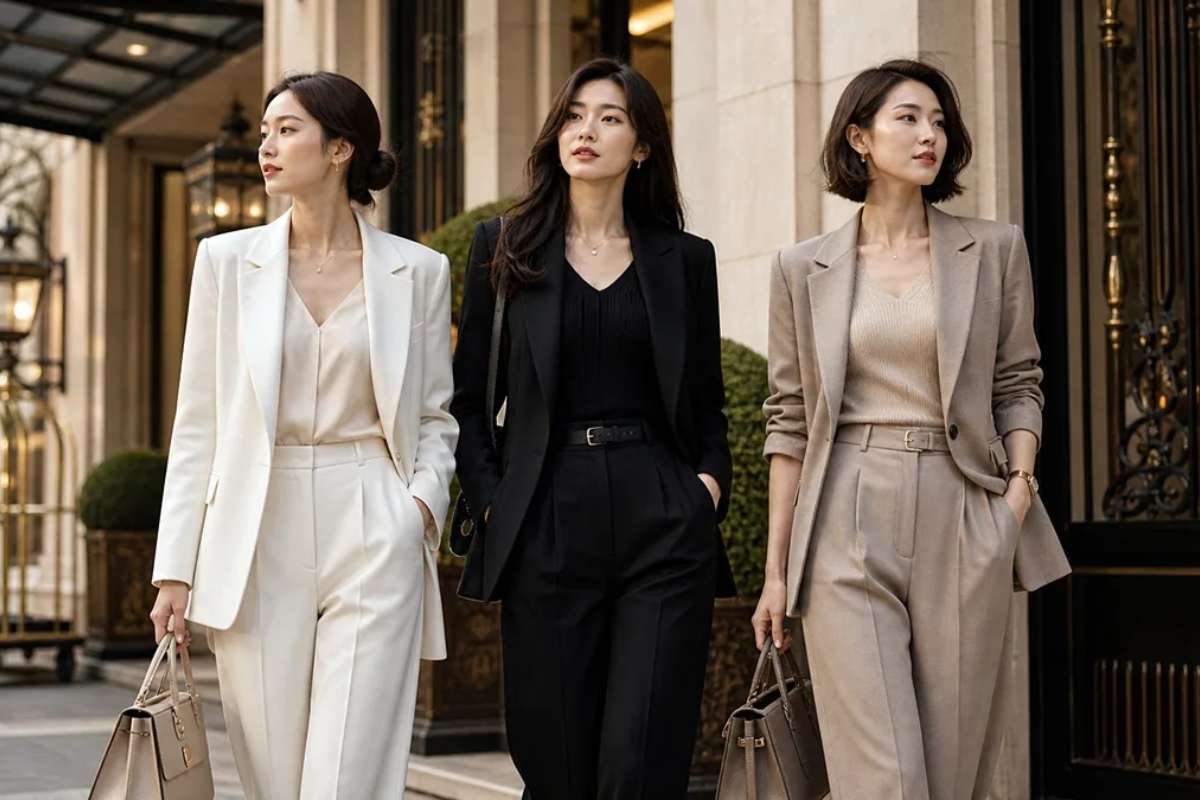
Not necessarily. Research on clothing and first impressions does not mean professional credibility requires expensive or designer clothing. For women building a professional wardrobe, the best way to look polished on a small budget is to prioritize well-fitting, structured, clean, and well-maintained pieces that work together easily.
Simple details such as footwear, jewelry, scarves, or color can add personality without relying on luxury labels. This is one of the key lessons from women CEOs and their signature style choices: a strong professional wardrobe is about intention, consistency, and confidence, not price.
How Can You Build Your Own CEO-Inspired Style?
An executive-inspired wardrobe does not require a corner office. Your style can evolve with your role, which is why the proper way to dress for success at every career stage should reflect your current professional stage.
- Choose your core colors.
Build around two or three versatile shades such as navy, black, charcoal, ivory, or camel.
- Identify your signature element.
Choose something that reflects your personality, such as statement earrings, blazers, colorful shoes, or scarves.
- Create repeatable outfit formulas.
Simple combinations like a blazer with tailored trousers or a midi dress with a structured jacket can make dressing easier.
- Dress for your environment.
Professional expectations vary across industries and workplaces. There is no universal “female CEO outfit.”
- Prioritize comfort.
Choose polished pieces that let you move comfortably through meetings, presentations, travel, and networking while avoiding common office fashion mistakes women make.
What the Leadership Data Tells Us

The growing number of women CEOs is meaningful, but the overall pipeline shows that there is still considerable room for progress.
In 2026, 55 Fortune 500 companies are led by women, up from 52 in 2025 and 2024. The share has risen from 7.4% in 2020 to 11% in 2026.
Yet McKinsey’s 2025 data shows women at just 29% of C-suite roles, compared with 42% at manager level.
The promotion gap is particularly important. For every 100 men promoted from entry-level to manager in 2025, only 93 women were promoted. For women of color, the number was 74.
These figures put women CEOs and their signature style choices into the right context.
Style can influence perception, but it cannot replace opportunity, sponsorship, skills, experience, or fair promotion practices.
Women should not have to dress perfectly to earn leadership opportunities.
Instead, a personal style can simply be one tool for showing up with confidence and consistency once those opportunities arrive.
Conclusion:
Women CEOs and their signature style choices show that executive dressing has no single formula. From statement jackets and bold colors to tailored silhouettes and understated accessories, successful women leaders build styles that reflect their personalities and roles.
The goal is not to copy them. Choose colors, fits, and outfit formulas that suit your career, environment, and comfort.
Your clothes do not define your leadership. But an authentic, intentional wardrobe can support how you show up.
FAQs
1. How should a female CEO dress?
There is no universal CEO dress code. A woman should consider her industry, role, audience, and workplace culture while prioritizing fit, comfort, and personal style.
2. What is the 3-3-3 rule for clothes?
The 3-3-3 rule uses three tops, three bottoms,s and three pairs of shoes to create multiple outfit combinations from a relatively small wardrobe.
3. What color makes you look expensive?
No single color automatically makes someone look expensive. Navy, black, charcoal, ivory, camel, el and burgundy can create a polished appearance when paired thoughtfully.
4. Who is considered the most stylish CEO?
There is no objective answer. Women CEOs and their signature style choices vary considerably, from Mary Barra’s statement jackets to Sara Blakely’s colorful and individualistic approach.
5. How can I develop a CEO-inspired signature style?
Start with two or three core colors, identify a signature accessory or silhouette, create a few repeatable outfit formulas, and prioritize fit and comfort over designer labels.