
An international assignment can give women access to leadership roles, higher pay, and global networks. But choosing a destination takes more than comparing salaries, since workplace culture, employment rights, personal safety, and long-term prospects all shape the experience.
For women expats in Asia vs. the Middle East, the right choice depends on the country, industry demand, and employer support. Singapore, Hong Kong, and Japan offer established multinational environments, while the UAE, Saudi Arabia, and Qatar are expanding opportunities across emerging industries.
Women Expats in Asia vs. the Middle East: Understanding the Career Landscape
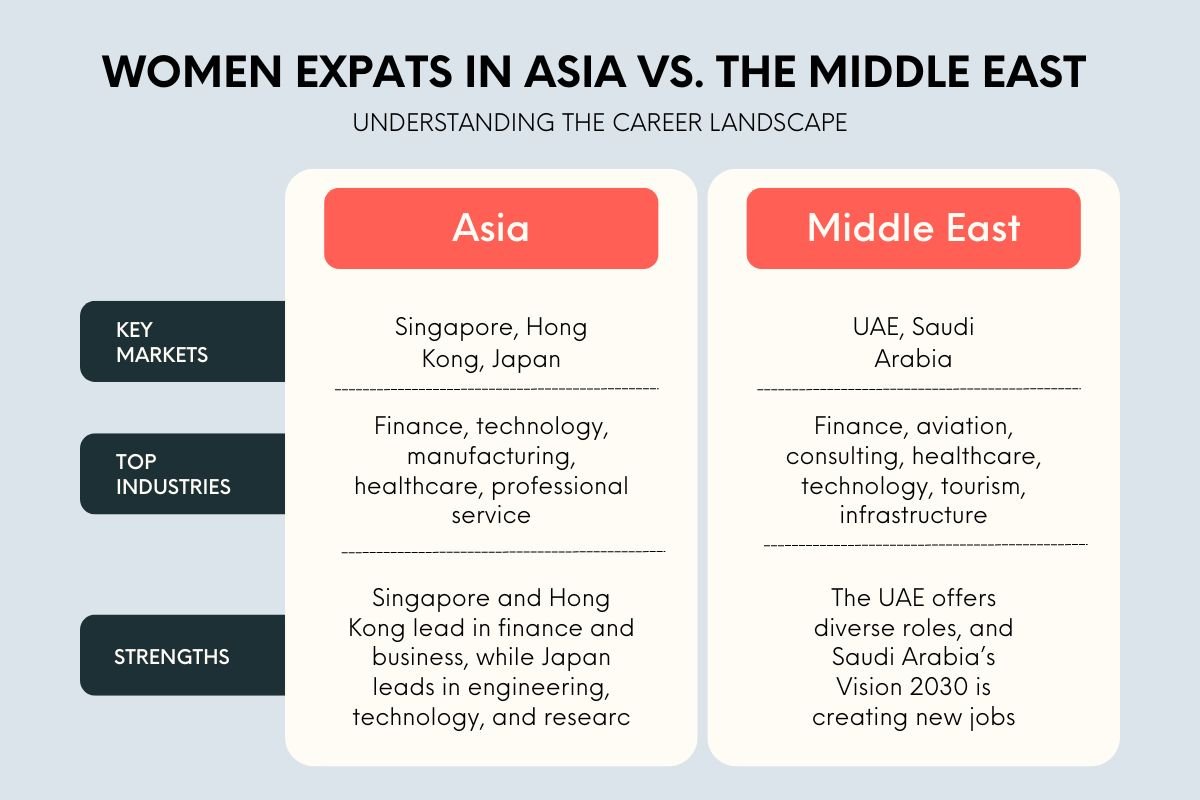
| Asia | Middle East | |
| Key markets | Singapore, Hong Kong, Japan | UAE, Saudi Arabia |
| Top industries | Finance, technology, manufacturing, healthcare, professional services | Finance, aviation, consulting, healthcare, technology, tourism, infrastructure |
| Strengths | Singapore and Hong Kong lead in finance and business, while Japan leads in engineering, technology, and research | The UAE offers diverse roles, and Saudi Arabia’s Vision 2030 is creating new jobs |
Growing attention to women and global mobility highlights the need for equal access to international assignments, leadership roles, and cross-border career development. Relocation decisions should reflect a woman’s skills and ambitions, not assumptions about family responsibilities or willingness to work abroad.
Women’s labour force participation (World Bank, 2025)
These figures reflect national labour markets, not expatriate women specifically.
Even so, they show how different the employment environments are. For women expats in Asia vs. the Middle East, understanding the local economy and employer expectations is essential before accepting an overseas role.
Cultural Reception and Workplace Expectations
Cultural adaptation can influence women’s professional relationships, networking opportunities, and everyday experiences.
In Singapore, international workplaces generally bring together professionals from diverse backgrounds. However, women may need to adapt to hierarchical management structures, communication styles, and demanding corporate schedules. Japan presents different challenges, including traditional workplace expectations and language barriers that can affect professional integration.
In the Middle East, workplace experiences vary considerably by country and organisation. The UAE has a large international business community, particularly in Dubai and Abu Dhabi. Saudi Arabia is also experiencing changes in women’s employment and professional participation.
Saudi Arabia’s Vision 2030 Annual Report 2024 shows women’s labour force participation rising from 22.8% in 2016 to 33.5% in 2024.
Women expats in Asia vs. the Middle East should evaluate individual workplace cultures rather than rely on regional stereotypes. Access to leadership meetings, client-facing responsibilities, networking events, flexible working arrangements, and promotion opportunities can vary between employers.
Salary, Benefits and Financial Opportunities
Compensation is an important consideration when comparing international assignments. Several Middle Eastern destinations offer competitive expatriate packages that may include housing allowances, medical insurance, relocation expenses, and annual flights. The UAE and other GCC countries can also offer favourable personal income tax arrangements, although tax treatment varies by jurisdiction and individual circumstances.
Asian destinations offer competitive salaries in sectors such as finance, technology, and consulting. Singapore and Hong Kong provide attractive professional opportunities, but high housing expenses can affect savings. Japan and Thailand have different salary structures and taxation requirements.
For women expats in Asia vs. the Middle East, comparing total compensation is more useful than looking at basic salary alone. Housing, healthcare, taxation, retirement contributions, and family benefits should all be considered.
Women should also examine salary transparency, performance bonuses, promotion-linked increases, and potential gender-related pay differences before signing an employment contract. Childcare, school fees, transportation, housing deposits, and currency exchange rates can further influence the financial benefits of relocation.
Career Advancement and Leadership Opportunities

International assignments can strengthen women’s professional profiles through regional responsibilities, exposure to international clients, and opportunities to manage multicultural teams.
Access to global assignment opportunities for women can differ across employers and destinations. Women should assess whether international roles provide regional decision-making responsibilities, exposure to senior leadership, and opportunities to progress into higher-level positions rather than simply offering overseas experience.
Singapore offers opportunities in regional management, financial services, and technology. However, leadership representation varies across Asian markets. Japan, for example, continues to face challenges in increasing women’s representation in senior management.
The Middle East is also creating new pathways for women. Saudi Arabia’s economic diversification initiatives have expanded professional opportunities, while the UAE’s multinational business environment provides access to regional management and executive roles. The UAE also has legal provisions requiring equal wages for women and men performing the same work or work of equal value.
Women expats in Asia vs. the Middle East should distinguish between receiving an international job title and gaining genuine decision-making authority. Transparent promotion criteria, executive sponsorship, mentorship, and access to strategic projects are important indicators of meaningful career progression.
Safety, Employment Rights and Relocation Support
Personal safety, healthcare access, and employment protections should be central to relocation decisions.
Women considering Asian assignments should research accommodation, transport, healthcare facilities, workplace harassment policies, and emergency assistance. Language requirements and access to local support networks can also influence everyday independence.
The same considerations apply to Middle Eastern destinations. Women should understand local laws, workplace regulations, healthcare coverage, and travel arrangements before relocating. They should also review provisions concerning discrimination, maternity leave, harassment reporting, and access to legal assistance.
The UAE provides an example of formal employment protections. Under its private-sector labour law, female employees are entitled to 60 days of maternity leave, including 45 days at full pay and 15 days at half pay. The law also provides nursing breaks after an employee returns to work.
Women expats in Asia vs. the Middle East should remember that employment rights differ across countries and sectors. Before accepting an offer, women should examine employment contracts, work visa conditions, renewal requirements, and dependent visa provisions. Companies should provide destination-specific safety assessments, comprehensive medical insurance, emergency assistance, and confidential reporting channels.
Real-World Country Comparisons: Singapore, Japan, UAE, and Saudi Arabia
Individual destinations offer different advantages and considerations for international professionals.
- Singapore: Offers regional business networks, an international professional environment, and opportunities in finance, technology, and management. High housing costs require careful financial planning.
- Japan: Provides opportunities in engineering, technology, research, and manufacturing. Women should evaluate language requirements, workplace hierarchy, and leadership representation.
- United Arab Emirates: Dubai and Abu Dhabi attract international professionals across finance, healthcare, aviation, and technology. Women should compare employment benefits, workplace protections, and contractual conditions.
- Saudi Arabia: Economic diversification under Vision 2030 is creating opportunities in emerging industries. Women should assess sector-specific hiring conditions, workplace practices, and long-term career pathways.
These destinations demonstrate why women expats in Asia vs. the Middle East should compare individual countries rather than make decisions based on regional assumptions.
How Women Can Choose Between Asia and the Middle East
Successful International career moves for women should be evaluated against professional goals, financial expectations, and destination-specific conditions. Before accepting an overseas position, women should assess five factors that can influence their career growth and relocation experience.
| Factor | Key question | What to check |
| Career progression | Does the role lead anywhere? | Leadership exposure, strategic responsibilities, promotion opportunities |
| Compensation | Is the full package clear? | Housing, healthcare, relocation support, retirement benefits |
| Employment rights | Are protections clearly defined? | Maternity provisions, anti-discrimination protections, visa conditions, contract terms |
| Personal safety | Are support systems in place? | Secure accommodation, reliable transport, healthcare, emergency assistance |
| Professional networks | Can women build connections? | Mentors, industry associations, executive sponsors |
Women expats in Asia vs. the Middle East should also consider whether their employer supports family relocation, childcare arrangements, dependent healthcare, and schooling where applicable.
Employer support can be as important as the destination itself. A company with transparent promotion policies and structured relocation assistance can make an international assignment more rewarding.
Conclusion:
Women expats in Asia vs. the Middle East can access valuable international career opportunities, but the experience depends on destination-specific conditions and organisational support. Asia offers established multinational ecosystems, while the Middle East presents expanding industries and potentially attractive compensation packages.
Women should evaluate leadership access, employment rights, safety, healthcare, and long-term career prospects before relocating. The best assignment is one that strengthens professional growth without compromising their independence or ambitions.
Frequently Asked Questions
1. Is Asia or the Middle East better for women expats?
Both regions offer professional opportunities. The right choice depends on the country, industry, employer policies, compensation, workplace culture, and long-term career goals.
2. Which countries offer good career opportunities for women expats?
Singapore, Japan, the UAE, and Saudi Arabia offer opportunities across technology, finance, healthcare, consulting, and professional services. The best destination depends on qualifications, experience, and sector-specific demand.
3. Do women expats earn more in the Middle East than in Asia?
Some Middle Eastern employers offer competitive salaries and additional relocation benefits. However, earnings depend on qualifications, experience, industry, taxation, living expenses, and contract terms.
4. What should women check before accepting an international assignment in Asia or the Middle East?
Women should review employment contracts, salary and benefits, visa conditions, maternity provisions, healthcare coverage, workplace policies, accommodation, and emergency support. They should also assess whether the position offers meaningful responsibilities and long-term career progression.
5. Do employment rights differ for women expats across Asian and Middle Eastern countries?
Yes. Employment protections, maternity leave, anti-discrimination provisions, working conditions, and contract requirements vary by country. Women should review local labour laws and employer policies before relocating.