
Negotiation skills for women can influence salary, promotions, flexibility, responsibilities, and career growth. This practical guide covers preparation, evidence-based tactics, negotiation scripts, common mistakes, and a simple framework for handling important workplace conversations with confidence.
Negotiation skills for women can shape far more than a salary. They can influence promotions, titles, responsibilities, flexible work, resources, and long-term career growth.
The stakes are significant. In 2024, women in the U.S. earned about 85% of men’s median hourly earnings, according to Pew Research Center. Yet the gap cannot simply be explained by women failing to negotiate. Harvard Business Review research found that women asked for raises as often as men, but were less likely to receive them.
Research from Harvard Kennedy School also shows that negotiation outcomes can depend on context, ambiguity, and social expectations. In one large-scale field experiment, explicitly telling applicants that wages were negotiable increased negotiation attempts from 7% to 21%.
This makes negotiation less about being aggressive and more about being prepared, evidence-led, and strategic. Whether negotiating compensation, flexible work, promotions, responsibilities, or resources, women can strengthen their position by knowing what to ask for, how to frame the request, and when to push for better terms.
This guide breaks down the essential negotiation skills for women, from preparation and proven tactics to practical scripts for real workplace conversations.
Why negotiation skills matter for women?
Negotiation affects far more than pay. It can shape promotions, responsibilities, flexibility, resources, and access to career-building opportunities. Research from Harvard Kennedy School shows that women negotiate for career advancement through compensation as well as role development and work–family arrangements.
For professionals developing negotiation skills for women, this broader view is important because many career-defining decisions happen outside formal salary reviews.
The career stakes are also measurable. McKinsey’s Women in the Workplace 2025 found that only 93 women were promoted to manager for every 100 men, while women held just 29% of C-suite positions.
That makes negotiation skills for women an important career-development tool. They can help women:
- Negotiate compensation: Base pay, bonuses, benefits, and raises.
- Advance their careers: Promotions, titles, leadership responsibilities, and visibility.
- Shape their roles: Workload, decision-making authority, project ownership, and deadlines.
- Secure flexibility: Remote or hybrid work, flexible hours, and leave arrangements.
- Access resources: Budgets, team support, training, and professional development.
Flexible work is particularly important. McKinsey found that flexible-work and family-support policies are associated with higher promotion rates for women, particularly in middle management, although the research does not establish a causal relationship.
The takeaway is simple: negotiation skills for women are not just useful during annual compensation reviews. They are an ongoing career skill that can influence the opportunities, resources, and conditions under which women work and advance.
How to prepare for a negotiation?
Strong negotiation rarely starts at the negotiating table. It starts with preparation. Harvard’s Program on Negotiation identifies thorough preparation as one of the most important steps in avoiding poor outcomes and recommends assessing your goals, alternatives, the other party’s interests, and objective benchmarks before talks begin.
For women negotiating salary, promotions, flexibility, or responsibilities, preparation makes the conversation more specific and easier to navigate. Instead of entering the discussion with a general desire for “more,” define what you want, why it is justified, and which terms matter most.
1. Define your target
Start by deciding what a successful outcome looks like. Your target should be specific enough to guide the conversation, whether that means a particular salary range, a promotion timeline, additional flexibility, a larger project scope, or more resources.
It also helps to separate your ideal outcome from your minimum acceptable outcome. This gives you room to negotiate without making decisions under pressure.
For example, if you are negotiating a promotion, your target could include a new title, a defined increase in responsibilities, and a review date for compensation. If the full request is not possible immediately, knowing which elements matter most helps you decide what you can trade.
2. Know your BATNA
Your BATNA (Best Alternative to a Negotiated Agreement) is what you will do if the negotiation does not produce an acceptable outcome. Knowing this helps establish your walk-away point and prevents you from accepting an offer simply because you feel pressured to reach an agreement.
Understanding your alternatives gives negotiation skills for women a stronger strategic foundation.
3. Build an evidence-based case
Replace “I deserve a raise” with evidence that demonstrates your value. Gather measurable achievements, expanded responsibilities, market compensation data, performance results, and relevant benchmarks.
Evidence is particularly valuable in negotiation skills for women because it allows the discussion to focus on contribution, scope, and objective standards rather than personal perceptions.
4. Anticipate the other side
Consider what your manager, recruiter, or employer needs and what objections they may raise. If budget is likely to be an issue, prepare alternatives such as a phased increase, additional benefits, training,g or greater flexibility.
Anticipating objections strengthens negotiation skills for women by helping you respond strategically rather than being caught off guard.
5. Rehearse the ask
Practice stating your request clearly and without unnecessary explanation. Preparation should also include thinking through how the other person might respond and how you will handle different scenarios.
Rehearsal is one of the simplest ways to turn negotiation skills for women from a theoretical capability into a practical workplace skill.
The goal is not to predict every word of the conversation. It is to enter the negotiation knowing what you want, what supports your case, what you can trade, and when you should walk away.
Essential negotiation rules and tactics for women
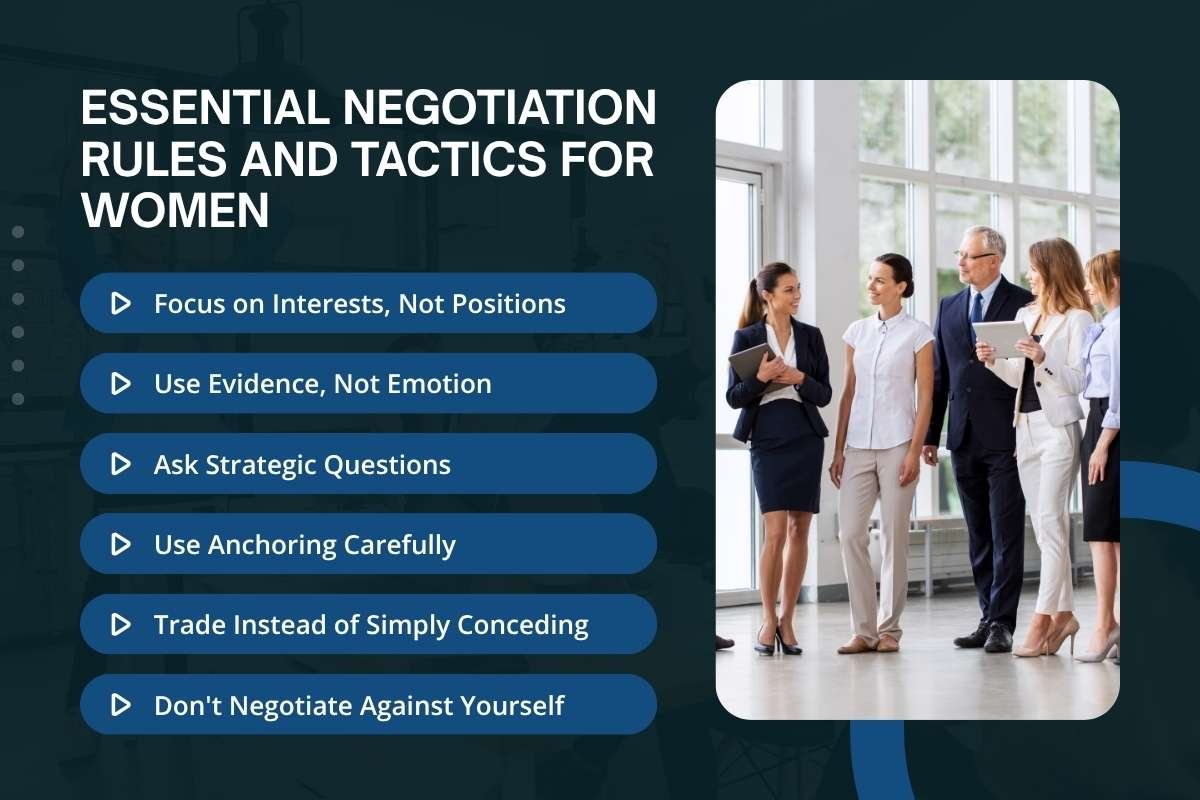
Preparation gives you a strong starting point, but the way you handle the conversation can determine how effectively you use it. Effective negotiation skills for women are not about making the biggest demand. They are about understanding the other side, asking thoughtful questions, using evidence, and creating room for mutually workable solutions. These principles are also relevant to B2B negotiation tactics, where negotiations often involve multiple stakeholders, competing priorities, budgets, and longer decision-making processes.
1. Focus on interests, not positions
A position is what someone says they want; an interest is why they want it. If a manager says, “We cannot increase the budget,” ask what constraint is driving the decision.
This approach is central to effective negotiation skills for women because it creates opportunities beyond the initial request. It also highlights the difference between collaborative negotiation and competitive negotiation, helping you choose an approach based on the relationship, stakes, constraints, and outcome you are trying to achieve.
2. Use evidence, not emotion
Support your request with measurable achievements, expanded responsibilities, market benchmarks, or performance results. Evidence shifts the conversation toward objective criteria rather than whether the request simply feels reasonable.
3. Ask strategic questions
Questions can uncover priorities and create opportunities for trade-offs. One useful principle is the 70/30 rule in negotiation, which emphasises giving the other person enough space to explain their priorities, concerns, and constraints before responding.
Try:
“What would need to happen for us to make this work?”
or
“Which part of the proposal is the biggest constraint?”
Strong negotiation skills for women include knowing when to stop presenting arguments and start asking questions.
4. Use anchoring carefully
The first number introduced can influence the rest of a negotiation. If you make the opening offer, base it on credible market data and the scope of the role rather than choosing an arbitrary figure.
For example:
“Based on the scope of the role, my experience, and current market benchmarks, I’m targeting a salary in the range of X to Y.”
5. Trade instead of simply conceding
If you cannot get everything you want, look for alternatives that have value to both sides. A salary constraint might be balanced with additional leave, professional development, flexibility, or a defined salary review.
Strategic trading is an important component of negotiation skills for women because it allows you to remain flexible without giving away value for free.
6. Don’t negotiate against yourself
Avoid reducing your own request before the other person has responded.
Instead of:
“I’d like to discuss a 15% increase, although I know that might be too much…”
State the request clearly and pause:
“Based on my expanded responsibilities and results, I’d like to discuss a 15% adjustment to my compensation.”
Let the other person respond before changing your position.
This is one of the most practical negotiation skills for women to develop: make the ask, then allow silence to work.
How can women negotiate assertively without sounding aggressive?
Knowing how women can negotiate effectively is not simply about being more assertive. Research suggests that how assertiveness is perceived can influence negotiation outcomes.
This makes communication an important part of negotiation skills for women. The objective is not to make requests softer, but to make them clear, evidence-based, and collaborative.
1. Frame the request around value
Instead of focusing only on what you want, connect the request to the organisation’s interests.
Instead of:
“I want a higher salary because I have been here for two years.”
Try:
“Over the past two years, I’ve taken on X responsibilities and delivered Y results. I’d like to discuss adjusting my compensation to reflect that expanded contribution.”
Value-based framing is one of the most useful negotiation skills for women because it connects personal advancement with organisational outcomes.
2. Use collaborative language
You can be firm without making the conversation adversarial.
Useful phrases include:
“How can we make this work?”
“What options could meet both priorities?”
“I’d like to find a solution that works for the team and reflects the scope of my role.”
“If the budget cannot accommodate this now, what alternatives could we consider?”
3. Be clear, not apologetic
Confidence does not require an aggressive tone. Avoid weakening the request with phrases such as:
“I’m sorry to ask…”
“This may be too much…”
“I completely understand if you can’t…”
Instead, state the request directly and give the other person space to respond. Clear communication is a core part of negotiation skills for women, particularly when discussing compensation and career advancement. Verbal communication is only part of the interaction; body language and negotiation can also influence how confidence, openness, and conviction are perceived.
4. Use objective standards
Market benchmarks, performance results, salary ranges, and measurable outcomes can shift the discussion away from personality and toward evidence. Harvard research specifically recommends objective measures as one way to reduce the effects of gender stereotypes during negotiations.
5. Don’t confuse warmth with giving in
Being collaborative does not mean accepting less. A woman can maintain a positive relationship while still holding her position, asking follow-up questions, and negotiating alternatives.
The distinction is important: assertiveness is about clearly advocating for an outcome; aggression is about using hostility or unnecessary pressure to get it. Effective negotiation requires the former, not the latter.
What can women negotiate at work?
Negotiation is not limited to asking for a higher salary. At work, it can shape the scope, value, and conditions of a role.
Understanding the full range of negotiable terms makes negotiation skills for women more useful beyond traditional salary discussions.
1. Compensation and benefits
This includes:
- Base salary and raises
- Bonuses and incentives
- Equity or other compensation
- Paid leave and benefits
However, compensation should not be viewed in isolation. A 2026 review from Harvard’s Program on Negotiation notes that women today negotiate pay as often as, or in some studies more often than, men, suggesting that negotiation alone does not explain persistent pay differences.
2. Promotions and titles
A promotion conversation can involve more than securing a new title. Women can negotiate promotion timelines, leadership responsibilities, decision-making authority, visibility on strategic projects, and clear criteria for progression. This makes negotiating job title and role scope an important part of a broader career conversation.
Instead of simply asking, “Can I be promoted?”, ask:
“What specific outcomes or responsibilities would demonstrate that I’m ready for the next level, and can we agree on a timeline to review them?”
3. Flexible work arrangements
Remote or hybrid work, flexible hours, and adjusted schedules can also be negotiated.
Knowing how to frame these requests is an increasingly important part of negotiation skills for women, particularly when flexibility affects long-term career sustainability.
4. Responsibilities and workload
A growing workload does not always need to mean an automatic acceptance of additional responsibilities. You can negotiate:
- Scope of work
- Deadlines
- Priorities
- Team support
- Additional compensation
- Ownership of projects
For example:
“I can take ownership of this project. Given the additional scope, which of my current priorities should we move or adjust?”
5. Resources and development
Negotiation can also secure the resources needed to perform effectively, including:
- Team members
- Budgets
- Training
- Certifications
- Conferences
- Mentorship
- Professional development opportunities
The key is to think beyond “What can I ask for?” and instead ask “What terms would allow me to perform, grow, and contribute at a higher level?”
That shift makes negotiation skills for women an ongoing career-management capability rather than a skill used only during salary reviews.
Negotiation scripts women can use

Knowing what to negotiate is only half the challenge. The next step is knowing what to say without weakening the request. Having practical negotiation scripts women can use can make it easier to turn preparation into a clear workplace conversation. Harvard’s Program on Negotiation recommends combining preparation, market research, clear framing, and flexibility when approaching salary and career negotiations.
The following scripts can be adapted to different workplace situations.
The format can also matter: negotiating in person vs. over email may call for different approaches to tone, timing, documentation, and follow-up.
1. Salary increase
Instead of simply asking for “more money,” connect the request to measurable contributions:
“Over the past year, I’ve taken on X responsibilities and delivered Y results. Based on my expanded role and market benchmarks, I’d like to discuss adjusting my compensation.”
2. Job offer
Avoid accepting the first offer immediately if there is legitimate room to negotiate.
“I’m very interested in the role. Based on the responsibilities, my experience, and the market range, I’d like to discuss whether the compensation package is flexible.”
Harvard research notes that negotiating an initial salary can have significant long-term financial effects because future raises may build on the starting figure.
3. Promotion
Rather than asking only for a title change, connect advancement to specific outcomes:
“I’ve taken on responsibilities beyond my current role and delivered X results. I’d like to discuss moving into the next level. What additional outcomes would you need to see to make that transition?”
4. Flexible work
Make flexibility a business proposal rather than only a personal request:
“I’d like to discuss a hybrid arrangement of three days in the office and two remotely. I can maintain availability during core hours and track deliverables to ensure there is no impact on team performance.”
5. Additional responsibilities
When your workload expands, clarify what changes in return:
“I’m happy to take ownership of this project. Given the additional scope, could we discuss adjusting my current priorities, timeline, or resources?”
6. Resources or budget
Tie the request directly to the expected outcome:
“To deliver this project within the agreed timeline, I’ll need additional support. Could we discuss adding one team member or reallocating part of the current budget?”
7. When the answer is no?
A rejection does not necessarily have to end the conversation.
“I understand that may not be possible right now. What specific results or milestones would make this possible in the next review cycle?”
The strongest scripts demonstrate the practical side of negotiation skills for women: make a clear request, provide a reason, and leave room for a constructive response.
How to negotiate flexible work arrangements?
Flexible work can be an important part of a negotiation, particularly when discussing remote or hybrid schedules, flexible hours, or adjusted working arrangements. Knowing how to negotiate flexible work arrangements can help you frame the request around business needs, performance expectations, and measurable outcomes.
For negotiation skills for women, flexible work is particularly relevant because the request often involves balancing performance expectations, team requirements, and individual working preferences.
1. Build a business case
Connect the proposed arrangement to performance and business needs.
For example:
“I’d like to work remotely on Tuesdays and Thursdays. I can maintain core-hour availability, attend required meetings, and continue tracking deliverables against our current targets.”
2. Define how it will work
Be specific about working hours, office days, meeting availability, communication, and expected deliverables. A clear proposal gives the employer concrete terms to evaluate.
3. Address concerns
Anticipate concerns about collaboration, visibility, deadlines, or client requirements. Offer practical solutions, such as regular check-ins or agreed performance measures.
4. Consider a trial period
If the employer is uncertain, suggest a 30-, 60-, or 90-day trial with clear success measures. This can make the arrangement easier to evaluate and create an opportunity to revisit it based on actual results.
The key is to negotiate flexibility as a mutually workable arrangement, with clear expectations and measurable outcomes. This is one of the most practical applications of negotiation skills for women in modern workplaces.
Do men and women negotiate differently?

The idea that men are naturally better negotiators than women is too simplistic. Research shows that gender alone does not reliably predict negotiation behaviour or outcomes.
For women’s negotiation skills, the more useful question is not whether women negotiate differently from men, but which contextual factors influence how negotiation strategies are received. Understanding different negotiation styles can help professionals choose an approach that fits the situation rather than relying on a single way of negotiating.
1. Context matters
Negotiation outcomes can change depending on who is involved, what is being negotiated, and how clearly the bargaining range is defined. Cultural differences in negotiation can also influence communication, expectations, decision-making, and how assertiveness is perceived. Ambiguity and gender-related cues can make stereotypes more influential, meaning the same strategy may not produce the same response in every workplace.
2. Social expectations matter
Women may also face different perceptions when advocating for themselves. Research has found that women who initiate salary negotiations can face social penalties, including being perceived as more demanding or less likable.
This creates a challenge: women need to advocate clearly while navigating expectations about how they should behave.
3. Focus on strategy, not stereotypes
Women do not need to negotiate like men, and there is no single “female” negotiation style. Strong negotiation depends more on preparation, clarity, evidence, context, and flexibility.
Ultimately, effective negotiation skills for women are not about adopting a particular gender-based style. They are about recognising potential biases, understanding the situation, and using evidence and strategy to advocate for better outcomes.
A better approach is to focus on the factors that actually strengthen a negotiation:
| Preparation | Know your target, evidence, and alternatives. |
| Clarity | State exactly what you want. |
| Objective standards | Use market data and measurable results. |
| Context | Understand the priorities and constraints of the other side. |
| Flexibility | Identify terms you can trade without compromising your priorities. |
Ultimately, effective negotiation skills for women are not about adopting a particular gender-based style. They are about recognising potential biases, understanding the situation, and using evidence and strategy to advocate for better outcomes.
Five negotiation mistakes women should avoid
Even a well-prepared negotiation can lose momentum when bad habits weaken the conversation. For women, avoiding these mistakes is an important part of strengthening negotiation skills for women in practice.
1. Failing to ask
Not negotiating can mean leaving potential value on the table. However, the solution is not simply to “ask for more.” The request should be supported by evidence, market data, and a clear rationale.
2. Negotiating without evidence
A vague request is easier to reject. Before negotiating, prepare measurable achievements, expanded responsibilities, market benchmarks, and specific outcomes that support your position.
3. Accepting the first offer immediately
An initial offer is not necessarily the final offer. If there is room to negotiate, ask whether flexibility exists before accepting.
At the same time, avoid negotiating simply for the sake of negotiating. Harvard’s Program on Negotiation notes that first offers can strongly influence the discussion through anchoring, but making an uninformed or unrealistic first offer can backfire.
4. Over-explaining the request
More justification does not automatically make a request stronger. Excessive explanations can make a negotiator sound uncertain and give the other side unnecessary points to challenge.
A better approach is:
Evidence → Request → Pause
State the facts, make the ask, and let the other person respond.
5. Treating negotiation as confrontation
Negotiation does not have to be a battle with a winner and loser. Framing the conversation around shared interests can create more room for solutions, particularly when salary, flexibility, or resources are constrained.
Instead of:
“I need this, and I won’t accept anything less.”
Try:
“This is the outcome I’m targeting. What options could help us reach it?”
The bigger lesson is that effective negotiation skills for women are not about being more aggressive. They are about knowing your value, preparing your evidence, making a clear request, and staying flexible enough to find a better outcome.
A simple 6-step negotiation framework
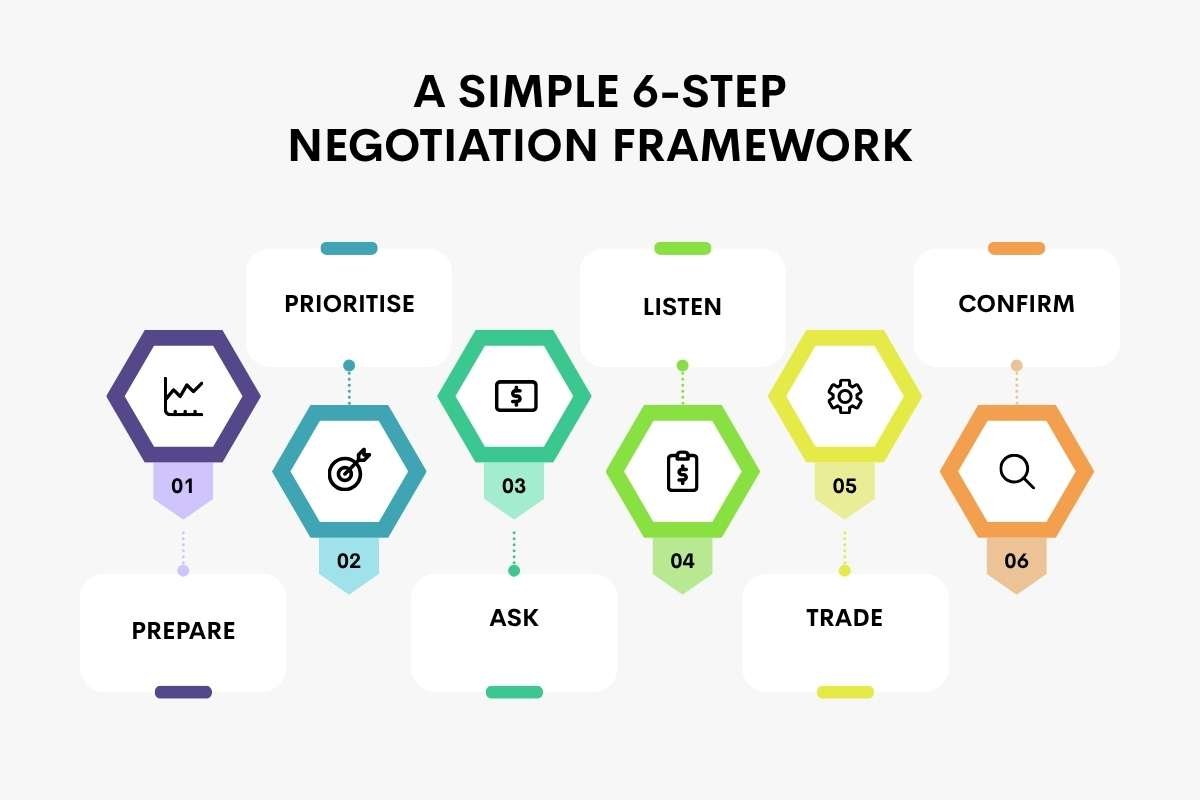
Once you know the core tactics, a simple process can help you apply them consistently. Use this framework before, during, and after an important negotiation.
| Prepare | Know your target, priorities, evidence, and BATNA—the alternative you have if the negotiation does not produce an acceptable outcome. |
| Prioritise | Separate your must-haves from your nice-to-haves. This makes it easier to decide where you can be flexible. |
| Ask | State exactly what you want and briefly explain why it is justified. Avoid apologising or weakening the request before the other person responds. |
| Listen | Give the other person space to explain their priorities, concerns, and constraints. Their response may reveal options you had not considered. |
| Trade | If your preferred outcome is not possible, consider alternatives that preserve your most important priorities. |
| Confirm | Before ending the conversation, clarify what has been agreed, what remains unresolved, and what happens next. Put important commitments in writing. |
Prepare → Prioritise → Ask → Listen → Trade → Confirm
This framework gives negotiation skills for women a repeatable structure without turning the conversation into a rigid script.
Conclusion:
Negotiation is not a single conversation about salary. It is an ongoing career skill that can influence pay, promotions, flexibility, responsibilities, resources, and leadership opportunities.
For women, developing negotiation skills for women means becoming better prepared to identify opportunities, communicate value, handle objections, and negotiate terms that support long-term career growth.
The good news is that negotiation skills can be developed. Preparation, evidence, practice, strategic questions, and clear communication can make important workplace conversations more effective.
Ultimately, negotiation skills for women are not about negotiating more aggressively. They are about negotiating more strategically with evidence, clarity, confidence, and purpose.
Frequently Asked Questions:
1. Why are negotiation skills important for women?
Negotiation skills for women can help improve outcomes related to salary, promotions, responsibilities, flexible work, benefits, resources, and professional development. They also help women communicate their value clearly and advocate for career opportunities.
2. What are the most important negotiation skills for women?
Key negotiation skills for women include preparation, evidence-based communication, active listening, strategic questioning, clear requests, understanding alternatives, and knowing when and how to make trade-offs.
3. What can women negotiate besides salary?
Women can negotiate promotions, job titles, bonuses, flexible work arrangements, deadlines, workloads, decision-making authority, professional development, budgets, team resources, and career progression timelines.
4. How can women negotiate confidently without sounding aggressive?
Women can negotiate confidently by using clear, evidence-based language, connecting requests to business value, asking collaborative questions, and avoiding apologetic or overly qualifying language. Being firm does not require being confrontational.
5. What should women do if their negotiation request is rejected?
If a request is rejected, ask what specific results, milestones, or conditions would make it possible in the future. This keeps the conversation open and can create a clear path for revisiting the request during the next review cycle.