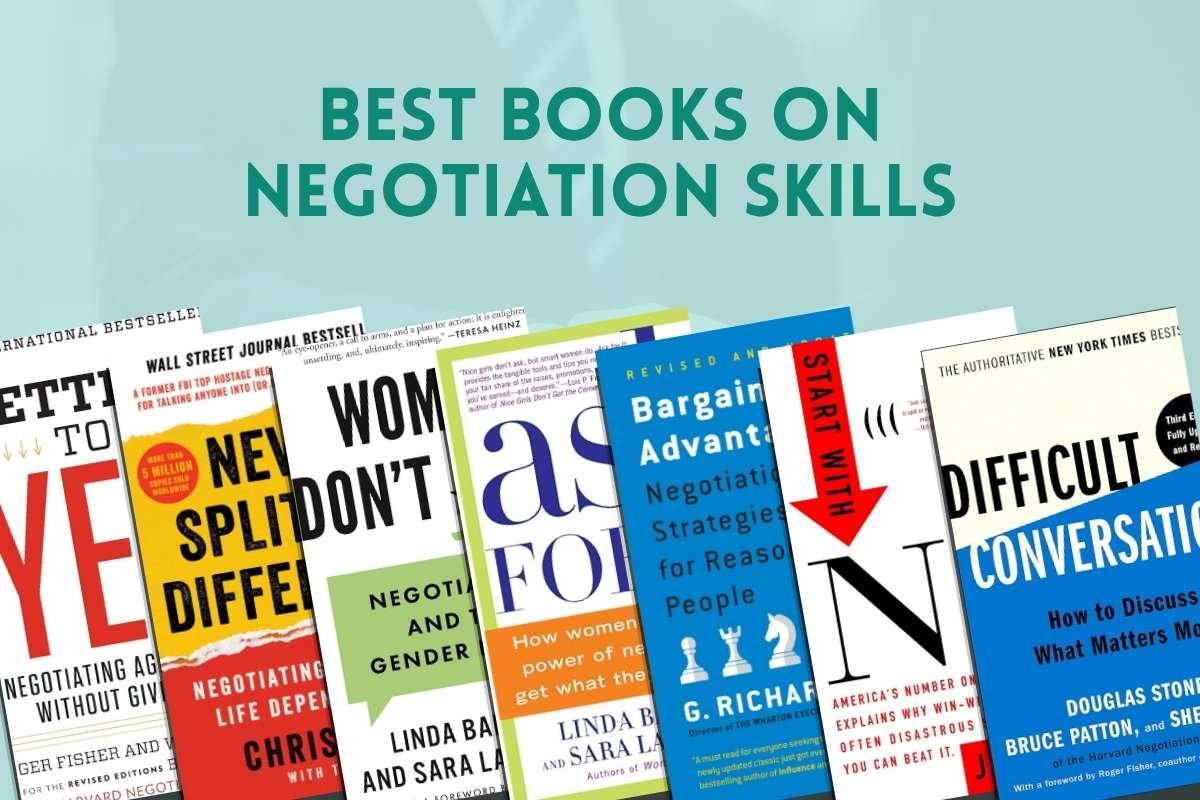

Negotiation is often reduced to a simple choice: be collaborative or be competitive. Collaborative vs competitive negotiation is a useful framework for understanding that choice, but effective negotiation rarely stays in one lane.
But for women, the stakes can extend far beyond winning a single conversation.
A salary negotiation can influence future raises. A promotion discussion can determine access to leadership opportunities. A conversation about responsibilities can establish whether additional work comes with additional authority and compensation.
The numbers show why these conversations matter. In the U.S., women earned 85% of men’s median hourly earnings in 2024, according to Pew Research Center. Women also represented 42% of managers but only 29% of C-suite roles in McKinsey’s 2025 Women in the Workplace data.
Negotiation, therefore, is not simply a communication skill. It can be a career skill.
And yet, research suggests that women can experience negotiation differently from men. A 2010 study found that women anticipated greater social backlash when negotiating assertively for themselves and consequently used fewer competitive tactics. A 2026 close replication involving 517 participants did not reproduce the original gender-by-advocacy interaction, but it still found that anticipated backlash was associated with women’s salary requests and that women described their own negotiating style as less competitive when negotiating for themselves.
That nuance matters. The answer is not for women to become more aggressive. It is to become more strategically flexible.
The real question is not collaborative negotiation vs. competitive negotiation.
It is: When should you create value, when should you claim it, and when should you protect your boundaries?
Collaborative vs competitive negotiation: Key Differences
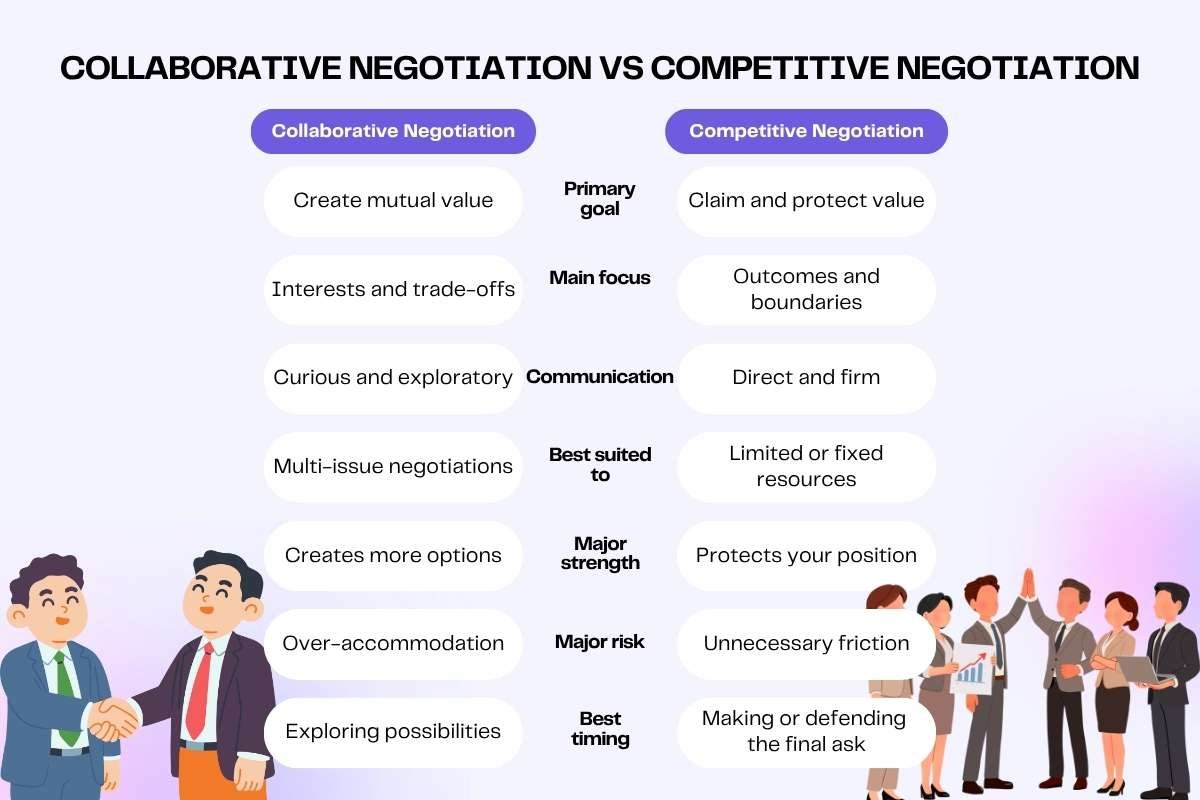
The Collaborative vs competitive negotiation debate becomes clearer when the two approaches are compared by purpose, timing, leverage, and the type of outcome each is designed to achieve.
- Collaborative negotiation asks: How can we create a better outcome for both sides?
- Competitive negotiation asks: How do I make sure I receive a fair share of the value available?
Neither is inherently superior.
The mistake is treating negotiation as though you must permanently operate in one mode.
What is collaborative negotiation?
Collaborative negotiation focuses on understanding interests, identifying trade-offs, and expanding the range of possible outcomes.
Imagine a woman receives a job offer with a salary below her target.
A competitive approach might focus entirely on increasing the base salary.
A collaborative approach might ask:
“If there is limited flexibility on base salary, which other parts of the package could we discuss?”
That opens the negotiation to:
- A signing bonus
- Additional paid leave
- Flexible working arrangements
- Professional-development funding
- A revised title
- Earlier salary review
- Performance-based compensation
- Additional decision-making authority
The objective is to find variables that matter differently to each side.
For example, a company may have limited salary flexibility but significant flexibility around working arrangements. The candidate may value remote work highly. That difference in priorities creates room for a better deal.
Collaboration expands the pie before the pie is divided. That is one of the clearest principles behind Collaborative vs competitive negotiation: create more options first, then decide how firmly to claim your portion.
What is competitive negotiation?
Competitive negotiation focuses on claiming value and protecting your interests.
It becomes particularly useful when:
- The resource is genuinely limited.
- The negotiation involves one primary issue.
- The other party refuses reasonable trade-offs.
- You are being asked to accept more responsibility without additional value.
- You have a clear minimum acceptable outcome.
- Your counterpart is applying pressure or repeatedly seeking concessions.
Competitive negotiation does not require hostility.
Consider the difference between:
“That’s ridiculous. I’m not accepting it.”
And:
“Given the expanded scope of the role, I would need the compensation and title to reflect those responsibilities.”
Both reject the existing proposal.
Only one protects the relationship while remaining firm.
Collaborative vs competitive negotiation at a Glance
| Collaborative Negotiation | Factor | Competitive Negotiation |
| Create mutual value | Primary goal | Claim and protect value |
| Interests and trade-offs | Main focus | Outcomes and boundaries |
| Curious and exploratory | Communication | Direct and firm |
| Multi-issue negotiations | Best suited to | Limited or fixed resources |
| Creates more options | Major strength | Protects your position |
| Over-accommodation | Major risk | Unnecessary friction |
| Exploring possibilities | Best timing | Making or defending the final ask |
The strongest negotiators know how to move between both.
Collaborate to create value. Compete strategically to claim it.
Which negotiation style works best for women?
When considering Collaborative vs competitive negotiation, women should avoid treating either style as a fixed personality trait. The stronger approach is to match the tactic to the situation.
There is no single negotiation style that works for every woman. Context matters.
The research on gender and negotiation is also more nuanced than the popular idea that “women are bad negotiators.” The 2026 close replication of earlier research is particularly important because it did not reproduce the original gender-by-advocacy effect. However, it did find a gender difference in salary requests that was mediated by anticipated backlash, alongside women describing themselves as less competitive when negotiating for themselves.
The practical lesson is not that women should avoid competitive negotiation.
It is that the way an assertive request is framed can matter.
Lead with evidence rather than intensity.
A strong negotiation does not need an aggressive personality.
Instead of:
“I deserve a promotion.”
Build the case:
“Over the past year, I have taken ownership of three additional projects, reduced reporting time by 20%, and taken responsibility for mentoring two team members. I’d like to discuss moving into the next-level role.”
The difference is significant.
The first statement asks someone to agree with your self-assessment.
The second gives them evidence to evaluate.
Use collaboration without becoming accommodating.
Women can use collaborative language without giving away leverage.
For example:
“I’d like to find an arrangement that supports the team’s priorities while reflecting the scope of my role.”
That is collaborative.
But if the employer responds by adding responsibilities without changing the terms, the strategy needs to shift:
“I’m open to taking on that scope, but I’d like to discuss the corresponding adjustment to my title and compensation.”
That is firm.
The two statements are not contradictory.
They are sequential.
Why this matters for career advancement?
Negotiation is not limited to annual compensation reviews. It can influence who gets opportunities, visibility, authority, and advancement.
McKinsey’s 2025 data found that only 93 women were promoted to manager for every 100 men, while the gap was considerably larger for women of color, with 74 women of color promoted for every 100 men.
Negotiation cannot solve structural barriers by itself.
But knowing how to advocate for scope, resources, sponsorship, compensation, and advancement can help women exercise greater influence over the opportunities they receive.
How to choose the right negotiation style?
A practical Collaborative vs competitive negotiation assessment starts with the issues involved, the relationship, the other side’s behavior, your leverage, and your minimum acceptable outcome.
Instead of deciding whether you are a “collaborative negotiator” or a “competitive negotiator,” assess the situation before you enter the conversation.
1. Count the issues on the table.
The more variables involved, the more useful collaboration becomes, which is one reason collaborative vs competitive negotiation is best viewed as a situational choice rather than a fixed negotiating identity.
If you are negotiating:
- Salary
- Title
- Responsibilities
- Start date
- Leave
- Flexibility
- Bonus
- Development opportunities
You have multiple opportunities to trade.
If the negotiation is simply:
“The budget is ₹X. Yes or no?”
there may be considerably less room to create value, making competitive tactics more important.
2. Assess the relationship
A negotiation with a future employer is different from one with your long-term manager.
If you will continue working together, the relationship itself has value.
That does not mean accepting an unfair outcome.
It means avoiding tactics that create unnecessary damage.
3. Study the other side’s behavior.
A collaborative counterpart typically shares information, explains constraints, and looks for alternatives.
A counterpart who repeatedly rejects reasonable trade-offs, demands unilateral concessions, or uses artificial urgency may require a more competitive response.
Do not decide your strategy based solely on the other person’s title.
Watch what they do at the table.
4. Measure your leverage
Leverage can come from:
- Specialized expertise
- Strong performance
- Scarce skills
- A competing offer
- Multiple opportunities
- Market information
- Timing
- Organizational influence
The more credible alternatives you have, the less dependent you are on one particular outcome.
5. Know your minimum before someone asks you to compromise.
Before negotiating, establish:
| Target | The outcome you want. |
| Reservation point | The least favorable deal you are willing to accept. |
| BATNA | What you will do if no agreement is reached. |
Without these three reference points, it becomes much easier to make concessions simply because the conversation becomes uncomfortable.
How to combine collaboration with competitive tactics?

The most effective answer to Collaborative vs competitive negotiation is often not choosing one side permanently, but deliberately sequencing both approaches.
Step 1: Start collaboratively
Begin by understanding the other side.
Ask:
“What are the biggest priorities for this role?”
“Which parts of the package have flexibility?”
“What constraints should I keep in mind?”
Questions give you information.
Information gives you options.
Step 2: Identify what can be traded
Do not become fixated on the first issue raised.
If salary cannot move, explore the review timeline.
If the title cannot change immediately, discuss responsibilities and a defined promotion review.
If remote work is restricted, discuss working hours.
The objective is to find different priorities with different values.
Step 3: Make your contribution measurable
A negotiation becomes stronger when your value is specific.
Instead of:
“I’ve worked really hard.”
Use:
“I managed X, delivered Y, and reduced Z by 18%.”
Useful evidence can include:
- Revenue generated
- Costs reduced
- Time saved
- Customers retained
- Projects delivered
- Teams managed
- Processes improved
- New responsibilities assumed
Step 4: Switch from creating value to claiming it
Once the options are clear, make your ask.
“Given the expanded scope and the results I’ve delivered, I’m targeting ₹X.”
Then pause.
Silence gives the other side room to respond.
It also prevents you from negotiating against yourself by immediately lowering your own request.
Step 5: Protect the boundary
If the response is no:
“I understand the constraint. Given the scope we’re discussing, I wouldn’t be comfortable taking on those responsibilities under the current terms.”
This is competitive negotiation without confrontation. It captures the practical balance at the heart of collaborative vs competitive negotiation: remain constructive while the conversation is productive, then become unmistakably firm when your boundary is tested. The goal is not to overpower the other person. It is to make your boundary unmistakable.
Real-world scripts for women
| Salary negotiation | “Based on the scope of the role, my experience, and the value I can bring, I’m targeting ₹X–₹Y. How much flexibility do we have around the compensation package?” |
| Low salary offer | “Thank you for sharing the offer. Based on the responsibilities of the role and the market information I’ve reviewed, I was expecting something closer to ₹X. Is there flexibility on the base compensation?” |
| Promotion | “My responsibilities have expanded significantly over the past year. I’ve taken ownership of X, delivered Y, and contributed to Z. I’d like to discuss aligning my title and compensation with the level at which I’m now operating.” |
| Additional responsibilities | “I’m open to taking on that responsibility. Given the additional scope, I’d like to discuss how the role, authority, or compensation should change accordingly.” |
| Salary cannot move. | “If the base salary cannot change at this stage, could we discuss a signing bonus, additional leave, professional-development support, or a compensation review after six months?” |
| Flexible work | “I’d like to propose a hybrid arrangement of three days in the office and two remotely. I’m happy to define measurable deliverables and review the arrangement after 90 days.” |
| Saying no | “I appreciate the opportunity, but I can’t commit to that scope under the current terms.” |
A strong negotiation does not require ten paragraphs of justification.
Sometimes, one clear sentence is stronger than ten defensive ones.
BATNA and strategic walk-away rules
Understanding collaborative vs competitive negotiation also requires understanding leverage. Your BATNA determines how much room you have to collaborate, how firmly you can compete, and when walking away becomes rational.
Your strongest negotiation tool may be the option you never have to use.
That option is your BATNA — Best Alternative to a Negotiated Agreement.
It is what you will do if the current negotiation does not result in an acceptable agreement.
For a job candidate, it could be another offer.
For an employee, it could be staying in the current position while continuing to pursue advancement elsewhere.
For a consultant, it could be another client.
For an entrepreneur, it could be another supplier, investor, or strategic partner.
BATNA changes how you negotiate
Consider two candidates receiving the same offer.
Candidate A needs the role immediately and has no other options.
Candidate B has another opportunity under consideration and knows exactly what she will accept.
Their qualifications could be identical.
Their negotiating positions are not.
Research involving more than 2,500 negotiators has also examined how gender and the strength of outside alternatives affect negotiation outcomes, finding that negotiations involving a woman with a strong alternative were more likely to end in impasse in that dataset. The finding is a reminder that leverage does not operate independently of social dynamics.
That is another reason to use leverage thoughtfully rather than theatrically.
Build your BATNA before the negotiation.
Ask yourself:
What will I do if they say no?
Then make that alternative stronger.
If you are negotiating a job:
- Continue interviewing.
- Research market compensation.
- Strengthen your professional network.
- Keep other opportunities active.
If you are negotiating internally:
- Document your accomplishments.
- Build sponsorship.
- Track expanded responsibilities.
- Understand the market value of your skills.
The objective is not to create a dramatic threat.
It is to reduce your dependence on one outcome.
Set your walk-away point.
Before entering the conversation, define the lowest acceptable outcome.
For example:
Target: ₹18 lakh
Acceptable range: ₹16–18 lakh
Walk-away point: Below ₹16 lakh unless meaningful non-cash benefits compensate for the difference.
The exact numbers will vary by situation.
The principle does not.
Never discover your minimum after the other side has already tested it.

A BATNA is useful because it is real.
If you have another offer, communicate it accurately.
If you do not, do not invent one.
A false threat may produce a short-term advantage but can destroy credibility if challenged.
Your BATNA should give you confidence, not encourage you to make threats.
When walking away makes sense
Walking away may be appropriate when:
- The offer falls below your minimum.
- The other side refuses reasonable trade-offs.
- Responsibilities significantly exceed compensation.
- Important terms remain unclear.
- Your alternative is objectively stronger.
- A non-negotiable professional boundary is being crossed.
Walking away is not necessarily losing.
Sometimes the most powerful negotiating position is knowing that you can leave the table.
Conclusion:
The debate over collaborative negotiation vs. competitive negotiation is ultimately the wrong question.
The better question is: What does this negotiation require right now?
Collaboration is powerful when there is value left to create. Competition is useful when value needs to be protected.
Collaboration helps you uncover interests, trade-offs, and possibilities. Competitive tactics help you anchor your expectations, claim your contribution, and establish boundaries.
For women, that flexibility can be especially valuable in a workplace where negotiation can affect compensation, promotions, responsibilities, and access to leadership opportunities.
The goal is not to become the most aggressive person in the room.
It is to become the person who can read the room, understand the leverage, create options, make the ask, and recognize when the answer should be no. Create value. Claim value. Protect value. That is the real advantage of strategic negotiation.
FAQs:
1. What is the difference between collaborative vs competitive negotiation?
Collaborative negotiation focuses on creating mutual value through shared interests and trade-offs, while competitive negotiation focuses on claiming and protecting value. Effective negotiators can use both approaches depending on the situation.
2. Which negotiation style works best for women?
Neither style is universally better. A strategic combination is often more useful: collaborate when there is room to create value, then use firm tactics when it is time to claim your share or protect an important boundary.
3. When should women use collaborative negotiation?
Collaborative negotiation is particularly useful when multiple issues are negotiable, the relationship matters, and both sides have an incentive to find a mutually beneficial outcome.
4. How can women negotiate firmly without appearing aggressive?
Use evidence, objective benchmarks, and clear requests instead of personal confrontation. Explain the business rationale behind your ask, state your expectations directly, and remain respectful while holding your boundary.
5. What is BATNA and why does it matter?
BATNA stands for Best Alternative to a Negotiated Agreement. It is the best realistic option available if the current negotiation does not produce an acceptable outcome. Knowing your BATNA helps establish your minimum acceptable deal and makes it easier to decide when walking away is the better choice.
Thank You For Reading!
See More
Negotiation Styles: The 5 Approaches That Can Change the Outcome of Any Negotiation