
Attentional Intelligence Skills for Professionals have become one of the most valuable workplace skills, helping individuals stay focused, make better decisions, and perform effectively in demanding work environments. This guide explains what these skills are, why they matter for productivity, decision-making, and career growth, and how you can strengthen them through practical habits, focus-building exercises, and proven workplace strategies.
The average employee is interrupted every two minutes during the workday. Add constant notifications, back-to-back meetings, and endless tab switching, and it’s no surprise that staying focused has become one of the biggest workplace challenges.
The result isn’t just a distraction; it’s costly. Missed deadlines, avoidable mistakes, forgotten action items, and poor decisions often stem from scattered attention rather than a lack of skill or effort. In a workplace where every detail matters, the ability to manage your attention has become a competitive advantage.
That’s where Attentional Intelligence (AQ) comes in. It’s the ability to direct, sustain, and shift your focus with intention, helping you work with greater accuracy, make better decisions, and perform consistently under pressure. Developing Attentional Intelligence Skills for Professionals enables individuals to navigate distractions, maintain deep focus, and deliver consistently high-quality work.
In this blog, you’ll learn what Attentional Intelligence is, why it matters more than ever, the core skills behind it, and practical ways to strengthen your focus every day.
The warning signs: do you have a focus deficit?
If work feels more mentally exhausting than ever, you’re not imagining it. According to Microsoft’s 2025 Work Trend Index, the average employee is interrupted every two minutes, roughly 275 times a day, by emails, chats, meetings, or notifications. Nearly 48% of employees say their work feels chaotic and fragmented.
The problem isn’t a lack of capability; it’s a lack of uninterrupted attention. When your brain is constantly switching between tasks, conversations, and notifications, even routine work demands more mental effort than it should.
If any of these sound familiar, your attention may be working against you:
- You make avoidable mistakes on routine tasks despite knowing exactly what to do.
- You jump between emails, chats, and browser tabs, but struggle to finish meaningful work.
- You leave meetings only to forget key action items a few minutes later.
- You reread the same email or document because your mind drifted.
- You find it difficult to stay focused during complex tasks without checking your phone or inbox.
- You end the day feeling busy but unable to point to meaningful progress.
Research has consistently shown that interruptions don’t just consume time; they disrupt memory, increase mental workload, and make it harder to return to the original task. Even a brief notification can derail your train of thought and increase the likelihood of errors.
These aren’t signs of poor work ethic, low intelligence, or a lack of discipline. They’re symptoms of unmanaged attention in an environment designed to compete for it. Attention is a trainable skill. Developing Attentional Intelligence Skills for Professionals helps you regain control over your focus, reduce distractions, and perform more effectively in demanding work environments. And that’s where Attentional Intelligence (AQ) comes in.
Understanding the benefits of attentional intelligence can help you recognize why improving your focus directly impacts productivity and decision-making.
8 core attentional intelligence skills for professionals to develop
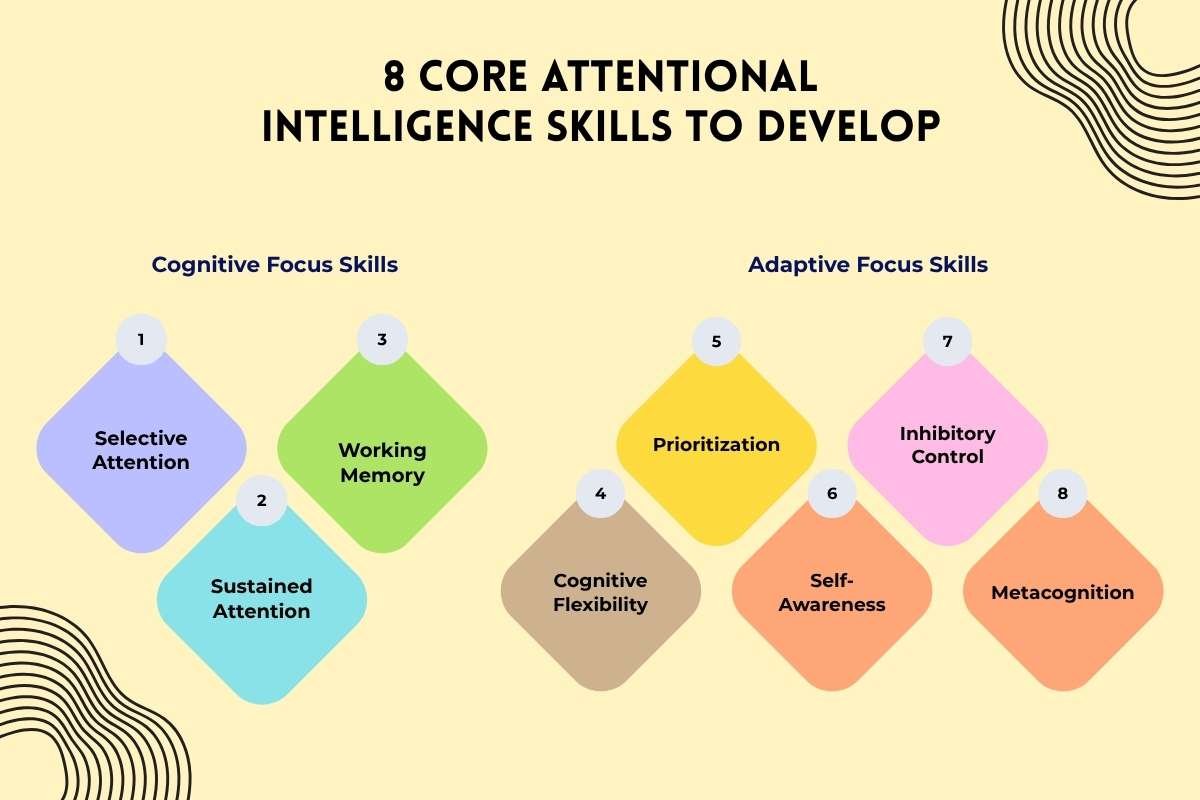
Attentional Intelligence is the ability to intentionally direct, sustain, and shift your attention based on changing tasks and priorities. Rather than being a single ability, it is a collection of cognitive skills that help professionals stay focused, filter distractions, adapt to changing demands, and make better decisions. Together, these core attentional intelligence skills determine how effectively you process information, manage interruptions, and perform under pressure in today’s fast-paced workplace.
Cognitive focus skills
These skills help you maintain concentration and process information accurately.
1. Selective attention
| What It Does | Filters out distractions to focus on what’s relevant |
| Why It Matters at Work | Reduces errors and improves concentration |
| Simple Way to Improve | Turn off notifications and keep only essential tabs open |
| How to build it | Silence non-essential notifications, keep only relevant tabs open, and dedicate uninterrupted time to high-priority tasks. |
2. Sustained attention
| What It Does | Maintains focus on one task for an extended period |
| Why It Matters at Work | Increases productivity and work quality |
| Simple Way to Improve | Schedule uninterrupted deep work sessions |
| How to build it | Work in focused intervals, take scheduled breaks, and avoid switching tasks before completing a meaningful milestone. |
3. Working memory
| What It Does | Holds and processes information in real time |
| Why It Matters at Work | Improves learning, comprehension, and problem-solving |
| Simple Way to Improve | Summarize meetings and practice active recall |
| How to build it: | Summarize key points after meetings, take structured notes, and regularly practice recalling information instead of rereading it. |
Adaptive focus skills
These skills help you respond effectively as priorities and situations change.
4. Cognitive flexibility
| What It Does | Shifts attention smoothly between changing priorities |
| Why It Matters at Work | Helps adapt without losing momentum |
| Simple Way to Improve | Batch similar tasks and allow transition time |
| How to build it | Group similar tasks together and leave brief transition time before moving to a different type of work. |
5. Prioritization
| What It Does | Directs attention to high-impact work |
| Why It Matters at Work | Prevents busywork and improves decision-making |
| Simple Way to Improve | Identify your top three priorities each day |
| How to build it: | Identify your three most important tasks each day and complete them before responding to low-priority requests. |
6. Self-awareness
| What It Does | Recognizes when focus is declining |
| Why It Matters at Work | Helps prevent mistakes caused by mental fatigue |
| Simple Way to Improve | Track your peak focus hours and take strategic breaks |
| How to build it | Notice patterns in your energy levels and schedule demanding work during your peak focus hours. |
7. Inhibitory control
| What It Does | Resists distractions and impulsive actions |
| Why It Matters at Work | Protects deep work and improves consistency |
| Simple Way to Improve | Check emails and messages at scheduled times |
| How to build it | Remove common distractions from your workspace and create specific times to check emails and messages. |
8. Metacognition
| What It Does | Reflects on and improves thinking habits |
| Why It Matters at Work | Builds long-term focus and continuous improvement |
| Simple Way to Improve | Review what helped or hindered your focus each day |
| How to build it: | Spend a few minutes at the end of each day reviewing when you were most productive and what disrupted your attention. |
Together, these eight skills form the foundation of Attentional Intelligence. The good news is that they aren’t fixed traits; they can be strengthened through consistent practice and the right daily habits.
Attentional intelligence vs. Attention to detail
Attentional Intelligence and attention to detail are closely related, but they aren’t the same.
- Attentional Intelligence is the ability to manage your focus intentionally.
- Attention to detail is the outcome of that focus: the ability to spot errors, inconsistencies, and important information.
Simply put, AQ is the skill that enables attention to detail. Without sustained focus, even experienced professionals can overlook critical details.
For example, consider two project managers reviewing a client proposal. Both have the same experience and technical knowledge. One is constantly responding to emails and chat messages while reviewing the document, while the other works without interruptions. The second manager is far more likely to catch pricing errors, missing deadlines, or inconsistencies—not because they’re naturally more detail-oriented, but because they’re giving the task their full attention. This is one of the clearest examples of how Attentional Intelligence Skills for Professionals translate into better accuracy and higher-quality work.
Research supports this. A study from the University of California, Irvine, found that it takes an average of 23 minutes and 15 seconds to regain focus after an interruption. Frequent context switching not only reduces productivity but also increases the likelihood of missing critical details and making avoidable mistakes.
The root causes of modern cognitive overload
A lack of focus is rarely caused by poor discipline alone. More often, it’s the result of an environment that constantly competes for your attention.
The most common causes include:
- Digital distractions: Constant emails, chats, notifications, and meetings interrupt concentration.
- Chronic stress: High stress reduces focus, memory, and decision-making ability.
- Sleep deprivation: Poor sleep impairs attention span, learning, and cognitive performance.
Research published by the American Psychological Association shows that task switching can reduce productivity by as much as 40%, as the brain expends extra effort refocusing between tasks.
These factors make it harder to stay present and perform at your best. Developing Attentional Intelligence Skills for Professionals helps you regain control over your attention, reduce distractions, and stay focused on high-impact work instead of letting interruptions dictate your day.
The professional ROI: Why AQ is a non-negotiable career skill
Technical expertise may get you hired, but your ability to stay focused, think clearly, and make sound decisions often determines how far you progress. As workplaces become more complex and fast-paced, Attentional Intelligence (AQ) is emerging as a key driver of individual and team performance.
A study by the Harvard Business Review found that people spend nearly 46.9% of their waking hours thinking about something other than what they’re doing, and this mind wandering is linked to lower performance and reduced well-being. Professionals who can consistently direct their attention are better equipped to deliver high-quality work and make smarter decisions.
1. Leadership and collaboration
Strong leaders don’t just communicate; they listen. High AQ enables professionals to stay fully present during meetings, actively listen to different perspectives, and ask thoughtful questions instead of reacting impulsively. This leads to better collaboration, stronger relationships, and fewer misunderstandings.
2. Strategic Decision-Making
Every day, professionals are flooded with information, making it easy to focus on what’s urgent rather than what’s important. Developing Attentional Intelligence Skills for Professionals helps filter out distractions, reduce decision fatigue, and evaluate information objectively, leading to faster and more informed decisions.
3. Learning velocity
The ability to learn quickly is a competitive advantage, but learning requires sustained attention. Whether it’s mastering a new tool, understanding industry trends, or adapting to changing business needs, professionals with strong AQ absorb, process, and retain information more effectively than those constantly distracted.
In short, Attentional Intelligence isn’t just about improving focus; it’s about improving how you lead, learn, and perform. As routine tasks become increasingly automated, the ability to manage your attention will remain a distinctly human skill that sets high performers apart.
How to improve your attentional intelligence? (the daily habits)

Like any other professional skill, Attentional Intelligence improves with consistent practice. You don’t need to overhaul your routine; small, intentional habits can strengthen your ability to focus, reduce distractions, and work more effectively over time.
Step 1: Practice intentional single-tasking
Despite its reputation as a productivity booster, multitasking often has the opposite effect. The brain isn’t designed to perform multiple cognitively demanding tasks simultaneously; instead, it rapidly switches between them, increasing mental fatigue and reducing accuracy. Developing Attentional Intelligence Skills for Professionals helps reduce this constant context switching by training you to stay focused on one task at a time.
Research from the American Psychological Association suggests that task switching can reduce productivity by as much as 40%. Focusing on one task at a time allows your brain to process information more efficiently and produce higher-quality work.
Try this:
- Finish one high-priority task before moving to the next.
- Close unnecessary tabs and applications while working.
- Keep your phone out of reach during focused work sessions.
Step 2: Use time-blocking and deep work sessions
Protecting your attention starts with protecting your calendar. Time-blocking involves setting aside dedicated periods for uninterrupted, high-value work, reducing the temptation to constantly react to emails and notifications.
Cal Newport, author of Deep Work, describes deep work as focused, distraction-free effort that leads to better learning, higher productivity, and improved problem-solving. Time-blocking is one of several proven strategies to boost attentional intelligence and build lasting focus.
Try this:
- Reserve 60–90 minutes each day for focused work.
- Schedule meetings and administrative tasks outside these blocks.
- Let colleagues know when you’re unavailable for interruptions.
Step 3: Lower your cognitive load
Your brain has limited mental capacity. The more information it has to remember, the less attention it can devote to the task at hand. Reducing unnecessary mental effort frees up cognitive resources for deeper thinking.
Try this:
- Write down tasks instead of relying on memory.
- Organize your digital workspace and close unused tabs.
- Turn off non-essential notifications during work hours.
- Use checklists and note-taking tools to track important information instead of keeping everything in your head.
Improving Attentional Intelligence isn’t about working longer hours; it’s about creating conditions that allow your brain to focus on what matters most. Once these habits become part of your routine, staying focused becomes significantly easier.
Practical exercises to train your brain
Building Attentional Intelligence Skills for Professionals requires regular practice. Just as physical exercise strengthens your body, short daily mental exercises can improve focus, memory, and concentration. The best part? Most of these take less than five minutes.
Daily micro-drills
Small, consistent exercises can help train your brain to notice details and stay present.
1. The one-minute observation drill
Choose an object, workspace, or room and study it for one minute. Then look away or close your eyes and recall as many details as possible, from colors and shapes to the placement of objects.
Why it works: This exercise strengthens selective attention and visual memory, helping you notice details more effectively during everyday tasks.
2. Reading with active recall
Instead of reading continuously, pause after each section and summarize the main idea in one or two sentences without looking back at the text.
Why it works: Active recall improves comprehension and memory retention by forcing your brain to retrieve information instead of simply recognizing it. Research in cognitive psychology consistently shows that retrieval practice is more effective for long-term learning than passive rereading.
How can managers cultivate attentional intelligence in teams?

Individual focus matters, but team performance depends on the environment managers create. Even highly attentive employees struggle to perform at their best when they’re constantly interrupted by meetings, messages, and shifting priorities. Leaders who actively foster Attentional Intelligence Skills for Professionals across their teams often see better productivity, fewer mistakes, and higher engagement.
Many of these leadership practices are demonstrated in our guide on How Women Leaders Use Attentional Intelligence Differently.
Gallup’s State of the Global Workplace has consistently found that employees are more engaged and productive when they have clarity, manageable workloads, and supportive managers, conditions that also help sustain attention.
1. Build systems that reduce cognitive load
Rather than relying on employees to remember every process, create systems that make work easier to follow.
| Document Standard Operating Procedures (SOPs) | Clear processes reduce decision fatigue and improve consistency. |
| Use checklists | They help prevent avoidable errors, especially for repetitive or high-risk tasks. Industries such as aviation and healthcare have long used checklists to improve accuracy and safety. |
| Centralize information | Store documents, project updates, and resources in one place to reduce time spent searching for information. |
2. Protect time for deep work
Constant interruptions make it difficult for teams to produce high-quality work. Managers can improve focus by creating dedicated periods for uninterrupted work.
Consider implementing:
- No-meeting focus blocks for one or two hours each day.
- Communication norms, such as using instant messaging only for urgent requests.
- Batching updates instead of sending multiple messages throughout the day.
Encourage peer reviews
Even the most attentive professionals can miss details after long periods of focused work. Peer reviews provide a second layer of quality control while encouraging collaboration and knowledge sharing.
For example:
- Review reports before they’re shared with clients.
- Conduct code reviews before software deployments.
- Verify financial data before submitting reports.
Attentional Intelligence isn’t built through longer work hours or constant oversight—it’s built through thoughtful systems that protect focus. When managers reduce unnecessary distractions and create clear workflows, teams can spend less time reacting and more time producing meaningful work.
Conclusion:
In a workplace where interruptions are constant and information never stops flowing, your ability to manage attention has become just as valuable as your technical expertise. Attentional Intelligence isn’t an innate talent; it’s a skill that can be developed through consistent practice and intentional habits.
Throughout this guide, you’ve learned how AQ differs from attention to detail, why it directly influences productivity and decision-making, the eight core skills that define it, and practical strategies to strengthen your focus. By developing Attentional Intelligence Skills for Professionals, whether you’re an individual contributor or a leader, you can work more accurately, learn faster, and perform with greater confidence.
For a broader understanding of how attention shapes productivity, leadership, and decision-making, read our complete guide on attentional intelligence in the workplace. The best way to build Attentional Intelligence is to start small. Choose one habit such as single-tasking, time-blocking, or the one-minute observation drill and practice it consistently for the next week. Small improvements in how you manage your attention today can lead to better decisions, stronger performance, and long-term career growth tomorrow.
Frequently asked questions (FAQs)
1. Can Attentional Intelligence be improved?
Yes. Attentional Intelligence is a trainable skill rather than a fixed trait. Consistently practicing habits such as single-tasking, time-blocking, mindfulness, and active recall can gradually improve your ability to focus, retain information, and adapt your attention to different tasks.
2. Why is Attentional Intelligence important in the workplace?
Attentional Intelligence helps professionals prioritize tasks, minimize distractions, make better decisions, and reduce avoidable mistakes. It also improves collaboration, learning, and overall productivity, making it a valuable skill across virtually every industry.
3. What is the difference between Attentional Intelligence and emotional intelligence (EQ)?
Attentional Intelligence Skills for Professionals focus on managing attention and cognitive resources, while emotional intelligence (EQ) is the ability to recognize, understand, and manage emotions in yourself and others. Although they are different skills, both contribute to effective leadership, communication, and workplace performance.
4. How long does it take to improve your attention span?
There’s no fixed timeline, as improvement depends on consistency and individual habits. Many people begin noticing better focus within a few weeks of reducing distractions and practicing attention-building exercises regularly. Like physical fitness, stronger attention develops through ongoing practice.
5. What are the best daily habits to strengthen Attentional Intelligence?
Some of the most effective habits include working on one task at a time, scheduling distraction-free focus sessions, minimizing digital interruptions, getting adequate sleep, practicing active recall, and reviewing your daily priorities before starting work. Small, consistent changes are often more effective than major productivity overhauls.
Sources:
https://www.microsoft.com/en-us/worklab/work-trend-index
https://www.weforum.org/publications/the-future-of-jobs-report-2025