
Cybersecurity breaches, supply chain disruptions, and regulatory changes can expose businesses to financial losses, operational delays, and reputational damage. As risks become increasingly interconnected, an enterprise risk management framework helps organizations identify threats, strengthen oversight, and align risk management with business objectives.
According to the World Economic Forum’s Global Risks Report 2026, geoeconomic confrontation ranks among the leading short-term global risks. A structured approach to risk management enables businesses to respond to emerging challenges, maintain operational stability, and strengthen long-term resilience.
What Is an Enterprise Risk Management Framework?
An enterprise risk management framework is a structured system of principles, policies, responsibilities, and processes that organizations use to identify, assess, respond to, and monitor risks across business functions. Enterprise Risk Management (ERM) provides a broader organizational approach that connects these activities with business objectives.
Unlike traditional risk management, which often addresses threats separately within departments, an enterprise risk management framework considers how different risks are interconnected and how they can affect overall business performance.
For example, a company expanding into international markets may encounter several types of enterprise risk , including:
| Risk Type | Example |
| Financial risks | Currency fluctuations and increased operating costs |
| Operational risks | Supply chain disruptions and workforce shortages |
| Compliance risks | Differences in employment laws and regulatory requirements |
| Technology risks | Cyberattacks and data security vulnerabilities |
| Reputational risks | Customer dissatisfaction and ethical concerns |
The framework establishes how these risks should be managed, who is responsible for addressing them, and when significant issues should be escalated to leadership.
Why Is an enterprise risk management framework Important?
An enterprise risk management framework helps businesses move beyond reactive problem-solving and establish a consistent approach to managing uncertainty.
Its major benefits include:
1. Improves Strategic Decision-Making
Organizations can evaluate potential risks before entering new markets, investing in technology, or acquiring another business. This allows leadership to compare potential returns against financial, operational, and regulatory exposure before committing resources.
2. Strengthens Corporate Governance
Stronger oversight helps leadership identify governance gaps, evaluate risk exposure, and ensure that business decisions remain aligned with organizational objectives. It also supports more informed discussions at the board and executive levels.
3. Reduces Financial and Operational Losses
Early risk identification helps organizations limit unexpected expenses, reduce operational downtime, and protect critical business resources. This can improve financial stability and reduce the impact of unexpected disruptions.
4. Supports Regulatory Compliance
A structured risk management approach helps organizations track regulatory changes, maintain accurate documentation, prepare for audits, and reduce the likelihood of legal penalties. It is particularly valuable for businesses operating across multiple jurisdictions.
5. Encourages Inclusive Risk Oversight
Diverse leadership perspectives can broaden discussions around workforce, governance, organizational culture, and business risks. According to the OECD Corporate Governance Factbook 2025, women held an average of 29% of board positions across 52 jurisdictions in 2024.
Increasing women’s participation in board committees and strategic decision-making can help organizations consider a wider range of perspectives when evaluating enterprise-wide risks.
Key Components of an Enterprise Risk Management Framework
An effective enterprise risk management framework consists of interconnected components that establish how organizations identify, evaluate, and respond to potential threats.
1. Governance and Risk Culture
This component establishes board oversight, executive accountability, risk committees, and clear reporting responsibilities. Employees should also be encouraged to report potential issues transparently and participate in organizational risk management.
2. Risk Appetite and Risk Tolerance
Risk appetite defines the amount of risk an organization is willing to accept while pursuing its objectives. Risk tolerance establishes acceptable limits for specific business activities.
For example, a company may accept moderate investment risk but maintain very low tolerance for data breaches.
3. Risk Identification and Assessment
Organizations identify potential threats through internal audits, employee discussions, historical incident analysis, and industry research.
Each risk is evaluated based on its likelihood and potential impact. A risk assessment matrix helps prioritize threats that require immediate attention.
4. Risk Response and Mitigation
After assessing potential threats, organizations determine how to manage each risk. Businesses generally use four approaches:
| Response | Description |
| Avoid | Discontinue activities involving unacceptable risks. |
| Reduce | Introduce controls to minimize potential exposure. |
| Transfer | Share financial exposure through insurance or contracts. |
| Accept | Retain risks within approved limits. |
5. Monitoring and Reporting
Regular assessments, internal audits, management dashboards, and Key Risk Indicators (KRIs) help organizations track changing risk exposure and evaluate whether existing controls remain effective.
Popular Enterprise Risk Management Frameworks and Standards
Organizations can adopt established frameworks based on their industry, business size, and regulatory requirements.
| Framework | Primary Focus | Best Suited For |
| COSO ERM | Strategy, governance, and performance | Large enterprises |
| ISO 31000 | Organization-wide risk management | Businesses across industries |
| NIST RMF | Information security and privacy | Technology-driven organizations |
| COBIT | IT governance and technology risks | Digitally dependent businesses |
| RIMS RMM | Assessing ERM maturity | Organizations improving existing risk programs |
Some widely adopted approaches include:
COSO Enterprise Risk Management Framework
Developed by the Committee of Sponsoring Organizations of the Treadway Commission, COSO connects risk management with business strategy and performance. Its five components cover governance and culture, strategy and objective-setting, performance, review and revision, and information, communication, and reporting.
ISO 31000 Risk Management Standard
ISO 31000 provides internationally recognized guidelines for identifying, analyzing, evaluating, treating, and monitoring risks. Its flexible approach makes it suitable for organizations across different industries and operational environments.
NIST Risk Management Framework
Developed by the National Institute of Standards and Technology, NIST RMF provides a seven-step approach to managing information security and privacy risks. It is particularly useful for organizations handling sensitive data and digital infrastructure.
Businesses can combine these approaches to create an enterprise risk management framework that addresses both strategic and specialized risks.
How to Build and Implement an Enterprise Risk Management Framework
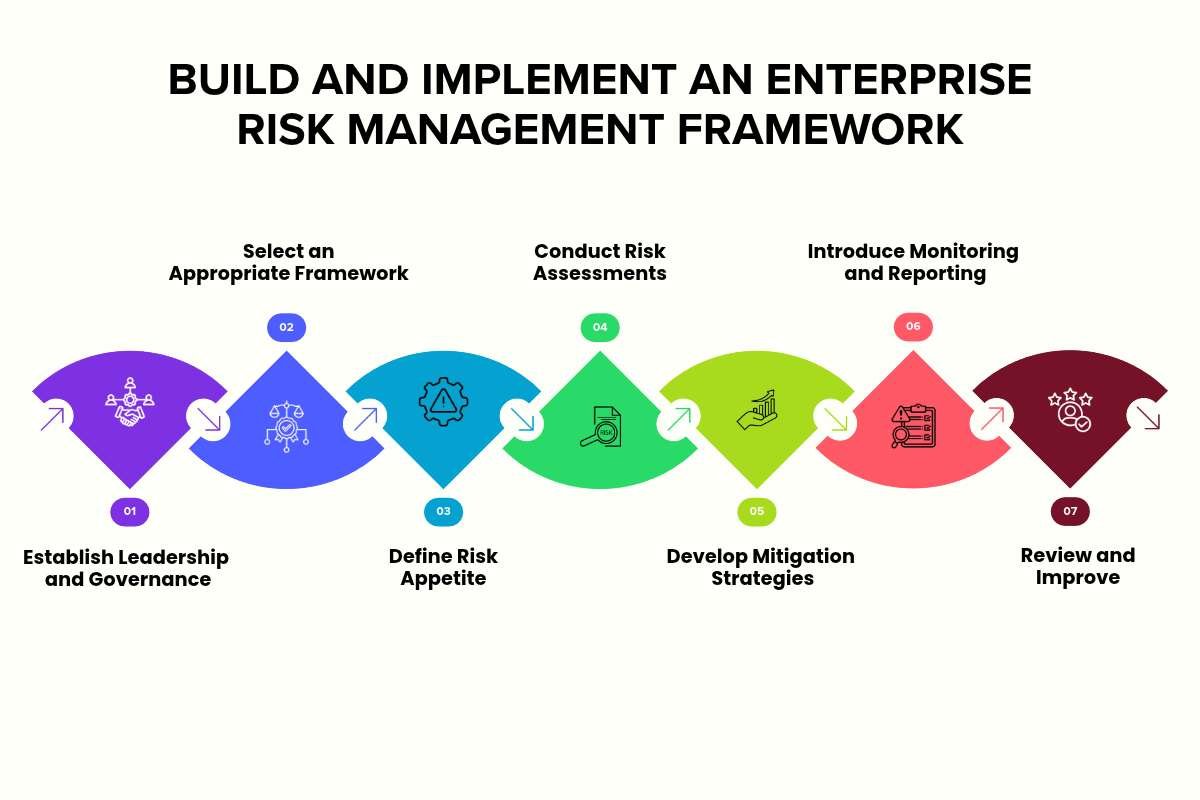
Implementing an enterprise risk management framework requires leadership involvement, clear processes, and continuous evaluation. The following seven steps provide a practical starting point.
| Step | Action | What Organizations Should Do |
| 1 | Establish Leadership and Governance | Secure board and executive support, create a risk committee, and assign responsibilities to departmental risk owners. |
| 2 | Select anAppropriate Framework | Choose COSO, ISO 31000, or a combination based on business requirements and regulatory exposure. |
| 3 | Define Risk Appetite | Establish acceptable risk levels and standardize assessment criteria for financial, operational, regulatory, and reputational exposure. |
| 4 | Conduct Risk Assessments | Organize departmental discussions, identify potential threats, evaluate existing controls, and develop a centralized risk register. |
| 5 | Develop Mitigation Strategies | Prioritize critical risks, assign responsibility, allocate resources, and establish corrective action plans. |
| 6 | Introduce Monitoring and Reporting | Establish KRIs, develop management dashboards, and introduce centralized Governance, Risk, and Compliance (GRC) systems where necessary. |
| 7 | Review and Improve | Conduct periodic assessments, test business continuity plans, evaluate control effectiveness, and update the framework as business conditions change. |
Common Challenges in Implementing an Enterprise Risk Management Framework
Even a well-designed enterprise risk management framework can face implementation challenges. Organizations must address the following obstacles to ensure that risk management becomes part of regular business operations.
- Lack of leadership involvement: Without executive support, risk management can become an isolated compliance activity. Establish board oversight and clear accountability.
- Departmental silos: Separate reporting systems limit organization-wide visibility. Introduce centralized risk reporting and cross-functional collaboration.
- Overcomplicated risk registers: Excessive documentation can distract teams from critical threats. Prioritize material risks based on their potential business impact.
- Outdated risk assessments: Static assessments may overlook emerging threats.Schedule regular reviews and update risk evaluations as business conditions change.
- Limited employee awareness: Employees may not recognize their role in risk management. Provide practical training and encourage transparent reporting.
The importance of addressing these challenges is reflected in NC State University’s 2026 State of Risk Oversight study. Among 331 executives and board-level respondents, 69% reported increased risk complexity over five years, while only 30% considered their organization’s risk oversight processes mature or robust.
This gap highlights the need to integrate risk management into strategic planning rather than treating it as an annual compliance requirement.
The Future of Enterprise Risk Management
Technology, geopolitical uncertainty, and changing regulatory requirements are reshaping how organizations manage risks. Three developments are particularly important:
| Development | Business Implications |
| AI and Predictive Analytics | Organizations are using advanced analytics to identify unusual patterns, detect fraud, and improve risk forecasting. However, AI-related bias, data privacy, and governance risks also require attention. |
| Cybersecurity and Third-Party Risk | Growing dependence on external technology providers makes vendor assessments, data protection, and incident response essential. |
| Inclusive Corporate Governance | Greater gender diversity in corporate leadership can broaden perspectives during risk discussions, particularly around workforce management, organizational culture, and governance priorities. |
The World Economic Forum’s 2026 Global Risks Report also identifies geoeconomic confrontation, misinformation, and societal polarization among the leading short-term global risks.
These developments are increasing the need for organizations to reassess their risk priorities and adapt their oversight practices to changing business conditions.
Conclusion:
An effective enterprise risk management framework helps organizations identify interconnected threats, strengthen oversight, and prepare for business disruptions.
Integrating risk management into strategic and operational decisions enables companies to protect resources and respond to emerging challenges.
Its success depends on leadership commitment, employee participation, reliable risk information, and continuous improvement.
Frequently Asked Questions (FAQs)
1. What is an Enterprise Risk Management Framework?
It is a structured approach that helps organizations identify, assess, manage, and monitor risks across business functions while aligning risk management with strategic objectives.
What are the five components of the COSO ERM Framework?
The five components are Governance and Culture, Strategy and Objective-Setting, Performance, Review and Revision, and Information, Communication, and Reporting.
What is the difference between COSO ERM and ISO 31000?
COSO focuses on integrating risk management with business strategy and performance, whereas ISO 31000 provides flexible risk management guidelines applicable across industries.