

Inclusive leadership for remote work is essential for building engaged, collaborative, and high-performing distributed teams. This guide explores the challenges of leading remote employees, practical strategies to foster psychological safety and inclusion, proven leadership models, real-world examples, and a step-by-step framework to create a more equitable and productive remote workplace.
Remote work has redefined the modern workplace, but it hasn’t automatically created an inclusive one. This is why inclusive leadership for remote teams has become more important than ever. While 74% of employees say they are happier working remotely, research also shows that remote employees are more likely to experience isolation, reduced visibility, and fewer opportunities to contribute equally. At the same time, organizations with inclusive cultures are up to 8 times more likely to achieve better business outcomes and are significantly more innovative than their peers.
The difference isn’t where people work; it’s how they’re led. Without intentional leadership, distributed teams can quickly fall victim to communication gaps, proximity bias, meeting inequality, and disengagement.
That’s why inclusive leadership for remote work has become a critical leadership skill. Leaders who prioritize psychological safety, equitable participation, and transparent communication don’t just build stronger team cultures; they create more engaged employees, better collaboration, and higher-performing remote teams.
In this guide, you’ll learn how to overcome the unique challenges of leading distributed teams and implement practical strategies to build a truly inclusive remote workplace.
What Is Inclusive Leadership for Remote Work?
Remote work has transformed not just where people work, but how leaders lead. Without daily face-to-face interactions, leaders must be intentional about building trust, encouraging participation, and ensuring every employee feels valued.
Inclusive leadership for remote work means creating a virtual workplace where everyone, regardless of location, time zone, role, or background, has equal opportunities to contribute, collaborate, and grow. Instead of rewarding visibility, inclusive leaders prioritize outcomes, flexibility, fairness, and belonging qualities that reflect the core characteristics of inclusive leadership, regardless of where employees work.
The Role of Digital Psychological Safety
At the heart of inclusive leadership for remote work is digital psychological safety, the confidence employees have to share ideas, ask questions, admit mistakes, and provide feedback without fear of judgment or exclusion.
Building psychological safety also requires leaders to demonstrate curiosity, collaboration, courage, and cultural intelligence competencies often highlighted in the 6-C model of inclusive leadership traits.
This goes beyond meetings. It means respecting different communication styles, supporting asynchronous collaboration, ensuring accessibility across time zones, and recognizing contributions wherever they happen. When employees feel safe and heard, they collaborate more openly, innovate more confidently, and strengthen the entire team’s performance.
Why Inclusion Is More Challenging in Remote Teams
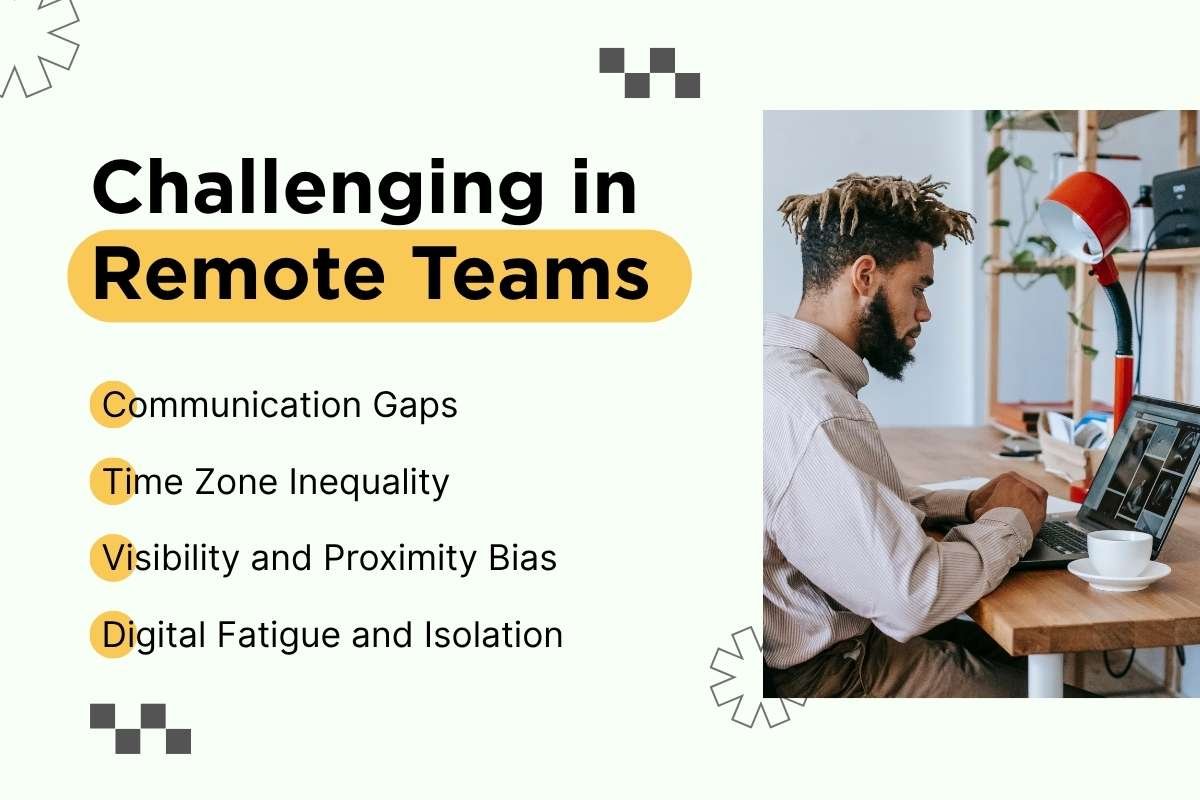
Creating an inclusive culture is harder when teams are distributed. Without face-to-face interactions, spontaneous conversations, or equal access to leaders, remote employees can feel overlooked, affecting engagement, collaboration, and career growth. As communication becomes increasingly digital and teams span multiple time zones, leaders must be more intentional about fostering inclusion.
1. Communication Gaps
One of the biggest challenges in inclusive leadership for remote work is preventing communication gaps in private chats or impromptu calls, leaving quieter employees or those in different time zones without the context they need to contribute.
2. Time Zone Inequality
Scheduling meetings around one region can repeatedly disadvantage the same employees, limiting participation and creating an uneven team experience.
3. Visibility and Proximity Bias
Successful inclusive leadership for remote work minimizes visibility and proximity bias by recognizing employees based on outcomes rather than online presence.
4. Digital Fatigue and Isolation
Frequent virtual meetings and constant notifications can lead to burnout, while fewer informal interactions can leave employees feeling disconnected from their teams.
These challenges can be overcome with intentional leadership that promotes fairness, belonging, and equal opportunities for every remote employee the same principles that define effective inclusive leadership across every workplace.
Benefits of Inclusive Leadership for Remote Work
Inclusive leadership isn’t just about creating a positive employee experience; it has a measurable impact on business performance. As remote and hybrid work become the norm, organizations that prioritize inclusion are better positioned to retain talent, foster innovation, and improve collaboration across distributed teams.
Deloitte’s research found that inclusive leaders improve team collaboration by 29%, increase decision-making quality by 20%, and drive a 17% increase in team performance. Employees working under inclusive leaders also report a 70% increase in feelings of fairness, belonging, and psychological safety, all essential ingredients for high-performing remote teams.
1. Higher Employee Engagement
One of the biggest benefits of inclusive leadership for remote work is higher employee engagement because employees who feel heard and valued contribute with greater confidence. Inclusive leaders encourage open communication, involve team members in decisions, and create an environment where everyone can contribute confidently. According to Deloitte, organizations with inclusive cultures experience stronger employee engagement because people feel respected, supported, and connected to their teams.
2. Better Collaboration and Innovation
Innovation thrives when diverse perspectives are encouraged, not just represented. Inclusive leaders create space for different viewpoints, enabling distributed teams to solve problems more creatively and make better decisions. Research by Deloitte shows that inclusive leadership improves collaboration by 29% while increasing decision-making quality by 20%, demonstrating that inclusion directly influences team effectiveness.
3. Stronger Retention and Employee Well-Being
Inclusive leadership for remote work reduces one of the biggest risks of distributed teams: employee isolation by creating trust, belonging, and psychological safety. When people don’t feel connected or included, engagement declines and turnover increases. Inclusive leadership addresses this by fostering trust, fairness, and psychological safety. Deloitte’s research on remote work also highlights that thoughtful inclusion practices help organizations create a more equitable experience for distributed employees, improving satisfaction and long-term retention.
Traditional vs. Inclusive Remote Leadership
| Traditional Remote Leadership | Inclusive Remote Leadership |
| Focuses on employee visibility | Focuses on outcomes and impact |
| One-way communication | Open, two-way communication |
| Fixed meeting schedules | Time-zone-conscious collaboration |
| Recognition based on presence | Recognition based on contribution |
| Decisions made by a few | Diverse voices included in decision-making |
Best Practices for Inclusive Leadership in Remote Work
Building an inclusive remote culture doesn’t happen by chance; it requires consistent leadership behaviors. While every organization has different needs, the most effective remote leaders share one common trait: they intentionally create systems that give every employee an equal opportunity to contribute, collaborate, and grow.
Here are ten proven practices that leaders can adopt immediately. Together, they form the foundation of strong inclusive management practices for distributed teams.
1. Build Digital Psychological Safety
Building psychological safety is the foundation of inclusive leadership for remote work, ensuring employees feel comfortable speaking up, asking questions, and sharing ideas. Leaders can foster this by encouraging open dialogue, welcoming constructive feedback, and treating mistakes as learning opportunities rather than failures. Google’s Project Aristotle also identified psychological safety as the single most important factor behind high-performing teams.
2. Reduce Proximity Bias Through Outcome-Based Leadership
In remote and hybrid workplaces, it’s easy to unconsciously favor employees who are more visible or work from the office. Instead of measuring commitment by online status or meeting attendance, evaluate employees based on outcomes, impact, and achievement of goals. This ensures recognition and career opportunities are based on performance rather than presence, a defining inclusive leadership characteristic in high-performing organizations.
3. Embrace Asynchronous Communication
Inclusive leadership for remote work embraces asynchronous communication so every employee can contribute regardless of location or time zone. Documenting decisions, sharing updates in collaborative platforms, and allowing employees to respond across time zones creates a more equitable work environment. Asynchronous communication also reduces meeting overload while giving employees time to provide thoughtful contributions.
4. Make Every Meeting Inclusive
Meetings should encourage participation from everyone, not just the loudest voices. Rotate meeting times for global teams, share agendas in advance, invite written input before discussions, and create space for quieter employees to contribute. Simple practices like round-robin discussions or anonymous brainstorming can significantly improve participation.
5. Communicate With Transparency
Remote employees rely on written communication more than informal office conversations. Leaders should clearly document key decisions, define expectations, and communicate changes openly. Transparent communication reduces misunderstandings and ensures everyone has equal access to information.
6. Prioritize Accessibility and Inclusive Communication
Inclusive communication means ensuring information is accessible to everyone. Use clear, jargon-free language, enable live captions or transcripts during meetings, and provide important updates in multiple formats. These practices not only support employees with accessibility needs but also improve clarity across diverse teams.
7. Personalize Support Instead of Standardizing It
Remote employees have different work environments, responsibilities, and communication preferences. Regular one-on-one conversations help leaders understand individual needs, remove barriers, and provide support that enables each employee to perform at their best.
8. Foster Meaningful Team Connections
Inclusive leadership for remote work encourages leaders to intentionally create opportunities for informal interactions and relationship building. Create opportunities for informal interactions, celebrate milestones, recognize achievements publicly, and encourage cross-functional collaboration to strengthen trust and belonging.
9. Measure Inclusion Regularly
What gets measured gets improved. Track employee engagement, psychological safety, participation in meetings, promotion equity, and feedback through regular pulse surveys. Reviewing these metrics helps leaders identify gaps before they become larger organizational issues.
10. Make Fair and Inclusive Talent Decisions
Hiring, performance reviews, promotions, and recognition should follow consistent, objective criteria. Structured evaluation frameworks reduce unconscious bias and ensure every employee has equal opportunities to grow, regardless of where they work.
Common Mistakes Leaders Make in Remote Teams

Even organizations committed to inclusive leadership for remote work can unintentionally create barriers to inclusion if leaders reinforce bias or exclude certain employees. These common mistakes can reduce trust, engagement, and collaboration over time.
1. Micromanaging Instead of Building Trust
Tracking online activity or expecting instant responses can undermine autonomy. Inclusive leaders focus on outcomes, not constant visibility.
2. Equating Visibility With Performance
Employees who speak up more or interact frequently with leaders may receive more recognition than quieter or asynchronous contributors. Performance should be measured by impact, not presence.
3. Overlooking Quiet Contributors
Not everyone thrives in live meetings. Inclusive leaders encourage input through multiple channels, including written feedback, collaborative documents, and one-on-one conversations.
4. Using a One-Size-Fits-All Approach
Remote teams have diverse communication styles, schedules, and responsibilities. Effective leaders adapt their approach while maintaining fairness and consistency.
5. Treating Inclusion as a One-Time Initiative
Inclusion isn’t built through a single policy or training session. In fact, many of these behaviors are among the most common causes of failure in inclusive leadership, especially when they become part of everyday management. It requires consistent leadership behaviors that promote fairness, belonging, and equal opportunities every day.
Leadership Models That Support Remote Inclusion
Inclusive leadership isn’t built on instinct alone. It draws from several established inclusive leadership models that help leaders create more equitable, collaborative, and high-performing teams. While no single model addresses every challenge of remote work, combining these approaches helps leaders create workplaces where distributed teams can thrive.
1. Inclusive Leadership Model
The Inclusive Leadership Model provides a strong foundation for inclusive leadership for remote work by placing belonging, fairness, and equitable participation at the center of leadership. It encourages leaders to actively seek diverse perspectives, minimize unconscious bias, and create opportunities for every employee to contribute. In remote environments, this means making decisions transparently, ensuring equal access to information, and fostering psychological safety across digital channels.
2. Servant Leadership
Servant leadership focuses on empowering people before directing them. Rather than controlling how work gets done, servant leaders remove obstacles, support employee well-being, and help individuals succeed. This approach is particularly effective for remote teams, where employees rely on trust, autonomy, and regular support rather than constant supervision.
3. Transformational Leadership
Transformational leaders inspire teams through a shared vision and encourage innovation by empowering employees to think creatively. In distributed workplaces, they maintain alignment through clear communication, recognition, and purpose-driven leadership. By connecting individual contributions to broader organizational goals, they keep remote employees engaged despite physical distance.
Why Inclusive Leadership Stands Out?
While each leadership style offers valuable principles, inclusive leadership brings together the strengths of multiple approaches to address the realities of modern remote work. It combines the empathy of servant leadership with the vision of transformational leadership while placing fairness, belonging, and equal opportunity at the core of every decision.
| Leadership Model | Primary Focus | Application in Remote Teams |
| Inclusive Leadership | Belonging, equity, and participation | Ensures every employee has an equal voice and opportunity to succeed. |
| Servant Leadership | Employee growth and support | Builds trust by removing barriers and empowering team members. |
| Transformational Leadership | Vision and motivation | Inspires distributed teams around shared goals and innovation. |
As remote work continues to evolve, organizations don’t need to choose one leadership style over another. The most effective leaders adopt an inclusive mindset while drawing on the strengths of different leadership models to meet the diverse needs of their teams.
Real-World Examples of Inclusive Remote Leadership

The principles of inclusive leadership are most effective when they move beyond theory and become part of everyday operations. Several global organizations have demonstrated that building an inclusive remote culture isn’t about having more meetings; it’s about creating systems that promote transparency, trust, and equal participation.
1. GitLab: Building an Async-First Culture
As one of the world’s largest all-remote companies, GitLab has built its culture around transparency and asynchronous collaboration. Instead of relying on meetings, the company documents processes, decisions, and workflows in a publicly accessible handbook. This ensures every employee, regardless of location or time zone, has equal access to information and can contribute without being excluded by geography or schedule.
Key takeaway: Documenting knowledge and embracing asynchronous communication creates a more equitable workplace for distributed teams.
2. Atlassian: Making Global Collaboration More Inclusive
With employees spread across multiple countries, Atlassian has adopted practices that reduce time-zone bias and encourage balanced participation. Teams rotate meeting schedules, prioritize asynchronous updates, and use collaborative tools to capture ideas before and after meetings. This approach ensures decisions are informed by diverse perspectives rather than only those available in real time. This is a practical example of inclusive leadership for remote work in action across global teams.
Key takeaway: Inclusive collaboration starts with designing work around people—not around a single time zone.
3. Microsoft: Prioritizing Flexibility and Psychological Safety
Microsoft’s hybrid work strategy emphasizes flexibility, employee well-being, and trust. Through research such as the Work Trend Index, the company has consistently highlighted the importance of psychological safety, inclusive communication, and outcome-based performance. Leaders are encouraged to focus on employee impact instead of visibility, giving remote employees greater autonomy while maintaining accountability.
Key takeaway: Trust-based leadership creates stronger engagement than constant supervision.
Measuring the Success of Inclusive Remote Leadership
Inclusive leadership is only effective if it leads to measurable improvements in employee experience and business performance. While fostering belonging and trust may seem intangible, organizations can track specific metrics to understand whether their inclusion efforts are making a meaningful impact. Regular measurement also helps leaders identify gaps, strengthen inclusive management practices, and create more equitable experiences across remote teams.
1. Employee Engagement
Measuring employee engagement helps organizations understand whether inclusive leadership for remote work is creating a more connected and productive workforce. Regular engagement surveys can help leaders assess whether remote employees feel connected, motivated, and supported. According to Gallup, highly engaged teams experience 23% higher profitability and significantly lower absenteeism and turnover, making engagement one of the strongest indicators of leadership effectiveness.
2. Psychological Safety
Employees should feel comfortable sharing ideas, asking questions, and providing honest feedback without fear of negative consequences. Organizations can measure psychological safety through pulse surveys, anonymous feedback, and one-on-one conversations. Consistently high scores indicate that leaders have built a culture of trust and openness.
3. Participation and Collaboration
Inclusive teams ensure that opportunities to contribute are shared across the organization. Leaders should monitor participation in meetings, collaborative projects, and decision-making processes to ensure that contributions aren’t limited to a small group of employees. Tracking collaboration across departments and time zones can also reveal whether distributed teams are working effectively together.
4. Promotion Equity and Career Growth
Remote employees should have the same opportunities for recognition, promotions, and professional development as their in-office peers. Reviewing promotion rates, performance ratings, and leadership opportunities across different work arrangements helps organizations identify and address potential proximity bias.
5. Retention and Employee Well-Being
High turnover can signal underlying issues with inclusion or employee experience. Monitoring retention rates alongside employee well-being indicators such as workload, burnout, and work-life balance provides a more complete picture of how inclusive leadership is influencing long-term organizational health.
Key Metrics at a Glance
| KPI | What It Measures | Why It Matters |
| Employee Engagement | Commitment and motivation | Indicates connection to the organization and leadership |
| Psychological Safety | Trust and openness | Encourages innovation and honest communication |
| Meeting Participation | Inclusion in discussions | Ensures diverse voices are heard |
| Promotion Equity | Fair career advancement | Helps identify visibility or proximity bias |
| Retention Rate | Employee loyalty | Reflects long-term satisfaction and belonging |
| Employee Well-Being | Burnout and work-life balance | Supports sustainable team performance |
A 5-Step Framework for Building Inclusive Remote Teams
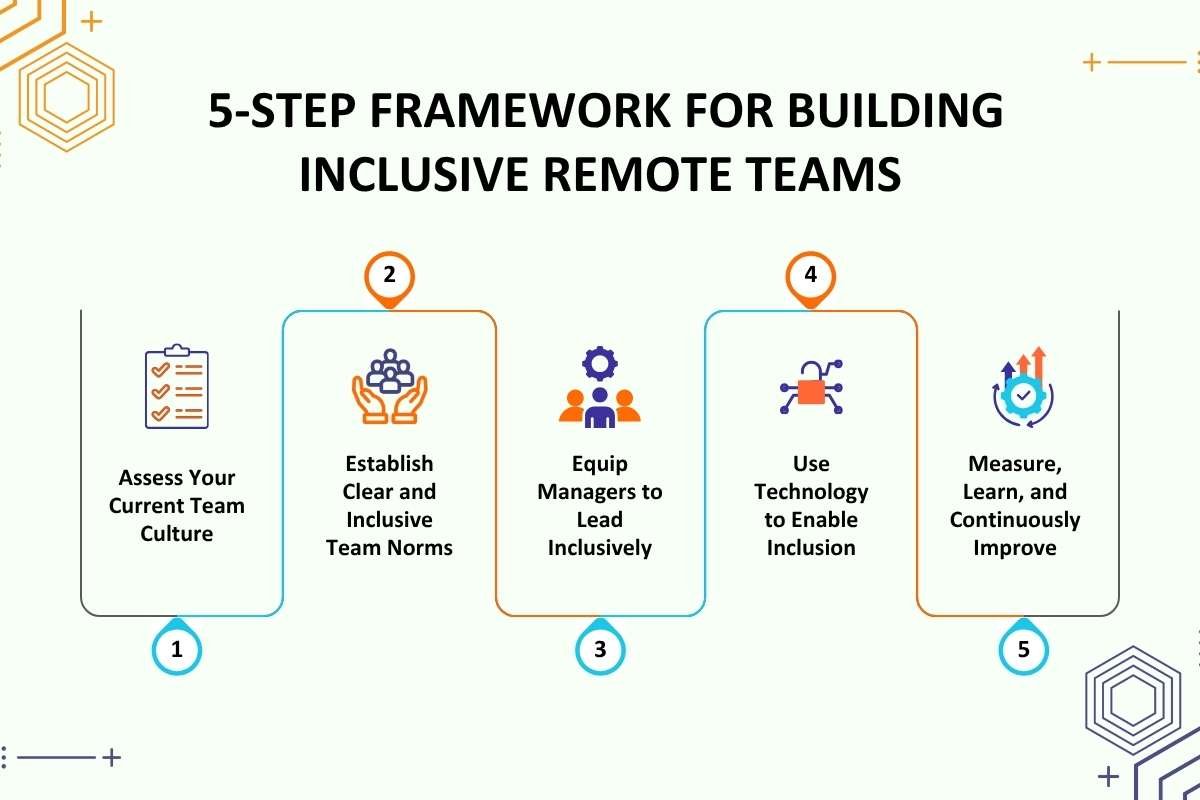
Creating an inclusive remote workplace isn’t about introducing isolated initiatives—it’s about embedding inclusion into the way teams communicate, collaborate, and make decisions every day. A structured framework helps leaders move from good intentions to consistent action, ensuring inclusion becomes part of the organization’s culture rather than an occasional effort.
Step 1: Assess Your Current Team Culture
Start by understanding where your team stands today. Gather feedback through employee surveys, one-on-one conversations, and engagement data to identify gaps in communication, collaboration, and belonging. Look for patterns related to meeting participation, psychological safety, promotion equity, and employee well-being.
Goal: Identify barriers before implementing solutions.
Step 2: Establish Clear and Inclusive Team Norms
Creating shared expectations is a fundamental practice of inclusive leadership for remote work, helping distributed teams work more consistently and fairly. Define response-time guidelines, meeting etiquette, decision-making processes, and when to use synchronous versus asynchronous communication. Clear norms help ensure consistency, fairness, and transparency across distributed teams.
Goal: Build a workplace where everyone understands how to contribute effectively.
Step 3: Equip Managers to Lead Inclusively
Managers play the biggest role in shaping the employee experience. Providing managers with a structured inclusive leadership toolkit for management can help standardize these behaviors and make inclusive leadership part of everyday decision-making. Encourage leaders to regularly seek feedback, recognize diverse contributions, and adapt their leadership style to individual team needs.
Goal: Develop leaders who build trust instead of relying on supervision.
Step 4: Use Technology to Enable Inclusion
Technology should remove barriers, not create them. Standardize collaboration tools that support accessibility, documentation, and asynchronous work. Features such as live captions, shared knowledge bases, collaborative whiteboards, and project management platforms help ensure every employee has equal access to information and opportunities to contribute.
Goal: Create a digital workplace that supports every employee, regardless of location or time zone.
Step 5: Measure, Learn, and Continuously Improve
Inclusive leadership is an ongoing process. Regularly review engagement surveys, promotion data, retention rates, and employee feedback to evaluate what’s working and where improvements are needed. Share progress with the team and refine your approach as the organization grows.
Goal: Make inclusion a continuous leadership practice rather than a one-time initiative.
The Framework at a Glance
| Step | Focus Area | Desired Outcome |
| 1. Assess | Understand employee experience | Identify inclusion gaps |
| 2. Establish | Define inclusive team norms | Create clarity and consistency |
| 3. Equip | Train and support managers | Build trust-based leadership |
| 4. Enable | Adopt inclusive technologies | Improve collaboration and accessibility |
| 5. Improve | Measure and refine continuously | Sustain long-term inclusion |
Implementing this framework doesn’t require a complete organizational overhaul. Small, consistent improvements, whether it’s rotating meeting times, documenting decisions, or creating space for quieter voices, can significantly strengthen inclusion over time. As these practices become part of everyday leadership, they lay the foundation for stronger collaboration, higher engagement, and better business outcomes.
The Future of Inclusive Leadership in Remote Work
Remote work is no longer a temporary workplace model; it’s reshaping how organizations attract talent, collaborate across borders, and build high-performing teams. As technology continues to evolve, inclusive leadership will become even more critical in ensuring that flexibility doesn’t come at the cost of fairness, belonging, or opportunity.
1. AI Will Support More Inclusive Collaboration
Artificial intelligence is already strengthening inclusive leadership for remote work by making collaboration more accessible across languages, abilities, and time zones. AI-powered meeting assistants can generate summaries, provide real-time translations, create live captions, and capture action items, making collaboration more accessible for employees across languages, abilities, and time zones. However, technology should support inclusion, not replace human judgment. Leaders must ensure AI is used to reduce bias rather than reinforce it.
2. Asynchronous Work Will Become the Default
As organizations continue to build global teams, asynchronous communication will play a larger role in improving productivity and inclusion. Instead of expecting employees to always be online, organizations will increasingly prioritize documented workflows, shared knowledge, and flexible collaboration. This approach not only accommodates different time zones but also gives employees more time to think, contribute, and innovate.
3. Success Will Be Measured by Outcomes, Not Presence
The future of inclusive leadership for remote work will continue shifting organizations toward outcome-based performance rather than visibility-based management. Organizations are increasingly recognizing that employee performance should be evaluated based on results, collaboration, and impact rather than hours worked or online activity. This transition helps reduce proximity bias while creating a more equitable experience for remote and hybrid employees.
Conclusion:
Inclusive leadership for remote work has become essential as organizations adapt to distributed and hybrid workplaces, requiring leaders to intentionally create environments where every employee can thrive. Building an inclusive remote team requires more than flexible policies or digital collaboration tools; it demands intentional leadership that values every voice, removes barriers to participation, and creates opportunities for everyone to thrive.
By fostering psychological safety, reducing proximity bias, encouraging transparent communication, and measuring inclusion consistently, leaders can transform distributed teams into highly engaged, innovative, and resilient workplaces. The benefits extend far beyond employee satisfaction; they drive stronger collaboration, better decision-making, improved retention, and sustainable business performance.
As remote and hybrid work continue to evolve, inclusive leadership for remote work will remain one of the defining skills of successful leaders. Those who prioritize belonging, trust, and equity won’t just build better teams; they’ll build organizations prepared for the future of work. Developing these capabilities starts with understanding the broader principles of inclusive leadership and applying them consistently through effective inclusive management practices, regardless of where teams work.