
“Flexibility is no longer a perk—it’s the new way work actually works.”
The way people work in America is changing and not in the way most expected. Remote work was supposed to make life easier, but for many, it just replaced office pressure with endless meetings, constant messages, and the feeling of always being “on.”
That’s where the asynchronous work culture in the US is starting to stand out.
Instead of expecting everyone to be online at the same time, async work allows people to work on their own schedules while still staying aligned with their teams. And it’s not just a trend, it’s backed by real data. Studies show that workplace interruptions happen every 10–12 minutes, making it hard to focus, while async-first teams report significantly more uninterrupted work time and higher productivity.
For women especially, this shift is powerful. In the US, flexibility isn’t just about convenience; it’s often the difference between staying in the workforce or stepping back. With async work, professionals get something far more valuable than remote work ever offered: control over their time.
The asynchronous work culture in the US is not just changing how work gets done; it’s changing who gets to thrive at work.
In this blog, we’ll break down why this shift is happening, what it means for the future, and how it’s opening new opportunities for women building modern careers.
What is an Asynchronous Work Culture?
Now that we understand the shift, let’s break this down in simple terms.
The asynchronous work culture in the US is a way of working where people don’t need to be online at the same time to collaborate. Instead of constant meetings and instant replies, teams rely on clear documentation, written updates, and flexible timelines.
In simple words, it’s the difference between:
- “Reply now.” vs “Respond when you’re ready—with clarity.”
This shift moves work away from being always available to being clearly accountable.
For example, instead of sitting in long meetings, teams share updates through documents, recorded videos, or project tools. This allows everyone to focus on their work and respond when they’re most productive.
And this is where the asynchronous work culture in the US stands out. It reduces constant interruptions, something that can break focus every 10–15 minutes, and replaces them with uninterrupted time for deep work.
But beyond productivity, it creates something more important: flexibility with fairness.
Not everyone works the same hours or has the same responsibilities. For many women balancing careers and personal commitments, fixed schedules can be limiting. Async work changes that by giving people more control over when and how they work without affecting outcomes.
In short, the asynchronous work culture in the US is about working smarter, with more clarity, focus, and control over your time.
And that naturally leads to the next question: why is this model gaining so much momentum right now?
Why Async-First is Rising in 2026?
Once you understand how async work functions, the next question is obvious: why is it suddenly gaining so much momentum now?
The answer is simple: remote work didn’t fully solve productivity or flexibility; it only shifted the problem.
Over the past few years, many US companies have adopted remote or hybrid models, expecting better efficiency. But instead, teams ended up in “calendar overload” days filled with meetings, constant pings, and very little time for actual focused work.
This is where the asynchronous work culture in the US is proving to be a smarter evolution.
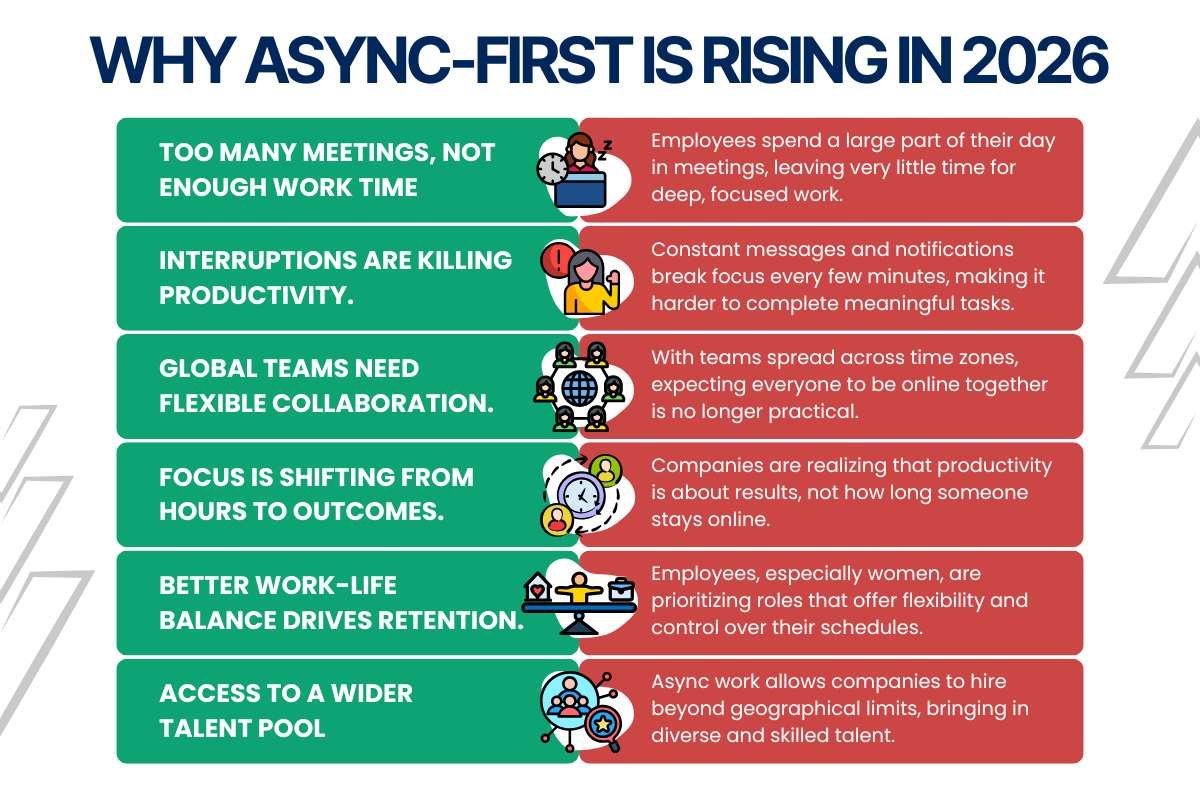
Here’s why more companies are moving toward async-first models:
| Too many meetings, not enough work time | Employees spend a large part of their day in meetings, leaving very little time for deep, focused work. |
| Interruptions are killing productivity. | Constant messages and notifications break focus every few minutes, making it harder to complete meaningful tasks. |
| Global teams need flexible collaboration. | With teams spread across time zones, expecting everyone to be online together is no longer practical. |
| Focus is shifting from hours to outcomes. | Companies are realizing that productivity is about results, not how long someone stays online. |
| Better work-life balance drives retention. | Employees, especially women, are prioritizing roles that offer flexibility and control over their schedules. |
| Access to a wider talent pool | Async work allows companies to hire beyond geographical limits, bringing in diverse and skilled talent. |
For women professionals, this shift is even more impactful. Flexibility has moved from being a perk to a career enabler, er making it easier to balance work with personal responsibilities without stepping back.
In short, the asynchronous work culture in the US is rising because it solves what remote work couldn’t:
How to work better, not just from anywhere, but at your best.
And this naturally leads to the next question: why are many companies now finding the remote-hybrid model ineffective?
Why “Remote-Hybrid” is Failing and “Async-First” is the New Standard?
At first glance, the remote-hybrid model seemed like the perfect middle ground. A few days in the office and a few days at home, it sounded flexible and practical.
But in reality, many companies in the US are now realizing that hybrid work often creates more confusion than clarity. Instead of simplifying workflows, it has led to mixed communication, meeting overload, and unclear expectations.
This is exactly why the asynchronous work culture in the US is emerging as a stronger, more sustainable model.
To understand this better, here’s a clear comparison:
| Aspect | Remote-Hybrid Model | Async-First Model |
| Work Style | Schedule-driven (fixed hours, meetings) | Outcome-driven (focused on results) |
| Flexibility | Partial (location flexibility only) | Full (time + location flexibility) |
| Communication | Real-time heavy(calls, instant replies) | Delayed but structured (docs, updates) |
| Meetings | Frequent and often necessary | Minimal and optional |
| Productivity | Interrupted by constant coordination | Higher due to deep work time |
| Collaboration | Depends on overlapping schedules | Works across time zones seamlessly |
| Work-Life Balance | Still restricted by timings | Greater control over daily schedule |
What becomes clear is that hybrid work tries to balance two systems but often ends up keeping the limitations of both.
For many professionals, especially women, this can feel restrictive. You may be working remotely, but you’re still tied to fixed hours, meetings, and constant availability.
The asynchronous work culture in the US changes that completely. It removes the need to always be “on” and replaces it with a system built on clarity, trust, and results.
That’s why companies are now shifting their focus from where people work to how work actually gets done.
And this naturally leads to the next question: What real benefits does async work bring to individuals and organizations?
Core Benefits of Async Work Culture
Sarah, a marketing manager in New York, starts her day with five back-to-back meetings. By late afternoon, she’s exhausted, but her actual work is still pending.
Now compare that to an async-first team member. Fewer meetings, clear priorities, and 3–4 hours of uninterrupted focus before lunch.
That difference is exactly why the asynchronous work culture in the US is gaining real momentum.
➤ Traditional Work vs Async Work:
| Traditional (Remote/Hybrid) | Async-First |
| Back-to-back meetings | Fewer, intentional meetings |
| Constant messages & pings | Structured updates |
| Work tied to fixed hours | Work tied to outcomes |
| Frequent interruptions | Deep focus time |
➤ What Makes Async Work Actually Better?
- More deep work, less distraction: Constant interruptions break focus every 10–15 minutes. Async work reduces this, giving employees longer stretches to think and execute.
- Flexibility that improves performance: A Stanford University study found remote workers were 13% more productive. Async builds on this by removing time restrictions completely.
- Lower burnout, better work-life balance: According to McKinsey & Company, lack of flexibility is one of the top reasons employees leave jobs. Async directly solves this.
- Clear communication, less confusion: Everything is documented, so decisions, updates, and feedback are easy to track without repeated meetings.
- Better, more thoughtful decisions: Teams get time to think before responding, leading to higher-quality outcomes.
➤ How Top Companies Are Doing It?
| GitLab | Operates with minimal meetings and a strong documentation culture across global teams. |
| Automattic | Uses internal blogs and written communication instead of real-time discussions. |
| Buffer | Emphasizes flexible schedules and transparent async communication, leading to high employee satisfaction. |
➤ Why This Matters More for Women?
For many professionals, flexibility is helpful, but for women, it’s often essential.
The asynchronous work culture in the US creates real impact by:
- Allowing a better balance between work and personal responsibilities
- Reducing burnout from rigid schedules
- Enabling consistent career growth without stepping back
How AI is Powering the Async Work Culture?
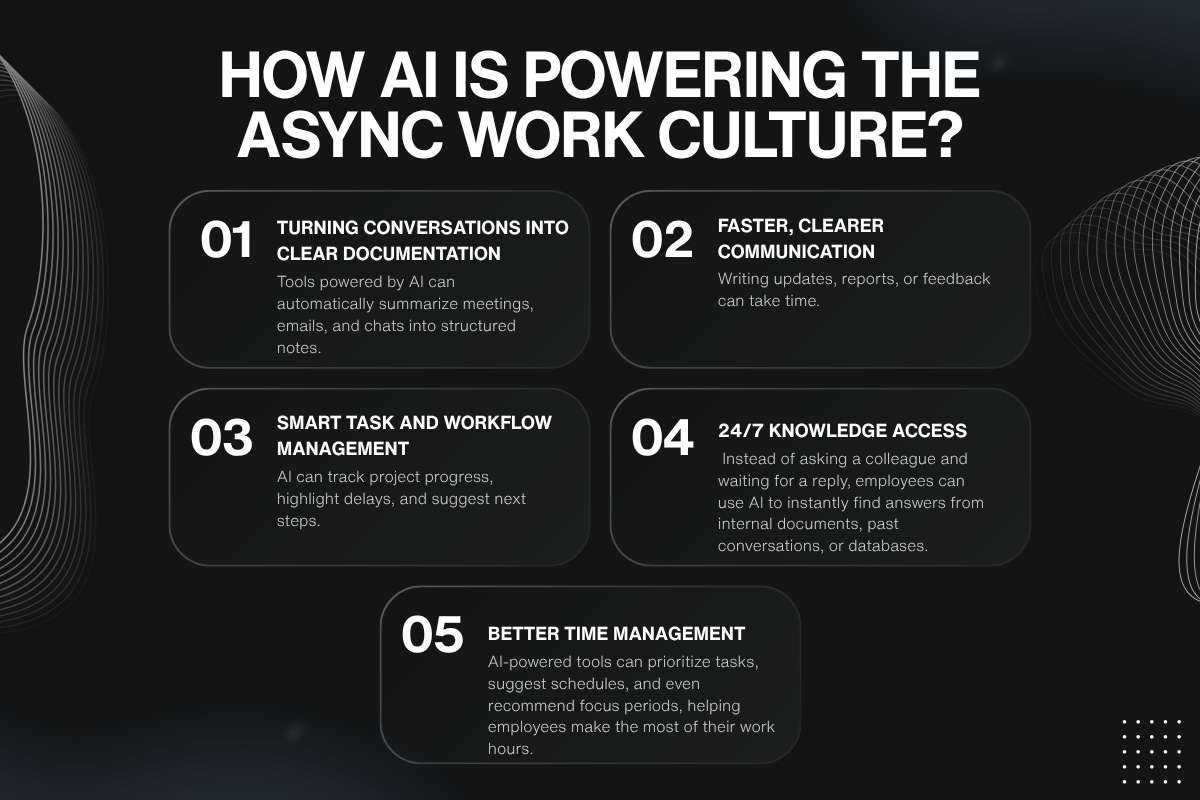
As async work continues to grow, one major factor is accelerating its adoption even faster: AI.
The asynchronous work culture in the US works best when communication is clear, structured, and accessible. And that’s exactly where AI is making a real difference, not by replacing people, but by removing friction from how work happens.
Here’s how AI is actively enabling async-first teams:
- Turning conversations into clear documentation: Tools powered by AI can automatically summarize meetings, emails, and chats into structured notes. This reduces the need for follow-up calls and keeps everyone aligned without real-time discussions.
- Faster, clearer communication: Writing updates, reports, or feedback can take time. AI tools help draft messages, refine tone, and ensure clarity, making async communication more efficient and easier to understand.
- Smart task and workflow management: AI can track project progress, highlight delays, and suggest next steps. This reduces the need for constant check-ins and helps teams stay on track independently.
- 24/7 knowledge access: Instead of asking a colleague and waiting for a reply, employees can use AI to instantly find answers from internal documents, past conversations, or databases.
- Better time management: AI-powered tools can prioritize tasks, suggest schedules, and even recommend focus periods, helping employees make the most of their work hours.
Real-world companies are already using this approach. For example, GitLab integrates AI into its documentation-first culture, while Microsoft has highlighted through its Work Trend Index that AI is significantly reducing time spent on repetitive tasks and improving productivity.
For women professionals, this shift is especially valuable.
The asynchronous work culture in the US, combined with AI, reduces the pressure to always be available. It allows work to move forward even when you’re offline, whether you’re managing personal responsibilities or simply focusing on deep work without interruptions.
In simple terms, AI is not just supporting async work; it’s making it scalable and sustainable.
And as more companies adopt this model, the next important question becomes:
How are leading organizations already implementing async work successfully in the real world?
Real-World Case Studies: Companies Leading the Async Shift
By now, the benefits of async work are clear, but what does it actually look like in practice?
Some of the most forward-thinking companies in the US have already built their entire work culture around async-first principles. And their results show that this model isn’t just possible, it’s highly effective.
Here’s how leading organizations are making the asynchronous work culture in the US work at scale:
- Key Companies Practicing Async Work
1. Automattic
| Work Model | Fully remote, async-first |
| Key Async Practice | Internal blogs (P2), written updates |
| Real Impact | Fewer meetings, seamless global collaboration |
Operates with teams spread across the globe, relying on internal blogs and written communication instead of meetings. Employees work on flexible schedules, making collaboration smooth across time zones.
2. GitLab
| Work Model | Remote, async-first |
| Key Async Practice | Public handbook, documentation-first culture |
| Real Impact | High transparency, minimal dependency on meetings |
Known for its extensive documentation culture, GitLab ensures that almost every process is written and accessible. This reduces confusion and allows employees to work independently.
3. Buffer
| Work Model | Remote with async focus |
| Key Async Practice | Flexible schedules, written communication |
| Real Impact | Higher employee satisfaction and lower burnout |
Focuses on transparency and well-being, using async practices to give employees more control over their time while maintaining strong team alignment.
➤ What These Companies Have in Common
Despite different industries and sizes, these companies follow similar principles:
| Documentation over discussion | Important information is written, not just spoken |
| Clarity over constant communication | Fewer but more meaningful updates |
| Flexibility over fixed schedules | Employees choose when they work best |
| Trust over micromanagement | Results matter more than online presence |
Inclusive Asynchronous Leadership for Women

As async work becomes more common, it’s not just changing how people work—it’s reshaping who gets to lead.
The asynchronous work culture in the US is creating new opportunities for women to step into leadership roles without being limited by traditional workplace expectations like long hours, constant visibility, or rigid schedules.
In many traditional environments, leadership has often been tied to presence, being in the room, speaking the most, or being available at all times. But async work shifts that focus on something far more meaningful: clarity, contribution, and outcomes.
Here’s how this shift is making leadership more inclusive:
- Performance over presence: Leadership is now judged by results, decision-making, and impact, not by how often someone is seen or heard in real time.
- Equal voice for everyone: Written communication gives everyone time to think and contribute, reducing the pressure to speak instantly in meetings, something that often benefits more thoughtful or reserved contributors.
- Flexibility supports career continuity: For many women balancing caregiving or personal responsibilities, async work removes the need to choose between leadership roles and life commitments.
- Reduced bias in communication: Structured, documented work reduces reliance on informal conversations or office dynamics, which can sometimes exclude or disadvantage women.
- Stronger focus on thoughtful leadership: Async environments encourage leaders to communicate clearly, document decisions, and think strategically, qualities that strengthen leadership overall.
There’s also strong data backing this shift. Reports from organizations like Deloitte consistently show that flexibility is one of the most important factors in improving women’s retention and advancement in the workforce.
The asynchronous work culture in the US builds on this by offering something deeper than flexibility; it offers control and consistency, which are critical for long-term career growth.
In simple terms, async work is not just making jobs more flexible; it’s making leadership more accessible.
And as more women step into these roles, the next challenge becomes equally important:
How do you build strong connections and mentorship in a world where people aren’t always working at the same time?
Remote Mentorship Framework in an Async World
As leadership becomes more inclusive, the next challenge is clear: how do you build strong mentorship when people aren’t always online at the same time?
In traditional workplaces, mentorship often happens through informal, quick chats, shadowing, or spontaneous advice. But in the asynchronous work culture in the US, those moments don’t happen naturally. They need to be designed intentionally.
The good news? When done right, async mentorship can be even more effective because it’s structured, documented, and consistent.
Here’s what a strong remote mentorship framework looks like in an async-first environment:
| Structured, not random | Mentorship is planned with clear goals, timelines, and expectations instead of relying on chance interactions. |
| Written guidance that lasts | Instead of one-time conversations, mentors share feedback through documents, recorded videos, or notes—creating a resource mentees can revisit anytime. |
| Flexible communication | Mentors and mentees don’t need to be online together. Questions, feedback, and updates can happen over time without pressure. |
| Regular async check-ins | Weekly or bi-weekly updates through shared docs or tools help track progress without needing live meetings. |
| Focus on outcomes, not hours. | Growth is measured by skill development and results, not how often someone connects in real time. |
Companies like GitLab and Automattic already use similar systems, where knowledge is shared openly, and mentorship is built into documentation and workflows.
For women professionals, this model is especially powerful.
The asynchronous work culture in the US removes common barriers to mentorship—like time constraints, schedule conflicts, or limited access to senior leaders. It allows mentorship to happen in a way that fits into real life, not outside of it.
In simple terms, async mentorship shifts from “being available” to “being accessible.”
And once mentorship is structured effectively, the next big question becomes:
How do you bring the next generation, especially Gen Z, into this culture without losing the human connection?
How to Onboard Gen Z into an Async Culture (Without Losing the Human Touch)?

As async work becomes the norm, a new challenge is emerging: how do you bring Gen Z into a system that doesn’t rely on constant interaction?
This generation is entering the workforce with very different expectations. They value flexibility, purpose, and digital-first communication, but they also seek connection, feedback, and a sense of belonging.
The asynchronous work culture in the US fits their need for independence, but onboarding them requires a more thoughtful approach to avoid making work feel isolating.
Read More: Gender Inclusive Company Culture: Why It’s a Business Imperative, Not a Trend
Here’s how companies are getting it right:
- Start with clarity, not chaos: Gen Z thrives when expectations are clear. Providing structured onboarding documents, guides, and workflows helps them understand how work happens in an async environment.
- Balance async with intentional human touchpoints: While daily work may be async, occasional live check-ins, team calls, or virtual meetups help build connection and trust.
- Use video and voice to make communication more personal: Recorded video updates or voice notes can feel more human than plain text, helping new hires feel more connected to their teams.
- Create safe spaces for questions: Async environments can make people hesitate to ask questions. Dedicated channels or regular check-ins ensure new employees feel supported.
- Provide faster feedback loops: Gen Z values timely feedback. Even in async setups, quick responses and structured reviews help maintain engagement and growth.
For many young professionals, especially women starting their careers, the asynchronous work culture in the US can be empowering, but only if it doesn’t feel isolating. The key is to combine flexibility with intentional connection.
In simple terms, onboarding Gen Z in an async world is about finding the right balance between independence and interaction.
And once that balance is achieved, it becomes easier to step back and look at the bigger picture:
how all these elements come together to shape the future of work in the US.
Conclusion:
The way work is structured in the US is clearly evolving and not just toward remote, but toward something far more effective. The rise of the asynchronous work culture in the US shows that productivity is no longer about being constantly available but about working with clarity, focus, and intention.
What started as a response to remote work challenges is now becoming a long-term strategy. Companies are realizing that fewer meetings, better documentation, and flexible schedules don’t just improve output; they create healthier, more inclusive workplaces.
For women, especially, this shift is significant. It removes many of the invisible barriers tied to rigid schedules and constant availability, making it easier to build sustainable, long-term careers without compromising on personal priorities.
From AI-powered workflows to async-first companies and more inclusive leadership models, the change is already underway. And as more organizations adopt this approach, one thing is becoming clear:
The asynchronous work culture in the US isn’t just a trend; it’s shaping the future of work in a way that works better for everyone.
FAQ Section (People Also Ask)
1. Is async work legal for hourly employees in the US?
Yes, under the Fair Labor Standards Act, async work is legal as long as employers properly track hours and pay for all time worked, including overtime. Clear documentation and time tracking are essential.
2. How do you measure productivity in an async culture?
Productivity is measured by outcomes, not online presence. Companies focus on completed tasks, quality of work, and meeting deadlines rather than response time.
3. Does async work reduce collaboration?
No, it changes how collaboration happens. Teams use shared documents, recorded updates, and structured feedback, often leading to more thoughtful and clear communication.
4. Is async work suitable for all roles?
Not fully, but many roles can adopt async elements. Even in real-time roles, planning and internal communication can still be handled asynchronously.
5. Do employees feel isolated in async work?
They can, if not managed well. That’s why companies combine async work with regular check-ins and team interactions to maintain connection and engagement.