
A woman can work for years to prove her value and still be overlooked for a promotion, underpaid for added responsibilities, or stuck in a role that no longer reflects her worth. Sometimes, the breakthrough isn’t working harder; it’s having the right negotiation that changed their careers.
Five women negotiation that changed their careers trajectories through one strategic conversation. One raised her salary from $58,000 to $74,000. Another turned an expanding workload into a leadership opportunity. An architect switched industries after recognizing her earning ceiling, while others negotiated career growth around maternity leave or used competing offers to prove their market value.
The bigger lesson? Negotiation isn’t just about asking for more money. It is about making your value visible and changing how your career is recognized.
The need is clear. In 2024, U.S. women earned 85 cents for every dollar earned by men, according to Pew Research Center. Women also held 46% of U.S. management roles in 2023, up from 29% in 1980.
Whether negotiating pay, promotions, responsibilities, career changes, or flexibility, one well-timed conversation can change the trajectory of a career.
5 women share the negotiation that changed their careers
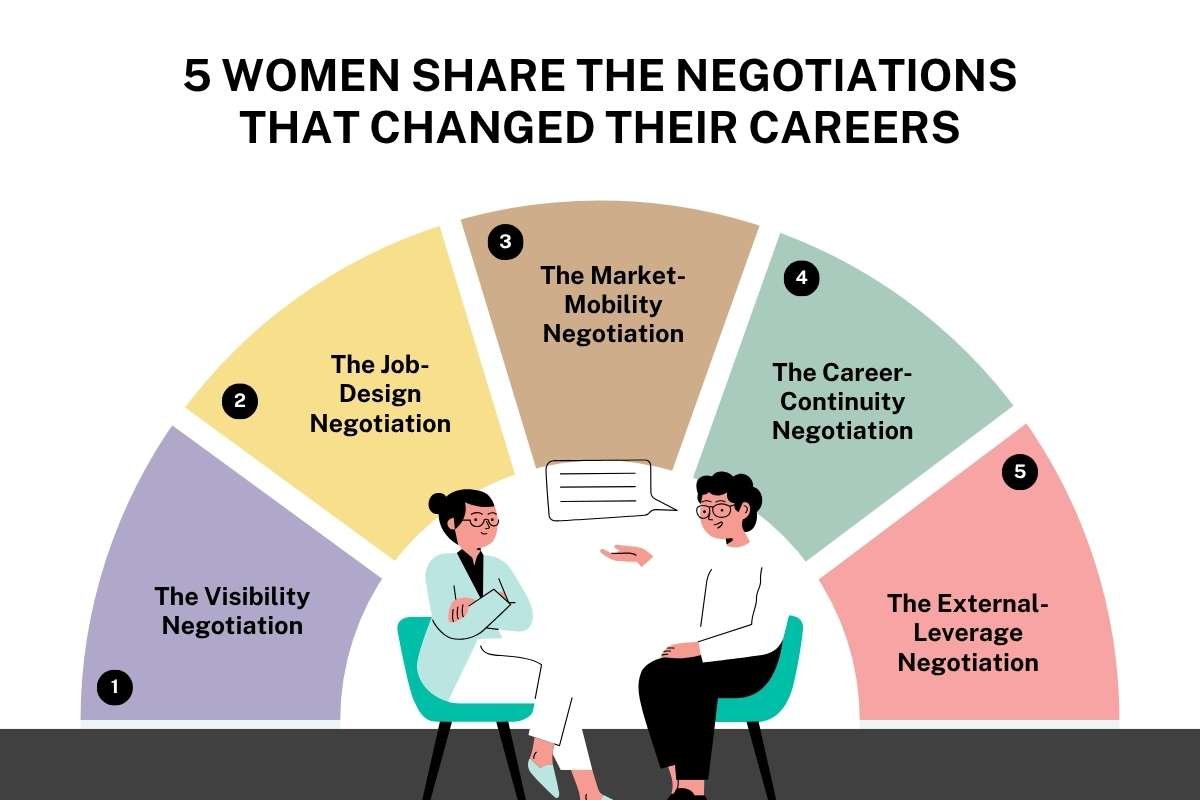
1. The visibility negotiation
- The Scenario
An accounting associate at a large accounting firm had spent two years working hard but felt increasingly overlooked. During her annual review, her manager rated her an average performer and offered the standard 5% raise. Meanwhile, colleagues were getting high-profile projects, promotions, and larger increases.
- The Move
Instead of assuming that strong performance would automatically lead to advancement, she began examining what higher-performing colleagues were doing differently.
She started deliberately advocating for herself, seeking greater visibility and pursuing high-profile client work rather than waiting to be noticed.
- The Outcome
Based on the information already provided in your draft, the outcome should explain the $58,000 → $74,000 increase, along with the change in visibility/advancement to introduce a new unsupported detail.
- The Lesson
Performance creates value; visibility helps decision-makers recognize it.
If you want a promotion, don’t limit the conversation to whether you have worked hard enough. Ask what experiences, projects, relationships, and measurable outcomes are required for the next level and negotiate access to them.
2. The job-design negotiation
- The Scenario
Six months into a marketing manager role earning $125,000, a professional inherited a significantly larger workload after a colleague resigned.
The obvious response would have been to absorb the additional responsibilities or ask for temporary compensation.
Instead, she treated the situation as evidence of an organizational gap.
- The Move
She mapped the expanded workload, identified overlapping responsibilities, and proposed a redesigned marketing structure that could eliminate the need to replace the departing employee.
Rather than negotiating only for a raise, she focused on negotiating job title and role scope, authority, and compensation. She presented the business case to senior leadership and used a trial period to demonstrate that the proposed structure could work.
- The Outcome
The redesigned role resulted in a VP-level position and a salary increase to $150,000, representing a 20% increase over her previous $125,000 salary.
- The Lesson
When your responsibilities expand significantly, negotiate the role, not just the paycheck.
A larger workload can become leverage when you can demonstrate that the business needs a different organizational structure. The strongest case connects your expanded responsibilities to measurable business outcomes such as revenue, efficiency, cost savings, customer growth, or operational capacity.
3. The market-mobility negotiation
- The Scenario
An architect earning $75,000 had reached what appeared to be a compensation ceiling in traditional architecture roles. Recruiters were offering similar salaries, making another job move unlikely to produce a meaningful financial change.
- The Move
Instead of repeatedly negotiating within the same market, she reconsidered where her skills were most valuable.
Her architectural expertise could transfer into commercial real estate development, where knowledge of design, construction, project management, and development could have a different economic value.
She shifted her search toward that market and focused on the value of her capabilities rather than anchoring her expectations to her previous salary.
- The Outcome
She moved into a project-director role in real estate development at $116,000, taking her compensation from $75,000 to $116,000, an increase of approximately 55%.
- The Lesson
Sometimes the most powerful negotiation is choosing a market where your skills are worth more.
Negotiation does not always mean convincing your current employer to pay more. It can mean recognizing that your skills are being priced differently elsewhere and strategically repositioning yourself.
4. The career-continuity negotiation
- The Scenario
A manager approaching maternity leave faced a familiar career concern: how to maintain professional momentum while temporarily stepping away from work.
Instead of treating leave as a pause in her career trajectory, she focused on maintaining visibility and strengthening relationships with senior decision-makers before her absence.
- The Move
She built relationships with internal sponsors, communicated her career ambitions clearly, and remained engaged in the promotion process when an appropriate senior opportunity emerged. In similar situations, women may also need to negotiate flexible work arrangements that support career continuity without reducing visibility or advancement opportunities.
The negotiation was therefore not simply about salary. It was about establishing that maternity leave should not automatically redefine her readiness for greater responsibility.
- The Outcome
She secured a promotion accompanied by an 11% salary increase.
- The Lesson
Career negotiation often begins before the formal negotiation.
Sponsorship, documented achievements, visible ownership of important work, and clear communication about career ambitions can strengthen a promotion case before a role becomes available.
The broader point is not that every woman should work during maternity leave. It is that career progression should be evaluated on demonstrated capability and agreed performance criteria, not assumptions about what taking leave means for commitment.
5. The external-leverage negotiation
- The Scenario
An operations manager earning $90,000 had gradually taken on team leadership and additional responsibilities. Despite delivering efficiency improvements, she was repeatedly told that department budgets and pay-band policies prevented a substantial compensation adjustment.
- The Move
Rather than relying solely on an internal argument, she tested her market value externally.
After interviewing with another company and receiving a $118,000 offer, she returned to her employer with evidence that the external market valued her experience differently.
Importantly, she did not frame the offer simply as an ultimatum. She connected the external opportunity to the business cost of replacing her institutional knowledge, relationships, and operational expertise.
- The Outcome
Her employer matched the $118,000 offer, representing a $28,000 increase, or approximately 31%, along with a retention bonus.
- The Lesson
Market evidence can strengthen a negotiation, but leverage is only useful when you are genuinely prepared to use it.
A competing offer should never be treated as a bluff. If an employee uses external leverage, she needs to be prepared for the possibility that her employer will decline to match it.
What these five women did differently?
The five stories behind 5 women who share the single negotiation that changed their careers reveal a common pattern: none of them relied solely on saying, “I deserve more.”
None of them relied solely on saying, “I deserve more.”
They connected their requests to something the organization could evaluate:
| Negotiation | What Changed | Core Lesson |
| Visibility | Access to higher-value projects | Make your ambition visible |
| Job design | Scope, structure and title | Negotiate responsibilities, not just pay |
| Market mobility | Industry and role | Know where your skills command a premium |
| Career continuity | Promotion trajectory | Build sponsorship before you need it |
| External leverage | Market alternatives | Know what your experience is worth outside your company |
The pattern matters because negotiation is fundamentally about value, leverage, timing, and alternatives.
And for women, the way a request is framed can matter as much as the request itself. Understanding different negotiation styles can help women balance assertiveness, collaboration, evidence, and business logic. Research from Harvard Business School analyzing data from more than 2,500 negotiators found evidence that women can face backlash when negotiating assertively, particularly as they move higher in organizational hierarchies.
That does not mean women should negotiate less aggressively or ask for less.
It means the strongest negotiation often combines assertiveness with evidence, business logic, and a clear rationale.
The five lessons behind career-changing negotiations

The five stories point to a broader set of negotiation skills for women that can influence pay, promotions, visibility, career mobility, and long-term advancement. These skills are not limited to salary conversations; they shape how women communicate value, build leverage, and advocate for better career opportunities.
1. Make your value visible
Doing excellent work is only one part of career progression.
Track the projects you led, revenue you influenced, costs you reduced, clients you retained, processes you improved, teams you developed, and responsibilities you absorbed.
Then use that evidence in career conversations.
Instead of:
“I think I’m ready for more responsibility.”
Try:
“Over the past year, I have taken ownership of X, delivered Y, and improved Z. I would like to discuss what is required for me to move into the next-level role.”
The difference is evidence. For other common career conversations, negotiation scripts women can use can help turn that evidence into a clear and confident request.
2. Negotiate scope before the work becomes permanent
One of the most common career traps is accepting additional responsibilities without discussing what they mean for title, authority, compensation, or advancement.
If your role expands substantially, ask:
- Is this temporary or permanent?
- Does the expanded scope change my level?
- What authority comes with these responsibilities?
- How will success be measured?
- When will compensation or title be reviewed?
More responsibility should create a conversation, not an assumption that you will simply absorb more work.
3. Know where your skills are most valuable
Your current salary is not necessarily the ceiling on your earning potential.
Skills can have very different market values across:
- Industries
- Company sizes
- Functions
- Geographic markets
- Business models
- Leadership levels
Before negotiating, research comparable roles and understand how your capabilities translate into business value elsewhere.
The question is not only “How much more can I negotiate here?”
It is also “Where does my existing skill set have the highest market value?”
4. Build sponsors before you need them
A promotion negotiation becomes easier when decision-makers already understand your impact.
That means building relationships before a promotion opens.
Identify senior people who understand your work, communicate your career ambitions, and make your contributions visible beyond your immediate manager.
Sponsorship is particularly important when career progression intersects with major transitions.
The objective is not to prove that you are constantly available. It is to ensure that your capability and career trajectory remain visible and fairly evaluated.
5. Create real alternatives
The strongest external leverage comes from having options.
That can mean:
- Another job offer
- Another internal role
- A new qualification
- A high-demand skill
- A strong professional network
- A credible market benchmark
But never manufacture leverage.
If you tell an employer you have another offer, you should actually have one. If the company says no, you need to know what you are willing to do next.
How to negotiate without making the conversation about personal need?
Knowing how women can negotiate effectively is not about avoiding assertiveness; it is about framing the conversation around evidence, business impact, market value, and the specific outcome being requested.
A common mistake is building a compensation argument around expenses.
Your rent may have increased. Childcare may be expensive. Inflation may have affected your household budget.
Those are legitimate personal realities, but they do not establish your market value.
A stronger negotiation connects compensation to business value.
Instead of:
“I need a raise because my expenses have increased.”
Try:
“My responsibilities have expanded to include team operations and client delivery. Based on these responsibilities, my results, and relevant market benchmarks, I would like to discuss adjusting my compensation to reflect the scope of my role.”
The second argument gives the employer something concrete to evaluate.
The practical negotiation checklist
Before the conversation
- Benchmark compensation for your role, experience, location, and industry.
- Define your target compensation.
- Establish the minimum outcome you would realistically accept.
- Document measurable achievements and expanded responsibilities.
- Identify the business value behind your request.
- Decide what alternatives you can negotiate if base salary cannot move.
During the conversation
- Lead with evidence rather than personal need.
- State your target clearly.
- Explain how your responsibilities or impact have changed.
- Ask for the promotion, title, compensation, flexibility, or opportunity directly.
- Pause after making your request instead of immediately negotiating against yourself.
- Keep the conversation collaborative without weakening your position.
Strong negotiation also requires listening, not just presenting your case. The 70/30 rule in negotiation offers a useful framework for balancing thoughtful questions with clear advocacy.
If They Say “There Is No Budget
Do not end the conversation there.
Ask:
“If compensation cannot change during this cycle, what would need to happen for us to revisit it?”
Then establish:
- Specific performance outcomes
- A realistic timeline
- A review date
- The decision-maker involved
- The compensation or role change being considered.
A vague “maybe later” is not a negotiation outcome. A measurable six-month plan with a defined review date is.
After the conversation
Document what was agreed.
A short follow-up email can confirm:
- The responsibilities discussed
- The requested change
- Agreed performance targets
- The review date
- Any commitments made by either side
Written clarity prevents future conversations from becoming dependent on memory.
The negotiation that changes a career is bigger than a raise

The five stories behind 5 women who share the single negotiation that changed their careers show that a career-changing negotiation can take very different forms.
One woman negotiated for visibility. Another negotiated for a role that did not previously exist. Another changed industries to increase the market value of her skills. Another protected her advancement during a major life transition. And another used an external offer to prove her market value.
The common thread is simple: they stopped treating negotiation as a request for permission and started treating it as a strategic conversation about value.
For women, that shift can matter throughout a career.
The most important negotiation may not be the one that produces the biggest immediate raise. It may be the conversation that changes your title, expands your authority, increases your visibility, moves you into a better-paying market, or gives you a credible alternative. That is what makes a single negotiation capable of changing an entire career.
FAQs
1. What can women negotiate besides salary?
Women can negotiate titles, responsibilities, promotion timelines, bonuses, equity, flexible work arrangements, professional development budgets, reporting structures, project ownership, and additional resources.
2. How should women negotiate for a promotion?
Start by documenting evidence that demonstrates readiness for the next level. Connect your achievements and expanded responsibilities to the expectations of the target role, then ask directly about the promotion, compensation, and specific criteria required to secure it.
3. What should you do if your employer says there is no budget for a raise?
Ask what alternatives are available, such as a title change, bonus, additional flexibility, professional development funding, or a defined compensation review. If the answer is still no, establish measurable goals and a specific date for revisiting the conversation.
4. Is getting another job offer a good negotiation strategy?
It can be effective when the offer is genuine, and you are prepared to accept it. A competing offer provides evidence of external market demand, but it should not be used as a bluff.
5. What can women learn from the negotiations that changed these careers?
Negotiation can influence compensation, promotions, visibility, responsibilities, and access to opportunities. With women still earning less than men on average and representing less than half of U.S. managers, strategic career conversations remain an important part of closing opportunity gaps.