
Social entrepreneurship vs business entrepreneurship is about the difference between building for impact and building for profit, and how that choice influences every decision a venture makes. The article explains what each model is and how they are evolving, with ventures blending both purpose and profit.
Most people assume every business is chasing the same finish line. Build fast, scale hard, and maximize returns. But that assumption starts to crack the moment you look at why different ventures are created in the first place.
Some founders are driven by a clear market opportunity. Others are pulled in by a problem that refuses to stay ignored, even when it is not the most profitable one to solve. This difference shows up in how decisions are made, how success is measured, and how each company grows and scales. It gives you two types of entrepreneurship: social and business.
Understanding social entrepreneurship vs business entrepreneurship is about reading those decisions closely. Because once you see what each path prioritizes, you start to understand why two businesses that look similar on the surface can move in completely different directions over time.
In this article, we will break down the two types so you get a clear idea of the difference between the two. And for that, we must first understand what they are exactly:
Business entrepreneurship means starting and running a venture to make money. The focus stays on profit, growth, and market success. A business entrepreneur looks for gaps in the market and builds products or services to fill them. They aim to attract customers, increase sales, and scale operations over time.
They measure success through revenue, market share, and long-term growth. Decisions often follow what drives demand and improves financial returns.
Social entrepreneurship means starting a venture to solve a social or environmental problem. The focus stays on impact first, then sustainability. A social entrepreneur builds solutions for issues like poverty, education, healthcare, or climate.
They may earn revenue, but they use it to support and expand their mission. Success depends on how much change they create and how many lives they improve.
Another thing to note is that social entrepreneurship is different than an NGO. A social enterprise runs like a business and earns its own revenue, while an NGO depends mainly on donations and grants to operate and deliver impact.
But coming back to the topic at hand, let us now take a look at the differences between business entrepreneurship and social entrepreneurship.
Social entrepreneurship vs business entrepreneurship: key differences
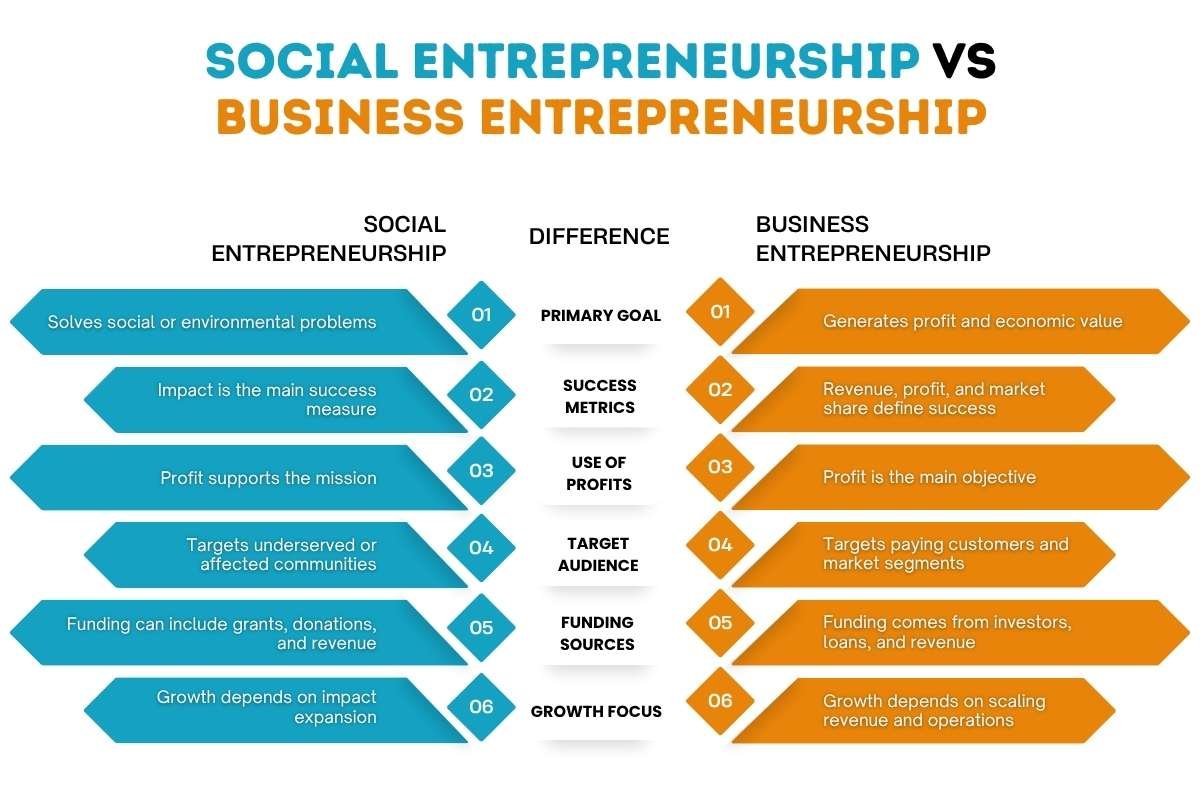
The differences between social entrepreneurship vs business entrepreneurship go beyond profit and purpose. Each model follows a different path in how it defines success, uses resources, and grows over time. These differences shape how ventures operate, who they serve, and how they measure progress.
| Social Entrepreneurship | Difference | Business Entrepreneurship |
| Solves social or environmental problems | Primary Goal | Generates profit and economic value |
| Impact is the main success measure | Success Metrics | Revenue, profit, and market share define success |
| Profit supports the mission | Use of Profits | Profit is the main objective |
| Targets underserved or affected communities | Target Audience | Targets paying customers and market segments |
| Funding can include grants, donations, and revenue | Funding Sources | Funding comes from investors, loans, and revenue |
| Growth depends on impact expansion | Growth Focus | Growth depends on scaling revenue and operations |
1. Primary goal:
Social entrepreneurship begins with a problem. It looks at issues like access, inequality, or sustainability and builds solutions around them. Business entrepreneurship begins with an opportunity. It focuses on what can sell, scale, and generate consistent returns. These starting points shape every decision that follows. They also influence how each venture defines long-term success.
2. Success metrics:
Social ventures measure success through impact. They track how many people they help or how much change they create. Business ventures measure success through numbers. Revenue, profit margins, and market share drive decisions. This difference affects how performance gets reported and evaluated. It also changes how stakeholders judge progress.
3. Use of profits:
Social enterprises earn money but channel it back into their mission. They use profits to expand reach or improve services. Business enterprises distribute profits to owners or reinvest to grow faster and increase valuation. This creates a gap in financial priorities. It also affects how each model attracts investors or partners.
4. Target audience:
Social entrepreneurs often work with communities that lack access or face challenges. Their users may not always pay. Business entrepreneurs focus on customers who can and will pay for a product or service. This impacts pricing strategies and delivery models. It also shapes how value is communicated to users.
5. Funding sources:
Social ventures combine revenue with grants or donations. This helps them stay sustainable while working on impact. Business ventures rely on investors, loans, or direct revenue streams to fund growth. Funding structure influences how quickly each venture can scale. It also determines the level of financial pressure involved.
6. Growth focus:
Social entrepreneurship grows by increasing impact. It expands reach, improves outcomes, and solves problems at scale. Business entrepreneurship grows by increasing sales, entering new markets, and scaling operations. Growth paths may look different between social entrepreneurship vs business entrepreneurship, but both aim for expansion. The difference lies in what they choose to expand first.
Read More: Social Enterprise vs NGO
Case study A: SELCO foundation
SELCO Foundation operates in India and focuses on energy access. It works with low-income households and small businesses that lack reliable electricity. The organization develops solar energy solutions suited to local conditions.
It combines product design with financing support. This helps users adopt systems they could not afford upfront. Its work often involves partnerships with local institutions and communities.
The model centers on long-term access to clean energy. Outcomes include increased energy use in homes and small enterprises. The approach reflects a focus on social impact, with revenue used to sustain operations.
Case Study B: Amazon
Amazon was founded in 1994 as an online bookstore. It expanded into a global e-commerce platform offering a wide range of products and services. The company built large-scale logistics and distribution systems to support growth.
It entered multiple sectors over time, including cloud computing through Amazon Web Services and digital content services. These expansions increased its revenue streams and market presence.
The business model focuses on growth, scale, and market share. Performance is measured through revenue, operating income, and expansion into new markets.
Social entrepreneurship vs business entrepreneurship: which is thriving in 2026

Both models continue to grow, but the direction has shifted. Business entrepreneurship still leads in scale and revenue. Social entrepreneurship is expanding faster in how new ventures are built.
According to the Global Entrepreneurship Monitor 2025–2026 Global Report, 84% of early-stage entrepreneurs now consider social or environmental impact when building ventures.
This signals a clear change in approach. More founders now combine profit with purpose. They build ventures that aim to grow while also addressing real-world problems.
Investors are also adjusting their focus. Many funds now look for both financial returns and measurable impact. This has pushed more startups to include impact goals from the start, even if profit remains a key target. Consumers play a role as well. Buyers now pay more attention to how companies operate. They prefer brands that show responsibility in areas like sustainability and ethics. This demand shapes how new ventures position themselves in the market.
The result is a shift, not a replacement. Business entrepreneurship still drives large-scale growth. Social entrepreneurship is shaping how that growth happens. Both models now move closer, with many ventures blending the two.
Conclusion:
Not every venture ends up where it first intended to go. Priorities shift, pressures build, and choices get tested in real time. What started as a clear direction can slowly blur if the foundation is not well understood from the beginning.
That is why looking closely at social entrepreneurship vs business entrepreneurship actually matters. It helps you stay aware of what you are optimizing for when growth speeds up, or trade-offs become unavoidable. Some decisions will push toward scale and efficiency. Others will pull toward impact and long-term change. The challenge is not choosing one over the other. It is staying consistent with the path you chose when it truly starts to matter.
People also ask
1. What is the main difference between social entrepreneurship vs business entrepreneurship?
The difference comes down to priority. Social entrepreneurship focuses on solving a social problem. Business entrepreneurship focuses on building a profitable and scalable venture.
2. Can a business be both profitable and socially driven?
Yes, many ventures combine both. They aim to generate profit while also creating measurable social impact.
3. Which type of entrepreneurship is more sustainable?
Both can be sustainable in different ways. Business ventures sustain through revenue and growth. Social ventures sustain through impact, funding models, and long-term relevance.
Thank You For Reading!
See More
Biggest Mistakes Social Enterprises Make That Stop Real Growth