

This article explains how the 6-C Model of inclusive leadership traits helps leaders create workplaces where every person feels valued. It covers the meaning of the model, its importance in modern workplaces, ways women leaders can strengthen inclusive leadership, practical implementation strategies, real-world examples, and common questions about inclusive leadership.
Have you ever noticed how one team leader can make everyone speak freely while another makes people stay silent?
Leadership is not only about giving instructions; sometimes it is about creating a space where ideas, backgrounds, and opinions can meet. A workplace without inclusion is like a pizza with only one topping, technically food, but missing the best parts.
The 6-C Model of inclusive leadership traits explains the qualities that help leaders connect with different people and build successful teams. These traits focus on creating trust, understanding, fairness, and collaboration.
A good example is how companies like Microsoft focus on inclusive workplace practices where employees from different backgrounds contribute ideas and feel respected. Inclusive leadership helps organisations leverage diverse perspectives rather than ignoring them.
In today’s fast-changing world, leaders who support every voice often create better solutions, stronger teams, and healthier work cultures.
What is the 6 Cs model?
Strong leadership is not only about making decisions or managing tasks. It is about understanding people, creating trust, and bringing different strengths together. The 6 Cs Model is a leadership framework that explains six important qualities leaders need to build an inclusive workplace where every employee feels respected and valued.
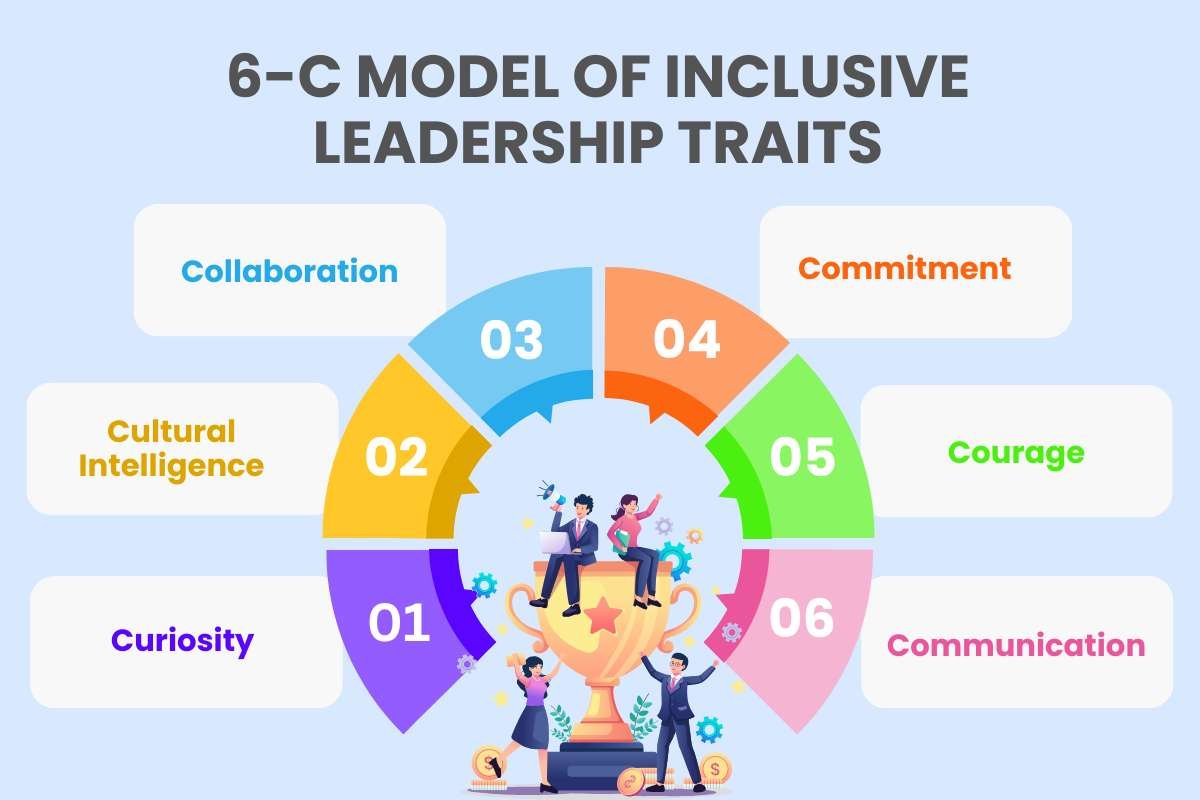
The 6-C Model of inclusive leadership traits focuses on curiosity, cultural intelligence, collaboration, commitment, courage, and communication. These six qualities help leaders recognise different perspectives, remove workplace barriers, and create an environment where people feel confident sharing ideas.
In a workplace where employees come from different cultures, generations, experiences, and professional backgrounds, a leader cannot use the same approach for everyone. People have different ways of thinking, communicating, and solving problems. The 6-C Model of inclusive leadership traits helps leaders understand these differences and turn them into opportunities for innovation and growth.
Research by Deloitte highlights that inclusive leaders often show behaviours such as openness, fairness, curiosity, and awareness of personal biases. These behaviours help improve employee engagement and create stronger team performance.
Each “C” represents a leadership behaviour that can be developed through daily actions:
1. Curiosity
Curiosity is the ability to stay open-minded and genuinely understand other people’s experiences. Inclusive leaders do not assume they already know what employees think or need. They ask questions, listen carefully, and look for different viewpoints.
A curious leader may ask:
- “What challenges are you facing?”
- “What ideas can improve this process?”
- “What perspective are we missing?”
This approach helps leaders discover new ideas and hidden problems. It also creates trust because employees feel that their opinions matter.
For example, a manager may notice that only a few employees speak during meetings. Instead of assuming they have nothing to contribute, a curious leader may privately ask for their thoughts and learn that some employees simply need a different space to share ideas.
Curiosity helps leaders avoid bias and make decisions based on understanding rather than assumptions.
2. Cultural Intelligence
Cultural intelligence means understanding and respecting differences in culture, communication styles, traditions, and ways of working.
Global workplaces often include employees from different countries and backgrounds. A communication style that feels normal to one person may feel uncomfortable to another. Leaders with cultural intelligence recognise these differences and adjust their approach.
For example, an employee from one culture may openly disagree during a meeting, while another may prefer to share concerns privately. A culturally intelligent leader understands both approaches and creates space for everyone.
Cultural intelligence also helps leaders build stronger international teams. Instead of seeing differences as challenges, they see them as valuable sources of knowledge and creativity.
3. Collaboration

Collaboration focuses on bringing people together to solve problems and achieve shared goals. Inclusive leaders do not allow only the loudest voices or highest-ranking employees to control discussions.
They create opportunities where everyone can contribute.
A collaborative leader encourages teamwork by:
- Asking for ideas from different team members
- Giving employees ownership of projects
- Recognising different skills and strengths
- Creating a supportive environment
When people work together, they combine different experiences and perspectives. This often leads to better decisions because the team considers more possibilities.
For example, a product development team with members from design, technology, marketing, and customer support can create stronger solutions because each person sees the problem differently.
4. Commitment
Commitment means treating inclusion as a continuous responsibility instead of a one-time activity.
Many organisations talk about diversity, but real progress happens when leaders consistently support inclusive practices. This includes fair decision-making, equal opportunities, respectful communication, and regular feedback.
A committed leader does not support inclusion only when it is convenient. They make it part of everyday leadership.
For example, a leader who is committed to inclusion ensures that promotions, meetings, and career opportunities are accessible to all employees. They regularly review whether workplace practices support everyone equally.
The 6-C Model of inclusive leadership traits shows that commitment creates long-term change because employees notice consistent actions more than temporary promises.
5. Courage
Courage helps leaders take action when situations become uncomfortable. Inclusive leadership sometimes requires challenging old habits, addressing unfair behaviour, or having difficult conversations.
A courageous leader speaks up when someone is ignored, treated unfairly, or excluded from important discussions.
For example, if a team meeting always gives attention to senior employees while new employees remain silent, a courageous leader may change the meeting structure and actively invite different opinions.
Courage also means accepting feedback. Leaders who are willing to learn from mistakes create a workplace where improvement becomes possible.
6. Communication
Communication connects all other qualities in the model. Without clear and respectful communication, even good leadership intentions may fail.
Inclusive leaders communicate openly, explain decisions, and encourage honest conversations. They make sure employees understand goals and feel comfortable sharing concerns.
Good communication also includes listening. A leader who only speaks but never listens cannot understand the needs of their team.
For example, during organisational changes, clear communication helps employees understand what is happening and why decisions are being made. It reduces confusion and builds trust.
Real-world example of the 6 Cs in action
A global example of inclusive leadership can be seen at Microsoft. The company manages teams across different countries and focuses on creating an environment where employees with different backgrounds and abilities can contribute. Its focus on accessibility, teamwork, and inclusive design reflects the 6-C Model of inclusive leadership traits by encouraging curiosity, collaboration, communication, and respect for diverse perspectives.
Another example is Unilever, which operates in many regions worldwide. The organisation promotes diversity and inclusion by building teams where employees from different cultures and experiences can share ideas. This approach supports stronger collaboration and helps leaders create workplaces where everyone feels valued.
When leaders apply the 6-C Model of inclusive leadership traits, they create teams where employees feel comfortable sharing ideas. This often leads to better innovation because people contribute without fear of being ignored.
How can women leaders improve their inclusive leadership traits?
Leadership is changing. Strong leaders are no longer measured only by decisions and results; they are also recognised by how well they support people. Women leaders are playing an important role in creating workplaces where different ideas, experiences, and skills are respected.
The 6-C Model of inclusive leadership traits gives women leaders a practical framework to build stronger connections, improve teamwork, and create an environment where every employee feels valued. The model focuses on six important qualities: curiosity, cultural intelligence, collaboration, commitment, courage, and communication.
Women leaders can strengthen these qualities through simple but powerful leadership habits.
1. Improve communication by creating space for every voice
Good communication is the foundation of inclusive leadership. Many workplaces still have situations where only confident or senior employees share ideas, while others remain quiet.
Women leaders can improve inclusion by encouraging open discussions, asking for different opinions, and making sure every team member gets an opportunity to contribute.
A real-world example is Jacinda Ardern, former Prime Minister of New Zealand, who became known for her empathetic communication style. Her leadership showed how listening, clarity, and understanding can build trust during difficult situations.
A leader who communicates with empathy creates stronger relationships because employees feel heard instead of ignored.
2. Build curiosity to understand different perspectives
Curiosity helps leaders move beyond assumptions. Instead of thinking they already know what employees need, inclusive leaders ask questions and listen carefully.
Women leaders can practise curiosity by asking:
- What challenges are team members facing?
- Are different opinions being included in decisions?
- What ideas have not been discussed yet?
This approach helps leaders understand different experiences and make better decisions.
The 6-C Model of inclusive leadership traits highlights curiosity because leaders who stay open to learning create teams where people feel comfortable sharing new ideas.
3. Strengthen cultural intelligence in diverse teams
Modern workplaces include people from different cultures, generations, and professional backgrounds. Each person may communicate and solve problems differently.
Cultural intelligence helps women leaders understand these differences and create fair opportunities for everyone.
For example, a global team may include employees who openly share opinions in meetings and others who prefer written communication. An inclusive leader recognises both styles and creates a balanced environment.
Understanding cultural differences helps leaders reduce bias and build stronger collaboration.
4. Show courage by challenging unfair practices
Inclusive leadership requires courage. Sometimes leaders need to question old systems, address unfair behaviour, and support employees who may not have a strong voice.
A courageous leader does not ignore problems. They take action.
This can include:
- Supporting equal opportunities
- Addressing workplace bias
- Encouraging underrepresented employees
- Creating fair decision-making processes
The courage element of the 6-C Model of inclusive leadership traits helps leaders create meaningful workplace change instead of only discussing inclusion.
5. Use collaboration to build stronger teams
Great ideas rarely come from one person. Collaboration allows employees with different skills and experiences to work together.
Women leaders can encourage collaboration by creating team environments where employees share responsibilities and respect each other’s strengths.
A good example is Accenture, which has focused on diversity and inclusion practices across its global workforce. The company highlights how inclusive cultures support innovation and employee growth.
When employees from different backgrounds collaborate, organisations gain new ideas and stronger problem-solving abilities.
6. Turn commitment into daily action
Commitment means inclusion should not be a short-term goal. It should become part of everyday leadership.
Women leaders can show commitment by:
- Giving fair feedback
- Supporting employee development
- Recognising different contributions
- Creating equal growth opportunities
Small actions repeated consistently create a workplace culture where employees trust their leaders.
The 6-C Model of inclusive leadership traits reminds leaders that inclusion grows through regular actions, not only through policies.
Why is the 6-Cmodel important in today’s workplace?
Modern workplaces bring together people with different cultures, skills, experiences, and ideas. Leaders need more than management skills; they need the ability to create trust, connection, and belonging.
The 6-C Model helps leaders build teams where employees feel respected, confident, and motivated to contribute.
1. Encourages better ideas and innovation

Different perspectives help teams find creative solutions and avoid limited thinking. Inclusive leaders encourage employees to share ideas without fear of judgment.
For example, Google highlights the importance of psychological safety, where employees feel comfortable asking questions and contributing ideas.
Source: Google re Psychological Safety Guide
2. Builds stronger employee engagement
Employees feel more connected when leaders listen and value their opinions. Inclusive workplaces improve motivation because people feel their work and ideas matter.
The inclusive leadership traits support engagement through communication, respect, and meaningful employee involvement.
3. Improves decision-making
Better decisions happen when leaders consider different viewpoints. Diverse teams can identify risks, understand customers, and create stronger solutions.
Inclusive leadership helps turn different experiences into valuable knowledge instead of workplace barriers.
4. Supports remote and hybrid work
Flexible work has changed how teams communicate and collaborate. Inclusive leaders ensure remote employees receive equal opportunities and stay connected.
Clear communication, regular feedback, and collaboration help teams work effectively across locations.
5. Creates a positive workplace culture
A strong workplace culture grows from daily leadership actions. Leaders who respect differences and support fairness create environments where employees can perform better.
The concept of inclusive leadership traits helps organisations build long-term inclusion instead of temporary initiatives.
6. Prepares organisations for the future
Future workplaces will continue to become more diverse and connected. Organisations need leaders who can manage differences and encourage teamwork.
By applying curiosity, cultural intelligence, collaboration, commitment, courage, and communication, leaders can create adaptable and successful teams.
Implementing the 6 c’s in your leadership strategy
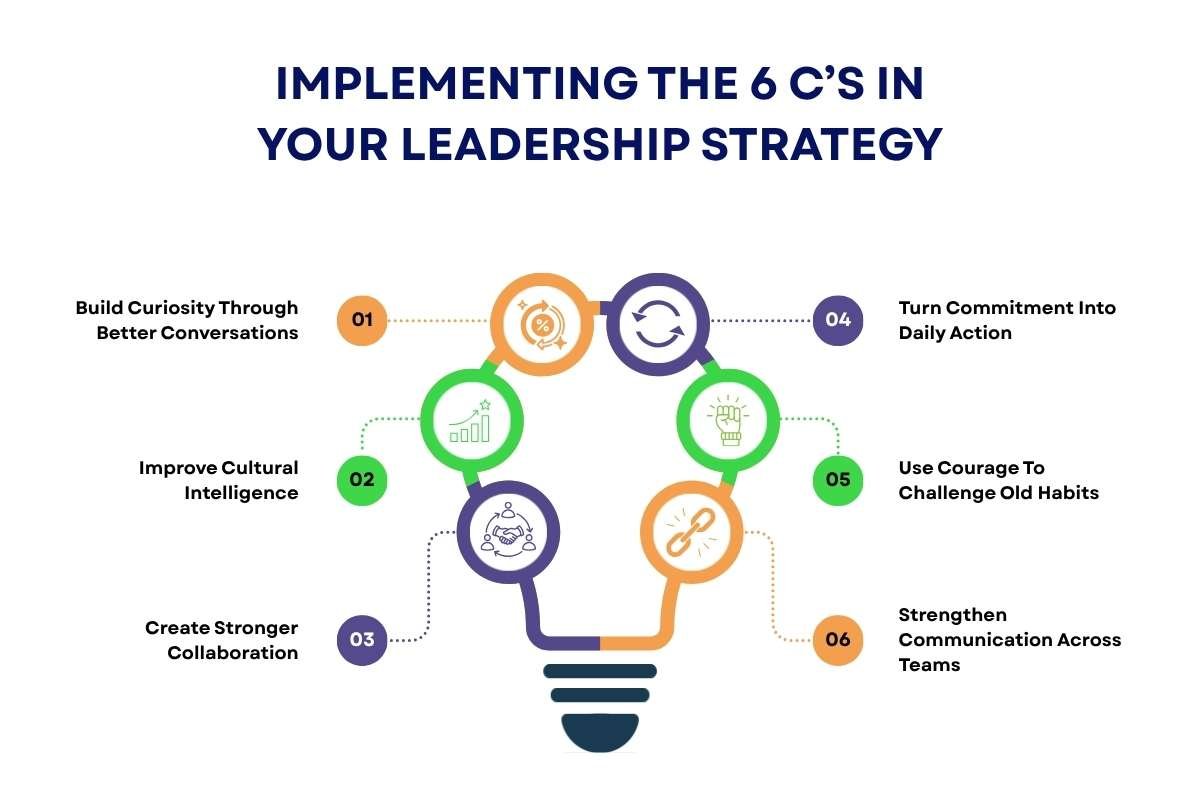
Building an inclusive workplace requires leaders to turn ideas into daily actions. The 6-C Model of inclusive leadership traits helps leaders create teams where everyone feels respected, heard, and valued.
Step 1: Build curiosity through better conversations
Leaders should ask questions, listen actively, and understand employee experiences instead of making assumptions. Small conversations can reveal hidden challenges and encourage more people to share ideas.
Step 2: Improve cultural intelligence
Every employee has different backgrounds, communication styles, and working methods. Leaders who respect these differences create stronger connections and a more comfortable workplace.
Step 3: Create stronger collaboration
Inclusive leaders bring people with different skills and perspectives together. Teamwork between diverse employees often leads to better ideas and smarter solutions.
Step 4: Turn commitment into daily action
Inclusion should become part of everyday decisions, from meetings to promotions and feedback. Consistent actions show employees that fairness and respect truly matter.
Step 5: Use courage to challenge old habits
Leaders need courage to address unfair practices and question outdated systems. Speaking up for equal opportunities helps build trust across teams.
Step 6: Strengthen communication across teams
Clear communication helps employees understand goals and feel involved. Leaders should share information openly and create spaces where everyone can express opinions.
Step 7: Measure progress and improve
Leaders can track inclusion through employee feedback, participation, and teamwork. Regular improvement helps create a workplace culture that continues to grow.
The 6-C Model of inclusive leadership traits becomes effective when leaders practise these behaviours consistently. Small daily actions can create stronger teams where people feel trusted and included.
Conclusion
Leadership is often compared to a journey, but the best leaders know it is also a conversation. A workplace becomes stronger when every person feels their voice matters.
The 6-C Model of inclusive leadership traits shows that great leadership is not about having all the answers. It is about curiosity, courage, communication, commitment, collaboration, and understanding.
Like the pizza example from the beginning, a workplace with only one perspective may function, but it will never reach its full potential. Inclusion adds the missing pieces that create a stronger team.
FAQs
1. What are the main qualities in the 6 Cs Model?
The model includes curiosity, cultural intelligence, collaboration, commitment, courage, and communication. These qualities help leaders create fair and supportive workplaces.
2. Why is inclusive leadership important for companies?
Inclusive leadership improves teamwork, encourages new ideas, supports employee engagement, and helps organisations make better decisions by considering different viewpoints.
3. How can leaders practise inclusive leadership every day?
Leaders can practise it by listening actively, asking for feedback, supporting different opinions, communicating clearly, and creating opportunities for every employee to participate.
Thank You For Reading!
See More
Success Stories of Inclusive Leaders