
Attentional intelligence in the workplace is the ability to intentionally manage your focus in an environment filled with constant distractions. This article explains why it has become a critical skill for improving productivity, decision-making, leadership, and employee well-being. It also shares practical strategies and an actionable framework to help professionals build stronger focus and perform more effectively at work.
Your attention is being pulled in hundreds of directions every workday, and it’s costing more than just time. Every notification, meeting, email, and message competes for your focus, making it harder to complete meaningful work without interruption.
The numbers tell the story. According to Microsoft’s 2025 Work Trend Index, employees are interrupted every two minutes on average during the workday. Meanwhile, Asana’s Anatomy of Work found that knowledge workers spend more than half of their time on “work about work”: meetings, emails, and status updates, rather than on the work that drives real impact. The challenge isn’t simply having too much to do; it’s deciding what deserves your attention.
This is where attentional intelligence comes in. It is the ability to direct, sustain, and shift your attention intentionally, helping you filter distractions, prioritize effectively, and stay focused on high-value tasks. Whether you’re leading a team or managing your own workload, this skill can improve decision-making, productivity, and overall performance.
As workplaces become increasingly fast-paced and digitally connected, attention is emerging as one of the most valuable professional assets. In this article, we’ll explain what attentional intelligence in the workplace is, why it matters, and how you can develop it to work smarter and lead more effectively.
What Is Attentional Intelligence?
Attentional intelligence is the ability to consciously direct, sustain, and shift your attention toward what matters most. Instead of reacting to every distraction, it helps you prioritize high-value work, make better decisions, and stay focused as priorities change.
The concept was popularized by psychologist Dr. Mihaly Csikszentmihalyi, whose research on flow showed that attention is a limited resource. Supporting this, research from the University of California, Irvine, found that it takes an average of 23 minutes to regain focus after an interruption, highlighting the real cost of fragmented attention in today’s workplace.
Key Components of Attentional Intelligence:
Developing core attentional intelligence skills for professionals is essential for navigating today’s cognitively demanding corporate landscape. These fundamental skills include:
| Selective Attention | Focusing on the right task while filtering out distractions. |
| Sustained Attention | Maintaining focus until a task is complete. |
| Attentional Shifting | Switching between priorities efficiently when needed. |
| Self-Awareness | Recognizing when your attention drifts and consciously refocusing it. |
Workplace Example
Imagine you’re preparing a client presentation when emails, messages, and meeting invites start flooding in. Rather than responding to each interruption, you complete the presentation first and check notifications later. That’s attentional intelligence in action, choosing where your attention goes instead of letting distractions decide for you.
Why Has Attention Become the Biggest Workplace Challenge?

Staying focused at work has become harder than ever. Emails, chat messages, meetings, phone calls, and notifications constantly compete for our attention, making it difficult to stay engaged with one task for long. While these tools make collaboration easier, they also reduce the time available for focused, meaningful work. This is why attentional intelligence in the workplace is becoming increasingly important, helping professionals manage distractions and focus on high-impact tasks.
The impact is measurable. According to Microsoft’s research, employees are interrupted every two minutes during the workday. In addition, the Slack Workforce Index found that nearly half of desk workers struggle to stay focused because of frequent digital interruptions. Over time, these distractions can lower productivity, increase mental fatigue, and affect the quality of work.
Some of the most common reasons employees lose focus at work include:
- Frequent notifications from emails, messaging apps, and collaboration platforms.
- Too many meetings, leaving little uninterrupted time for important tasks.
- Understanding how multitasking affects attention is crucial, as attempting to process multiple tasks simultaneously splits cognitive resources and lowers overall efficiency.
- Switching between tasks makes it harder to regain concentration.
- Information overload, with employees expected to process more emails, documents, and updates than ever before.
- An always-on work culture, where the pressure to respond quickly makes it difficult to focus on deep work.
In a workplace filled with constant distractions, success is no longer about doing more at once; it’s about giving your full attention to what matters most.
Why Attentional Intelligence Matters in the Workplace?
Attentional Intelligence in the workplace isn’t just about staying focused; it directly influences how employees work, collaborate, and make decisions. When people can manage their attention effectively, they’re more likely to prioritize high-impact tasks, solve problems efficiently, and deliver consistent results, even in demanding work environments.
Research shows that attention has a measurable impact on workplace performance:
- According to Gallup’s State of the Global Workplace 2025, highly engaged employees are 18% more productive and contribute to 23% higher profitability than their less engaged peers.
- McKinsey & Company reports that employees spend 28% of their workweek managing emails, leaving less time for strategic and value-adding work.
- Research from the University of California, Irvine, found that after an interruption, it takes an average of 23 minutes and 15 seconds to regain focus.
Organizations that help employees protect their focus often unlock extensive benefits of attention intelligence across both performance and well-being, including:
| Higher productivity | More time is spent on meaningful work instead of recovering from interruptions. |
| Better decision-making | Focused thinking leads to more informed and accurate decisions. |
| Lower stress and burnout | Employees feel more in control of their workload and priorities. |
| Stronger collaboration | Active listening and full presence improve communication and teamwork. |
| Greater creativity | Uninterrupted focus creates space for deeper thinking and innovative ideas. |
| Improved work quality | Fewer distractions reduce errors and improve overall outcomes. |
As the volume of information and workplace demands continues to grow, attentional intelligence is no longer just a personal productivity skill; it’s becoming a key driver of organizational performance and effective leadership.
Why Is Attentional Intelligence Becoming More Important Than IQ in Leadership?
A high IQ can help leaders analyze data and solve complex problems, but it doesn’t determine where their attention goes. In today’s fast-moving workplace, leaders are expected to manage competing priorities, make timely decisions, and stay focused despite constant interruptions. That’s where attentional intelligence in the workplace makes the difference.
According to Harvard Business Review, leaders spend a significant portion of their day responding to emails, meetings, and unexpected requests, leaving limited time for strategic thinking. Those who intentionally protect their attention are better equipped to focus on long-term goals instead of constantly reacting to short-term demands.
A well-known example is Bill Gates. For decades, Gates has set aside dedicated “Think Weeks,” periods of complete isolation from daily meetings and emails to read, reflect, and focus on long-term strategy. During these sessions, he reviewed ideas that influenced major Microsoft initiatives and future technology trends. His practice demonstrates that effective leadership isn’t just about processing more information; it’s about creating uninterrupted time for deep thinking and better decision-making.
Leaders with strong attentional intelligence are more likely to:
- Prioritize effectively, focusing on high-impact work instead of urgent distractions.
- Make better decisions by giving important issues the attention they deserve.
- Stay calm under pressure, even in fast-changing situations.
- Listen actively, leading to stronger communication and higher team trust.
- Think strategically, creating time for planning, innovation, and long-term growth.
- Set the right example, encouraging teams to value focus over constant busyness.
As workplaces become increasingly connected, leadership is no longer defined solely by knowledge or expertise. The ability to manage attention, stay present, and focus on what truly matters is becoming one of the most valuable leadership skills.
How Do Women Leaders Demonstrate Attentional Intelligence at Work?
Strong leadership isn’t just about making the right decisions; it’s also about knowing where to focus your time and energy. When we look closely at modern workplace dynamics, we can see exactly how women leaders use attentional intelligence differently to cultivate highly collaborative and high-performing environments. Many successful women leaders demonstrate this capacity by prioritizing strategic work, listening actively, and staying focused on long-term goals despite competing demands.
Research shows that these leadership behaviors deliver measurable results:
- According to McKinsey’s Women in the Workplace 2024 report, women leaders are more likely than men to support employee well-being, foster inclusion, and invest time in coaching and developing team members’ behaviors that require intentional focus and active attention.
- Gallup’s State of the Global Workplace 2025 found that managers account for 70% of the variance in team engagement, highlighting how leaders who are present and attentive directly influence team performance.
- Harvard Business Review reports that leaders spend the majority of their workweek in meetings, emails, and administrative tasks, leaving limited time for strategic thinking. Leaders who consciously protect their attention are better positioned to make thoughtful, long-term decisions.
Women leaders often demonstrate attentional intelligence by:
- Prioritizing high-impact work over constant firefighting.
- Practicing active listening, helping employees feel heard and valued.
- Balancing multiple priorities without losing sight of long-term objectives.
- Creating space for focused work, both for themselves and their teams.
- Leading with empathy, enabling thoughtful decisions during periods of change.
- Developing people intentionally, giving employees the attention and feedback they need to grow.
A strong example is Indra Nooyi, former CEO of PepsiCo. Throughout her tenure, she was known for disciplined prioritization, thoughtful listening, and a long-term strategic vision. Her “Performance with Purpose” strategy helped PepsiCo achieve sustained growth while advancing sustainability, employee well-being, and healthier product innovation, demonstrating how attentional intelligence in the workplace can drive both business performance and lasting organizational impact.
As leadership becomes increasingly complex, attentional intelligence is proving to be more than a productivity skill; it’s a leadership capability that helps build engaged teams, stronger relationships, and better long-term decisions.
The Workplace AQ Framework: A Practical Approach to Building Attentional Intelligence
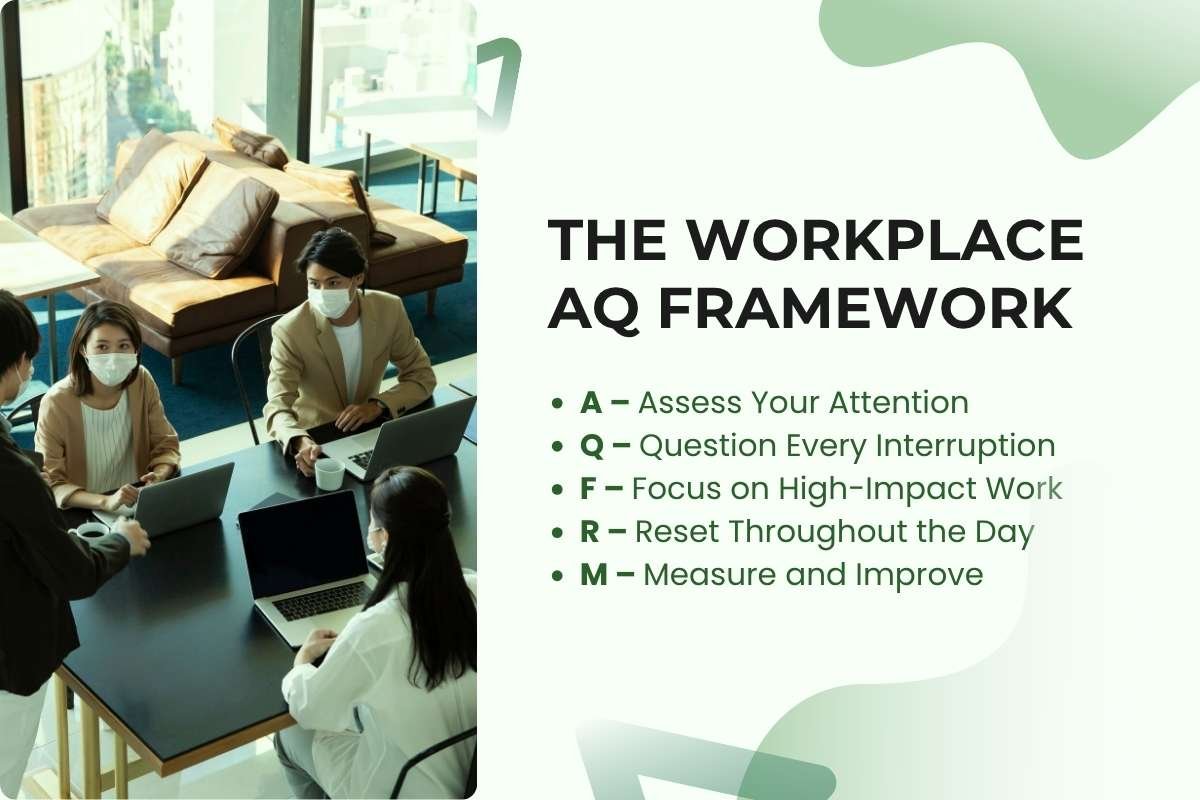
Attentional intelligence is a skill that can be developed with consistent practice. One simple way to strengthen it is by following the AQ (Attentional Quotient) Framework, which helps individuals become more intentional about where they invest their time and mental energy.
The framework focuses on five essential habits:
A – Assess Your Attention
Before starting your day, identify your most important priorities. Recognize the distractions that are likely to interrupt your focus and plan how you’ll manage them.
Q – Question Every Interruption
Learning How To Control Workplace Distractions begins with evaluating what truly requires your immediate energy. Not every notification, email, or meeting requires an instant response. Pause and ask, “Does this need my attention right now?” before switching tasks.
F – Focus on High-Impact Work
Dedicate uninterrupted time to your most valuable tasks. Protecting even one or two hours for deep work each day can significantly improve productivity and decision-making.
R – Reset Throughout the Day
Short breaks between tasks help your brain recover and maintain concentration. Research from the Draugiem Group’s productivity study found that the most productive employees worked for about 52 minutes, followed by a 17-minute break, helping them sustain focus over longer periods.
M – Measure and Improve
At the end of each day, reflect on how you spent your attention. Identify what distracted you, what helped you stay focused, and what you can improve tomorrow.
The AQ Framework isn’t about eliminating distractions; it’s about making conscious choices about where your attention goes. Over time, these small habits can lead to better productivity, stronger decision-making, and more effective leadership.
Practical Ways to Build Attentional Intelligence at Work
Developing attentional intelligence doesn’t require major life overhauls. Implementing targeted strategies to boost attentional intelligence can help you significantly improve focus, reduce day-to-day friction, and make better use of your time.
Here are some practical strategies to strengthen attentional intelligence in the workplace:
| Time-block your priorities | Reserve dedicated blocks of time for your most important tasks before checking emails or attending meetings. |
| Work on one task at a time. | Multitasking often reduces efficiency. Completing one task before moving to the next helps improve both focus and work quality. |
| Limit unnecessary notifications | Turn off non-essential alerts during focused work sessions to minimize interruptions. |
| Follow the 80/20 rule. | Identify the tasks that create the greatest impact and focus your attention on them first. |
| Schedule regular breaks | Short breaks between work sessions help maintain concentration and reduce mental fatigue. |
| Create meeting-free focus time. | Set aside periods during the day when meetings and calls are avoided, allowing uninterrupted work and strengthening attentional intelligence in the workplace. |
| Practice active listening | During conversations and meetings, give your full attention instead of thinking about your next response. This improves communication and collaboration. |
| Review your day | Spend a few minutes reflecting on what distracted you, what helped you stay focused, and how you can improve tomorrow. |
Research reinforces the value of these habits. According to Stanford University, multitasking can reduce attention, memory, and overall cognitive performance compared to focusing on a single task. Similarly, the American Psychological Association notes that frequent task switching can lower productivity because the brain takes time to adjust each time attention shifts.
Building attentional intelligence in the workplace is less about working longer hours and more about using your attention intentionally. Over time, these simple practices can improve productivity, decision-making, and overall workplace performance.
How to Maintain Attentional Intelligence While Using AI Productivity Tools?

AI-powered tools can help streamline routine tasks, summarize information, and improve efficiency. However, if used without intention, they can also contribute to information overload and constant context switching. The goal isn’t to avoid these tools; it’s to use them in ways that protect your attention.
According to Microsoft’s 2025 Work Trend Index, employees are increasingly relying on AI to manage their workloads. At the same time, the report emphasizes that the growing volume of information makes it even more important for professionals to prioritize, evaluate, and focus on what matters most.
Here are a few ways to maintain attentional intelligence while using AI tools:
- Use AI to automate repetitive tasks, giving yourself more time for strategic thinking and problem-solving.
- Review AI-generated content carefully instead of accepting every suggestion at face value.
- Set clear objectives before using AI, so you know what information you’re looking for.
- Avoid constantly switching between multiple tools and platforms while working on the same task, as this helps strengthen attentional intelligence in the workplace and reduces unnecessary context switching.
- Schedule dedicated focus time where notifications and unnecessary interruptions are minimized.
- Rely on your judgment for decisions that require creativity, context, or critical thinking.
AI works best as an assistant, not as a substitute for thoughtful decision-making. The more intentionally you use these tools, the easier it becomes to stay focused, make better decisions, and maintain control over your attention.
Ultimately, attentional intelligence is about directing your attention, not letting technology direct it for you.
Conclusion:
In today’s workplace, attention is one of your most valuable resources. The ability to stay focused, prioritize what matters, and avoid unnecessary distractions can improve productivity, decision-making, and overall performance.
The good news is that attentional intelligence in the workplace isn’t something you’re born with; it’s a skill you can develop. By building simple habits that protect your focus, you can work more effectively, lead with greater clarity, and achieve better results.
As the demands of work continue to evolve, those who learn to manage their attention will be better equipped to thrive in any role or industry.
Frequently Asked Questions (FAQs)
1. What are the 3 pillars of attentional intelligence?
The three pillars of attentional intelligence are:
Directing attention: Focusing on what matters most.
Sustaining attention: Maintaining focus on a task.
Shifting attention: Switching between priorities intentionally when needed.
2. Is attentional intelligence a skill or a trait?
Attentional intelligence is a skill that can be developed. Habits like minimizing distractions, prioritizing tasks, and practicing focused work can strengthen it over time.
3. What is the difference between AQ and attention to detail?
AQ (Attentional Quotient) is the ability to manage and direct your attention effectively across tasks and priorities. Attention to detail is the ability to notice small details and maintain accuracy while completing a specific task. In short, AQ determines where your focus goes, while attention to detail determines how carefully you perform the task.