
The modern workspace brings constant, unavoidable noise. To survive, you need both emotional intelligence (EI or EQ) and Attentional Intelligence (AI). While EQ manages your feelings and relationships, AI controls your focus and blocks out bad screen distractions. High EQ helps you connect with your team, but you need AI to protect your time and finish tasks. In the AI vs. EQ debate, the truth is clear: The best leaders use both to guide their teams and guard their minds.
Your phone buzzes. A calendar alert pops up. A new email arrives. In less than a minute, three different screens demand your focus. This constant noise does more than waste your time. It drains your energy and leaves you feeling empty.
For years, companies valued emotional intelligence/ emotional quotient (EQ) to fix workplace friction. Teams learned to manage relationships and read the room. But today, a new crisis sits at your desk. You cannot manage your emotions if you cannot control where you look.
The debate is no longer just about empathy. It has shifted to AI vs. EQ. Here, AI means Attentional Intelligence. This is the ability to direct your focus intentionally. The future belongs to leaders who master both their feelings and their focus.
Let’s look at how these two forces work together to protect your mind.
What is attentional intelligence (AI)?
Every app on your phone wants your time. Tech companies design systems to capture your gaze and sell it to advertisers. In this attention economy, your focus is the product. Attentional Intelligence (AI) is your defense system.
AI is the ability to direct, hold, and shift your focus by choice. It combines mental filtering with deep work. For example, a leader with high AI can ignore a sudden Slack notification to finish an important strategy paper. Modern tech weakens this skill by offering quick hits of dopamine. AI allows you to block the noise and choose your priorities.
What is emotional intelligence?
Emotional Intelligence, or Emotional Quotient, handles a different side of your mind. It rules your self-awareness, empathy, and social skills. You use EQ when you calm an angry client or guide a stressed team member.
While EQ regulates how you feel and react to others, AI regulates what you notice in the first place. EQ builds strong relationships, but AI protects the cognitive power you need to sustain them.
AI vs. EQ: understanding the core differences
How do these two forces actually compare when the pressure builds? While both shape how you navigate a busy workday, they manage entirely different internal resources.
The easiest way to see the difference between AI vs. EQ is to contrast their core mechanics:
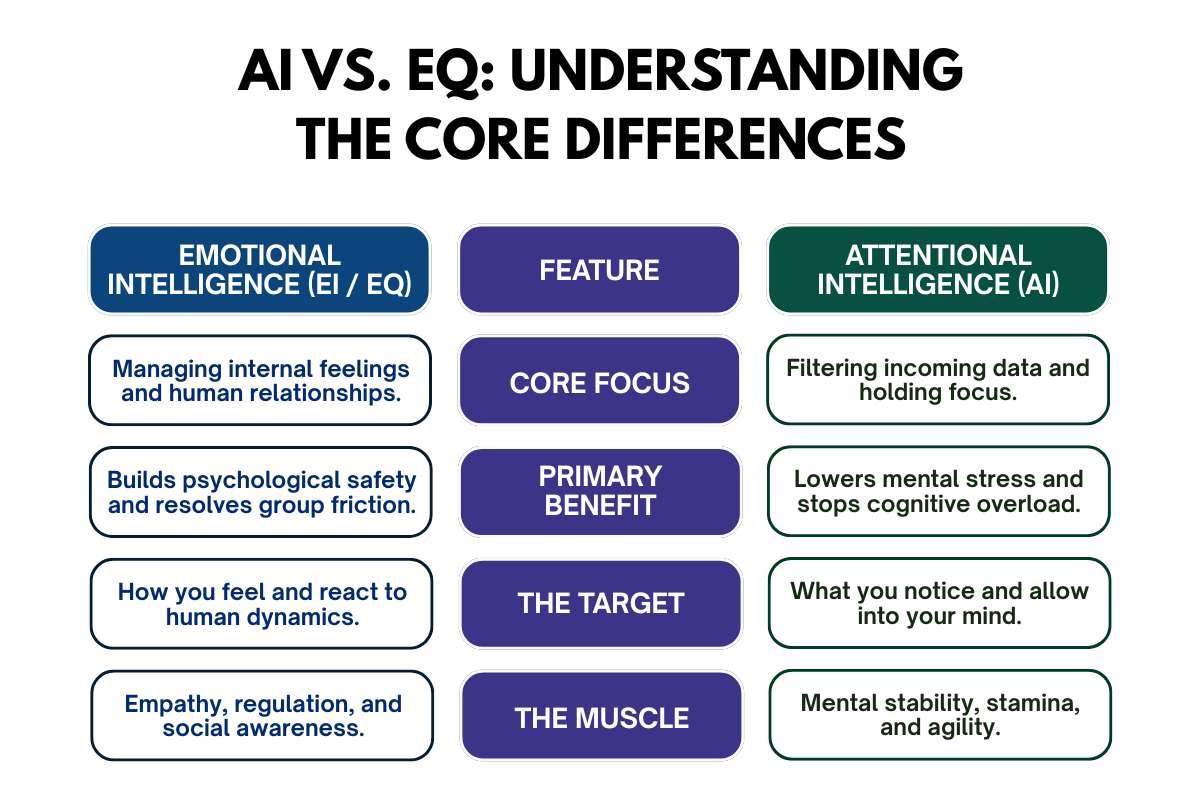
| Feature | Emotional Intelligence (EI / EQ) | Attentional Intelligence (AI) |
| Core Focus | Managing internal feelings and human relationships. | Filtering incoming data and holding focus. |
| Primary Benefit | Builds psychological safety and resolves group friction. | Lowers mental stress and stops cognitive overload. |
| The Target | How you feel and react to human dynamics. | What you notice and allow into your mind. |
| The Muscle | Empathy, regulation, and social awareness. | Mental stability, stamina, and agility. |
1. Social safety vs. Distress tolerance
EQ builds workplace trust and manages interpersonal friction. It creates psychological safety so teams can collaborate without fear. However, the Merck Group’s research introduces AI as a tool for distress tolerance. AI helps teams withstand workplace anxiety, doubt, and ambiguity without giving in to negative, impulsive habits.
In a study of 271 graduates, emotional intelligence predicted job satisfaction even after controlling for personality traits and proactive personality, suggesting that EQ contributes meaningful value beyond “soft skills” alone. Research also shows that emotional intelligence is linked to work attitudes and career outcomes across multiple studies, which strengthens its relevance in workplace writing.
2. Self-regulation vs. Quality-driven behavior

EQ relies heavily on basic self-regulation. It helps you shift from an automatic, emotional reaction to an intentional, measured response by pausing and breathing. AI takes this a step further by driving quality-based choices. It ensures that you choose your actions based on core organizational values rather than simply reacting to stressful external stimuli.
During an unexpected budget cut, EQ allows you to acknowledge your initial panic safely. AI helps you look past that immediate fear so you can direct your energy toward high-quality, long-term solutions.
3. Emotional management vs. Psychological flexibility
EQ manages emotional labor. It helps you navigate intense interpersonal dynamics, practice empathy, and handle office politics. AI governs psychological flexibility. It gives you the mental agility to change your cognitive strategies on the fly when facing sudden, unexpected environmental demands.
When a project brief changes right before the deadline, EQ helps you validate the team’s shared frustration. AI gives you the actual agility to quickly shift your focus, abandon the old plan, and rewrite the strategy.
Scientific data show that attention rules emotion, not the other way around. You cannot easily fix your feelings if you cannot control where you look.
- Focus Builds Emotion: A 2020 study published in Frontiers in Psychology put adults through an eight-week attention and mindfulness program. By training their attention first, the participants’ overall emotional intelligence scores rose as a direct side effect.
- When Focus Fails, EQ Drops: A 2023 study by the National Institutes of Health (NIH) compared children with ADHD, which is fundamentally an attention challenge, to neurotypical peers. The data revealed that when attention regulation collapses, emotional quotient scores drop significantly across the board.
Teaching someone to manage feelings without training their focus is like teaching someone to drive a car without a steering wheel.
The key insight:
This contrast brings us to a critical insight. EQ helps people connect, but AI helps people concentrate. While EQ manages your inner emotions, AI manages your mental bandwidth.
When you look at popular leadership advice, everyone praises empathy. But what happens when you care deeply about everyone’s feelings but cannot protect your own time?
High EQ without attentional control can often lead to emotional exhaustion.
You absorb the stress of your team, listen to every complaint, and sense every shift in the office mood. Yet, because you lack AI, you cannot shut out the noise to finish your own tasks. You end up drained, overworked, and unable to think clearly.
True mental strength requires a balance. You must know when to open your heart to connect and when to close your mind to focus.
Why attentional intelligence matters more today?

The term “Attentional Intelligence” was coined in 2012 by Linda Ray, founder of NeuroCapability. She proved that the skill to notice and direct your focus is a distinct, standalone mental capacity. It is the base upon which other skills are built.
A 2018 eye-tracking study at the University of North West England backed this up. Researchers tracked how adults looked at different human faces and social scenes. They found that people with high emotional skill automatically directed their eyes to positive images first. What looked like an emotional choice was actually a split-second focus choice. Your attention acts as the engine, and your emotional response is the output.
Why the future requires both AI and EQ?
The workplace of tomorrow does not demand a choice between focus and feelings. You need both emotional regulation and attention regulation to survive. A simple framework explains why: EQ helps you manage human energy, while AI helps you manage mental energy.
Look at how these two skills support different professionals every day:
- The Modern Leader: They use EQ to read team anxiety during a tight market shift. But they need AI to tune out market gossip, ignore the noise, and execute the actual recovery strategy.
- The Creative Writer: They rely on EQ to understand their audience’s deep desires and pain points. Yet, they need AI to sit down, block out social media notifications, and actually write the copy.
Without EQ, you become a cold machine that people avoid. Without AI, you become a well-meaning colleague who never finishes a project.

AI vs. EQ: how to improve both skills?
You can train your mind to handle both people and focus. Small daily habits build these mental muscles quickly.
Try these simple tactics to boost your AI:
- Practice single-tasking: Close your tabs and work on just one document for thirty minutes.
- Kill your notifications: Silence all non-urgent pings to protect your visual field.
- Filter your consumption: Choose educational books over mindless scrolling.
Use these exercises to sharpen your EQ:
- Listen with intent: Drop your phone and focus completely on a colleague’s words.
- Write it down: Journal for five minutes to track your daily emotional triggers.
- Pause before reacting: Take one deep breath before you reply to an annoying email.
Which of these habits can you start during your next break? Let’s wrap things up with a final thought on your digital future.
Conclusion:
To conclude this, AI vs. EQ is not a fight of which one is more important. If anything, the best results are found in the middle of these two. Intelligence is changing because our environment is changing. Emotional understanding builds trust, but it is not enough on its own.
In a noisy world, attention is your scarcest resource. The most successful professionals will master both their feelings and their focus to stay ahead.
So, the question remains: Are you ready to claim control over your mind?
Because, in a distracted world, the ability to protect your attention may become just as valuable as the ability to understand emotions.
People also asked:
What is the main difference in the AI vs. EQ debate?
EQ manages your emotional responses and human relationships, while AI controls your mental focus and filters for distractions.
Can you have high EQ but low AI?
Yes, you can be deeply empathetic to others while completely struggling to control your attention span and finish tasks.
Why is Attentional Intelligence suddenly so important for professionals?
The modern attention economy constantly monetizes your distraction, making focus your rarest and most valuable career asset.