
Women’s health in the workplace plays a vital role in employee wellbeing and business success. This article covers common workplace health challenges women face, their impact on organizations, and practical solutions, supported by real-world examples and expert insights.
The office lights are on. Deadlines are moving. Meetings begin right on time. Everything looks normal until you realize that many women are quietly working through menstrual pain, pregnancy-related fatigue, menopause symptoms, migraines, anxiety, or chronic health conditions without saying a word.
Here is the surprising part: businesses invest heavily in new technology, modern offices, and employee benefits, yet one of the biggest drivers of workplace performance often receives far less attention: women’s health in the workplace.
When women do not receive the support they need, the impact goes far beyond individual well-being. It can lower productivity, increase absenteeism, affect confidence, reduce employee retention, and limit career growth. On the other hand, organizations that create a supportive environment build stronger teams, improve employee satisfaction, and encourage long-term business success.
As more women take on leadership roles and contribute across every industry, workplace wellbeing can no longer follow a one-size-fits-all approach. Supporting women’s health is not simply an employee benefit; it is a business priority that helps people perform at their best while creating a healthier and more inclusive work culture.
This article looks at the hidden health challenges many working women face, why these issues are still overlooked in many organizations, and the practical steps employers can take to build workplaces where employees and businesses grow together.
The health issues affecting working women that companies still ignore
Many organizations have introduced wellness programs, but they often focus on general health instead of the unique needs of women. As a result, several important health issues remain overlooked.
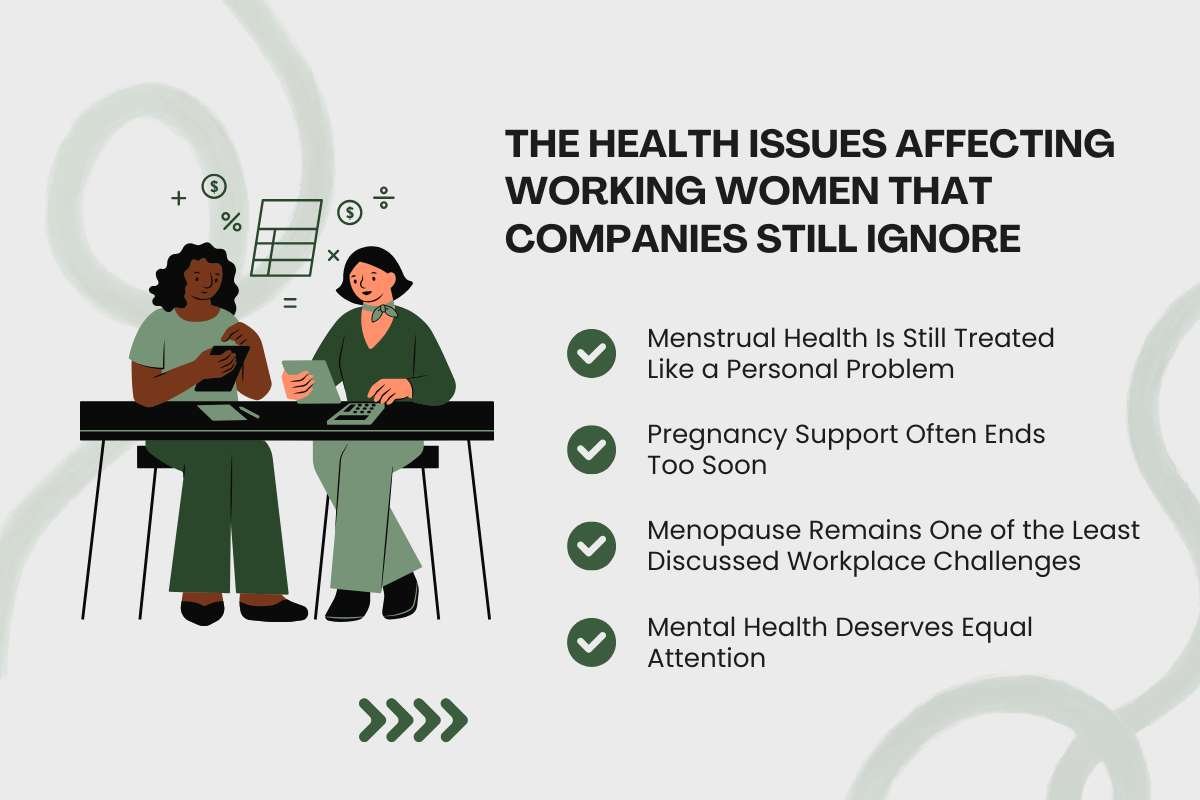
1. Menstrual health is still treated like a personal problem
For many women, menstrual pain is far more than mild discomfort. Conditions such as endometriosis, adenomyosis, heavy bleeding, and polycystic ovary syndrome (PCOS) can make even routine work extremely difficult.
Yet many workplaces still expect employees to perform normally without offering flexibility or understanding. Women often hesitate to ask for support because menstrual health remains a sensitive topic in professional environments.
When organizations openly acknowledge menstrual health, employees feel more comfortable seeking help instead of silently struggling.
2. Pregnancy support often ends too soon
Pregnancy is one of the most visible stages of a woman’s life, yet workplace support frequently focuses only on maternity leave.
Many women experience morning sickness, fatigue, back pain, anxiety, or medical complications months before taking leave. After returning to work, they often face new challenges such as breastfeeding, sleep deprivation, childcare responsibilities, and physical recovery.
Without flexible policies, many talented professionals struggle to balance their careers with motherhood.
Organizations that provide gradual return-to-work programs, lactation rooms, flexible schedules, and supportive managers create better experiences for new mothers while improving employee retention.
3. Menopause remains one of the least discussed workplace challenges
Millions of women continue working during menopause, yet very few organizations openly discuss its impact.
Hot flashes, poor sleep, brain fog, anxiety, fatigue, and reduced concentration can affect daily performance. Unfortunately, many employees remain silent because they worry these symptoms may be misunderstood.
Companies that educate managers about menopause and implement flexible workplace policies allow experienced employees to continue contributing without unnecessary stress.
Supporting menopause is another important step toward improving women’s health in the workplace.
4. Mental health deserves equal attention
Women often balance multiple responsibilities beyond their careers. Many manage households, childcare, elder care, and family commitments alongside demanding jobs.
Over time, this constant pressure increases the risk of stress, anxiety, burnout, and depression.
Mental well-being programs become more effective when they recognize these unique experiences instead of offering one-size-fits-all solutions.
Creating psychologically safe workplaces where employees can discuss challenges without fear helps improve overall Women’s health while strengthening organizational culture.
Case study: how supportive policies improved employee well-being
Global professional services firm Deloitte expanded its family support, fertility benefits, mental health resources, and flexible working policies for employees. These initiatives encouraged more open conversations around women’s health and helped create a workplace where employees felt supported throughout different life stages.
The company’s approach highlights an important lesson: investing in employee well-being is not simply about offering benefits. It is about creating an environment where people feel respected, valued, and able to perform at their best.
The hidden cost of ignoring women’s health in the workplace
Many businesses measure success through profits, customer satisfaction, and innovation. However, one factor often goes unnoticed: the health of their employees. When organizations overlook women’s health in the workplace, the effects reach far beyond individual well-being.
Health challenges can reduce concentration, increase sick leave, and make it harder for employees to perform at their best. Some women may leave their jobs because they feel unsupported, while others continue working despite health issues, a situation known as “presenteeism.” In both cases, businesses lose valuable talent, experience, and productivity.
According to the World Economic Forum, companies with healthier and more inclusive workplaces tend to achieve stronger employee engagement and better long-term business performance. Supporting women’s health is not only the right thing to do; it is also a smart investment that benefits the entire organization.
Why do many women stay silent about their health at work?
Although awareness around employee wellbeing has improved, many women still hesitate to discuss health concerns in professional settings.
Some fear that speaking about menstrual pain, fertility treatment, pregnancy complications, or menopause could make them appear less capable. Others worry these conversations may affect promotions, leadership opportunities, or performance reviews.
Workplace culture also plays a major role. When managers avoid discussing women’s health or dismiss concerns as personal matters, employees often choose silence instead of seeking support.
Creating an open environment is one of the simplest ways to improve women’s health in the workplace. Employees should know they can speak honestly without fear of judgment or career setbacks.
The mental load that many working women carry every day

A typical workday rarely ends when office hours are over. Many women return home to manage cooking, childcare, household responsibilities, or care for elderly family members.
This invisible workload is often referred to as the mental load. It includes planning schedules, remembering appointments, managing school activities, organizing family needs, and handling countless small decisions throughout the day.
Over time, this constant responsibility can lead to:
- Chronic stress
- Sleep problems
- Anxiety
- Emotional exhaustion
- Burnout
Unlike physical fatigue, mental exhaustion is harder to recognize. Many employees continue working without realizing how much it affects their focus, creativity, and confidence.
Organizations that promote flexible working arrangements, realistic workloads, and mental health support create healthier environments that strengthen Women’s health.
Fertility challenges deserve more workplace support
Millions of women undergo fertility treatments while continuing full-time jobs.
Medical appointments, hormone therapy, emotional stress, and uncertainty can make balancing work extremely difficult. Yet fertility remains one of the least discussed workplace topics.
Some employees use annual leave for medical appointments because they feel uncomfortable explaining the reason.
Supportive employers can make a significant difference by offering:
- Flexible working hours
- Paid medical leave for fertility treatment
- Private healthcare support
- Confidential HR policies
- Manager training
When organizations acknowledge fertility challenges, they show employees that every stage of life deserves understanding. This approach strengthens women’s health in the workplace while building trust between employers and staff.
Menopause is not the end of a successful career
Many women reach the peak of their careers during their late 40s and 50s. Ironically, this is also when menopause symptoms often become more noticeable.
Common symptoms include:
- Hot flashes
- Night sweats
- Fatigue
- Difficulty sleeping
- Brain fog
- Mood changes
- Joint pain
These symptoms can affect meetings, presentations, decision-making, and daily work.
Expert insight
According to Dr. Sherif Wakil, Founder of Dr. SW Clinics & Dr. SW Sexual Regenerative Centre, menopause should not be viewed as the end of a woman’s professional growth.
Through his work in regenerative medicine, he emphasizes that menopause can affect much more than physical health. It may also influence energy levels, confidence, sleep quality, mood, concentration, and overall well-being.
Dr. Wakil believes that with early support, personalized care, and open workplace conversations, women can continue to thrive in leadership roles and high-performing careers.
He also stresses that employers who acknowledge menopause as a genuine workplace health issue help create more inclusive, supportive, and productive environments for experienced professionals.
Supporting menopause demonstrates that Women’s health in the workplace extends across every stage of a woman’s career.
The importance of preventive healthcare
Many women postpone regular health check-ups because of demanding work schedules.
Skipping preventive care may delay the diagnosis of conditions such as:
- Breast cancer
- Cervical cancer
- High blood pressure
- Diabetes
- Osteoporosis
- Thyroid disorders
Forward-thinking organizations encourage preventive healthcare by offering annual health screenings, paid medical appointments, and awareness campaigns.
Early diagnosis benefits employees while reducing long-term healthcare costs for employers.
Improving access to preventive care is another important step toward strengthening Women’s health.
Flexible work can improve women’s health

The pandemic changed how many organizations view flexible work.
While remote and hybrid work are not perfect solutions, they have helped many women better manage medical appointments, pregnancy, caregiving responsibilities, and recovery from illness.
Flexibility allows employees to maintain productivity without sacrificing their health.
Successful organizations focus on outcomes rather than hours spent at a desk. This approach supports women’s health in the workplace while improving employee satisfaction and retention.
Real-world example: Microsoft Japan
Microsoft Japan experimented with a four-day workweek and reported significant improvements in productivity and employee satisfaction. Although the initiative benefited all employees, flexible working arrangements particularly helped workers balance family and personal responsibilities.
This example shows that flexible policies can improve well-being without reducing business performance.
Workplace policies that truly make a difference
Many organizations already offer health insurance and paid leave, but modern workplaces need broader support systems.
A strong workplace policy should include flexible working options, menstrual health support, maternity and parental leave, menopause awareness, mental health resources, and access to preventive healthcare.
Companies should also review their workplace environment. Clean washrooms, nursing rooms for breastfeeding mothers, ergonomic workstations, and private wellness spaces show employees that their well-being matters.
Clear communication is equally important. Employees should know exactly what benefits are available and how to access them without unnecessary paperwork or hesitation.
These improvements strengthen women’s health in the workplace while creating a culture where employees feel respected and supported.
Legal rights that every working woman should know
Many countries have introduced laws to protect women at work, yet not every employee understands these rights.
Depending on the country, legal protections may include:
- Maternity leave
- Protection against workplace discrimination
- Equal pay regulations
- Safe working environments
- Protection from harassment
- Reasonable workplace accommodations during pregnancy
In India, for example, the Maternity Benefit Act, 1961 (amended in 2017) increased paid maternity leave for eligible women to 26 weeks in many organizations. The law also introduced provisions related to crèche facilities for certain employers.
Knowing these rights helps employees make informed decisions and encourages organizations to maintain fair workplace practices. Supporting legal protections is another essential aspect of improving women’s health.
The future of women’s health in the workplace

The conversation around workplace wellbeing continues to evolve.
Experts expect organizations to focus more on personalized healthcare, preventive medicine, digital health solutions, and flexible work arrangements over the coming years.
Artificial intelligence may also help employees access personalized wellness recommendations, schedule health appointments, and identify potential health risks earlier.
At the same time, businesses are expected to place greater emphasis on employee experience rather than simply measuring productivity.
Future workplaces will likely recognize that supporting employee health is essential for sustainable business growth.
As expectations change, women’s health in the workplace will become a standard part of workplace strategy instead of a special initiative.
Conclusion
A healthy workplace is one where every employee has the opportunity to succeed without sacrificing their well-being. Women contribute valuable skills, ideas, and leadership across every industry, yet many still face health challenges that remain overlooked.
Improving women’s health in the workplace does not require complicated solutions. It begins with awareness, understanding, and practical support. When organizations listen to employees, create inclusive policies, and invest in preventive care, everyone benefits. Businesses become stronger, employees feel respected, and workplaces become places where people can grow with confidence throughout every stage of their careers.
FAQs
1. Why is women’s health in the workplace important?
Women’s health in the workplace improves employee wellbeing, productivity, and retention by creating a supportive work environment. According to the World Health Organization (WHO), healthy workplaces benefit both employees and business performance.
2. What are the biggest health challenges working women face?
Working women commonly experience menstrual health issues, pregnancy-related concerns, menopause symptoms, mental health challenges, PCOS, endometriosis, and burnout. Addressing these issues helps create a healthier and more inclusive workplace.
3. How can companies improve women’s health in the workplace?
Companies can offer flexible work, mental health support, inclusive healthcare benefits, maternity policies, and regular health screenings. Leading organizations like Deloitte, Accenture, Unilever, and Vodafone show that these initiatives improve employee well-being and retention.