
An Inclusive Leadership Toolkit for Management provides managers with practical frameworks, strategies, and resources to build inclusive, high-performing teams. This article covers the core principles of inclusive leadership, essential leadership competencies, everyday management practices, free toolkit resources, and ways to measure success. It also explains how inclusive leadership improves employee engagement, reduces bias, strengthens collaboration, and prepares organizations for the future of work.
Every manager wants a team that collaborates, shares ideas, and stays engaged. But with diverse and hybrid workplaces, creating an environment where everyone feels valued requires intentional leadership.
The business case is compelling. McKinsey’s Diversity Matters Even More (2023) found that companies with the most ethnically diverse executive teams are 39% more likely to outperform their peers in profitability. Meanwhile, Gallup’s State of the Global Workplace 2025 reports that only 21% of employees worldwide are engaged at work.
An Inclusive Leadership Toolkit for Management helps managers move beyond good intentions by providing practical strategies to reduce bias, encourage diverse perspectives, lead inclusive teams, and build a culture of belonging.
This guide covers what an inclusive leadership toolkit is, why it matters, the essential tools every manager needs, the best free resources for 2026, and how to keep your toolkit effective as your team evolves.
What is inclusive leadership?
Inclusive leadership is a leadership style that ensures every employee feels respected, valued, and empowered to contribute, regardless of their background or identity. Rather than viewing diversity as a checkbox, inclusive leaders foster a culture where different perspectives are welcomed, opportunities are fair, and everyone has a voice.
At its core, inclusive leadership creates a sense of belonging. It promotes open communication, psychological safety, and collaboration, enabling employees to share ideas confidently and drive innovation.
Inclusive leaders also recognize and address unconscious bias in areas such as hiring, promotions, and decision-making to ensure equal opportunities for all. As workplaces become more global, hybrid, and diverse, this approach has become essential.
According to Deloitte, effective inclusive leaders demonstrate six key traits: commitment, courage, cognizance of bias, curiosity, cultural intelligence, and collaboration. Together, these qualities help build stronger teams, improve decision-making, and create a lasting competitive advantage.
Why is inclusive leadership a business imperative?

Inclusive leadership is no longer just a people initiative; it’s a business imperative. Organizations that foster inclusion are better positioned to attract talent, boost innovation, and improve performance.
According to McKinsey’s Diversity Matters Even More (2023), companies with the most ethnically diverse executive teams are 39% more likely to outperform their peers in profitability. Diverse perspectives lead to better decisions and greater adaptability.
Inclusion also improves employee engagement. Gallup’s State of the Global Workplace 2025 found that only 21% of employees are engaged globally, making leaders who foster trust, belonging, and open communication critical to retaining motivated teams.
Additionally, Deloitte highlights that inclusive leaders create psychological safety, reduce unconscious bias, and encourage collaboration, driving stronger innovation and problem-solving.
Ultimately, inclusive leadership is a core management capability that strengthens employee retention, team performance, and long-term business success.
Read More: Inclusive Leadership Theory
Core principles of an inclusive leadership toolkit
Inclusive leadership isn’t built on a single policy or training session; it’s shaped by the everyday decisions managers make. Whether it’s hiring a new employee, leading a team meeting, or evaluating performance, small actions determine whether people feel included. That’s why every Inclusive Leadership Toolkit for Management is built around a few core principles that help leaders create fair, collaborative, and high-performing teams.
1. Self-awareness and bias recognition
Every leader has unconscious biases that can influence hiring, promotions, and day-to-day decisions. Recognizing these biases is the first step toward becoming a more inclusive leader. According to Deloitte, one of the defining characteristics of inclusive leaders is cognizance of bias, the ability to acknowledge personal blind spots and actively reduce their impact. Self-assessments, regular feedback, and reflection exercises are valuable tools for making more objective and equitable decisions.
2. Equity and fair opportunity
Inclusive leaders understand that fairness isn’t about treating everyone identically—it’s about ensuring everyone has equal access to opportunities. This means creating transparent hiring processes, objective performance evaluations, and equitable access to learning and career development. Research from McKinsey & Company shows that organizations with diverse leadership teams consistently outperform their peers, highlighting how equitable opportunities contribute to stronger business outcomes and more effective leadership.
3. Psychological safety and respect
Employees perform at their best when they feel safe expressing ideas, asking questions, and admitting mistakes. This concept, known as psychological safety, is a cornerstone of inclusive leadership. According to Google’s Project Aristotle, psychological safety was identified as the most important factor behind high-performing teams, even more significant than individual talent or team composition. When managers create a respectful environment where every voice is valued, collaboration and innovation naturally improve.
Together, these four principles form the foundation of an effective Inclusive Leadership Toolkit for Management. When practiced consistently, they help managers build trust, strengthen collaboration, improve employee engagement, and create a workplace where everyone has the opportunity to succeed.
Key traits of inclusive leaders (from toolkit insights)
Understanding the principles of inclusive leadership is only the beginning. The real difference lies in how leaders apply them every day. Research by Deloitte identifies six signature traits that consistently set inclusive leaders apart. These qualities help managers build stronger relationships, encourage innovation, and create workplaces where employees feel they belong.
1. Commitment
Inclusive leaders don’t treat inclusion as a one-time initiative—they make it part of their leadership style. They actively promote fairness, hold themselves accountable, and ensure inclusion is reflected in everyday decisions, from hiring to career development.
2. Courage
Leading inclusively often means challenging long-standing practices, addressing unconscious bias, and having difficult conversations. Courage allows managers to question the status quo, speak up against unfair practices, and create a culture where diverse opinions are respected.
3. Cognizance of Bias
Every leader has unconscious biases, but inclusive leaders work to recognize and manage them. They rely on structured decision-making, diverse interview panels, and objective evaluation criteria to reduce bias in hiring, promotions, and performance reviews.
4. Curiosity
Curious leaders actively seek different viewpoints instead of assuming they already have the best solution. According to Harvard Business Review, leaders who encourage diverse perspectives make better decisions because they draw on a wider range of experiences and ideas. Asking questions, listening carefully, and staying open to feedback are essential habits of inclusive leadership.
5. Cultural Intelligence
As organizations become more global and geographically distributed, leaders need the ability to work effectively across cultures. Cultural intelligence helps managers understand different communication styles, values, and work preferences, enabling them to build trust and strengthen collaboration across diverse teams.
6. Collaboration
Inclusive leaders create opportunities for everyone to contribute. Rather than relying on a few outspoken team members, they encourage balanced participation and shared decision-making. Research by Cloverpop found that inclusive teams make better business decisions up to 87% of the time, reinforcing the value of collaboration in driving stronger outcomes.
These traits are not innate; they can be developed through continuous learning, self-reflection, and practical experience. An effective Inclusive Leadership Toolkit for Management provides managers with the exercises, frameworks, and feedback mechanisms needed to strengthen these qualities and apply them consistently in the workplace.
Core competencies for managers using an inclusive leadership toolkit
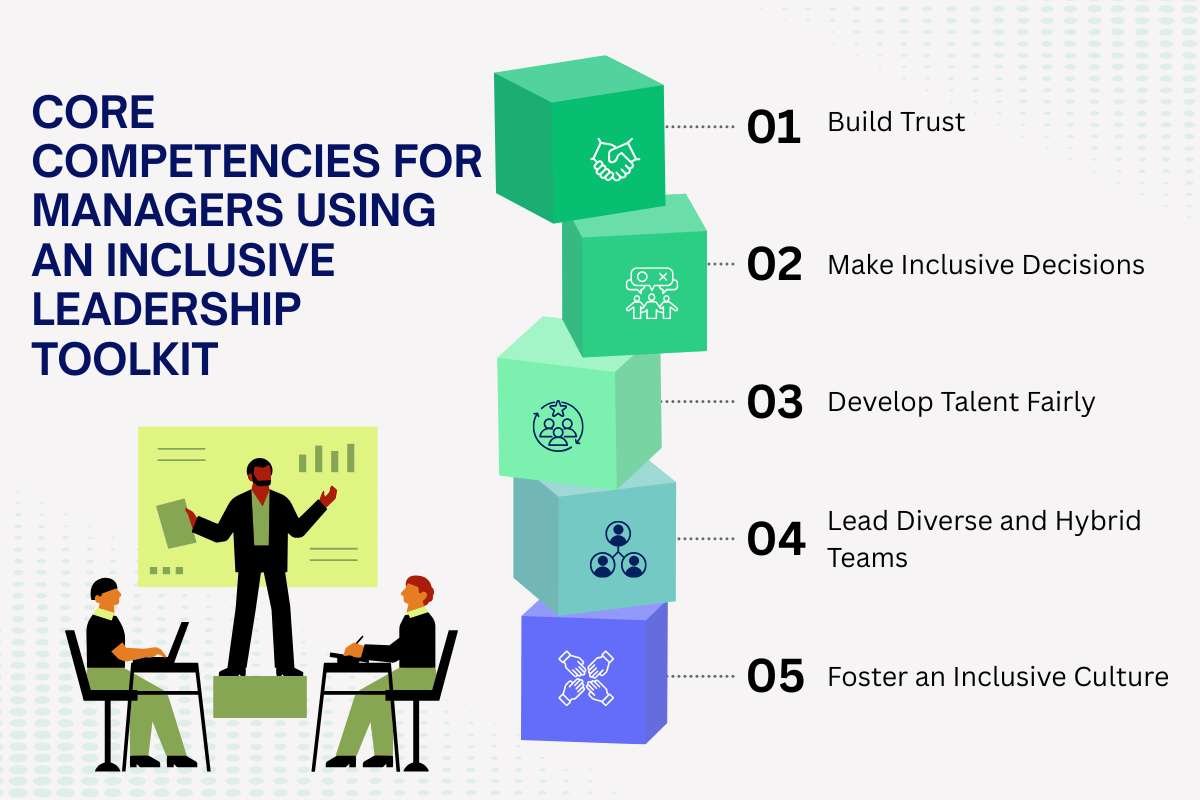
Inclusive leadership is defined by actions, not intentions. An effective Inclusive Leadership Toolkit for Management helps managers build practical skills to create fair, collaborative, and high-performing teams.
1. Build trust
Trust grows through transparent communication, consistency, and active listening. Regular one-on-one meetings and honest feedback strengthen engagement. Gallup reports that employees who trust their leaders are significantly more engaged at work.
2. Make inclusive decisions
The best decisions reflect diverse perspectives. Inclusive managers invite input, reduce bias through structured decision-making, and encourage participation. Cloverpop found that inclusive teams make 87% better decisions and execute them twice as fast.
3. Develop talent fairly
Growth opportunities should be based on performance and potential—not bias. Inclusive leaders provide equitable access to mentoring, learning, feedback, and career advancement.
4. Lead diverse and hybrid teams
Managers must ensure remote and on-site employees have equal opportunities to contribute and grow. Inclusive meetings, equal access to information, and performance-based evaluations help create a level playing field.
5. Foster an inclusive culture
Inclusive managers shape team culture by encouraging open dialogue, addressing exclusionary behaviors, and valuing diverse perspectives. Deloitte highlights that inclusive leadership strengthens innovation, collaboration, and adaptability.
An Inclusive Leadership Toolkit for Management supports these competencies with practical frameworks, self-assessments, and feedback tools, helping managers make inclusion part of everyday leadership.
Practical components of an inclusive leadership toolkit
An Inclusive Leadership Toolkit for Management turns inclusion into everyday action by giving managers practical resources for hiring, communication, decision-making, and team development.
- Self-Assessment Tools: Help managers identify unconscious bias, evaluate leadership behaviors, and track progress through regular self-reflection.
- Inclusive Communication Frameworks: Guide active listening, inclusive language, meeting facilitation, and feedback to ensure every voice is heard.
- Decision-Making Frameworks: Use structured checklists and processes to reduce bias, gather diverse perspectives, and make fairer decisions.
- Coaching and Mentorship Resources: Support equitable employee development with coaching templates, mentoring guides, career planning, and feedback frameworks.
- Team Inclusion Practices: Include practical tools such as team charters, psychological safety check-ins, and inclusive meeting agendas to strengthen collaboration and trust.
Together, these resources help managers lead more fairly, communicate effectively, and create inclusive, high-performing teams every day.
What are the best free inclusive leadership toolkits for 2026?
The growing focus on diversity, equity, inclusion (DEI), and belonging has led many organizations and universities to develop free leadership resources. While dozens of toolkits are available online, only a handful offer practical, research-backed guidance that managers can immediately apply. Below are some of the most trusted free Inclusive Leadership Toolkits for Management in 2026.
1. Babson College – Inclusive Leadership Toolkit
- Best for: Leadership development, self-assessment, and team management.
Developed by Babson Executive Education, this toolkit is designed to help managers build inclusive leadership habits through self-reflection and practical exercises. It covers topics such as unconscious bias, psychological safety, active listening, and equitable decision-making, making it particularly useful for first-time and mid-level managers looking to strengthen their leadership skills.
2. The Belonging Effect – Inclusive Leadership Toolkit
- Best for: Building inclusive team cultures and improving employee belonging.
The Belonging Effect toolkit focuses on helping leaders create workplaces where employees feel respected, valued, and connected. It includes actionable guidance on building trust, encouraging employee participation, leading difficult conversations, and embedding inclusion into everyday management practices.
3. Catalyst – Inclusive Leadership Resources
- Best for: Research-backed leadership strategies and inclusive workplace practices.
Catalyst, a global nonprofit focused on workplace inclusion, offers a collection of free guides, research reports, webinars, and leadership resources. Its materials are backed by decades of workplace research and are particularly valuable for organizations looking to improve leadership effectiveness and gender equity.
How can an inclusive leadership toolkit help with remote team management?

Remote and hybrid teams often face communication gaps, isolation, and proximity bias. An Inclusive Leadership Toolkit for Management equips managers with practical strategies to keep every employee engaged, connected, and treated fairly.
- Promotes Equal Participation: Toolkits provide meeting frameworks that encourage balanced discussions, ensuring every team member has an opportunity to contribute—not just the most vocal participants.
- Reduces Proximity Bias: Hybrid workplaces can unintentionally favor in-office employees. Microsoft’s 2022 Work Trend Index found that 85% of leaders struggle to assess remote productivity. Toolkits promote objective performance metrics, consistent feedback, and transparent evaluations.
- Improves Communication and Trust: Resources like one-on-one meeting templates, active listening techniques, and communication checklists help managers maintain regular, meaningful connections with remote employees.
- Builds Psychological Safety: Inclusive leadership practices create virtual environments where employees feel comfortable sharing ideas, asking questions, and raising concerns, leading to stronger collaboration and innovation.
- Enhances Collaboration Across Diverse Teams: For teams spread across locations and time zones, toolkits encourage inclusive communication, cultural awareness, and flexible collaboration. According to Gallup, employees who receive clear expectations and meaningful feedback are significantly more engaged.
How managers can apply the toolkit in daily leadership?
An Inclusive Leadership Toolkit is most effective when applied consistently in everyday leadership. Small, intentional actions can help create a workplace where everyone feels valued and included.
- Run Inclusive Meetings: Share agendas in advance, encourage quieter employees to contribute, rotate facilitators, and leave time for questions to ensure balanced participation.
- Provide Fair, Constructive Feedback: Use objective criteria and focus on behaviors, not personal opinions. Regular feedback reduces bias and supports employee growth.
- Make Hiring and Promotions Fair: Use structured interviews, standardized evaluation criteria, and diverse hiring panels to ensure decisions are based on skills and performance.
- Encourage Diverse Perspectives: Create opportunities for everyone to share ideas through brainstorming, anonymous feedback, or rotating project leadership. Cloverpop found that inclusive teams make 87% better business decisions.
- Lead by Example: Model inclusive behaviors by listening actively, respecting different viewpoints, admitting mistakes, and treating everyone fairly.
Consistently applying these practices turns inclusion into a daily habit, helping managers build stronger, more engaged, and higher-performing teams.
Common challenges in inclusive leadership
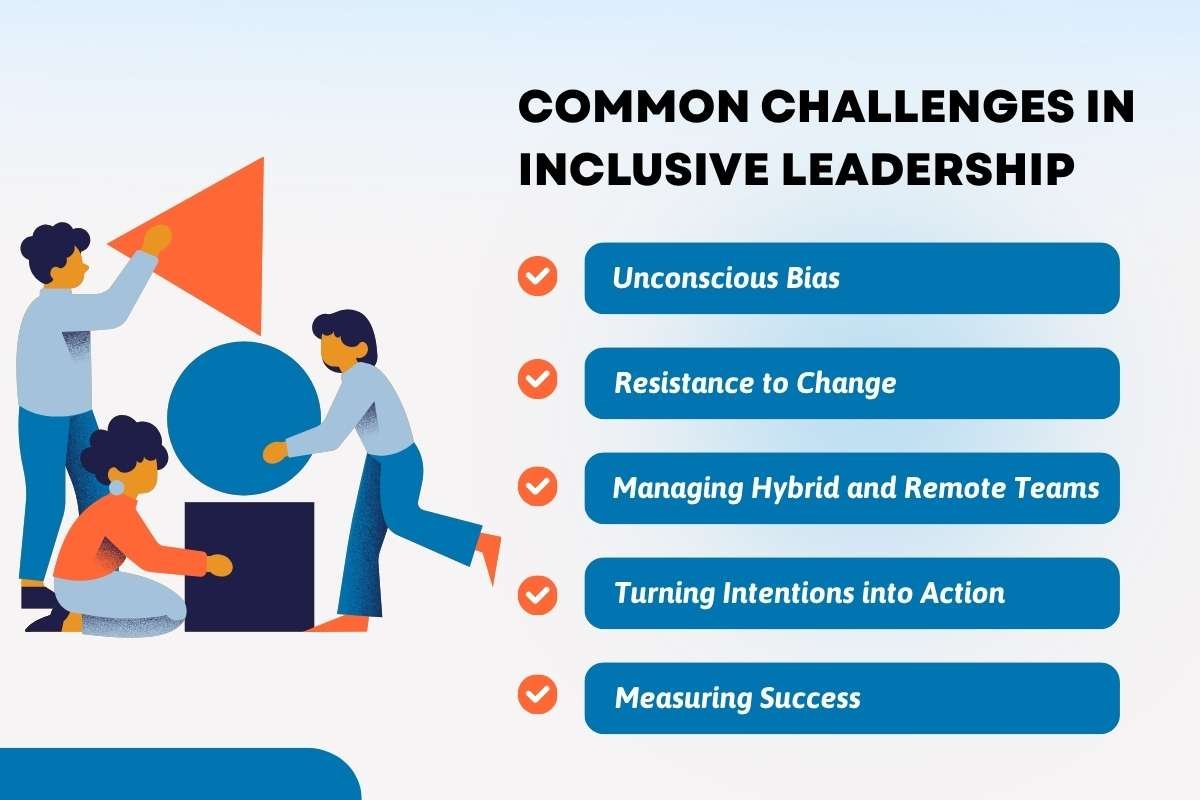
Building an inclusive workplace takes consistent effort. Managers often face these common challenges:
- Unconscious Bias: Hidden biases can affect hiring, promotions, and performance reviews. Structured interviews, standardized evaluations, and self-assessments help reduce bias.
- Resistance to Change: Some employees may see inclusion initiatives as unnecessary. Embedding inclusion into everyday leadership and clearly communicating its business value helps drive adoption.
- Managing Hybrid and Remote Teams: Remote employees can be overlooked due to proximity bias. Microsoft’s Work Trend Index found 85% of leaders struggle to assess remote productivity, making fair participation and performance evaluation essential.
- Turning Intentions into Action: Many organizations support inclusion but lack consistent execution. An Inclusive Leadership Toolkit for Management provides practical frameworks and checklists to make inclusive leadership a daily habit.
- Measuring Success: Inclusion is harder to measure than financial metrics. Tracking employee engagement, retention, promotions, meeting participation, and feedback helps assess progress and identify improvement areas.
How to keep your inclusive leadership toolkit updated as your team grows?
An Inclusive Leadership Toolkit should evolve as your team and workplace change. Regular updates help managers lead diverse, growing teams more effectively.
- Review Leadership Practices Regularly: Assess hiring, meetings, performance reviews, and communication every quarter or biannually to identify improvement opportunities.
- Gather Employee Feedback: Use surveys, one-on-one meetings, and team discussions to understand how included employees feel. Gallup reports that employees who feel their opinions matter are significantly more engaged.
- Adapt for Hybrid and Global Teams: Update your toolkit with resources for asynchronous communication, inclusive virtual meetings, flexible work, and cross-cultural collaboration.
- Invest in Continuous Learning: Keep managers up to date through leadership workshops, DEI training, webinars, and industry resources to reflect evolving workplace practices.
- Track Meaningful Metrics: Measure progress using employee engagement, retention, promotions, leadership diversity, participation rates, and feedback scores to identify what’s working and where improvements are needed.
Regularly updating your toolkit ensures managers can adapt to changing workplace needs and build a more inclusive, high-performing organization.
Measuring the impact of inclusive leadership
Inclusive leadership should be measured like any other business strategy. Tracking the right metrics helps organizations evaluate progress, identify gaps, and demonstrate business impact.
- Employee Engagement: Higher engagement often reflects an inclusive culture where employees feel valued and heard. According to Gallup’s State of the Global Workplace 2025, global employee engagement is only 21%, highlighting significant room for improvement.
- Employee Retention: Monitor retention and voluntary turnover across teams and demographics. Lower turnover often indicates employees feel supported, included, and see growth opportunities.
- Leadership Representation: Track diversity across management and executive roles to assess whether career advancement opportunities are equitable and inclusive.
- Employee Feedback & Psychological Safety: Use surveys, pulse checks, and one-on-ones to measure trust, belonging, respect, and employees’ confidence in sharing ideas without fear.
- Innovation & Business Performance: Inclusive teams deliver stronger results. Research by Cloverpop found they make 87% better decisions, execute twice as fast, and achieve 60% better outcomes. Tracking innovation, collaboration, and project success helps quantify this impact.
Measuring these KPIs ensures inclusive leadership remains a measurable business priority rather than just an aspiration. Once these metrics are in place, organizations can focus on embedding inclusion into everyday culture for long-term success.
Future of inclusive leadership in management (2026 and beyond)

As AI, hybrid work, and workforce diversity reshape organizations, inclusive leadership is becoming a business necessity rather than a workplace trend.
- AI-Enabled, Human-Led Decisions: AI will play a bigger role in hiring and performance management, but leaders must combine AI insights with human judgment to ensure fairness and reduce bias.
- Hybrid Leadership as the Norm: With hybrid work here to stay, leaders must provide equal access to opportunities, communication, and career growth for both remote and in-office employees.
- Greater Focus on Employee Experience: Success will increasingly be measured by engagement, well-being, belonging, and team development, making empathy and emotional intelligence essential leadership skills.
- Data-Driven Inclusion: Organizations will rely on metrics such as engagement, retention, promotion rates, leadership diversity, and belonging scores to refine inclusion strategies and improve outcomes.
- Continuous Learning: As workplace expectations evolve, leaders must regularly update their Inclusive Leadership Toolkit for Management with new skills, technologies, and best practices to lead diverse, global teams effectively.
Conclusion
Inclusive leadership is no longer a trend; it’s a business necessity. As workplaces become more diverse, managers need practical tools to ensure every employee feels valued, heard, and empowered. An Inclusive Leadership Toolkit for Management helps translate inclusive leadership into everyday actions.
Throughout this guide, we’ve explored the key principles, competencies, and strategies that build stronger, more collaborative teams. Research from McKinsey, Gallup, Deloitte, and Microsoft consistently shows that inclusive organizations attract top talent, foster innovation, and adapt more effectively to change.
Inclusion isn’t built through one-time initiatives; it grows through consistent actions like listening to diverse perspectives, making fair decisions, and encouraging open communication. By investing in an inclusive leadership toolkit and continuously improving your approach, you can create a workplace where people feel they belong, perform at their best, and help drive long-term business success.
Frequently asked questions (FAQs)
1. What is an Inclusive Leadership Toolkit for Management?
It is a set of tools and frameworks that help managers build fair, inclusive, and high-performing teams through structured communication, decision-making, and bias-awareness practices.
2. Why is inclusive leadership important?
It improves engagement, reduces turnover, and boosts performance. Research shows that inclusive teams consistently outperform others in productivity and profitability.
3. What are the main components of an inclusive leadership toolkit?
Key components include self-assessments, inclusive communication guides, decision-making frameworks, and team practices that promote fairness and psychological safety.
4. How does inclusive leadership improve performance?
It encourages diverse perspectives, reduces bias, and builds trust, leading to better decisions and stronger team outcomes.
5. What are the key traits of inclusive leaders?
Core traits include commitment, courage, curiosity, cultural intelligence, awareness of bias, and collaboration.
6. How can managers reduce unconscious bias?
By using structured interviews, clear evaluation criteria, diverse hiring panels, and regular self-reflection.
7. How does it help remote and hybrid teams?
It ensures equal participation, reduces proximity bias, and improves communication and fairness across distributed teams.
8. Can inclusive leadership be measured?
Yes. It can be measured through engagement levels, retention rates, leadership diversity, feedback scores, and team performance metrics.
Thank You For Reading!
See More
Inclusive Leadership vs Servant Leadership