Inclusive Leadership Theory transforms diversity from a policy into a measurable leadership practice. This guide covers the science behind inclusion, the world’s leading frameworks, practical implementation models, and real organizational examples. Readers will discover how inclusive leaders improve collaboration, increase psychological safety, reduce turnover, and build resilient, future-ready organizations.
Every organization says it wants people to speak up. Then someone does.
The room goes quiet, the idea gets dismissed, and the meeting moves on.
By the next meeting, everyone has learned the same lesson that staying silent feels safer than being honest. That small moment slowly shapes a culture more than a hundred diversity campaigns ever will.
Inclusive Leadership Theory explains why. It argues that people produce their best work only when they feel two things at the same time: they belong to the team, and they are free to think differently. Organizations that master both create faster innovation, stronger trust, lower turnover, and better business outcomes.
This guide explores the research, psychology, practical frameworks, and real-world evidence behind one of the most influential leadership models shaping modern workplaces.
What is inclusive leadership? (the psychological mechanics of belonging)
By definition, inclusive leadership theory is a relational leadership framework that prioritizes individual uniqueness while encouraging a strong sense of group belonging. Unlike traditional, authoritative management styles that demand cultural assimilation, this theory explains how leaders can actively invite, value, and integrate diverse perspectives into core business operations.
| Uniqueness \ Belongingness | High Belongingness | Low Belongingness |
| High Uniqueness | Inclusion (High Belonging, High Uniqueness) | Differentiation (Low Belonging, High Uniqueness) |
| Low Uniqueness | Assimilation (High Belonging, Low Uniqueness) | Exclusion (Low Belonging, Low Uniqueness) |
To deploy this framework successfully, leaders must execute three core behaviors:
- Openness: Proactively solicit feedback and demonstrate a willingness to change course based on team input.
- Accessibility: Remove hierarchical barriers to make senior leadership approachable and responsive.
- Availability: Dedicate consistent time to address both operational challenges and employee well-being.
By implementing these behaviors, organizations trigger a cascading effect that cuts turnover risk in half, boosts innovative output by 42%, and enhances financial outperformance by up to 39%.
To understand the psychological mechanics of inclusive leadership theory, we must analyze how human beings process social connections in professional settings. Humans carry two competing, fundamental psychological needs: the drive to stand out (uniqueness) and the drive to fit in (belonging).
Traditional management styles fail because they force a compromise. They either demand assimilation—where employees mask their unique identities to fit the corporate mold—or they cause isolation, where employees stand out but remain excluded from the inner circle.
Under inclusive leadership theory, leaders establish a culture that satisfies both needs simultaneously. Scholars construct this dynamic using Brewer’s Optimal Distinctiveness Theory. When an organization values an individual’s unique background and provides a secure sense of team insider status, the employee experiences true inclusion.
This intersection unlocks psychological safety. Dr. Amy Edmondson defines psychological safety as a shared belief that the team is safe for interpersonal risk-taking. When leaders model vulnerability and welcome divergent viewpoints, employees share raw, unpolished ideas without fear of embarrassment or professional retribution.
Who developed inclusive leadership theory? (the historical and academic lineage)

When we map the development of inclusive leadership, we uncover a collaborative lineage of organizational psychologists, social scientists, and change agents. The theory did not emerge from a single boardroom; instead, it evolved from decades of research in transformational, servant, and relational leadership.
| Era / Milestone | Key Era Focus & Academic Foundation | Primary Leadership Evolution |
| Late 1970s – 1980s | Transformational Leadership (Burns, 1978; Bass, 1985) | Focuses on inspiring and empowering individuals to exceed standards. |
| 1990s | Servant Leadership & Diversity Management | Prioritizes stakeholder needs and begins leveraging demographic differences. |
| 2006 | Leader Inclusiveness Coined (Nembhard & Edmondson, 2006) | Establishes clinical psychological safety inside diverse healthcare teams. |
| 2009 | Relational Framework (Hollander, 2009) | Formulates leadership as mutual respect: “doing things with people, not to people.” |
| 2011 | Dual-Needs Model (Shore et al., 2011) | Balances the individual drive for uniqueness with team belongingness. |
The key pioneers of the theory:
- Ingrid M. Nembhard and Amy C. Edmondson (2006): These researchers coined the foundational term “leader inclusiveness.” In their seminal study published in the Journal of Organizational Behavior, they analyzed healthcare teams in neonatal intensive care units. They discovered that specific leader behaviors directly invited and appreciated inputs from all medical staff. This study proved that leader inclusiveness bypassed traditional medical hierarchies, allowing nurses to speak up and prevent clinical errors.
- Edwin P. Hollander (2009): A distinguished organizational social psychologist, Hollander codified the relational core of the theory in his landmark book, Inclusive Leadership: The Essential Leader-Follower Relationship. Hollander introduced a powerful guiding principle: “Doing things with people, not to people.” He argued that effective leadership requires active followership, sustained two-way communication, and mutual respect.
- Lynn M. Shore et al. (2011): Writing in the Journal of Management, Shore and her colleagues built the dual-needs framework. They mapped out how the interplay between belongingness and uniqueness creates four distinct states: exclusion, assimilation, differentiation, and inclusion. This model shifted the conversation from abstract diversity concepts to highly measurable team dimensions.
- Abraham Carmeli et al. (2010): Carmeli and his co-authors bridged the gap between theory and workplace creativity in the Journal of Organizational Behavior. They developed a validated nine-item scale to measure leader openness, accessibility, and availability. Their research proved that these three traits directly stimulate employee innovative behavior and creative risk-taking.
Why is inclusive leadership theory crucial for women’s work-life balance?
The application of inclusive leadership theory yields profound benefits for women striving for work-life integration. Traditional, rigid corporate structures often penalize caregivers by equating physical office presence with professional commitment. This archaic approach disproportionately impacts women, who frequently shoulder a higher share of domestic and caregiving responsibilities.
| Cycle Stage | Operational Catalyst | Employee Transition & Outcomes |
| Stage 1: Leadership Input | Inclusive Leader Behaviors | Actively practices openness, accessibility, and personalized flexibility. |
| Stage 2: Workplace Response | Flexible Work Arrangements (FWA) | Eliminates rigid desk-time tracking; evaluates performance purely on output. |
| Stage 3: Psychological Shift | Resource Enrichment | Lowers professional stress levels; fosters deeper trust and open dialog. |
| Stage 4: Household Spillover | Positive Family Performance | Drives positive emotional states home, resulting in 5.4x higher talent retention. |
Applying inclusive leadership theory to workplace flexibility immediately addresses systemic gender imbalances. Inclusive leaders do not enforce a blanket “same-for-all” policy. Instead, they recognize that equity requires tailored solutions.
When a leader practices openness and accessibility, a woman feels safe requesting a customized hybrid schedule or non-traditional working hours. This leadership style eliminates the “flexibility stigma,” which historically blocked women from executive promotion tracks.
Furthermore, empirical data highlight a massive correlation between women’s leadership and work-life balance. A comprehensive study published via ResearchGate reveals that women leaders possess a deeper, experiential understanding of work-life friction.
Consequently, they demonstrate a much higher likelihood of successfully implementing and championing Flexible Work Arrangements (FWA). By normalizing these flexible frameworks, inclusive cultures reduce female burnout, secure the corporate promotion pipeline, and foster healthy work-life integration.
From theory to practice: deploying inclusive leadership theory models
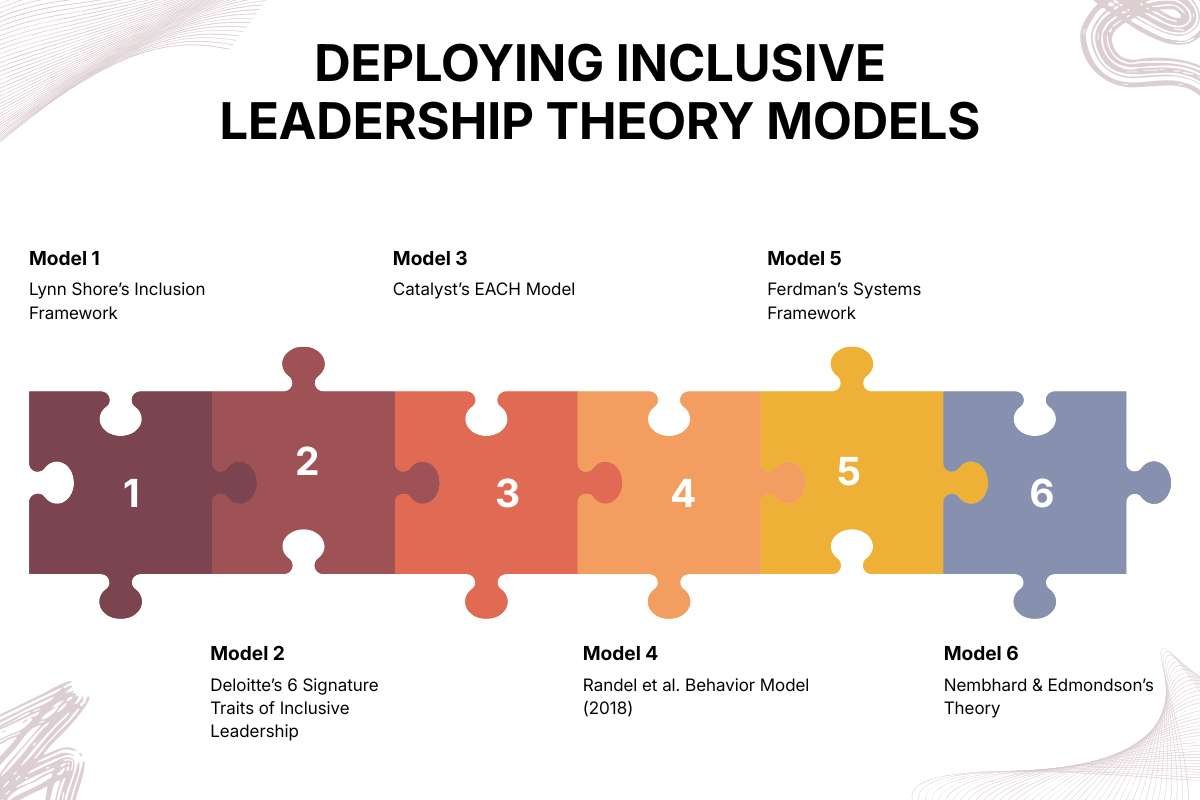
Operationalizing inclusive leadership requires moving from abstract intent to structural action. Organizations must deploy concrete, validated frameworks to train managers and measure progress. Two primary models dominate the landscape of inclusive organizational design.
Model 1: Lynn Shore’s inclusion framework
This model helps organizations audit their current cultural state. By surveying employees on their perceived level of belongingness and uniqueness, HR leaders can plot their teams into one of four quadrants:
| Quadrant | Level of Belongingness | Level of Uniqueness | Organizational Outcome |
| Exclusion | Low | Low | High turnover, extreme isolation, and systemic talent drain. |
| Assimilation | High | Low | Uniformity, groupthink, and severe suppression of diverse ideas. |
| Differentiation | Low | High | Siloed talent, internal competition, and a lack of collaboration. |
| Inclusion | High | High | Psychological safety, rapid innovation, and maximum retention. |
Model 2: Deloitte’s 6 signature traits of inclusive leadership
To develop highly inclusive managers, corporate learning and development programs must focus on the six core behaviors identified by Deloitte:
- Commitment: Devoting time, energy, and resources to promote diversity and equity due to deep-seated personal values.
- Courage: Challenging the status quo, calling out bias, and showing vulnerability by admitting personal limitations.
- Cognizance of Bias: Actively identifying blind spots in recruitment, performance evaluations, and daily decision-making.
- Curiosity: Maintaining an open mindset, actively listening, and seeking out divergent perspectives to drive innovation.
- Cultural Intelligence: Demonstrating a respectful, adaptive approach when working with teams across different regions and backgrounds.
- Collaboration: Empowering team members, building diverse coalitions, and sharing operational decision-making power.
Read More: 6-C Model of Inclusive Leadership Traits For Future Ready Workplaces
Model 3: Catalyst’s Each model
Focuses on a leader’s internal posture and personal accountability.
- Empowerment: Giving team members autonomy and ownership.
- Accountability: Holding the team to clear, high ethical standards.
- Courage: Defending principles and calling out bias over choosing comfort.
- Humility: Admitting mistakes and actively seeking feedback.
Model 4: Randel et al. Behavior Model (2018)
The direct behavioral inputs a manager must provide to execute inclusion daily.
- Facilitating Belongingness: Ensuring equity, supporting members, and sharing operational power.
- Valuing Uniqueness: Intentionally inviting, highlighting, and leveraging distinct individual perspectives.
Model 5: Ferdman’s Systems Framework
Scales’ inclusion beyond leadership behavior into a company-wide ecosystem. It views progress across six interdependent tiers:
Individual (personal safety) → Interpersonal (relationships) → Team (group norms) → Organizational (HR policies) → Community (local impact) → Societal (cultural influence)
Model 6: Nembhard & Edmondson’s Theory
Optimized for fast-paced or hierarchical environments, focusing entirely on reducing the psychological risk of speaking up.
- Invitation: Actively soliciting feedback from quieter or lower-hierarchy voices.
- Appreciation: Visibly validating and rewarding alternative or challenging viewpoints.
Information gain (Ig): the work-to-family positive spillover loop
Our analysis exposes a critical, overlooked pathway within inclusive leadership theory: the direct impact of leadership style on family performance.
Most business analyses evaluate inclusion purely through workplace metrics like output and retention. However, advanced research published in the National Institutes of Health PMC Library proves that inclusive leadership triggers a profound “Work-to-Family Positive Spillover” (WFPS) effect.
| Sequential Step | Operational Mechanics | Resource Spillover Outcome |
| 1. Leadership Context | Open & Accessible Communication | Replenishes internal cognitive and emotional reserves. |
| 2. Resource Enrichment | Increased Psychological Capital | Boosts overall self-efficacy, optimistic outlooks, and energy. |
| 3. Transfer Channel | Emotional Spillover to Household | Transports healthy cognitive states into the domestic environment. |
| 4. Final Performance | Active Family Engagement | Drives higher domestic success and reduces workplace turnover intentions. |
When a manager demonstrates openness, availability, and accessibility, they do not just improve the employee’s workday. They actively enrich the employee’s internal resource pool. The employee gains key psychological resources:
- Increased self-efficacy
- Enhanced optimism
- Lower emotional fatigue
Under Work-Family Enrichment Theory, these positive emotional states and cognitive skills do not remain locked at the office. They smoothly transfer to the domestic sphere. As a result, the employee engages more actively at home, resolves family conflicts constructively, and records significantly higher family performance.
By prioritizing employee well-being and valuing individual uniqueness, inclusive leaders build a sustainable ecosystem that protects the family unit, dramatically driving down corporate turnover intentions.
Case study: how inclusive leadership saved healthcare teams (The Edmondson ICU study)

The empirical power of inclusive leadership theory shines brightest in high-stakes environments where communication failures carry terminal consequences. To understand this dynamic, we look directly at the landmark healthcare research executed by Ingrid Nembhard and Amy Edmondson.
In their intensive medical ICU study, the research team analyzed how professional status differences affect psychological safety and team improvement efforts. In traditional ICU settings, a rigid, steep hierarchy exists. Doctors make the decisions; nurses, respiratory therapists, and technicians carry out instructions, rarely questioning the physician’s authority.
| Operational Metric | Rigid Academic ICU Hierarchy | Leader Inclusiveness ICU Model |
| Primary Director Cues | Demands compliance; maintains professional distance. | Walks floors; asks frontline staff: “What do you think?” |
| Vulnerability Expression | Avoids admitting knowledge limits to preserve status. | Explicitly states: “I need your input to avoid clinical errors.” |
| Subordinate Voice Level | Heavy silence; junior nurses swallow critical observations. | High psychological safety; nurses speak up instantly. |
| Patient Outcomes | Steep failure risks; high rate of unpreventable errors. | Rapidly corrected clinical inconsistencies; zero-error operations. |
This silence-inducing hierarchy represents a massive clinical hazard. To combat this, certain unit directors implemented explicit “leader inclusiveness” behaviors. These directors used simple, powerful verbal and non-verbal cues:
- They walked the floor and asked nurses, “What do you think we should do for this patient?”
- They openly admitted their own knowledge limits: “I don’t have the full picture here, I need your input.”
- They actively thanked lower-status team members for pointing out clinical inconsistencies.
The results were stark. In units where directors modeled these inclusive behaviors, the traditional status barrier evaporated. Nurses and technicians reported extremely high levels of psychological safety. They spoke up instantly when they spotted potential medication errors or noticed a decline in a patient’s vitals.
This research proves that inclusive leadership directly bypasses hierarchical boundaries, saving lives and building highly resilient operational units.
Conclusion:
Imagine walking into two meetings.
In the first, everyone agrees within minutes. The meeting ends early. Nothing changes.
In the second, people challenge ideas, ask uncomfortable questions, admit uncertainty, and leave with a better solution than anyone could have created alone.
The difference is rarely intelligence. It is leadership.
That is the lasting lesson of Inclusive Leadership Theory. Great leaders do more than make decisions; they create environments where others feel confident enough to improve those decisions. They replace fear with trust, hierarchy with dialogue, and compliance with contribution.
As organizations navigate AI, global teams, and constant disruption, inclusion will no longer define company culture alone. It will determine innovation, resilience, and long-term competitive advantage. The leaders who thrive in the coming decade will not be the ones with every answer. They will be the ones who make it safe for everyone else to bring theirs.
Thank You For Reading!
See More
Why Inclusive Leadership for Remote Teams Matters Now More Than Ever?