
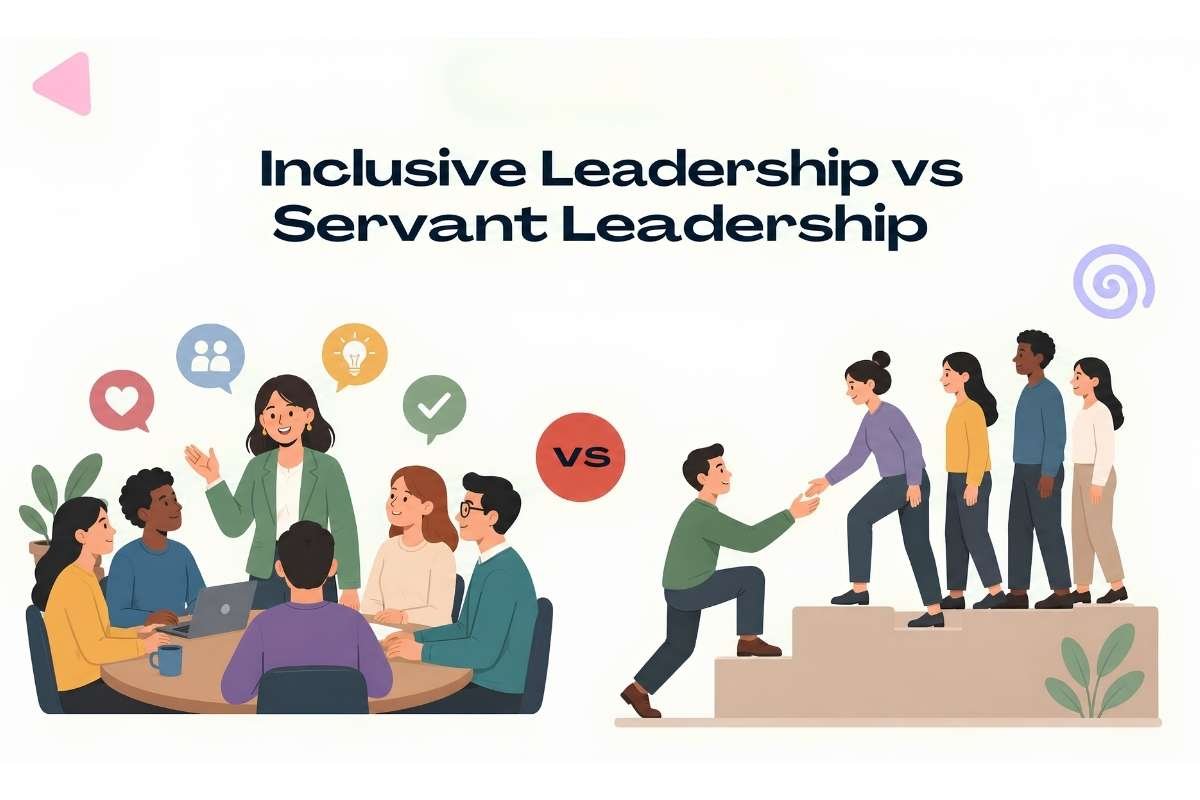
Inclusive leadership vs servant leadership highlights the difference between creating space for every voice and actively supporting every individual within a team, showing how two people-focused approaches lead to different outcomes in practice. This article emphasizes the difference between the two and also tells how they can work together
Have you ever worked with a leader who made everyone feel heard, and another who quietly put the team’s needs ahead of their own? Both felt effective, but in very different ways.
In many workplaces, leadership is no longer just about direction or authority. It is about how people are treated, how decisions are shaped, and how teams grow together. That is where different leadership styles start to stand out in subtle but important ways.
When you look at inclusive leadership vs servant leadership, the difference is not always obvious at first. Both focus on people. Both aim to create stronger teams. But the way they approach that goal, and the role a leader plays in the process, can feel quite different in practice.
Understanding that difference helps you recognize what kind of leadership environment you are part of, and what kind of leader you may want to become.
Inclusive Leadership vs Servant Leadership: What Do They Mean?
Leadership style shapes how teams behave each day. Some leaders focus on results first, while others focus on people. Inclusive leadership and servant leadership both lean toward people. Still, they solve different problems within teams.
Inclusive leadership focuses on voice and belonging. A leader builds a space where people feel safe to speak and share ideas. They do not wait for input. They actively ask for it, especially from those who stay quiet. They question bias in decisions and make sure no one gets overlooked. This creates a team where different views surface early. As a result, ideas improve, and decisions become stronger.
Servant leadership starts with service, not authority. Robert K. Greenleaf defined it clearly: “The servant-leader is servant first.” The leader puts the team’s needs ahead of their own role. They listen, support, and remove barriers that slow people down. They focus on helping individuals grow over time. Trust builds through actions, not position.
Both styles value people, but they begin from different angles. Inclusive leadership makes sure every voice gets heard. Servant leadership makes sure every person gets supported. That difference shapes how each leader acts day to day.
Inclusive Leadership vs Servant Leadership: Key Differences Explained
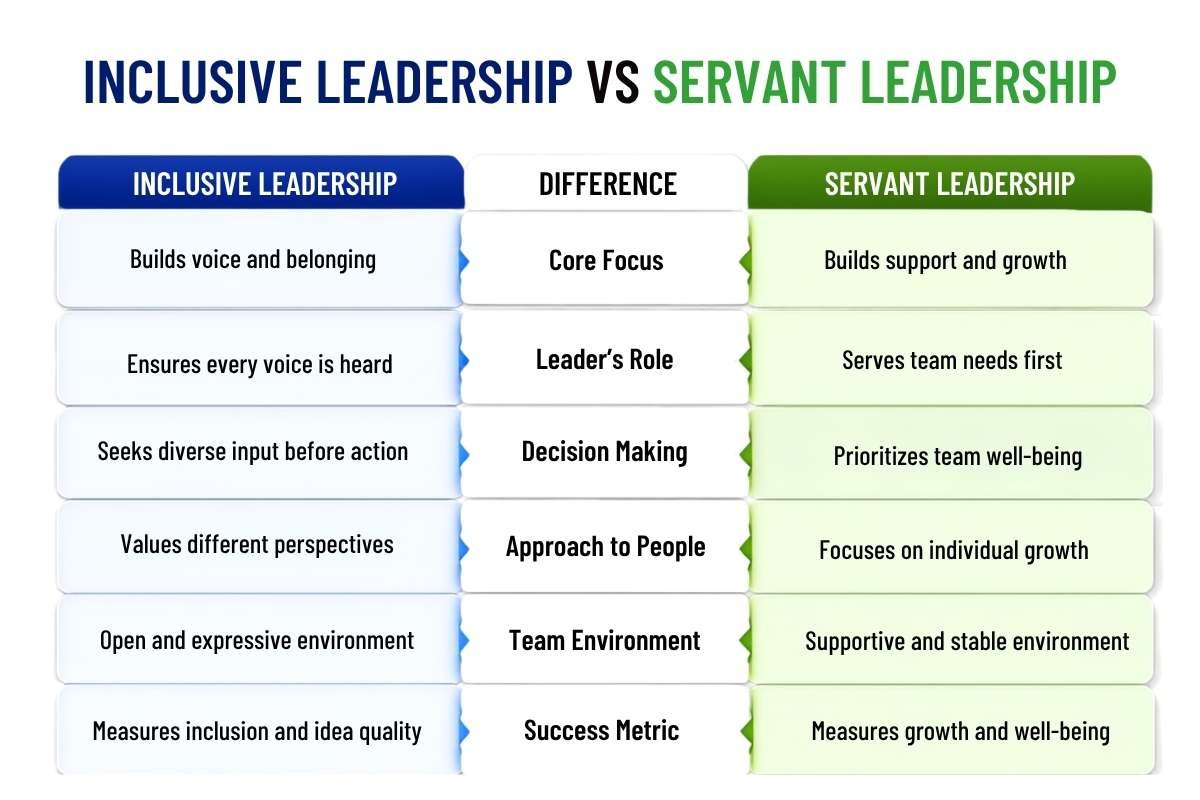
At a glance, inclusive leadership and servant leadership can feel similar. Both focus on people and team growth. But the intent behind each approach changes how a leader acts day to day. The difference shows up in how decisions get made, how teams interact, and what the leader chooses to prioritize. Looking at these differences of inclusive leadership vs servant leadership side by side makes it easier to see where each style stands.
| Inclusive Leadership | Difference | Servant Leadership |
| Builds voice and belonging | Core Focus | Builds support and growth |
| Ensures every voice is heard | Leader’s Role | Serves team needs first |
| Seeks diverse input before action | Decision Making | Prioritizes team well-being |
| Values different perspectives | Approach to People | Focuses on individual growth |
| Open and expressive environment | Team Environment | Supportive and stable environment |
| Measures inclusion and idea quality | Success Metric | Measures growth and well-being |
1. Core focus:
Inclusive leadership works on voice and belonging inside a team. The leader pushes for input from everyone and makes sure ideas come from different people. This improves thinking and leads to stronger decisions. Servant leadership works on support and growth. The leader looks at what the team needs and acts to help people improve over time. The focus stays on development, not just participation.
2. Leader’s role:
An inclusive leader manages how people contribute. They guide discussions and make sure no one gets ignored. They watch group dynamics closely. A servant leader supports people in their work. They remove obstacles and step in when help is needed. Their role stays tied to enabling performance.
3. Decision making:
Inclusive leaders gather input before making a decision. They listen to different views and then move forward. This can take time, but it often improves the outcome. Servant leaders focus on what helps the team most. They make decisions that support well-being and long-term growth. The process stays practical, and people are focused.
Read More:
- 6-C Model of Inclusive Leadership Traits For Future Ready Workplaces
- Why Inclusive Leadership for Remote Teams Matters Now More Than Ever?
4. Approach to people:
Inclusive leadership values different perspectives. The leader encourages debate and accepts disagreement. They believe better ideas come from varied thinking. Servant leadership focuses on individual growth. The leader understands each person’s strengths and gaps. They guide people step by step.
5. Team environment:
Inclusive teams feel open and expressive. People speak freely and share ideas without fear. Conversations stay active. Servant-led teams feel stable and supportive. People trust the leader to back them. The focus stays on steady work and strong relationships.
6. Measure of success:
Inclusive leadership tracks participation and idea quality. It looks at how many voices shape decisions. Servant leadership tracks growth and well-being. It looks at how people improve and how supported they feel over time.
Inclusive Leadership vs Servant Leadership: Can a Leader Be Both?

A leader does not need to choose one style over the other. In practice, many strong leaders use both inclusive leadership and servant leadership at the same time. They shift based on what the team needs in that moment.
Inclusive leadership helps a leader draw ideas from the team. It makes sure people speak, question, and share views without fear. This matters in group discussions, planning sessions, and decision-making. Without this, some voices stay silent, and ideas get lost.
Servant leadership supports what happens after those ideas come out. The leader focuses on helping people act on them. They remove blockers, give support, and guide individuals as they work. This ensures that good ideas turn into real progress.
The inclusive leadership vs servant leadership styles connect well when used together. A leader may first create space for open input, then step in to support execution. One builds voice, the other builds follow-through. This creates a balance between thinking and doing.
Still, using both styles takes awareness. A leader must know when to step back and listen, and when to step in and support. Too much focus on inclusion can slow decisions. Too much focus on service can limit challenge and debate. The balance depends on the team and the situation.
Leaders who manage this balance well often build stronger teams. People feel heard, and they also feel supported. This combination leads to better ideas and steady growth over time.
Knowing the differences between inclusive leadership vs servant leadership helps, but real leadership rarely works in isolation. Teams do not need just one approach. They need a mix of voice and support at the same time. This is where both styles start to connect. When leaders bring them together, they solve more than one problem at once. That combination leads to stronger outcomes across the team.
Why Modern Women Leaders Need to Focus on Both?

1. Stronger decision-making:
Inclusive leadership helps women leaders create space where every voice is heard, including their own. This is important because women leaders are often interrupted, overlooked, or expected to hold back in decision-making spaces. By building inclusive environments, they ensure diverse perspectives come forward.
Servant leadership helps them turn those perspectives into action. It allows women leaders to support their teams, remove barriers, and confidently make decisions. This leads to decisions that are both well-rounded and effectively executed.
2. Higher team trust:
Inclusive leadership allows women leaders to build trust by making people feel respected and heard. When team members see fairness in discussions, they respond with openness.
Servant leadership strengthens that trust through consistent support. Women leaders who actively back their teams and prioritize their needs create a sense of safety. This becomes especially important in environments where women leaders may face skepticism. Trust grows faster when both inclusion and support are visible.
3. Better leadership growth:
Inclusive leadership pushes women leaders to stay open to new ideas and perspectives. It challenges them to listen, adapt, and expand their thinking. Servant leadership adds a personal growth layer. It encourages women leaders to understand individual team needs, mentor effectively, and lead with empathy. Together, these styles help women leaders grow both strategically and personally.
4. Improved team performance:
Teams perform better when a woman leader ensures everyone contributes. Inclusive leadership brings out ideas that may otherwise stay hidden. Servant leadership ensures those ideas are not lost in execution. By removing obstacles and supporting progress, women leaders can drive consistent results. This combination eliminates the debate between inclusive leadership vs servant leadership and allows people to showcase stronger performances and better outcomes.
5. Higher engagement and retention:
Inclusive leadership helps women leaders build teams where people feel valued and involved. This increases engagement because team members see their input matter. Servant leadership deepens that engagement by focusing on growth and well-being. Women leaders who support their teams beyond tasks create loyalty. This helps reduce attrition and builds long-term commitment.
6. A more balanced leadership identity:
Inclusive leadership helps women leaders establish presence and authority by guiding conversations and decisions. It ensures they are not sidelined. Servant leadership balances this by showing empathy and support without losing control. Together, these styles help women leaders avoid being seen as either too passive or too aggressive. Instead, they create a leadership style that is both strong and respected.
Conclusion:
When you look at inclusive leadership vs servant leadership closely, the distinction becomes clearer. One centers on creating space where every voice is valued and included in decisions. The other focuses on supporting the team by putting their needs first and helping them perform at their best. Both approaches build trust, but they do it through different paths.
Understanding these differences is not about choosing one over the other. It is about recognizing what your team needs in a given moment and how leadership style influences culture, communication, and long-term growth.
People Also Ask
1. What is the main difference between inclusive leadership vs servant leadership?
Inclusive leadership focuses on ensuring everyone feels heard and involved, while servant leadership focuses on serving and supporting the team’s needs.
2. Can a leader practice both styles?
Yes, many leaders combine elements of both to create a balanced and effective leadership approach.
3. Which leadership style is better for team performance?
Both can improve performance, depending on team dynamics and organizational goals.
Thank You For Reading!
See More
Transformational vs. Inclusive Leadership