
Inclusive management practices turn big workplace goals into daily habits. They help every worker feel safe, valued, and heard. This approach builds trust in hybrid teams across all age groups. It keeps top talent happy and boosts your daily results. Small changes in your meetings and workflows make a huge impact. Read the full guide to transform your team now.
You want your teams to do their best work every day. Yet, a diverse team can still fail without the right care. Diverse hiring is just a start for any good modern firm.
Managers shape how people feel during the workday from start to finish. We see huge changes with remote work and four generations in one room. Now, fast AI tools and global shifts make our work lives complex. You must change your approach to keep up with these swift trends.
We use inclusive management practices to help every single worker feel heard. These steps turn a mix of people into a strong, united force. You will learn how to build trust with your team right now. We will show you how to lead day-to-day with ease.
What are inclusive management practices?
What are Inclusive Management Practices? To truly understand this concept, you must look at specific roles within your firm. Inclusion means that every single person feels safe, valued, and respected (Center for Creative Leadership). Inclusive leadership builds a strong, bold vision for the future of your team. Yet, leadership inspires while management puts those plans into daily action.
Leadership creates vision, while management creates the daily employee experience. This crucial difference separates big goals from real, lasting change. For tech leaders, the real work lives inside your operational routines.
You must focus on communication, delegation, feedback, and your hiring methods. True equity also shows up in daily promotions, meetings, and decision-making. Managers translate high corporate values into real habits that support your people.
We can track these habits through clear data on team outcomes (McKinsey). These fair methods drive sustainable growth and enduring talent success (JMSR). As CIOs, you turn grand ideals into standard workflows each day.
Why inclusive management matters today?
The tech world faces rapid shifts that challenge how we run operations. Global hiring means your teams span multiple time zones. Right now, five distinct generations work side-by-side in our industry (Harvard Business Review). Furthermore, hybrid work models completely alter how we track team performance (Stanford SIEPR). New AI tools also change how your engineers collaborate every day.
These massive shifts create high expectations from your top technical talent. Workers want real support, fair treatment, and clear growth paths now. For women CIOs, standard routines simply cannot handle these complex demands. True inclusion has become a strict business necessity for corporate survival (IMD).
You cannot let remote gaps or cultural walls block your progress. Modern inclusive management practices bridge these gaps to keep teams unified. They help you retain key experts and boost total daily output. In short, your bottom line depends on how you run teams.
8 inclusive management practices every team needs
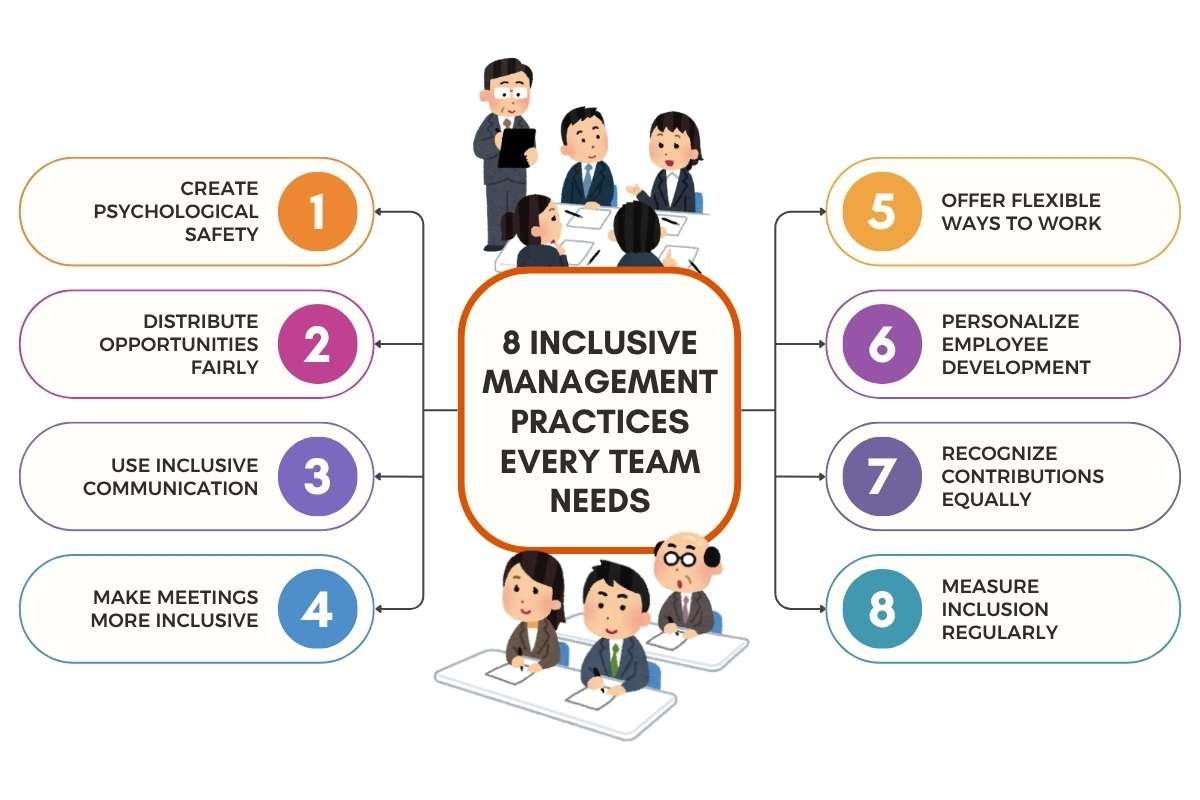
Great leaders know that grand tech visions require strong operational roots. You must convert high-level cultural values into daily workflows for your staff. These systemic habits bridge the gap between abstract goals and real progress. Let us review the core methods that will transform your tech department.
1. Create psychological safety
You must encourage tough questions and normalize small technical mistakes to build trust. Invite healthy disagreement during your code reviews and deep architectural planning sessions.
For example, share your own past development errors during team meetings. This open approach shows your engineers that failure is a tool for learning. Innovation thrives when your developers feel safe enough to share risky ideas.
2. Distribute opportunities fairly
Unconscious favoritism often skews how you pass out core assignments. You must track who gets high-visibility tasks and major stretch projects. Ensure all engineers get a fair shot at leading critical system upgrades.
Check your promotion metrics regularly to stop accidental bias in its tracks. Balanced growth creates a stronger, more capable engineering pipeline for your business.
3. Use inclusive communication
Clear language reduces friction across global, multi-cultural tech departments. You should always use accessible phrasing and avoid broad cultural assumptions daily. Practice active listening by repeating back core points during your one-on-one syncs.
This style ensures everyone stays aligned on major software sprint goals. Good communication builds deep respect among your diverse engineering team members.
4. Make meetings more inclusive
Send detailed agendas beforehand so introverts can process information before you meet. Rotate your session facilitators weekly to give every engineer a leadership role. You can collect fresh ideas through anonymous feedback tools before major calls.
This format guarantees equal speaking time and stops loud voices from dominating. Diverse input always leads to better software architecture and faster deployment.
5. Offer flexible ways to work
Flexible setups empower caregivers, workers with disabilities, and those in distinct time zones. You can rely on asynchronous updates to keep cross-border projects moving smoothly. Let your developers choose core hours that fit their unique personal lives.
This trust boosts daily output while lowering employee burnout across your group. Flexibility shows your tech talent that you respect their time and needs.
6. Personalize employee development
Ditch identical growth tracks for customized plans that fit specific career goals. Ask your developers about their preferred learning styles during quarterly reviews. Pair your junior staff with senior tech experts for targeted mentorship loops. Custom development paths help you retain top-tier female engineers and architects. Your team grows stronger when individuals master skills that fit their passions.
7. Recognize contributions equally
Visibility bias often highlights loud talkers while hiding your quiet performers. You need to praise excellent background work like documentation and bug fixes. Build objective recognition systems that track clear, measurable engineering metrics every month.
Celebrate these solid wins publicly so everyone feels valued for their work. Fair praise keeps morale high across your entire engineering department.
8. Measure inclusion regularly
Use quick pulse surveys to track real sentiment across your department. Look at hard promotion data and turnover rates across different demographic groups. High turnover among specific groups signals a clear need for operational changes.
These strict metrics provide a clear framework that modern tech executives love. Data helps you refine your inclusive management practices for maximum impact.
How to practice inclusive management with strong and struggling teams?
Your team’s performance level alters how you deploy your daily operational tools. High-performing groups need space to grow, while struggling units require deep structure. You must adapt your approach to fit the current health of your staff.
The tables below outline how you can guide both team types.
| Operational Focus | Strategy for Strong Teams | Strategy for Struggling Teams |
| Team Autonomy | Pass full ownership to senior engineers for major system designs. | Define clear, simple targets for every single developer on your team. |
| Voice & Input | Request opposing technical viewpoints during your core architecture reviews. | Remove fear of failure by treating code bugs as learning moments. |
| Daily Guidance | Intervene when loud developers drown out quieter tech experts. | Hold frequent, supportive one-on-one sessions to build technical skills. |
| Peer Dynamics | Let different engineers lead your weekly software sprint planning sessions. | Pair struggling workers with empathetic mentors for daily coding support. |
| Morale Boosters | Challenge your top performers with high-visibility stretch assignments. | Praise small engineering improvements to lift low team morale quickly. |
You must tailor your inclusive management practices to meet people where they are. Strong teams thrive on freedom, while struggling groups need steady, clear guidance.
Inclusive behaviors at work: tips for first-time women managers

Stepping into your first tech management role requires a clear shift in mindset. You must establish your authority without copying old, aggressive corporate command styles. Focus on building clear workflows that protect your team and your time.
Use these targeted tips to lead your engineering unit with confidence:
- Set Clear Boundaries: Define your working hours clearly to prevent late-night Slack message burnout.
- Stop Over-Apologizing: Swap soft phrases like “sorry to bother you” for direct, professional requests.
- Balance Accountability: Pair deep empathy for personal situations with firm deadlines for software sprints.
- Create Fair Openings: Rotate stretch assignments intentionally instead of picking the same visible worker.
- Give Direct Feedback: Share clear performance critiques right away so your developers can improve quickly.
- Handle Interruptions Firmly: Use calm phrases like “Let me finish my thought” during tech meetings.
These practical steps help you run an efficient and balanced engineering group. They ensure you maintain high standards while keeping your workspace completely fair. You can protect your team’s culture while driving real technical results.
Your unique approach will redefine what modern inclusive management practices look like.
Read more:
- What are Inclusive Leadership Characteristics? Here’s All You Need to Know
- Success Stories of Inclusive Leaders
Inclusive management practices for remote and hybrid teams
Running remote and hybrid tech engineering teams requires a deliberate, intentional structure. You cannot rely on casual office chats to keep your workers aligned. Instead, you must build explicit digital systems that support everyone equally.
Focus on these essential workflows to optimize your distributed tech group:
- Shift to Async Syncs: Use clear status dashboards to track sprint progress across global locations.
- Write Everything Down: Maintain detailed technical documentation so everyone can access project files easily.
- Respect Time Zones: Rotate your meeting schedules fairly so no single region suffers constantly.
- Equalize Virtual Voices: Invite feedback via text chat during calls to include quiet introverts.
- Ensure Digital Access: Test your internal corporate software tools for basic screen reader compatibility.
- Track Pure Outcomes: Judge your engineers by their code quality rather than desk hours.
- Onboard with Care: Pair every remote hire with a virtual buddy for culture checks.
These structured habits prevent remote engineers from feeling isolated or completely left out. They help you build a cohesive, high-performing department across different continents. You ensure that geography never limits a talented developer’s career growth path.
Your remote setup will thrive when you embed inclusive management practices deeply.
Examples of inclusive management in women-led businesses

Real-world success stories show how top executives put these concepts into action. We can learn deep operational lessons from leaders interviewed by The Enterprise World. These business case studies prove that structural habits drive real team growth.
- Build Strong Process Foundations: Prachi from Dharohar uses a strict framework called L.A.N.D. to guide her real estate firm. She focuses heavily on legality, acquisition, nuance, and solid investment decisions. This process ensures that quality is repeatable rather than just accidental. She builds strong internal systems instead of merely chasing fast market transactions.
- Create Future Leaders Daily: Deepti Sharma, Director at MultiFit, believes true success means creating new leaders. She actively fosters resilience and helps her staff adapt to changing world trends. She also emphasizes total well-being, mental fitness, and healthy emotional balance. Her management style empowers people to build supportive communities inside the office.
- Design a Better Table: Amelia Castellanos, Founder of Buffaloe Digital, advises women to act before feeling ready. She encourages her team members to speak up when their views differ. Her operational goal is to build a better table for future talent. She trains managers to see the whole system rather than quick symptoms.
These corporate examples show how tech leaders can run balanced departments today. You can use these exact steps to upgrade your operational routines. True inclusive management practices turn these great leadership philosophies into a daily reality.
Inclusive leadership vs inclusive management
To scale your tech department, you must understand how these roles interact. Leadership sets the grand path, while management ensures your team runs smoothly.
The table below outlines the core differences between these two approaches:
| Inclusive Leadership | Inclusive Management |
| Creates a broad vision | Executes that vision daily |
| Inspires corporate culture | Builds steady team habits |
| Focuses on long-term strategy | Handles daily team operations |
| Influences the entire organization | Influences the immediate team |
| Sets core company values | Applies those values directly |
Your tech organization absolutely needs both styles to achieve true workplace equity. High-level vision fails without steady, everyday operational support across your engineering pods. Conversely, daily routines lose their core purpose without a clear guiding strategy.
Women CIOs must balance these twin tracks to build sustainable tech pipelines. You can use inclusive management practices to ground your grand leadership visions. This balance turns high ideals into repeatable, fair habits for every engineer.
Read more: Transformational vs. Inclusive Leadership
Conclusion:
True workplace equity does not come from broad corporate statements or grand goals. Instead, real inclusion happens through your small, everyday technical management decisions. Consistent, fair behaviors build deep trust across your engineering department over time. You do not need to change your entire corporate structure overnight.
We encourage you to start with just one or two core actions. For example, you can rotate your meeting facilitators starting next week. Small, intentional changes will yield massive improvements for your engineering team members. You can slowly build a high-performing tech workspace that welcomes everyone.
Commit to these Inclusive Management Practices to unlock your team’s full potential. Your daily dedication will pave the way for a brighter tech future.
People also asked:
1. What are inclusive management practices?
Inclusive management practices are daily operational routines that ensure every single employee feels safe, valued, and respected.
2. How are inclusive management and inclusive leadership different?
Leadership sets the high-level corporate vision, while management executes that vision through everyday workplace habits.
3. Why are inclusive management practices important for remote teams?
These structured digital habits prevent remote engineers from feeling isolated across different time zones.
4. What are examples of inclusive management in the workplace?
Practical examples include sharing meeting agendas beforehand and rotating your session facilitators weekly.
5. How can first-time managers become more inclusive?
New managers can build trust by setting clear boundaries and handling meeting interruptions firmly.
Thank You For Reading!
Know More
Causes of Failure in Inclusive Leadership: Why 80% of Corporate Diversity Strategies Fail Women Executives