

Negotiation styles shape how you handle conflict, protect your interests, and reach agreements. This guide explains the five core styles, when to use each, practical negotiation tactics, common mistakes, and strategies for salary, promotions, flexible work, and business negotiations.
Negotiation is not about being the toughest person in the room. The negotiation styles you use can influence whether you reach a quick compromise, create a better deal, preserve a relationship, or walk away from an unfavourable agreement.
A competing approach can help protect an important outcome, while collaboration can create value when both sides have different priorities. Compromise, accommodation, and avoidance can also be effective when used deliberately.
Understanding these differences matters in salary discussions, promotions, business deals, workplace conflicts, client negotiations, and everyday decisions.
The goal is not to master one style. It is to know when to push, when to collaborate, when to compromise, and when to pause.
What are negotiation styles?
Negotiation styles are the different ways people approach disagreements, competing interests, concessions, and agreements.
The five commonly recognised styles are competing, collaborating, compromising, accommodating, and avoiding. They differ mainly in how much importance a negotiator places on their own outcome versus the relationship or the other party’s outcome.
| Negotiation style | Primary focus | Best used when |
| Competing | Protecting your interests | The outcome is highly important |
| Collaborating | Creating mutual value | Both sides have important interests |
| Compromising | Finding middle ground | A practical solution is needed |
| Accommodating | Preserving the relationship | The issue matters less to you |
| Avoiding | Delaying or withdrawing | More information or better timing is needed |
These styles are not fixed personality types. The same person can use different negotiation styles in different situations. The way these styles are expressed can also vary across cultures, workplaces, and professional settings, making cultural differences in negotiation an important consideration when negotiating across teams, organisations, or countries.
For example, you might collaborate with a long-term client, compete when protecting a critical business boundary, compromise when time is limited, and avoid a discussion temporarily when emotions are too high.
That flexibility is what makes negotiation strategic rather than automatic.
What are the five main negotiation styles?
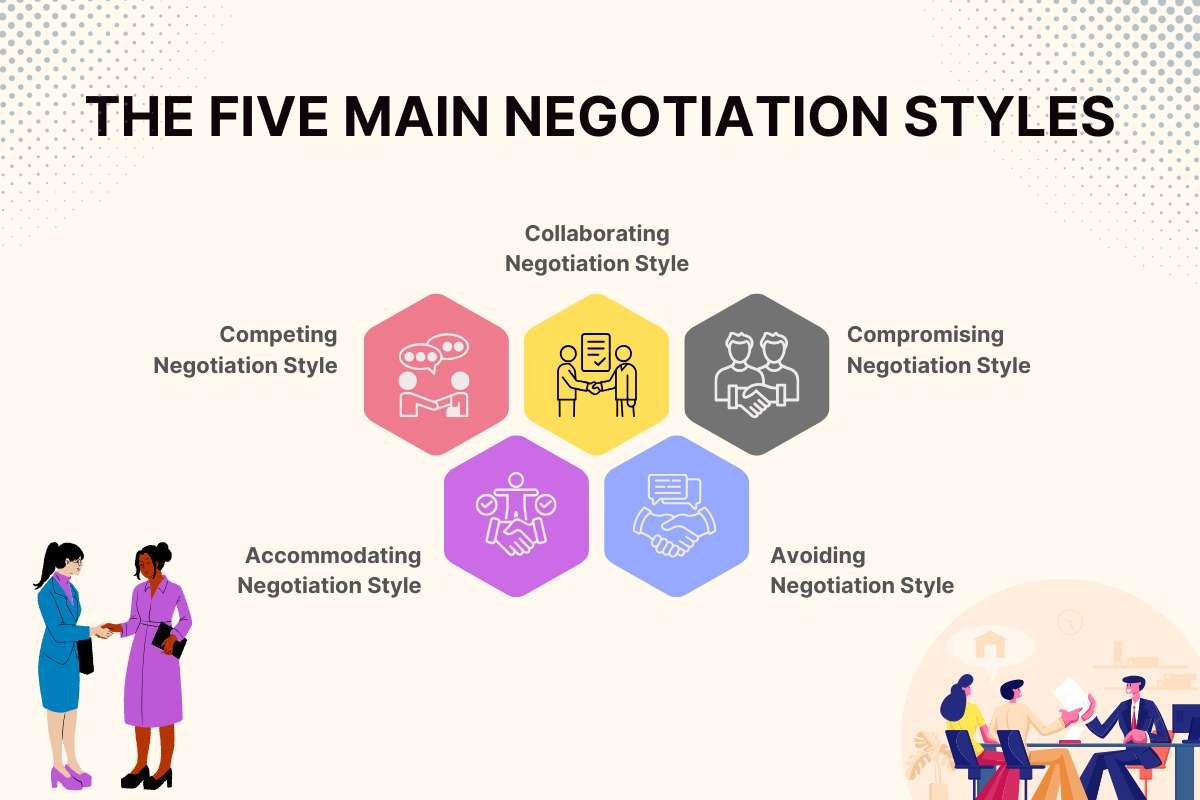
1. Competing negotiation style
The competing negotiation style is highly assertive and focused on achieving your preferred outcome.
It can be appropriate when:
- The issue has significant consequences
- You have strong evidence supporting your position
- You have a strong alternative
- A clear boundary needs to be protected
- The relationship is less important than the immediate outcome
For example, if you are negotiating a salary and research shows that your target is supported by the market and your experience, you might say:
“Based on the scope of the role and relevant market benchmarks, I’m targeting ₹15 lakh.”
Being competitive does not mean being aggressive. You can be firm without becoming confrontational.
The risk is overusing this style. Constantly treating negotiations as contests can damage relationships, reduce trust, and make future collaboration harder.
Best principle: Be firm about important interests without turning the negotiation style into a personal
conflict.
2. Collaborating negotiation style
The collaborating negotiation style focuses on understanding both sides and finding an outcome that creates value for everyone involved.
It works particularly well when:
- The relationship matters
- Multiple issues can be negotiated
- Both sides have important interests
- You expect to work together again
- There is potential to create additional value
Consider a salary negotiation.
If the employer cannot increase base pay, you might explore:
- Performance bonuses
- Flexible work
- Additional leave
- Professional development
- Earlier salary review
- Title or responsibilities
Instead of asking only:
“Can you increase the salary?”
you can ask
“If the base salary is fixed, what flexibility is available elsewhere in the overall package?”
This changes the conversation from dividing a fixed amount to exploring what else can be negotiated.
The collaborative style is especially useful in complex negotiations because different priorities can create mutually beneficial trade-offs.
Best principle: Look for differences in priorities that allow both sides to gain something important.
3. Compromising negotiation style
The compromising negotiation style aims for a middle-ground solution.
Both sides give up something to reach an agreement.
For example:
- One party wants a project completed in four weeks.
- The other needs six weeks.
- They agree on five weeks.
Compromise can be useful when:
- Time is limited
- Both sides have relatively similar bargaining power
- The issue is important but not critical
- A workable agreement is better than prolonged disagreement
However, compromise should not become an automatic response.
Splitting the difference is not always fair or optimal.
If one party has strong evidence supporting its position, simply meeting halfway may leave value on the table.
Before compromising, ask:
“What am I giving up, and what am I receiving in return?”
4. Accommodating negotiation style
The accommodating negotiation style prioritises the other party’s needs or the relationship over your own immediate outcome.
It can make sense when:
- The issue is relatively minor to you
- The relationship is highly valuable
- The other party cares much more about the issue
- You want to build goodwill
- The cost of accommodating is low
For example, if a colleague strongly prefers a particular meeting time and the timing makes little difference to you, accommodating their preference may be an efficient choice.
But repeated accommodation can become costly.
If you constantly accept additional responsibilities, lower your price, or give up your preferences without receiving anything in return, you may weaken your negotiating position.
Best principle: Accommodate deliberately, not automatically.
5. Avoiding negotiation style
The avoiding negotiation styles involve delaying, postponing, or temporarily withdrawing from a negotiation.
It is useful when:
- The issue has little importance
- You need more information
- Emotions are running high
- The timing is poor
- Continuing the conversation would create more cost than value.
For example:
“I’d like some time to review the proposal before I respond.”
That is not necessarily a weak response.
Strategic delay can give you time to research the market, evaluate your alternatives, or prepare a stronger position.
The problem arises when avoidance becomes a habit and prevents important conversations from happening.
Best principle: Pause strategically, but do not use avoidance to escape necessary decisions.
The five negotiation styles compared
| Style | Assertiveness | Cooperation | Main advantage | Main risk |
| Competing | High | Low | Protects important outcomes | Can damage relationships |
| Collaborating | High | High | Creates mutual value | Can take more time |
| Compromising | Moderate | Moderate | Produces workable solutions | May leave value unused |
| Accommodating | Low | High | Preserves goodwill | Can lead to excessive concessions |
| Avoiding | Low | Low | Creates space to reassess | Can delay necessary action |
The important takeaway is that no negotiation style is universally superior. The choice between assertiveness and cooperation is particularly important when deciding whether to compete or collaborate; collaborative negotiation vs competitive approaches can produce very different outcomes depending on the situation.
The best approach depends on what you are negotiating, how important the relationship is, how much flexibility exists, and what alternatives you have.
What the research says about negotiation outcomes
Negotiation styles is also influenced by factors beyond communication style. Research has found that expectations and initial positions can affect outcomes.
A 2024 study published in Labour Economics examined data from more than 15,000 students and found relationships between wage expectations, negotiation behaviour, and subsequent wages. The researchers also identified gender differences in wage expectations and negotiation behaviour.
More recently, a 2025 Organization Science study examined more than 700,000 initial salary offers made to U.S. job candidates between 2017 and 2020. After accounting for job, employer, occupation, industry, location, and human-capital characteristics, the researchers reported a 5.5% gender difference in initial salary offers.
These findings reinforce an important practical point: “Preparation matters before the negotiation even begins.”
Knowing your market value, defining your target, and understanding your alternatives can help you enter the conversation with a clearer position rather than relying on guesswork.
Choosing the right negotiation style
Knowing the five negotiation styles is useful, but the real skill is knowing which style to use and when. There is no universally effective style. Research and established negotiation frameworks treat competing, collaborating, compromising, avoiding, and accommodating as different responses to different combinations of assertiveness and cooperation.
The value of learning different negotiation styles is not simply knowing their definitions. It is being able to recognise which approach is most likely to work based on the stakes, relationship, time pressure, and flexibility available.
How to choose the right negotiation style
Knowing the five negotiation styles is useful, but the real skill is knowing when to use each one. The right approach depends on the importance of the outcome, the value of the relationship, the time available, and your alternatives if no agreement is reached.
| Situation | Style to consider | Why |
| The outcome is critical, and your position must be protected | Competing | Prioritises an important objective |
| Both sides have important interests | Collaborating | Creates opportunities for mutual gains |
| You need a practical solution within limited time | Compromising | Balances competing priorities |
| The issue matters more to the other side | Accommodating | Preserves goodwill at a relatively low cost |
| Emotions are high, or information is incomplete | Avoiding | Creates time to reassess before deciding |
These are starting points rather than fixed rules. You can change your negotiation style as the discussion develops.
Consider the importance of the outcome
The more important the outcome, the more carefully you should protect your interests. For high-stakes negotiations involving salary, pricing, ownership, or contractual terms, an assertive approach may be appropriate when you have strong evidence supporting your position.
For low-stakes issues, however, spending significant time negotiating may not be worthwhile.
This is one reason negotiation styles should be treated as flexible tools rather than fixed behaviours. A high-stakes discussion may require more assertiveness, while a lower-stakes issue may call for cooperation or compromise.
Consider the relationship
Ask:
“Will I need to work with this person again?”
If the answer is yes, an overly competitive approach can create unnecessary friction. Collaboration may be more effective when dealing with a manager, long-term client, business partner, colleague, or strategic supplier.
The goal is not to sacrifice your interests, but to reach an outcome while preserving a relationship that has future value.
Consider Your Alternatives
Your BATNA (Best Alternative to a Negotiated Agreement) is what you will do if the negotiation fails. It could be another job offer, supplier, client, contract, or simply maintaining the current arrangement.
Before accepting an agreement, ask:
“If this negotiation fails, what is my best realistic option?”
A stronger alternative gives you greater clarity about whether an offer is worth accepting and reduces the pressure to agree to unfavourable terms.
Adapt your style as the negotiation changes
You do not have to use one negotiation style from beginning to end. You might collaborate while identifying the other party’s interests, compete when an important boundary is challenged, compromise on a lower-priority issue, accommodate when the cost is minimal, or pause when more information is needed. The way you adapt can also depend on how the conversation takes place, since negotiating in person vs over email can involve different communication dynamics.
The objective is not to choose the “best” style. It is to choose the most appropriate approach for the situation.
What are the four types of negotiation?

Negotiation types describe the nature of the problem being negotiated, while negotiation styles describe how you approach the conversation. Understanding the difference helps you choose the right strategy without confusing the two.
| Type | Main focus | Example |
| Distributive | Dividing limited value | Negotiating a fixed price |
| Integrative | Creating value for both sides | Negotiating salary, benefits, and flexibility |
| Compromise | Finding middle ground | Agreeing on a project deadline |
| Interest-based | Addressing underlying needs | Resolving a workplace disagreement |
- Distributive negotiation: Distributive negotiation focuses on dividing a fixed amount of value. When one side gains more, less remains for the other. Price negotiations are a common example.
- Integrative negotiation: Integrative negotiation looks for ways to create additional value before deciding how to divide it. Different priorities can make trade-offs possible, making a collaborating negotiation style particularly useful.
- Compromise: Compromise involves both sides making concessions to reach a workable agreement. It can be effective when time is limited, or neither party can achieve its preferred outcome.
- Interest-based negotiation: Interest-based negotiation focuses on why each party wants something rather than only what they are demanding. Identifying underlying interests can reveal solutions that satisfy both sides.
The type of negotiation and the style you use are not the same thing. For example, an integrative negotiation can involve a collaborating style, while a distributive negotiation may require a more competing approach.
What are the four golden rules of negotiation?
The most effective negotiations are built on a few fundamentals: prepare your position, understand the other side’s interests, know your alternatives, and keep disagreements focused on the issue rather than the person.
These principles provide the foundation for the practical negotiation tactics that follow. They help you choose the right negotiation style while staying clear about your priorities, limits, and potential trade-offs.
Practical negotiation tactics that work
Regardless of which negotiation style you prefer, effective preparation gives you greater control over the conversation. Your target, reservation point, BATNA, priorities, and supporting evidence should shape how you approach the negotiation. These same principles become particularly important when negotiating with clients, suppliers, or business partners, where B2B negotiation tactics can help structure discussions around pricing, contracts, scope, and timelines.
1. Know your target, minimum, and batna
Before negotiating, establish three things:
- Target: What you ideally want
- Reservation point: The least favourable deal you are prepared to accept
- BATNA: Your best alternative if no agreement is reached
For example, in a salary negotiation:
| Preparation point | Example |
| Target | ₹15 lakh |
| Reservation point | ₹13 lakh |
| BATNA | Continue pursuing other opportunities |
Your BATNA should be realistic, not hypothetical. A potential alternative that is unlikely to materialise should not give you false confidence.
2. Research before you make an offer
Your position becomes stronger when it is supported by objective information.
Depending on the negotiation, this could include:
- Market salary data
- Comparable prices
- Industry benchmarks
- Performance results
- Revenue contribution
- Cost savings
- Scope of responsibilities
- Previous agreements
Instead of:
“I think ₹15 lakh is fair.”
say:
“Based on the role’s scope, my experience, and relevant market benchmarks, I’m targeting ₹15 lakh.”
Objective criteria can make a proposal easier to evaluate and reduce the perception that the number is arbitrary. Harvard’s negotiation framework specifically recommends using objective benchmarks, standards, and precedents to support your position.
3. Ask before you argue
One of the simplest ways to improve a negotiation is to ask better questions and give the other person enough space to explain their position. The 70/30 rule in negotiation is one useful way to think about this balance, encouraging you to spend more of the conversation listening and asking questions rather than doing all the talking.
Instead of immediately responding to:
“We can’t increase the salary.”
Ask:
“What is limiting the current offer?”
Or:
“If the base salary is fixed, where else might there be flexibility?”
You may discover that the real constraint is not the entire compensation package but one specific component.
This creates room for a collaborative negotiation style rather than forcing the conversation into a yes-or-no decision.
4. Use conditional concessions
Do not give something away without understanding what you receive in return.
Use:
“If you can X, I can consider Y.”
For example:
“If the base salary cannot move, could we discuss an earlier compensation review?”
Or:
“If we extend the contract term, I can consider adjusting the price.”
This turns concessions into trades rather than giveaways.
5. Negotiate multiple issues
A negotiation becomes more flexible when there is more than one issue on the table.
Instead of discussing only salary, you might negotiate:
- Base pay
- Bonus
- Title
- Working arrangements
- Leave
- Review timeline
- Responsibilities
- Professional development
This is where integrative negotiation can be especially useful: differences in priorities can create opportunities for both sides to gain something they value.
Harvard’s Seven Elements framework similarly emphasises identifying interests and generating options rather than treating a negotiation as a single fixed demand.
6. Do not negotiate against yourself
After making an offer, give the other person an opportunity to respond. Their words are not the only signals worth noticing; pauses, facial expressions, posture, and other non-verbal cues can also provide useful context. Paying attention to body language and negotiation can help you recognise how the other person is responding before deciding what to say next.
For example:
“Based on the scope of the role, I’d like to discuss ₹15 lakh.”
Then pause.
Avoid immediately adding:
“But I’m flexible.”
or:
“I could accept ₹14 lakh.”
You have not yet received a counteroffer, so there is no reason to reduce your own position.
Common negotiation mistakes to avoid
Even a well-prepared negotiation can lose momentum when emotions, poor preparation, or unnecessary concessions weaken your position. Avoid these common mistakes:
| Avoid | Use instead |
| “Sorry to ask, but…” | “I’d like to discuss…” |
| “Whatever works for you.” | “My preferred option is…” |
| “That’s completely unfair.” | “Could we look at the criteria behind that?” |
| “Take it or leave it.” | “This is the point I’d need to reconsider.” |
| Immediate concessions | Conditional trade-offs |
| Personal criticism | Focus on the issue |
| Empty threats | A genuine BATNA |
Five mistakes that can weaken your position
- Negotiating without preparation: Know your target, priorities, evidence, and alternatives before entering an important negotiation.
- Revealing your minimum too early: Your reservation point is for deciding what you will accept, not necessarily for revealing to the other party.
- Making unconditional concessions: If you give something up, look for something of value in return. Conditional concessions turn giveaways into trades.
- Making it personal: Challenge the proposal rather than attacking the person. Keeping the discussion focused on the issue makes disagreement easier to manage.
- Ignoring your BATNA: If the proposed agreement is worse than your realistic alternative, continuing to negotiate may not be worthwhile.
Hardball tactics such as threats, insults, bluffs, or “take it or leave it” demands can escalate conflict. Staying prepared and responding to the issue rather than the emotion can help you maintain control of the negotiation.
How to apply negotiation styles to salary and career growth
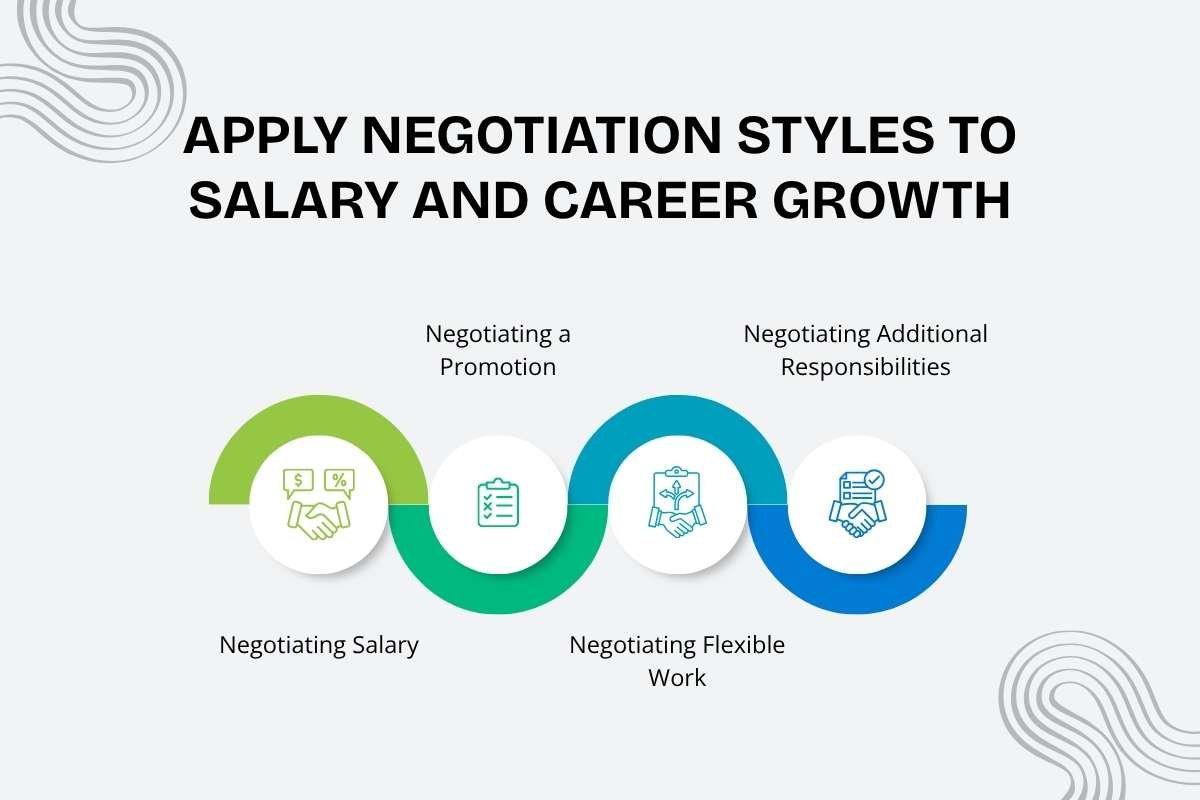
Career negotiations are where these principles become particularly practical. Different negotiation styles can be useful across salary discussions, promotion requests, flexible-work arrangements, and changes in responsibilities, depending on what you want to achieve. These situations also require understanding how women can negotiate strategically, particularly when discussing pay, promotions, responsibilities, or career opportunities.
1. Negotiating salary
Start with evidence rather than personal need.
Instead of:
“I need a higher salary because my expenses have increased.”
Focus on:
“Given the scope of the role, my experience, and the value I can contribute, I’d like to discuss a compensation package closer to ₹15 lakh.”
If the employer cannot move on base pay, shift toward a collaborative negotiation style and explore the broader package.
2 Negotiating a promotion
A promotion discussion should focus on scope and impact, not only tenure. If your responsibilities have grown significantly, but your title, level, or authority has not changed accordingly, it may be worth discussing negotiating job title and role scope alongside the promotion itself.
Instead of:
“I’ve been here for three years, so I think I deserve a promotion.”
Try:
“My responsibilities have expanded to include X, Y, and Z, and I’ve delivered these results. Could we discuss whether my current title and level reflect my current scope?”
If the promotion cannot happen immediately, negotiate measurable milestones and a defined review date.
3. Negotiating flexible work
Connect your request to how the arrangement can support performance and business requirements. When discussing the specifics of the arrangement, the principles behind how to negotiate flexible work arrangements can help you frame your request around both your needs and the organisation’s priorities.
For example:
“I’d like to discuss a hybrid arrangement of three remote days per week while maintaining availability for team meetings and key in-person requirements.”
If three days are not possible, you can negotiate around two days, working hours, or a trial period.
The goal is not simply to ask for flexibility, but to demonstrate how the arrangement can work.
4. Negotiating additional responsibilities
More responsibility should come with clarity around expectations.
Ask:
- What exactly is being added?
- What authority will I have?
- What existing work will be reduced?
- How will success be measured?
- When will the role be reviewed?
- Will the change affect title or compensation?
This keeps the discussion focused on the value and scope of the role, rather than simply accepting additional work.
Conclusion:
There is no single “best” negotiation style. A competing style can protect an important interest. Collaboration can create value. Compromise can resolve practical disagreements.
Accommodation can preserve a relationship when the issue matters less to you. Avoidance can give you time when the timing or information is not right.
The strongest negotiators know how to move between these approaches, and building negotiation skills for women can make that flexibility especially valuable in salary, promotion, workplace, and career conversations.
Before your next negotiation, ask yourself:
What do I want? What does the other side want? What can we trade? What is my alternative? And which negotiation style fits the situation?
That preparation can turn negotiation from an uncomfortable conversation into a deliberate strategy for reaching better outcomes.
The ability to switch between negotiation styles is particularly valuable because workplace and business negotiations rarely follow a single pattern from beginning to end.
FAQs
1. What Are the Five Main Negotiation Styles?
The five main negotiation styles are competing, collaborating, compromising, accommodating, and avoiding. Each is useful in different situations depending on your goals, relationship, and alternatives.
2. What Are the Four Types of Negotiation?
The four common types are distributive, integrative, compromise, and interest-based negotiation. They differ in whether the focus is dividing value, creating value, finding middle ground, or understanding underlying interests.
3. What Are the Four Golden Rules of Negotiation?
Know your value, understand the other side, know your BATNA, and separate the person from the problem.
4. What Is the Number One Rule of Negotiation?
Prepare before negotiating. Know your target, alternatives, evidence, priorities, and limits before starting the conversation.
5. What Should You Avoid While Negotiating?
Avoid poor preparation, emotional reactions, unnecessary concessions, personal criticism, empty ultimatums, and revealing your minimum too early.