
International careers allow women to work across markets, lead cross-border projects, build professional networks, and develop leadership skills. However, gender stereotypes, family responsibilities, workplace expectations, and unequal access to assignments can limit these opportunities.
Women and global mobility is therefore both a career-development issue and an organizational responsibility. Helen De Cieri’s chapter, Women and Global Mobility, published in Cambridge University Press’s Global Mobility and the Management of Expatriates, examines women’s international career experiences, advancement opportunities, and institutional barriers. It highlights the need for fair assignment selection, adequate relocation support, meaningful responsibilities, and recognition of international experience in career progression.
What Does Global Mobility Mean for Women?
Global mobility describes work-related movement across geographical boundaries. It can include company-sponsored international assignments, overseas employment, internal transfers, international business travel, regional management, and certain cross-border working arrangements.
Women can enter global careers through different routes depending on their qualifications, professional goals, financial circumstances, and personal preferences.
1. Company-Sponsored International Assignments
A company-sponsored assignment involves an employer sending an employee to another country for a defined business purpose. The assignment may support market expansion, project delivery, knowledge transfer, operational management, or leadership development.
For example, a finance professional may move to a regional office to coordinate operations across several markets. A technology manager may lead a product launch in another country or support the integration of an international team.
These assignments can help women gain exposure to unfamiliar markets and develop skills beyond their existing roles. However, an overseas posting should have a clear professional purpose. Women should understand their responsibilities, reporting structure, performance expectations, and potential career path before accepting.
Understanding global assignment opportunities for women can help professionals compare roles based on responsibilities, leadership exposure, and long-term career prospects. It also highlights why women and global mobility should be considered during employee development and succession planning.
2. Self-Initiated International Careers
Not every woman moves abroad through an employer-sponsored programme. Some professionals independently apply for overseas positions, relocate to pursue specialist opportunities, or seek employment in a country where their skills are in demand.
This route can offer greater control over the destination and type of work. However, it may provide less relocation assistance than a company-sponsored assignment.
Women pursuing self-initiated international careers should evaluate job security, immigration eligibility, recognition of qualifications, healthcare, housing, and access to professional networks. They should also determine whether the new role advances their career or simply changes their location.
For women crossing borders to pursue new roles, evaluating employment conditions, professional networks, and long-term career prospects can help make each move more sustainable. These considerations are equally important when examining women and global mobility beyond traditional corporate assignments.
3. International Projects and Regional Roles
International experience does not always require permanent relocation. Employees may participate in cross-border projects, travel for business, coordinate regional operations, or work with colleagues in several countries.
These opportunities can help women develop international experience while maintaining their existing household arrangements.
Organizations should ensure that international projects are distributed fairly. If challenging assignments and high-visibility responsibilities are repeatedly offered through informal networks, qualified women may miss opportunities to demonstrate their potential.
For this reason, women and global mobility should also include access to regional responsibilities, international client management, and cross-border leadership projects.
4. Remote Work With International Teams
Remote work can provide access to international employers and clients without requiring an employee to relocate. Women may contribute to global projects, manage overseas accounts, or work with distributed teams from their current location.
However, remote work is not automatically free from cross-border complications. Immigration, employment contracts, payroll, social security, and taxation may depend on where the employee physically works and how the arrangement is structured.
For women and global mobility, remote work is one possible route to international professional experience, but its career value depends on the responsibilities, visibility, and development opportunities it provides.
Women comparing relocation with remote employment can weigh the benefits of relocating for work vs. building a remote global career against their professional goals, family commitments, and preferred working arrangements.
Why International Experience Matters for Women’s Career Development
International assignments can contribute to career growth when women receive meaningful responsibilities and their achievements are recognized. Simply working in another country does not guarantee a promotion or stronger leadership prospects.
1. Building International Leadership Skills
Managing teams across borders can expose women to different business practices, regulatory environments, customer expectations, and management styles.
A woman leading a regional expansion project, for example, may gain experience in market entry, budgeting, stakeholder management, and cross-cultural communication. These skills can be relevant to future positions involving international operations or regional business strategy.
To gain this value, women should seek assignments with measurable objectives and genuine decision-making authority. An assignment that involves substantial responsibility may provide more professional development than a prestigious location with limited influence.
2. Expanding Professional Networks
International work can connect women with colleagues, customers, mentors, senior executives, and industry professionals in other markets.
These relationships can help women understand local business practices, exchange knowledge, and identify future opportunities. They may also provide support when women move into a new organization or return to their home country.
Building a professional network should begin before relocation and continue throughout the assignment. Women can connect with colleagues at the destination office, join relevant industry associations, and maintain relationships with managers in their home organization.
Strong professional networks can also improve access to international assignments, making them an important consideration in women and global mobility programmes.
3. Developing Cross-Cultural Business Knowledge
International work can help women understand how communication, negotiations, customer expectations, and business decisions vary across markets.
This knowledge may be valuable when managing international partnerships or coordinating regional operations. However, effective cross-cultural leadership requires more than observing differences. Professionals also need to understand local regulations, listen to colleagues, and adapt their management approach to the situation.
For women and global mobility, the key is to turn international exposure into demonstrable professional capability.
What Barriers Affect Women’s Global Mobility?
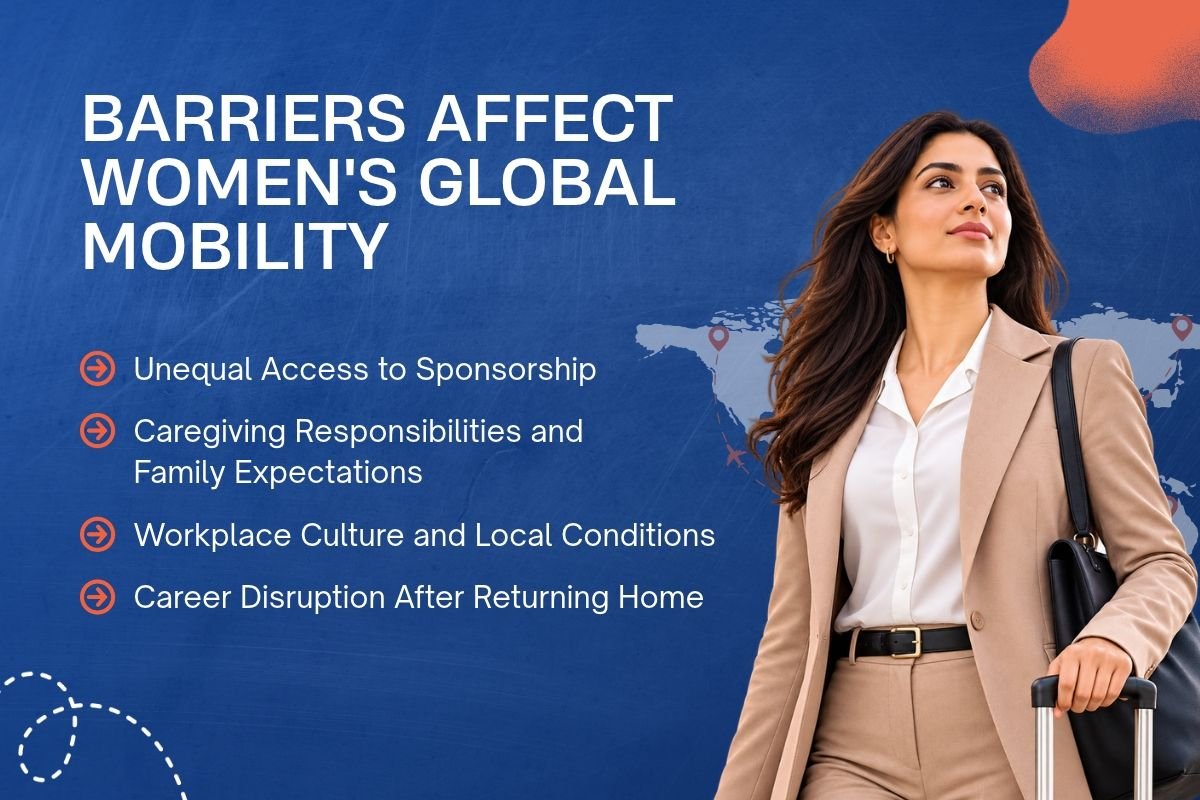
Women do not share one uniform international career experience. Barriers differ according to destination, industry, seniority, organizational culture, and personal circumstances. Nevertheless, several issues can influence access to assignments and career progression.
Examining these barriers is essential to understanding women and global mobility, particularly when organizations want to create fairer international career opportunities.
Gender Stereotypes in Assignment Selection
Managers may assume women won’t relocate, travel frequently, or accept positions that require long periods away from home.
These assumptions can prevent women from being considered for opportunities before their interest is established. A woman with family responsibilities may still be willing and able to accept an assignment, while another employee may prefer a regional or remote role.
Organizations should not treat gender, marital status, or parenthood as a substitute for assessing individual interest and suitability.
Transparent selection criteria, open expressions of interest, and documented decisions can help reduce the influence of informal assumptions. These measures are particularly relevant to women and global mobility because assignment decisions can influence access to future leadership positions.
1. Unequal Access to Sponsorship
Mentoring and sponsorship can play different roles in career advancement. Mentors offer advice and help professionals navigate challenges. Sponsors use their influence to advocate for employees, recommend them for demanding assignments, and support their progression.
When sponsorship develops mainly through informal relationships, access may be uneven. Women who are excluded from influential networks can miss opportunities to demonstrate their abilities.
The World Economic Forum’s 2024 article on women’s representation in the transport and mobility industry highlights sponsorship programmes as one measure organizations can use to improve women’s access to senior and challenging roles.
The article concerns transport and aviation organizations rather than the entire global workforce, but its recommendation is relevant to employers reviewing their talent-development practices.
Source: World Economic Forum, 3 Ways to Increase the Representation of Women in Mobility.
Organizations can establish formal sponsorship programmes, ensure women are considered for high-visibility assignments, and assess whether sponsored employees receive meaningful career opportunities. Such measures can strengthen the organizational approach to women and global mobility.
2. Caregiving Responsibilities and Family Expectations
Relocation can affect childcare, eldercare, schooling, a partner’s employment, and access to an established support network. These considerations can influence whether an international assignment is practical or desirable.
The International Labour Organization estimated that 708 million women and 40 million men worldwide were outside the labour force because of unpaid care responsibilities in 2023. The estimates covered 125 countries.
Source: International Labour Organization, Unpaid Care Work and Labour Force Participation.
This statistic does not measure international assignment participation or prove that caregiving causes women to reject overseas positions. It demonstrates the wider scale of care-related barriers affecting women’s participation in paid employment.
Employers can help by providing sufficient relocation notice, dependent support, flexible assignment structures, and clear information about schooling and healthcare. Women should also be able to make career decisions based on their own priorities without being expected to prove their commitment through relocation.
Addressing these practical concerns is an important part of making women and global mobility programmes more accessible and sustainable.
3. Workplace Culture and Local Conditions
A destination’s employment laws, workplace culture, healthcare access, accommodation, and transport arrangements can influence a woman’s relocation decision.
Women should examine relevant employment protections, workplace reporting procedures, and the practical conditions associated with the role. They should also ask employers about insurance, emergency support, and destination-specific risk assessments.
Conditions vary between countries and employers. Broad assumptions about an entire region are not a reliable substitute for country-specific research.
Organizations have a duty to communicate relevant risks and support arrangements clearly before an employee commits to a move.
Women comparing opportunities as expats in Asia versus the Middle East should assess country-specific employment laws, workplace expectations, safety arrangements, and career prospects before deciding where to relocate.
These considerations demonstrate why women and global mobility must account for both professional opportunities and the practical realities of working in different countries.
4. Career Disruption After Returning Home
An international assignment can become a career setback if the employee returns without a suitable role or finds that the experience is not recognized.
A woman may have managed an international project, developed new market expertise, or led a distributed team without receiving a clear opportunity to apply those skills after returning.
Career continuity should therefore be addressed before the assignment begins. Managers should discuss expected outcomes, performance measures, potential next roles, and the process for evaluating the employee’s achievements.
For women and global mobility, successful relocation is not the only measure of success. The assignment should also contribute to the employee’s long-term professional development.
How Women Can Prepare for International Career Opportunities
Women can improve their readiness for global careers by evaluating opportunities carefully and preparing for the practical demands of working across borders.
Preparation is an important part of women’s global mobility because international opportunities involve professional, financial, legal, and personal considerations.
1. Identify the Right Career Route
The first step is to determine the type of international experience that supports the woman’s professional goals. Options may include a company-sponsored assignment, an independently secured overseas job, a regional leadership role, a short-term project, or remote work with an international team.
Women should assess whether the role offers specialist expertise, greater responsibility, market exposure, or access to future leadership opportunities.
They should also consider whether relocation is necessary to achieve those goals. A strong regional role or international project may provide substantial experience without requiring a permanent move.
Comparing international career moves for women can help professionals decide whether an overseas job, an internal transfer, a regional leadership role, or a cross-border project best fits their ambitions.
2. Review the Assignment Terms
Before accepting an international role, women should request clear information about:
- Job responsibilities, reporting lines, and performance expectations.
- Salary, relocation allowances, housing, insurance, and other benefits.
- Assignment duration, renewal conditions, and termination provisions.
- Work authorization and dependent visa requirements.
- Healthcare, schooling, transport, and accommodation.
- Career development, mentoring, and possible roles after the assignment.
An International Work Assignment Checklist can help women compare offers and identify unanswered questions before committing.
3. Evaluate Financial Viability
A higher salary does not automatically translate into a better financial outcome. Women should compare expected take-home pay with destination-specific taxes, rent, transport, insurance, childcare, schooling, and other household expenses.
They should also account for relocation costs, travel to their home country, currency fluctuations, and any reduction in a partner’s income.
Where applicable, the employment contract should explain who pays relocation expenses and whether the employee must repay any benefits if the assignment ends early.
The aim is to understand the overall financial implications rather than focus on the headline salary.
4. Verify Immigration and Employment Requirements
Visa and work authorization requirements differ by country, nationality, employer, and role. Women should consult the destination country’s official immigration authority to confirm the appropriate route.
They should check whether the permit authorizes the intended work, whether dependants may accompany them, and whether accompanying family members can work.
Reviewing work visa options for women professionals can help applicants identify suitable immigration routes and understand whether their permits allow employment, dependent relocation, or work by accompanying family members.
Remote work also requires careful consideration. Working for an overseas employer while physically present in another country can raise immigration, payroll, and tax questions even when the employee does not relocate permanently.
Where the rules are unclear, qualified immigration or tax advice may be necessary.
5. Build Networks Before Departure
Women can connect with colleagues in the destination office, industry associations, alumni networks, and professional communities before moving.
Communities and networks for women working abroad can provide additional perspectives on workplace expectations and the practicalities of living in a new country.
Mentors can offer guidance on unfamiliar business environments, while sponsors can advocate for career opportunities. Both relationships can be useful during an assignment and after a return to the home market.
Developing these connections early can make women’s global mobility experiences more professionally rewarding and help employees establish support systems in unfamiliar markets.
How Can Organizations Improve Women’s Global Mobility?

Organizations play an important role in determining who gets considered for international assignments, what support employees receive, and whether overseas experience contributes to career progression.
The Cambridge University Press chapter emphasizes that women’s globally mobile careers are influenced by factors that can facilitate or hinder participation. This makes global mobility a shared responsibility rather than a challenge women should be expected to solve individually.
Improving women’s global mobility requires organizations to review their recruitment, assignment selection, employee support, and career development practices.
1. Make Assignment Selection Transparent
Employers should establish clear eligibility criteria and give employees a fair opportunity to express interest in international roles.
Selection should be based on relevant skills, performance, role requirements, and career potential. Managers should avoid assuming that women will be unwilling to relocate because of family circumstances.
Organizations can track the number of eligible women, women nominated, women selected, and assignments accepted. These figures help identify where participation differs and where further investigation may be useful.
2. Listen to Women’s Experiences
Policies should respond to the actual challenges employees experience rather than relying on assumptions about what women need.
The World Economic Forum’s transport-sector article recommends involving women in developing career initiatives and increasing their visibility in leadership discussions, presentations, and organizational communications.
For broader global mobility programmes, employers can apply the underlying principle by consulting women who have completed assignments, gathering feedback from employees considering relocation, and reviewing whether existing policies address their concerns.
The specific interventions should reflect the organization’s workforce and operating environment. Listening to employees can help businesses identify practical barriers and improve the effectiveness of women and global mobility initiatives.
3. Establish Sponsorship Programmes
Employers can formalize sponsorship by connecting women with senior leaders who can advocate for their development and access to challenging roles.
Sponsors should help women gain exposure to meaningful projects, understand advancement criteria, and connect with decision-makers.
The programme should be evaluated through actual career opportunities and outcomes, rather than participation numbers alone.
4. Provide Practical Relocation Support
Relocation packages should explain the support available for housing, immigration, insurance, healthcare, schooling, and dependants where applicable.
Organizations can also consider short-term assignments, rotational roles, international projects, and regional responsibilities for employees who cannot commit to long-term relocation.
Flexible options can widen access to international experience without assuming that every employee has the same needs or preferences.
A flexible approach to women and global mobility can help organizations accommodate different career stages and personal circumstances without reducing professional opportunities.
5. Plan for Career Progression
Before an assignment begins, managers should agree on objectives, expected results, and the skills the employee is expected to develop.
During the assignment, employees should receive feedback and remain connected to relevant decision-makers in their home organization.
Before the assignment ends, the employee and employer should discuss suitable next steps. After returning, the organization should evaluate the experience and consider roles that make use of the employee’s new capabilities.
For women on global assignment, regular feedback, leadership sponsorship, and a defined return-to-work plan can help ensure that international experience contributes to long-term career advancement.
This continuity is essential to ensuring that women and global mobility initiatives deliver professional value beyond the duration of an overseas posting.
Measuring Progress in Women’s Global Mobility
Organizations need clear measures to understand whether their policies are improving access and career outcomes.
Useful indicators include:
| Measure | What it can reveal |
| Assignment nomination rates by gender | Whether women are being considered for international opportunities |
| Selection rates among eligible candidates | Whether selection outcomes differ and require further examination |
| Assignment acceptance and completion | Whether the role and support arrangements meet employees’ needs |
| Promotion after an assignment | Whether international experience is recognized in career decisions |
| Retention after returning home | Whether employees have viable opportunities after an assignment |
| Access to sponsorship and leadership projects | Whether women receive support and visibility for advancement |
These indicators should be interpreted in context. Differences may reflect job requirements, employee preferences, assignment types, or organizational practices. The purpose of measurement is to identify patterns and investigate barriers, not to assume that every difference has the same cause.
Employers should also protect employee privacy and use consistent definitions when comparing outcomes.
Tracking these indicators can help businesses understand whether their women and global mobility policies are improving access to international roles and supporting career progression. Measurement should focus on meaningful outcomes rather than simply counting the number of women who relocate.
The Business Perspective: Why Inclusive Global Mobility Matters

International assignments can help organizations develop market knowledge, transfer expertise, build regional leadership capabilities, and prepare employees for broader responsibilities.
When qualified women are overlooked, organizations may fail to consider part of their available talent. Transparent assignment processes and structured sponsorship can help widen the pool of employees considered for international roles.
The World Economic Forum’s transport and mobility article provides an industry-specific example of this challenge. It discusses women’s underrepresentation in senior roles in aviation and identifies listening to women, developing sponsorship, and recruiting into underrepresented positions as practical actions.
These recommendations should be applied according to the context of each organization rather than treated as proof that the same barriers or solutions exist in every industry.
Businesses can assess the effectiveness of their global mobility programmes by examining assignment participation, career progression, retention, and achievement of defined business objectives.
A credible business case should connect these outcomes to actual programme data rather than assume that international exposure or gender diversity automatically guarantees stronger financial performance.
From a business perspective, women and global mobility should be treated as part of workforce planning, leadership development, and talent retention. Organizations that evaluate access to international opportunities can identify gaps in their talent pipelines and make better-informed decisions about employee development.
Inclusive policies can also help businesses create more transparent assignment processes, strengthen employee engagement, and ensure that international responsibilities are allocated according to professional capability rather than assumptions.
Ultimately, the success of women and global mobility initiatives should be assessed through fair access, meaningful responsibilities, employee experiences, and measurable career outcomes.
Conclusion:
Women and global mobility involve more than the decision to relocate. It includes access to international opportunities, the quality of the assignments offered, the support available during relocation, and the recognition women receive for their work.
Research on women in globally mobile careers highlights the importance of understanding both the factors that enable participation and the barriers that restrict it. Organizations can respond by making assignment selection transparent, developing sponsorship programmes, listening to women’s experiences, and connecting international assignments to long-term career development.
Women, in turn, can evaluate opportunities through their professional objectives, financial implications, legal requirements, and personal priorities.
When global mobility programmes are designed around fair access, meaningful responsibilities, and measurable outcomes, international careers can become a more effective part of women’s professional and leadership development.
Frequently Asked Questions:
1. What Does Women and Global Mobility Mean?
Women and global mobility refers to women’s access to international career opportunities, including overseas jobs, company-sponsored assignments, regional leadership roles, and cross-border remote work.
2. What Challenges Do Women Face in Global Mobility?
Women may face unequal assignment access, gender stereotypes, limited sponsorship, caregiving responsibilities, workplace concerns, and uncertain career progression after returning home.
3. How Can Companies Support Women on International Assignments?
Companies can ensure transparent selection, provide sponsorship and relocation support, set clear assignment goals, and plan for employees’ career progression after their return.
4. Can Women Build International Careers Without Relocating?
Yes. Cross-border projects, international remote teams, regional roles, and overseas client management can provide valuable global experience without relocation.
5. Why Is Sponsorship Important for Women’s Career Advancement?
Sponsors advocate for women’s career growth by recommending them for challenging assignments, connecting them with decision-makers, and supporting access to high-visibility projects.