
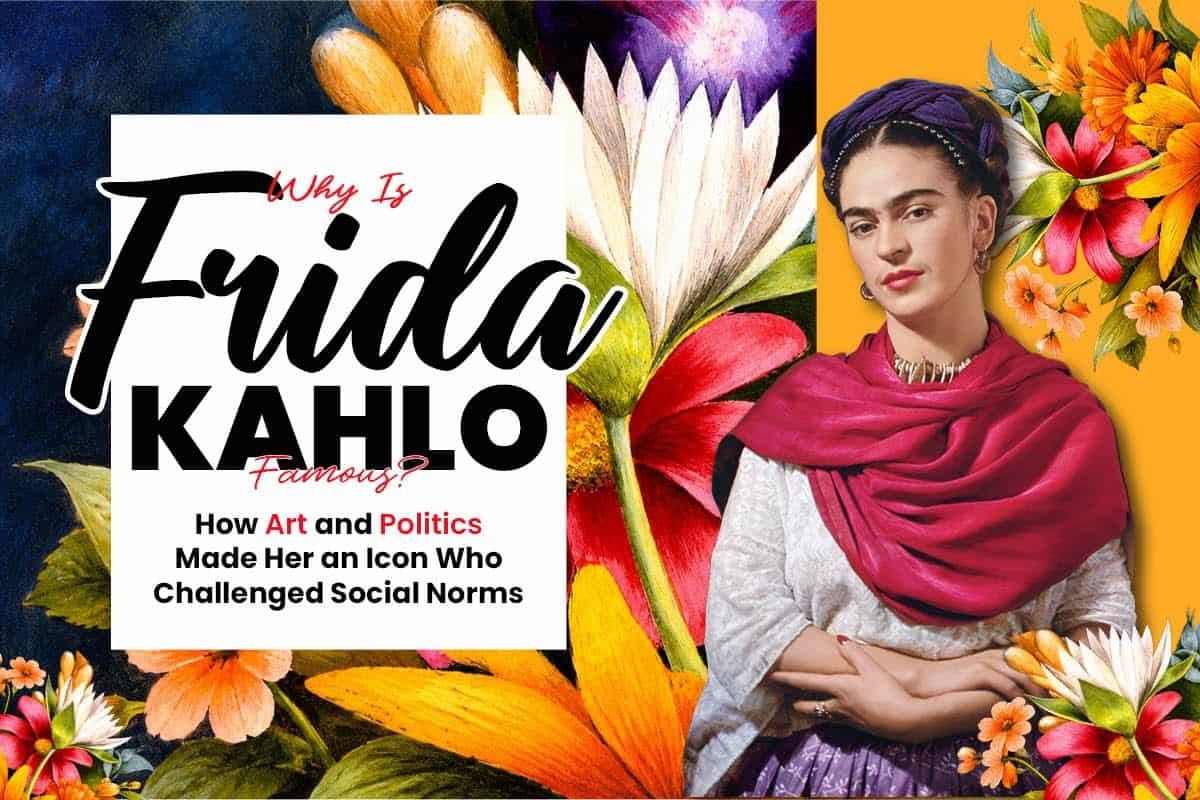
Why Is Frida Kahlo Famous? The Story Behind the Icon
Why is Frida Kahlo famous? She turned her own face into a canvas for some of the most difficult questions of her time: Who gets to define a woman? How does the body carry suffering? And can personal identity become an act of resistance? The Mexican artist became known for self-portraits that explored physical suffering, emotional conflict, Mexican cultural identity, and resistance to conventional expectations of femininity. Works such as The Two Fridas and The Broken Column transformed personal experiences into complex visual statements.
Her legacy extends beyond these paintings: her Communist commitments, distinctive self-presentation, and challenges to gender conventions have contributed to her later recognition as a feminist and LGBTQ+ icon. These labels reflect how subsequent generations have interpreted her life and work, rather than fully capturing how she understood herself.
How Did Frida Kahlo Turn Personal Experience Into Art?
A bus accident in 1925 left Kahlo with serious injuries and long-term health problems. During her recovery, she painted while using a mirror to observe her own face. Self-portraiture subsequently became a central part of her artistic practice, allowing her to examine identity, physical vulnerability, and emotional experience through carefully constructed images. Her accident helps explain the circumstances in which she developed her practice, although her art cannot be reduced to her injuries alone.
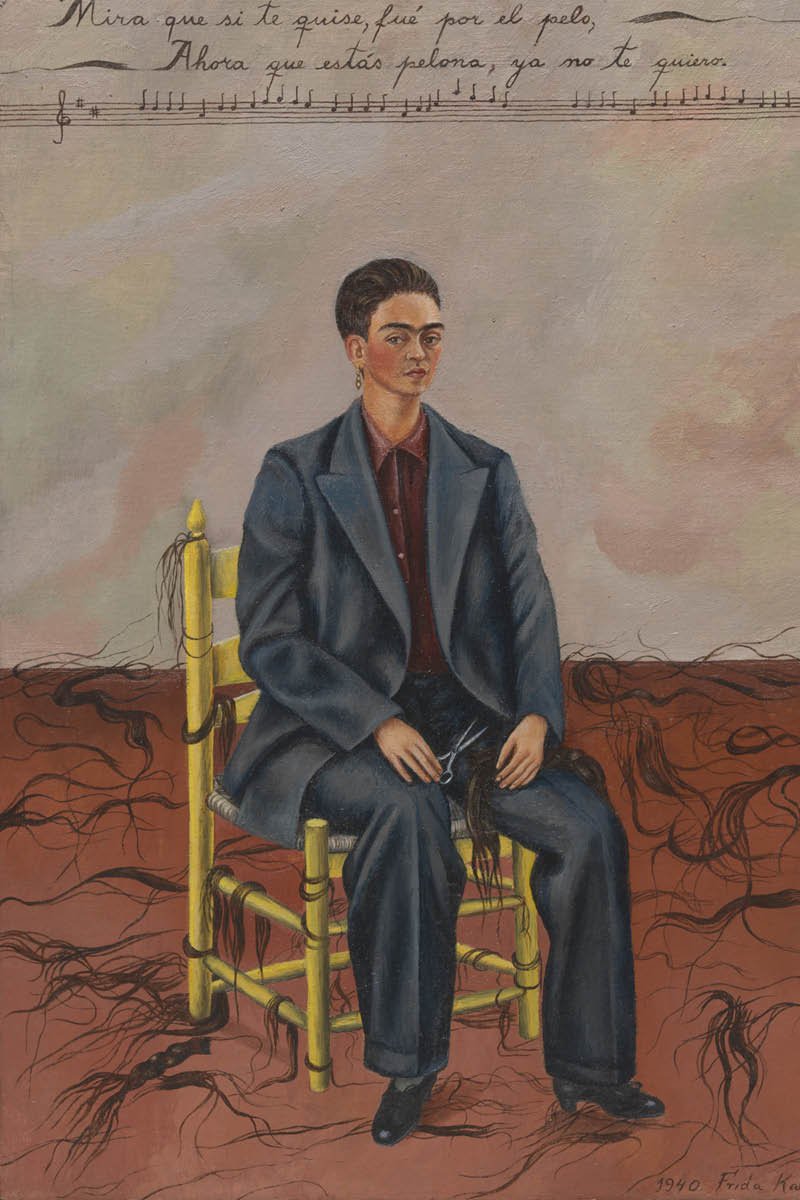
Among Frida Kahlo’s famous works of art are The Two Fridas (1939), The Broken Column (1944), and Self-Portrait with Cropped Hair (1940). Each offers a different way of examining identity and personal experience. The Two Fridas is often interpreted as an exploration of divided identity and emotional conflict, while The Broken Column represents bodily vulnerability through the image of a fractured torso. Rather than simply documenting her life, these paintings invite viewers to consider broader questions about identity, suffering, and resilience.
Kahlo’s self-portraits often used symbolic details to convey more than physical likeness. In Fulang-Chang and I (1937), a pink ribbon connects her to her pet monkey, Fulang-Chang, creating an imaginative representation of reality. Kahlo’s approach also reflected her interest in how artists see and interpret the world, a process she explored by using mirrors while painting. The work illustrates how she combined personal experience with imaginative visual details.
How Did Frida Kahlo Challenge Expectations of Women and Gender?
Kahlo used clothing, hairstyle, and self-portraiture to shape how she presented herself to the world. In Self-Portrait with Cropped Hair (1940), she appears in an oversized suit with short hair, departing from the long-haired, traditionally feminine image associated with several of her other portraits. The contrast makes the painting a powerful subject for discussions of gender expression and personal autonomy. Her photographs also reveal that self-presentation was an important part of her public identity. These choices challenged conventional expectations of femininity, although their meaning should be understood within Kahlo’s historical and cultural context rather than reduced to a single modern label.
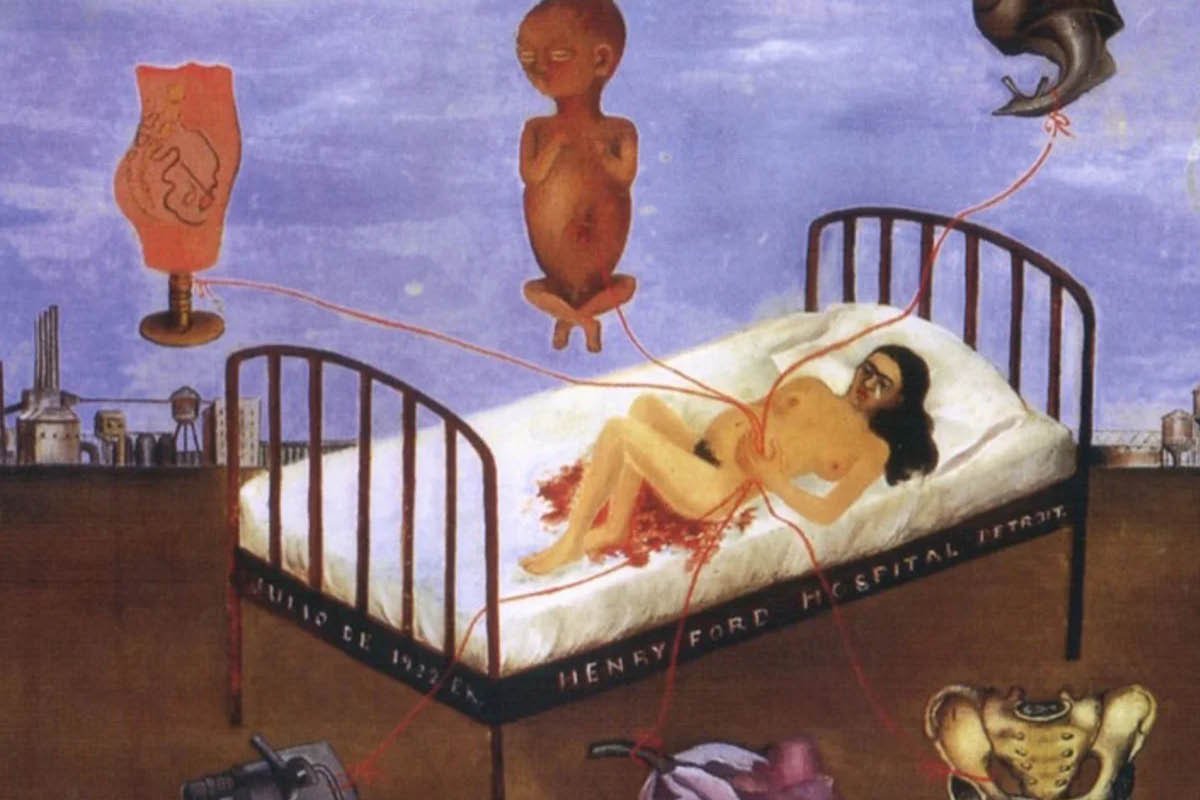
Kahlo also brought reproductive loss and physical vulnerability into her art. Her painting Henry Ford Hospital (1932) is associated with the miscarriage she experienced in Detroit that year. The Museo Frida Kahlo’s official timeline identifies the work with this event, while the San Francisco Museum of Modern Art discusses the painting in the context of her medical and personal struggles. The work’s treatment of reproductive loss brought an intimate experience into public view, challenging conventional boundaries around the subjects represented in art.
Today, LGBTQ+ artists and audiences find significance in Kahlo’s art and challenges to conventional expectations of gender and self-expression. Her posthumous recognition as an LGBTQ+ icon reflects how later generations have interpreted her work and life, although modern labels cannot fully explain how she understood her own identity or politics.
How Were Frida Kahlo’s Art and Political Beliefs Connected?
Kahlo’s political commitments formed an important part of her artistic identity. She identified as a Communist and engaged with the political and cultural debates shaping Mexico during her lifetime. Her work also drew on Mexican popular art and Indigenous cultural traditions, which informed how she represented national identity and her place within it. One direct expression of her political beliefs appears in Marxism Will Give Health to the Sick (1954), which presents Marxist ideology as a response to human suffering.
The painting depicts Kahlo casting aside crutches as a pair of hands associated with Marxism supports her body. This imagery reflects her belief in Marxism’s potential to free people from oppression and vulnerability. Created in the final year of her life, the work brings her political convictions into conversation with her experience of chronic illness, showing how ideology shaped her interpretation of personal suffering.
THREE PAINTINGS, THREE CHALLENGES
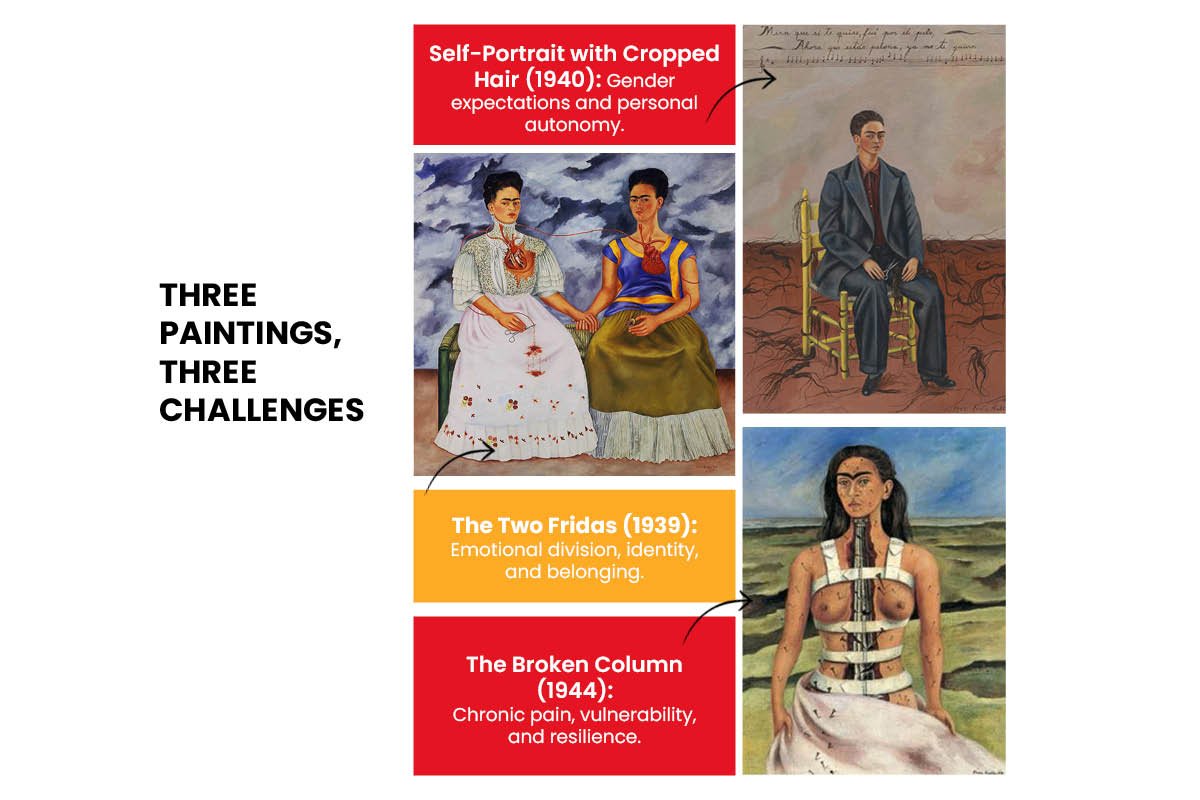
- The Two Fridas (1939): Emotional division, identity, and belonging.
- Self-Portrait with Cropped Hair (1940): Gender expectations and personal autonomy.
- The Broken Column (1944): Chronic pain, vulnerability, and resilience.
What Did Frida Kahlo’s Relationship With Diego Rivera Reveal About Her Life?
Kahlo and Rivera shared an intense, often turbulent relationship shaped by art, politics, infidelity, separation, and reconciliation. They married in 1929, divorced in 1939, and remarried the following year. Rivera was an important presence in her life, but Kahlo’s artistic identity cannot be explained simply through their marriage.
Her paintings frequently explored love, betrayal, loneliness, and emotional conflict on her own terms. Rivera formed part of her story, but her work established a distinct artistic voice that deserves to be considered independently of his reputation.
Why Is Frida Kahlo Still an Icon Today?
Why is Frida Kahlo famous beyond the art world? Although she was relatively little known outside artistic circles during her lifetime, her reputation grew after she died in 1954. During the 1970s and 1980s, feminist movements and Chicano artists helped bring renewed attention to her work. Hayden Herrera’s widely read 1983 biography further expanded her audience, helping introduce Kahlo’s life and art to readers around the world.
Today, Kahlo is recognized as both an influential artist and a global cultural icon. Her paintings continue to attract museum audiences, while her distinctive appearance features on fashion, merchandise, and social media. Her image is associated with Mexican identity, feminism, independence, and self-expression. Yet this popularity carries a tension: the commercial image of Kahlo can celebrate her individuality while flattening the political convictions and artistic complexity behind it. Her paintings remain significant for more than their visual appeal; they turn personal experience into an examination of society and the self.
Frequently Asked Questions (FAQs)
1. Is Frida Kahlo known for her self-portraits?
Yes. Kahlo is famous for self-portraits exploring identity, physical suffering, emotional conflict, and Mexican culture. The Two Fridas and The Broken Column are among her best-known works.
2. What was Frida Kahlo’s involvement in politics?
Kahlo was a committed Communist whose political beliefs influenced her artistic outlook, public identity, and engagement with social issues.
3. Why is Frida Kahlo considered an LGBTQ+ icon?
Kahlo’s relationships with women, varied self-presentation, and challenges to conventional gender expectations have contributed to her enduring significance for many LGBTQ+ audiences. Her status as an icon reflects how later generations have interpreted her life and work, and should not be treated as a definitive account of how she understood her own identity.
4. Was Diego Rivera unfaithful to Frida Kahlo?
Yes. Rivera had several affairs, including one with Kahlo’s sister Cristina, which placed considerable strain on their marriage. The couple divorced in 1939 and remarried in 1940.
Looking Beyond the Icon
Why is Frida Kahlo famous? The flowers in her hair and the unmistakable lines of her face may offer the quickest answer, but they are not the most important ones. Her paintings challenge viewers to question the boundaries between personal experience and public expression, and to reconsider the conventions by which people are judged. Perhaps that is the real paradox of Frida Kahlo: the more familiar her face becomes, the more urgently we need to look beyond it.
Read More: Malala Yousafzai: Courage, Books, and a Fund for Girls’ Education