

A senior executive receives two offers from growing companies. One offers an unpaid advisory role, while another proposes a formal board seat with director fees. Which opportunity fits her goals, time, and risk tolerance?
The paid board seat vs unpaid advisory role comparison goes beyond compensation. Both roles can shape strategy, but their authority, legal duties, and influence differ. For women leaders, advising a founder may build valuable relationships with investors and business leaders.
Yet advisory experience does not automatically qualify someone for a corporate board appointment. This blog compares compensation, decision-making power, liability, career value, and key questions before accepting either opportunity.
Understanding the two leadership roles
Understanding a paid board seat vs unpaid advisory role starts with the legal structure and expectations attached to each position.
The key distinction in a paid board seat vs unpaid advisory role is that a director is formally appointed to the board, while an advisor typically provides expertise without board voting authority.
A paid board seat starts with formal appointment to a company’s board. Directors help oversee strategy, risk, and corporate governance. Compensation may include director fees, meeting fees, equity, or other agreed benefits. Executive and non-executive directors hold different roles within the company.
An unpaid advisory role offers expertise without a standard fee. Advisors may share market insight, guide founders, or connect businesses with investors. Their authority depends on the agreement and their actual conduct. A strategic advisor title alone does not create a board appointment.
Comparing compensation, authority and responsibility
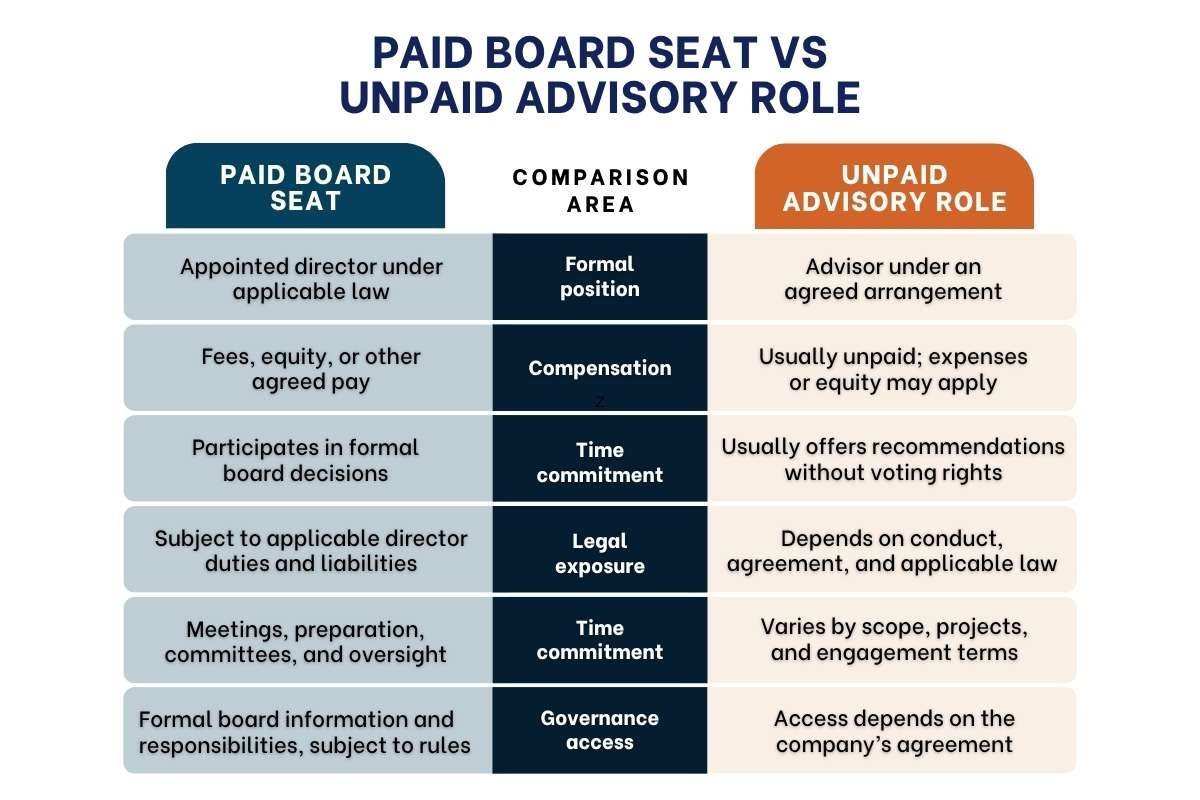
The paid board seat vs unpaid advisory role comparison becomes clearer when we examine practical differences.
| Comparison area | Paid board seat | Unpaid advisory role |
| Formal position | Appointed director under applicable law | Advisor under an agreed arrangement |
| Compensation | Fees, equity, or other agreed pay | Usually unpaid; expenses or equity may apply |
| Decision-making | Participates in formal board decisions | Usually offers recommendations without voting rights |
| Legal exposure | Subject to applicable director duties and liabilities | Depends on conduct, agreement, and applicable law |
| Time commitment | Meetings, preparation, committees, and oversight | Varies by scope, projects, and engagement terms |
| Governance access | Formal board information and responsibilities, subject to rules | Access depends on the company’s agreement |
What do these differences mean?
The paid board seat vs unpaid advisory role comparison involves more than compensation. A paid director may carry substantial legal duties. An unpaid advisor may gain valuable access to founders and investors.
The main distinction involves influence versus formal authority. An advisor might guide a CEO on cybersecurity risks. A board director may review risk controls and participate in oversight decisions.
For example, a cybersecurity executive could advise a startup on data protection. A formally appointed director may oversee risk governance within the board’s mandate. U.S. corporate law and applicable local rules determine the specific duties and liabilities.
The takeaway: Unpaid does not mean worthless, and paid does not mean risk-free. Review the agreement, responsibilities, and expected time before accepting either opportunity.
Which role supports your board career goals?

A formal board seat can show experience with oversight, risk, and board decisions. Yet the company’s size, sector, and governance structure matter. A director role at a private startup differs from a public company appointment.
The global picture adds context. Women held 29% of board seats across 52 economies in 2024, according to the OECD Corporate Governance Factbook 2025. The United States recorded 33.7% women’s participation on listed-company boards. These figures show representation, not proof that any single career path leads to a board seat.
An unpaid advisory role can build founder ties, sector knowledge, and strategic experience. However, don’t present advisory work as formal directorship experience. Track your actual impact through a clear mandate and measurable contributions.
For women leaders, unpaid work should never become a default test of worth. Assess the access, expertise, visibility, and time the role offers. Board-readiness evidence and relationship-building experience can overlap, but they are not interchangeable.
What should you check before saying yes?
Before accepting either role, request written terms. A clear agreement helps you understand your duties, protect your time, and avoid future disputes.
Checklist for women leaders
Use this paid board seat vs unpaid advisory role checklist to compare compensation, authority, liability, and time commitments.
For a paid board seat:
- Confirm your formal appointment and director status.
- Review legal duties, liability, and potential conflicts.
- Check director fees, equity, and payment terms.
- Ask about committees, meeting schedules, and time demands.
- Review applicable D&O insurance and indemnification provisions.
For an unpaid advisory role:
- Define your advice, scope, and expected deliverables.
- Request a written agreement covering confidentiality and intellectual property.
- Confirm expenses, equity, or future compensation terms.
- Clarify who acts on your recommendations.
- Check conflicts with your employer or other board roles.
Your agreement should explain confidentiality, intellectual property, conflicts, and exit terms. Review the questions to ask before accepting a board seat before signing either arrangement.
How to evaluate the real value of each opportunity?

The paid board seat vs unpaid advisory role choice needs a wider lens. Look at five factors: authority, accountability, access, growth, and return on time.
- Authority: Can you vote on board decisions, or only advise?
- Accountability: What duties and liabilities could follow your role?
- Access: Will you join key talks and receive useful information?
- Growth: Does the role build skills for your target boards?
- Return on time: Does the value justify the hours and effort?
Consider two executives with different goals. One seeks governance experience, so she chooses a board seat. Another wants fintech exposure, so she chooses an unpaid advisory role with direct sector access. Neither choice holds greater value in every case. A strong advisory mandate may offer deeper sector learning than a low-engagement board seat.
Conclusion:
A paid board seat and an unpaid advisory role carry different demands. Their legal status, authority, compensation, and responsibilities can vary widely. Your goals, time, risk tolerance, and opportunity quality should guide your choice. Read the written terms before trusting any title or promise.
The paid board seat vs unpaid advisory role decision forms one part of a wider board career strategy. For women on corporate boards, each role can build distinct skills, networks, and governance knowledge.
Frequently asked questions
1. What is the difference between a paid board seat and an unpaid advisory role?
A board seat involves formal appointment, governance duties, and potential compensation. An advisory role generally involves an agreed arrangement, with legal duties depending on the role and jurisdiction.
2. Can an unpaid advisory role lead to a paid board seat?
An advisory relationship may create future board opportunities, but it offers no guarantee. Companies assess candidates through their own selection and appointment processes.
3. Do unpaid advisors have legal responsibilities?
Yes, depending on applicable law, the agreement, and their conduct. Advisors do not automatically share every director’s duties or liabilities.
4. Should women accept unpaid advisory positions to gain board experience?
Consider the role’s learning value, access, time demands, and career goals. Advisory experience can build useful skills, but it does not equal formal directorship experience.