A single cybersecurity breach, supply chain disruption, or regulatory change can expose an organization to financial losses, operational setbacks, and reputational damage. As business risks become increasingly interconnected, managing them through separate departmental controls is no longer enough.
Enterprise risk management provides an organization-wide approach to identifying, assessing, and managing risks before they threaten business objectives.
The urgency is evident in NC State University’s 2026 State of Risk Oversight study, which found that 69% of executives reported an increase in the volume and complexity of risks over the past five years, while only 30% considered their risk oversight processes mature or robust.
For modern businesses, effective enterprise risk management is essential to strengthening resilience, improving strategic decisions, and protecting long-term business value.
What Is Enterprise Risk Management (ERM)?
Enterprise risk management (ERM) is a structured approach that enables organizations to identify, assess, prioritize, mitigate, and monitor risks across different business functions. It connects risk management with corporate strategy, financial performance, operational activities, and organizational objectives.
Unlike traditional risk management, which often addresses individual threats within separate departments, ERM considers how different risks interact and influence the organization as a whole.
For example, a cybersecurity breach can create financial losses, interrupt business operations, expose customer information, and damage brand reputation. Enterprise risk management evaluates these interconnected consequences rather than treating cybersecurity as an isolated IT concern.
Traditional Risk Management vs. Enterprise Risk Management
| Traditional Risk Management | Enterprise Risk Management |
| Focuses on individual departments. | Covers the entire organization. |
| Often responds to existing problems. | Identifies potential threats proactively. |
| Risk ownership remains within specific teams. | Encourages shared accountability. |
| Focuses primarily on preventing losses. | Balances risk reduction with business opportunities. |
The primary objective of enterprise risk management is not to eliminate every business risk. Instead, it helps organizations understand which risks they can accept, reduce, transfer, or avoid while pursuing their strategic objectives.
Key Types of Enterprise Risks Organizations Must Manage
Organizations face several interconnected threats depending on their industry, geographical presence, business model, and operational structure. The main types of enterprise risk include strategic, operational, financial, cybersecurity, compliance, environmental, and reputational risks.
Enterprise risk management helps businesses identify these threats, assess their potential consequences, and establish appropriate mitigation strategies.
Strategic Risks
- Strategic risks emerge when business decisions or external developments affect long-term organizational objectives.
- Examples include failed acquisitions, changing customer preferences, new competitors, unsuccessful product launches, and market disruptions.
- Management approach: Conduct market research, competitor analysis, scenario planning, and regular strategy reviews.
Operational Risks
- Operational risks arise from failures involving internal processes, employees, infrastructure, suppliers, or business systems.
- Examples include manufacturing delays, equipment failures, workplace accidents, inventory shortages, and workforce attrition.
- Management approach: Establish standardized procedures, employee training, quality controls, and supplier assessment systems.
Financial Risks
- Financial risks affect cash flow, profitability, investments, and financial stability.
- Common examples include interest rate fluctuations, currency exchange exposure, liquidity shortages, credit defaults, and unexpected operating expenses.
- Management approach: Use financial forecasting, stress testing, credit assessments, and appropriate insurance or hedging strategies.
Cybersecurity and Technology Risks
- Digital transformation has increased organizational exposure to ransomware, data breaches, cloud vulnerabilities, unauthorized access, and AI-related risks.
- The 2026 Risk in Focus research identified cybersecurity and data security as the leading organizational risk, cited by 82% of surveyed chief audit executives.
- Management approach: Implement encryption, access controls, cybersecurity monitoring, employee awareness programs, and incident response plans.
Compliance and Legal Risks
- Compliance risks arise when businesses fail to meet applicable laws, regulations, contractual requirements, or industry standards.
- Examples include data protection violations, financial reporting errors, employment disputes, and regulatory penalties.
- Management approach: Conduct regular compliance audits, legal reviews, policy assessments, and employee training.
Environmental and ESG Risks
- Climate change, extreme weather, resource shortages, and environmental regulations can affect business continuity, infrastructure, and supply chains.
- Management approach: Evaluate climate exposure, assess supplier sustainability practices, and incorporate environmental considerations into long-term business planning.
Reputational Risks
- Reputational risks emerge when business practices, leadership decisions, product failures, or workplace misconduct damage stakeholder confidence.
- Management approach: Maintain transparent communication, ethical business practices, effective complaint management, and crisis response procedures.
Why Is Enterprise Risk Management Important for Modern Businesses?
Businesses face interconnected challenges involving technology, financial markets, regulations, workforce changes, and global supply chains. A coordinated risk management approach helps leadership prepare for disruptions while protecting organizational resources.
According to the 2026 State of Risk Oversight study by NC State University’s ERM Initiative and AICPA, 74% of surveyed organizations had experienced a significant operational surprise within the previous five years. Additionally, 72% reported that geopolitical uncertainty was affecting their business models or strategic initiatives.
These findings demonstrate the importance of integrating enterprise risk management into business planning.
Improves Strategic Decision-Making
- Major business decisions, including international expansion, acquisitions, product launches, and technology investments, involve uncertainty.
- ERM helps leadership evaluate market conditions, financial exposure, regulatory requirements, and operational dependencies before committing resources.
Strengthens Financial Stability
- Interest rate fluctuations, currency volatility, credit defaults, and liquidity shortages can affect profitability.
- Enterprise risk management supports financial forecasting, stress testing, cash flow monitoring, and credit assessments to reduce unexpected financial exposure.
Supports Business Continuity
- Natural disasters, cyberattacks, supplier failures, and infrastructure disruptions can interrupt essential operations.
- ERM helps businesses establish disaster recovery plans, alternative sourcing arrangements, and emergency response procedures.
Strengthens Compliance and Corporate Governance
- Organizations must comply with data protection laws, financial reporting requirements, employment regulations, and industry-specific standards.
- An effective enterprise risk management framework establishes accountability, improves internal controls, and helps leadership monitor regulatory exposure.
Builds Investor and Stakeholder Confidence
- Investors, customers, employees, and business partners expect organizations to demonstrate responsible decision-making.
- Transparent risk reporting and effective governance help businesses communicate how they manage uncertainty and protect long-term organizational value.
Understanding the Enterprise Risk Management Framework
An enterprise risk management Framework establishes the policies, processes, responsibilities, and controls organizations need to identify, assess, prioritize, and manage risks consistently. It connects risk oversight with business objectives and provides a structured approach to managing uncertainty across departments.
Two widely recognized approaches are COSO ERM and ISO 31000. Organizations with significant technology and cybersecurity exposure can also use the NIST Risk Management Framework.
1. The COSO ERM Framework
The Committee of Sponsoring Organizations of the Treadway Commission (COSO) introduced its updated ERM framework in 2017 under the title Enterprise Risk Management – Integrating with Strategy and Performance.
It contains five interconnected components:
| Governance and Culture | Establishes leadership accountability, ethical values, and risk awareness. |
| Strategy and Objective-Setting | Integrates risk considerations into business strategies and objectives. |
| Performance | Identifies, assesses, prioritizes, and responds to risks. |
| Review and Revision | Evaluates the effectiveness of risk management processes. |
| Information, Communication, and Reporting | Ensures relevant risk information reaches decision-makers. |
COSO helps organizations connect enterprise risk management with strategic planning, performance measurement, and corporate governance.
2. ISO 31000 Risk Management Framework
ISO 31000:2018 provides internationally recognized guidelines for managing risks across different organizational activities.
Its process includes establishing the context, identifying risks, analyzing their likelihood and consequences, evaluating exposure, implementing risk treatments, and monitoring outcomes.
Unlike a rigid certification framework, ISO 31000 provides adaptable principles and guidance that organizations can apply according to their operational requirements.
3. NIST Risk Management Framework
The National Institute of Standards and Technology (NIST) Risk Management Framework is particularly relevant to organizations managing information systems, cybersecurity, and technology-related exposure.
Its seven steps are:
- Prepare
- Categorize
- Select
- Implement
- Assess
- Authorize
- Monitor
It helps organizations incorporate security and privacy considerations into information system management.
4. Risk Appetite, Risk Tolerance, and Risk Assessment
Risk appetite refers to the amount and type of risk an organization is willing to accept while pursuing its objectives. Risk tolerance establishes acceptable variations around specific risk limits or performance targets.
Businesses can use a likelihood-impact matrix to prioritize risks according to their potential consequences.
For example, a temporary software interruption may represent a moderate risk, while a ransomware attack affecting critical operations and customer records may require immediate executive attention.
How to Implement Enterprise Risk Management Successfully
Successful implementation requires leadership involvement, clear responsibilities, reliable information, and continuous monitoring.
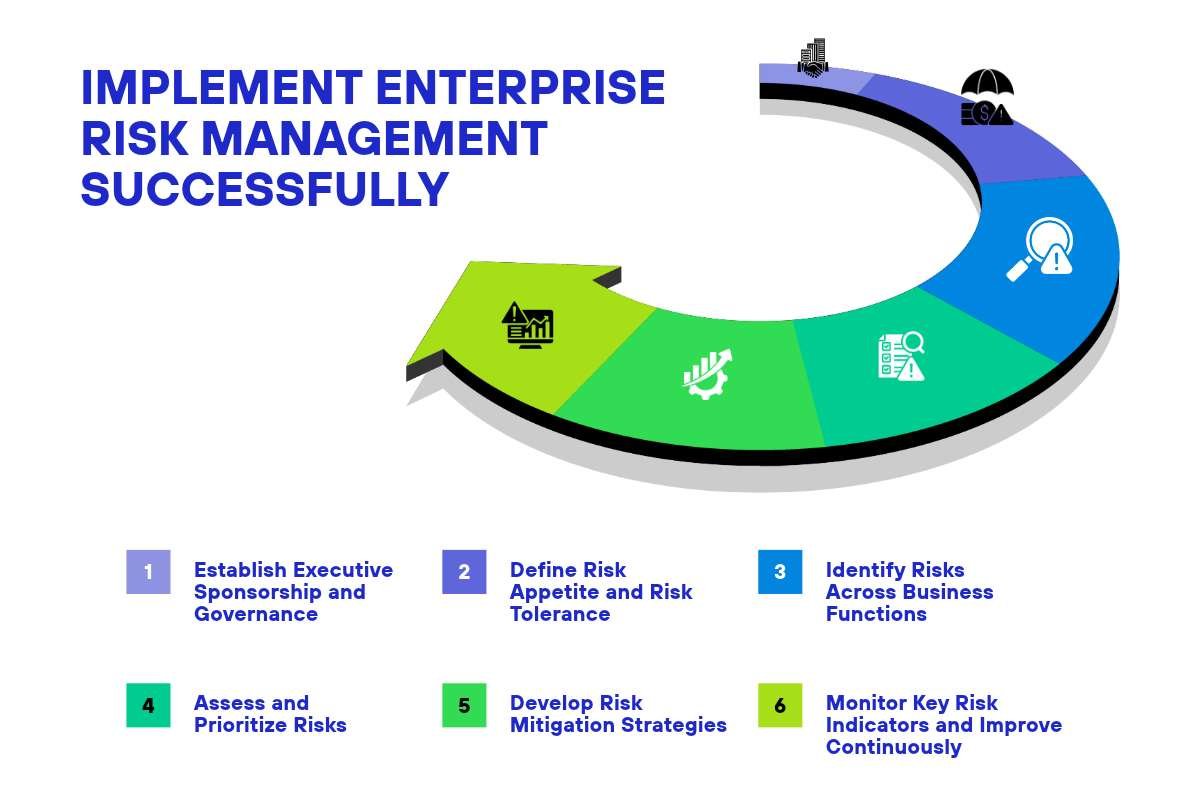
Organizations can follow these six steps to establish a practical enterprise risk management strategy.
Step 1. Establish Executive Sponsorship and Governance
The board and senior management should define risk oversight responsibilities and establish appropriate governance structures.
Depending on the organization, this may involve a Chief Risk Officer (CRO), risk committee, CFO, CISO, and department heads.
Step 2. Define Risk Appetite and Risk Tolerance
Businesses should establish which risks they are willing to accept and where additional controls are necessary.
For example, a financial institution may have a low appetite for regulatory violations and cybersecurity exposure but accept carefully evaluated risks associated with technology investments.
Step 3. Identify Risks Across Business Functions
Conduct internal audits, employee interviews, risk assessment workshops, and supplier evaluations to identify potential threats.
The findings should be documented in a centralized enterprise risk register.
Step 4. Assess and Prioritize Risks
Evaluate each risk based on its likelihood, potential impact, speed of occurrence, and connection with other business risks.
Organizations can use a 5×5 risk matrix to distinguish low, moderate, high, and critical exposure.
They should also distinguish between:
| Inherent risk | Exposure before considering controls. |
| Residual risk | Exposure remaining after existing controls are applied. |
Step 5. Develop Risk Mitigation Strategies
Businesses generally use four approaches:
| Risk response | Meaning |
| Avoid | Discontinue activities that create unacceptable exposure. |
| Reduce | Introduce controls to lower risk likelihood or impact. |
| Transfer | Shift certain financial consequences through insurance or contractual arrangements. |
| Accept | Retain risks within approved limits. |
The appropriate response depends on organizational risk appetite, financial resources, and business priorities.
Step 6. Monitor Key Risk Indicators and Improve Continuously
Key Risk Indicators (KRIs) help organizations monitor changing exposure and identify emerging threats.
Examples include increasing employee turnover in critical roles, growing cybersecurity vulnerabilities, supplier delivery delays, and declining cash reserves.
Regular reviews help leadership determine whether risk controls remain effective and whether the enterprise risk management strategy requires changes.
The Role of Technology in Enterprise Risk Management
Technology enables businesses to collect risk information, automate reporting, identify unusual patterns, and improve decision-making.
According to the FERMA and PwC Global Risk Manager Survey 2026, 46% of surveyed risk managers already use AI, while another 46% consider AI use one of the least adequately managed risks.
This highlights the dual role of technology in enterprise risk management: it can improve risk detection while creating new vulnerabilities.
1. Governance, Risk, and Compliance Software
GRC platforms centralize risk registers, compliance records, internal audits, policy documentation, and control monitoring.
They improve coordination between departments and provide leadership with consolidated risk information.
2. Artificial Intelligence and Predictive Analytics
AI and machine learning can identify unusual transactions, analyze supplier performance, detect potential fraud, and support predictive risk assessments.
However, organizations must monitor algorithmic bias, data quality, privacy, and the reliability of AI-generated recommendations.
3. Real-Time Monitoring and Executive Dashboards
Centralized dashboards can integrate information from financial systems, cybersecurity tools, and supply chain platforms.
This allows decision-makers to identify changing exposure and respond to emerging threats more efficiently.
4. Cybersecurity and Data Protection
Businesses must protect sensitive information through encryption, identity management, access controls, vulnerability assessments, and incident response planning.
Technology strengthens enterprise risk management when supported by clear governance and human oversight.
Challenges Businesses Face When Implementing ERM
Despite its advantages, enterprise risk management can be difficult to implement when organizations lack coordination, resources, or leadership support.
| Implementation challenge | Practical solution |
| Departmental silos | Establish cross-functional risk committees and shared reporting. |
| Limited budgets | Prioritize critical risks and implement scalable solutions. |
| Lack of leadership support | Connect risk management with strategic and financial objectives. |
| Fragmented data | Standardize risk reporting and establish centralized records. |
| Resistance to change | Provide employee training and clarify responsibilities. |
| Emerging threats | Conduct regular assessments and monitor KRIs continuously. |
Another challenge is treating risk management as a compliance exercise rather than a strategic business function.
The 2026 State of Risk Oversight study found that only 29% of surveyed organizations had formally articulated risk appetite in the context of strategic planning. This indicates that many businesses still have opportunities to strengthen the connection between risk oversight and business decisions.
An effective enterprise risk management program requires continuous leadership involvement, employee participation, and regular evaluation.
Role of Women Leaders in Enterprise Risk Management
Enterprise risk management requires strategic judgment, financial expertise, technology knowledge, effective communication, and strong corporate governance.
Women working in finance, cybersecurity, compliance, operations, and executive leadership can contribute to these responsibilities through their professional expertise and organizational experience.
Their participation is particularly important as businesses seek broader representation in board-level risk oversight and strategic decision-making.
1. Women in Corporate Governance and Risk Oversight
According to MSCI’s Women on Boards and Beyond – 2025 Report, women held 28.3% of board seats globally at large- and mid-cap companies in 2025.
However, representation in senior leadership positions remains uneven.
The World Economic Forum’s Global Gender Gap Report 2026 reported that women’s representation in board leadership positions increased from 3.2% in 2014 to only 5.2% in 2024.
These figures highlight the gap between board participation and access to leadership positions where important governance decisions are made.
2. How Leadership Diversity Can Broaden Risk Perspectives
Diverse leadership teams bring different professional experiences and areas of expertise to organizational decision-making.
For example, leaders with experience in human resources may identify workforce retention, workplace safety, and succession planning risks. Technology executives may highlight cybersecurity vulnerabilities, AI governance, and data protection challenges.
Inclusive risk committees can therefore benefit from a wider range of perspectives and help reduce dependence on narrow assumptions or groupthink.
3. Building Opportunities for Women in Risk Management
Organizations can strengthen women’s participation in risk leadership through:
- Leadership development and board-readiness programs.
- Mentorship and executive sponsorship opportunities.
- Cross-functional experience in finance, technology, and compliance.
- Transparent promotion and succession planning.
- Access to professional risk management qualifications.
- Greater representation on audit and risk committees.
Increasing women’s participation in enterprise risk management is not simply a representation target. It is also about ensuring that qualified professionals have meaningful opportunities to influence governance, risk oversight, and strategic business decisions.
Real-World Examples of Enterprise Risk Management in Action
Business experiences demonstrate how risk management decisions can influence operational resilience, financial stability, and organizational reputation.
1. Toyota – Supply Chain Risk Management
- The 2011 Great East Japan Earthquake and tsunami disrupted manufacturing operations and exposed vulnerabilities in automotive supply chains.
- Toyota faced production challenges because suppliers and manufacturing facilities were affected.
- The disruption encouraged greater attention to supplier visibility, critical component dependencies, and supply chain resilience.
- ERM lesson: Businesses should map critical suppliers, evaluate concentration risks, and establish alternative sourcing arrangements.
2. Maersk – Cybersecurity and Operational Resilience
- In 2017, shipping company Maersk was affected by the NotPetya cyberattack, which disrupted its global IT systems and business operations.
- The company reported losses of approximately $250–300 million.
- The incident highlighted the financial and operational consequences of cybersecurity failures across interconnected business networks.
- ERM lesson: Cybersecurity requires organization-wide governance, network protection, incident response planning, and business continuity arrangements.
3. Silicon Valley Bank – Financial Risk and Governance Failures
- The 2023 collapse of Silicon Valley Bank demonstrated the consequences of concentrated funding, interest rate exposure, and inadequate risk oversight.
- The bank experienced significant pressure when rising interest rates reduced the value of its securities portfolio, and depositors withdrew funds rapidly.
- The failure highlighted weaknesses in interest rate risk management, liquidity planning, and governance.
- ERM lesson: Financial institutions must monitor liquidity, concentration, interest rate exposure, and changing market conditions while ensuring effective board oversight.
- These examples demonstrate why enterprise risk management must address interconnected risks rather than focusing on individual business threats.
How Businesses Can Measure the Effectiveness of ERM
Organizations should regularly evaluate whether their risk management activities are reducing exposure and supporting strategic objectives.
Some important performance indicators include:
| Indicator | What it measures |
| Key Risk Indicators (KRIs) | Changes in exposure to significant risks. |
| Risk mitigation completion rate | Progress in implementing risk controls. |
| Incident frequency | Number of operational, security, or compliance incidents. |
| Financial loss exposure | Actual or potential financial consequences. |
| Audit findings | Weaknesses identified through internal and external audits. |
| Recovery time | Time required to restore critical operations. |
| Compliance violations | Frequency and severity of regulatory breaches. |
Businesses should distinguish between KRIs and Key Performance Indicators (KPIs).
While KPIs measure business performance, KRIs provide warning signals about potential threats to organizational objectives.
For example, increasing cybersecurity vulnerabilities may indicate growing exposure even before a security incident occurs.
Regular audits, executive reviews, and risk maturity assessments help organizations improve their enterprise risk management processes.
Conclusion:
Enterprise risk management is essential for identifying interconnected business risks, strengthening accountability, and preparing organizations for disruptions. Its effectiveness depends on leadership commitment, reliable information, employee participation, and continuous monitoring.
By promoting inclusive decision-making and strategic oversight, businesses can move beyond routine compliance and use enterprise risk management to protect organizational value, support informed decisions, and build long-term resilience.
Frequently Asked Questions:
1. What are the five components of the COSO ERM Framework?
The five components are Governance and Culture, Strategy and Objective-Setting, Performance, Review and Revision, and Information, Communication, and Reporting.
2. What is the difference between ERM and GRC?
Enterprise Risk Management focuses on identifying and managing risks across the organization in alignment with business objectives. Governance, Risk, and Compliance (GRC) is a broader management approach that connects corporate governance, risk management, and regulatory compliance through policies, processes, and technology.
3. Who is responsible for Enterprise Risk Management in a company?
The board of directors and senior management provide oversight, while the Chief Risk Officer, risk committees, and department heads coordinate implementation. Employees also contribute by identifying and reporting potential risks within their responsibilities.