

For women aiming for a corporate board seat, board diversity mandates around the world in 2026 are changing how companies approach leadership, succession, and director appointments.
The global picture is moving in the right direction. According to MSCI’s 2025 research, women held 28.3% of board seats globally, up from the previous year. However, the pace of improvement has slowed in some developed markets.
The remaining gap becomes clearer at the highest levels of leadership. Board representation does not automatically mean women have equal access to chair, CEO or other influential positions.
That is why board diversity mandates around the world in 2026 matter. They can push companies to widen candidate searches, formalise appointment processes and build stronger pipelines of women ready for board-level leadership.
What are board diversity mandates?
Board diversity mandates are laws, listing requirements, targets or disclosure rules intended to improve the representation of underrepresented groups on corporate boards.
For women, they generally take four forms:
| Type | What it means |
| Mandatory quota | Companies must meet a specified representation level |
| Target | Companies are expected to work toward a stated percentage |
| Comply-or-explain | Companies missing a target must explain why |
| Disclosure requirement | Companies must report diversity policies and progress |
The distinction is important. A legal quota creates a different obligation from a voluntary target or a requirement to explain non-compliance.
Board diversity can also include professional expertise, age, nationality, background and independence. Gender remains a major focus because women continue to be underrepresented in corporate decision-making.
Understanding board diversity mandates around the world in 2026 therefore requires looking beyond headline percentages. The enforcement mechanism, company coverage, and definition of the board can vary significantly by market.
Why board diversity mandates matter for women?
A board appointment can give women a direct role in decisions involving corporate strategy, risk, capital allocation, executive compensation, technology, and succession.
It can also strengthen the leadership pipeline. Once women gain board experience, they can build greater exposure to governance, investors, and senior decision-making.
But simply adding one woman to a board does not guarantee meaningful representation.
MSCI’s data show that women held 28.3% of global board seats in 2025, leaving boards well short of gender parity.
The quality of representation matters too. Women need opportunities to serve on influential committees and take on leadership responsibilities rather than being appointed only to satisfy a numerical target.
The goal should therefore be meaningful participation, not representation for its own sake. This is one of the most important considerations when assessing board diversity mandates around the world in 2026.
Board diversity mandates around the world in 2026
Countries have taken very different approaches to improving women’s representation in corporate leadership. Some use statutory quotas, while others rely on listing rules, targets, disclosure, or a combination of approaches.
1. European union: a major 2026 milestone
The European Union’s Women on Boards Directive is one of the most significant developments for women in corporate governance.
By 30 June 2026, covered listed companies are expected to reach either:
- 40% of non-executive director positions held by the underrepresented sex; or
- 33% of all director positions held by the underrepresented sex.
The framework also requires transparent, gender-neutral and merit-based appointment procedures for companies that have not met the targets.
This is particularly important for women because it places greater emphasis on how directors are selected, not simply on the final numbers.
The European Commission reported that women represented approximately 34% of corporate board members across the EU in early 2025, showing progress toward the 2026 targets.
Among the board diversity mandates around the world in 2026, the EU framework stands out because it combines representation targets with more structured appointment procedures.
2. France: a 40% gender-balance requirement
France is one of the world’s established examples of legislated gender balance on corporate boards.
Its rules require applicable companies to maintain at least 40% representation of each sex on covered boards.
The French approach demonstrates how regulation can move boardrooms away from heavily male-dominated structures. However, board representation remains only one part of the wider leadership pipeline.
For women, the next step is ensuring that increased board participation translates into more opportunities to become chairs, CEOs and senior executives.
France’s experience is therefore an important reference point when examining how board diversity mandates around the world in 2026 can influence long-term leadership representation.
3. Germany: 30% for certain supervisory boards
Germany uses a targeted quota system.
Certain listed companies subject to the country’s co-determination rules are required to maintain at least 30% women and 30% men on supervisory boards.
The German model is significant because it establishes a minimum level of representation rather than relying entirely on voluntary corporate commitments.
It also illustrates an important distinction for women: supervisory-board representation does not necessarily mean equal representation in executive management.
4. Norway: a pioneer in board gender balance
Norway has been a global pioneer in board gender quotas.
The Norwegian government states that the country was the first to require at least 40% of each sex on the boards of medium-sized and large companies, with the rules expanded to additional companies from 2024.
The Norwegian experience demonstrates how regulation can reshape board composition at scale.
It also offers a broader lesson for women: increasing the number of women directors is only one part of achieving gender equality in corporate leadership.
5. Spain: moving toward 40%
Spain has also strengthened its gender-balance framework.
Its parity legislation establishes a 40% threshold for the underrepresented sex in relevant corporate governance contexts, with provisions for listed companies being phased in.
The development reflects a wider European trend toward balanced representation rather than relying exclusively on voluntary initiatives.
For women, these changes can widen the pool of board opportunities while encouraging companies to use more structured succession and recruitment processes.
Spain’s approach adds another dimension to the wider landscape of board diversity mandates around the world in 2026, particularly across European markets.
6. United Kingdom: 40% target with senior leadership focus
The UK’s approach relies on listing rules and disclosure rather than a statutory board quota.
Under the Financial Conduct Authority’s rules, covered companies report against targets that include:
- At least 40% women on the board
- At least one woman in a senior board position, such as chair, CEO, CFO or senior independent director
- At least one board member from a minority ethnic background
Companies that do not meet the targets must explain why.
The senior-position requirement is particularly important.
It recognises that board diversity should not stop at the overall percentage of women. Women also need access to the roles that carry significant influence over board agendas and company strategy.
This makes the UK model particularly relevant to the discussion around board diversity mandates around the world in 2026, where representation and influence increasingly need to be considered together.
7. India: a formal pathway into the boardroom
India has adopted a minimum-representation model rather than a universal 40% female-board quota.
SEBI’s listing regulations require the boards of the top 1,000 listed entities to have at least one independent woman director.
Separately, India’s Companies Act framework requires prescribed classes of companies to have at least one woman director.
For Indian women, these requirements create a formal pathway into corporate governance.
However, board readiness remains critical. Expertise in finance, technology, cybersecurity, law, risk, sustainability, and human capital can help candidates bring value beyond simply satisfying a representation requirement.
India’s model shows that board diversity mandates around the world in 2026 can take different forms while still creating opportunities for women to enter board-level governance.
8. Australia: a 30% objective
Australia has traditionally relied on corporate-governance principles and disclosure rather than a statutory board gender quota.
For companies in the S&P/ASX 300, the governance framework sets a measurable objective of at least 30% of directors of each gender within a specified period.
ASX governance material has reported women holding approximately 35% of S&P/ASX 300 directorships, above the 30% objective.
Australia therefore demonstrates how measurable targets, disclosure and investor scrutiny can contribute to greater representation without a universal statutory quota.
9. United States: a different regulatory direction
The United States provides a contrasting model.
Nasdaq previously operated board-diversity requirements involving diverse directors or explanations for non-compliance. However, the Fifth Circuit vacated the SEC’s approval of those rules in 2024, and Nasdaq did not pursue an appeal.
As a result, there is no comparable nationwide Nasdaq board-diversity requirement in force in 2026.
The US experience highlights an important point: board diversity mandates around the world in 2026 are not moving in a single regulatory direction. Board diversity can be influenced by regulation, investors, shareholders, and voluntary corporate policies, and those approaches can change over time.
Board diversity mandates at a glance
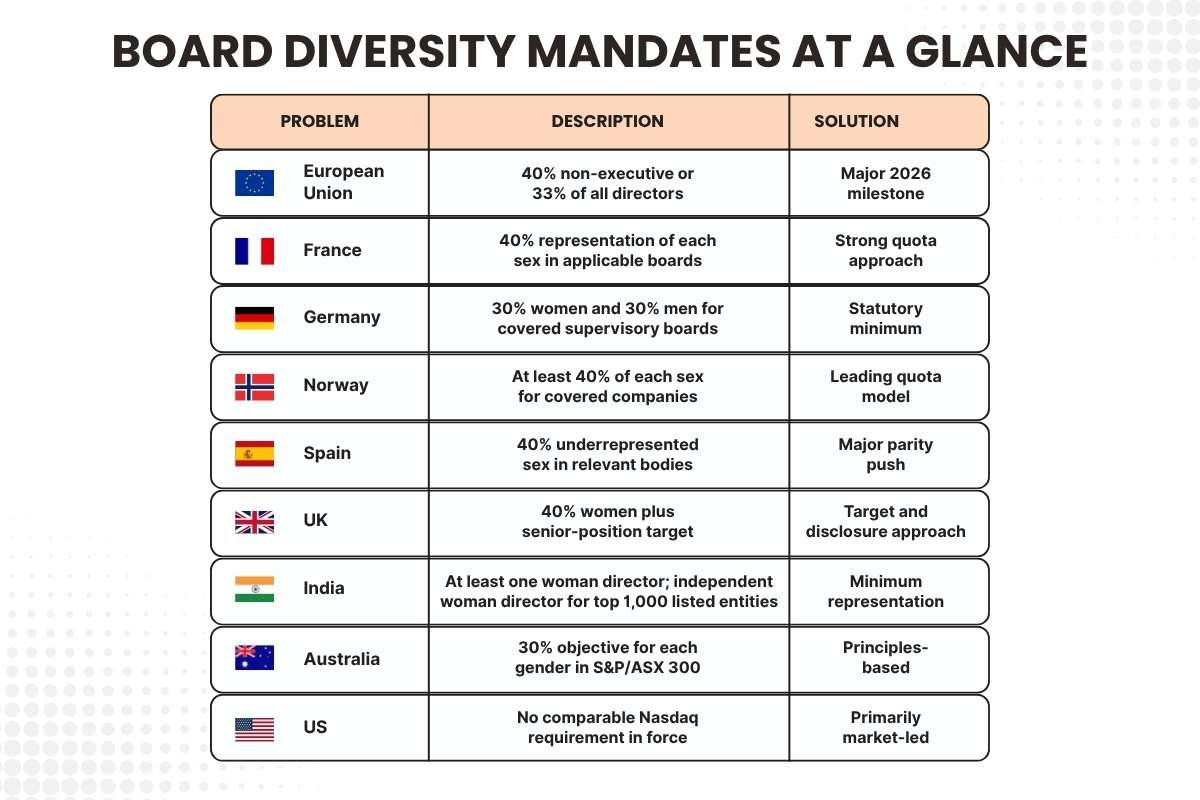
| Market | 2026 approach | What it means for women |
| European Union | 40% non-executive or 33% of all directors | Major 2026 milestone |
| France | 40% representation of each sex in applicable boards | Strong quota approach |
| Germany | 30% women and 30% men for covered supervisory boards | Statutory minimum |
| Norway | At least 40% of each sex for covered companies | Leading quota model |
| Spain | 40% underrepresented sex in relevant bodies | Major parity push |
| UK | 40% women plus senior-position target | Target and disclosure approach |
| India | At least one woman director; independent woman director for top 1,000 listed entities | Minimum representation |
| Australia | 30% objective for each gender in S&P/ASX 300 | Principles-based |
| US | No comparable Nasdaq requirement in force | Primarily market-led |
This comparison shows why there is no single global formula for board diversity mandates around the world in 2026. The rules differ in percentage, enforcement, company coverage, and whether they focus on representation, disclosure, or both.
What is 40-40-20 gender diversity?
The 40-40-20 model proposes:
- 40% women
- 40% men
- 20% people of any gender
The model is intended to move beyond a simple male-female binary quota while maintaining substantial representation for women and men.
It is important to note that 40-40-20 is not a universal legal requirement in 2026. It is a gender-balance model or target discussed in corporate-diversity contexts.
The principle is relevant to women because reaching 40% representation creates a more meaningful presence than having one or two women on a large board.
What percentage of board members are female?

Women held 28.3% of global board seats in 2025, according to MSCI. The figure increased from the previous year, although the pace of progress slowed in developed markets.
The global figure also masks significant differences between markets.
The European Union, for example, had women occupying approximately 34% of corporate board positions in early 2025.
Australia reported approximately 35% women among S&P/ASX 300 directorships.
These figures show that several markets are moving toward the 30–40% range, but global boardrooms have not yet reached parity.
The data also explain why board diversity mandates around the world in 2026 remain relevant. Even with progress in several major markets, women still account for less than one-third of board seats globally.
Which country ranks #1 in gender equality?
According to the World Economic Forum’s Global Gender Gap Report 2025, Iceland ranked first globally, closing 92.6% of its measured gender gap.
Finland ranked second at 87.9%, while Norway ranked third at 86.3%. Iceland has led the index for 16 editions and is the only economy to have closed more than 90% of its measured gender gap.
However, a country’s overall gender-equality ranking does not automatically translate into equal corporate representation.
National gender equality, board diversity, and executive leadership are related but separate measures. This distinction is important when comparing board diversity mandates around the world in 2026 with broader national gender-equality performance.
What Should Women Do to Prepare for a Board Seat?
Board diversity rules may create opportunities, but board readiness still matters.
1. Build relevant expertise
Women can strengthen their board profiles by developing expertise in areas such as:
- Finance and audit
- AI and technology
- Cybersecurity
- Risk management
- Legal and compliance
- Sustainability
- Human capital
- Consumer strategy
2. Understand corporate governance
Aspiring directors should understand fiduciary responsibilities, board committees, financial oversight, conflicts of interest, and executive succession.
3. Build professional visibility
Board appointments often depend on professional networks and recommendations. Building relationships with senior executives, investors, existing directors, and governance professionals can increase visibility.
4. Gain strategic experience
Experience in transformation, crisis management, risk oversight, budgeting, and organisational strategy can strengthen a candidate’s board profile.
5. Assess the board before accepting
A board appointment is a two-way evaluation.
Women should examine a company’s financial health, governance practices, board culture, director tenure, committee responsibilities and potential conflicts before accepting a seat.
A prestigious board position is not automatically a well-governed one.
What are the top corporate governance priorities for 2026?
While there is no single universal list, several issues are increasingly important for boards.
| AI and Technology Oversight | Boards need sufficient expertise to oversee AI strategy, data governance, and technology-related risks. |
| Cybersecurity and Resilience | Cyber risk increasingly affects financial performance, reputation, operations, and regulatory compliance. |
| Board Effectiveness and Succession | Companies need the right combination of independence, skills, experience, and leadership capability. |
| Diversity and Leadership Pipelines | Board diversity is increasingly connected to succession planning and the development of future chairs and CEOs. |
| Transparency and Sustainability | Boards face growing expectations around disclosure, resilience and responsible corporate decision-making. |
These priorities create opportunities for women with specialist expertise. A board does not only need former CEOs; it needs directors who understand the risks and opportunities shaping modern businesses.
What do board diversity mandates mean for women in 2026?

The global boardroom is changing, but there is no single path to gender balance.
The EU is implementing a major 2026 milestone. France and Norway demonstrate the impact of quotas. Germany uses a targeted statutory minimum. The UK uses listing targets and disclosure. India establishes minimum female representation. Australia relies on measurable objectives, while the US has moved away from Nasdaq’s former diversity requirement.
Taken together, board diversity mandates around the world in 2026 show that regulation can create entry points for women, but regulation alone cannot guarantee equal influence.
The central lesson is consistent:
Getting women onto boards is only the beginning.
Women also need opportunities to lead committees, become board chairs, enter CEO succession pipelines, and influence strategic decisions.
For women preparing for the boardroom, 2026 therefore presents a significant opportunity.
The strongest candidates will not be defined only by gender. They will bring expertise, independence, strategic judgment and governance knowledge, qualities that make their presence valuable long after a diversity target has been met.
Ultimately, board diversity mandates around the world in 2026 can open the door. Women with the right expertise can help redefine what happens inside the boardroom once they are there.
Frequently asked questions
1. What are board diversity mandates around the world in 2026?
They are laws, listing requirements, targets, or disclosure rules designed to improve representation on corporate boards. Major approaches in 2026 include the EU’s 40%/33% framework, France’s 40% requirement, Germany’s 30% quota for certain supervisory boards, Norway’s 40% gender-balance requirement, India’s woman-director requirements, and the UK’s 40% board target.
2. What percentage of board members are female?
Women held 28.3% of global board seats in 2025, according to MSCI. The figure increased from the previous year, although the pace of progress slowed in some developed markets.
3. What is 40-40-20 gender diversity?
The 40-40-20 model proposes 40% women, 40% men, and 20% people of any gender. It is a gender-balance framework rather than a universal legal requirement.
4. What does board diversity mean?
Board diversity means having directors with a broad mix of gender, skills, experience, professional backgrounds, perspectives, age, and other relevant characteristics. Gender diversity is one important component of overall board diversity.
5. Which country ranks #1 in gender equality?
Iceland ranked first in the World Economic Forum’s 2025 Global Gender Gap Index, closing 92.6% of its measured gender gap. Finland ranked second and Norway third.